在此页面上:了解 Adobe Journey Optimizer 中历程的基础知识,包括历程类型、设计工作流、关键功能和构建个性化客户体验的最佳实践。
Adobe Journey Optimizer 使您能够创建个性化的多步骤客户历程,实时响应受众行为与需求。 通过直观的拖放式画布,您可以跨多个渠道编排消息与行动,利用上下文数据和受众目标选择实现最大影响力。
本指南提供了一个清晰的路线图,以帮助您了解历程基础知识,为您的用例选择正确的历程类型,并自信地设计出可提供有意义、及时的客户体验的历程。
什么是历程?
历程是自动化的多步骤客户体验,可根据客户行为、业务事件或预定营销活动,跨渠道编排个性化互动。
使用Journey Optimizer历程以:
- 利用事件或数据源中存储的上下文数据,构建 实时编排 用例
- 设计可动态响应客户行为和业务事件的多步骤进阶场景
- 通过电子邮件、推送、移动消息、应用程序内、Web等大规模提供1:1个性化体验
➡️准备好开始构建了吗? 在 5 分钟内创建您的第一个历程。
历程与营销活动:分别是何时使用 journeys-vs-campaigns-intro
Adobe Journey Optimizer 提供三种触达客户的方式:历程(一对一实时编排)、营销活动(简单的批量或 API 触发的投放),以及编排的营销活动(采用多实体数据的批量画布工作流)。
快速决策:
- 使用 历程 来设计多步骤、行为驱动的体验,让每位客户按自己的节奏前进
- 使用操作/API 触发的营销活动,向受众进行简单、定时或触发式的消息投放。
- 使用 编排的营销活动 来执行需要多实体分段和精确发送前计数的复杂批量工作流
选择您的历程类型 journey-types
Adobe Journey Optimizer 支持四种历程类型,分别针对不同的进入机制和业务场景设计:
- 单一历程:实时、事件触发的体验(购物车放弃挽回、欢迎电子邮件)
- 读取受众历程:定时批量触达细分受众(新闻通讯、促销活动)
- 受众资格筛选历程:对受众成员资格变化的实时响应(VIP 升级、重新互动)
- 业务事件历程:影响多客户群体的业务条件(库存预警、限时闪购)
➡️ 历程类型:选择正确的类型 – 详细的比较、决策指南和功能兼容性矩阵
使用历程设计器构建 journey-designer
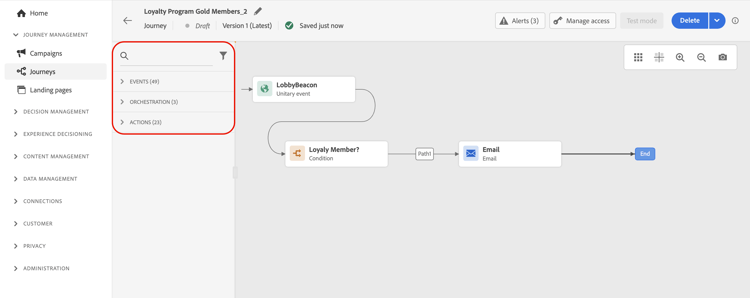
历程设计器是您用于创建客户体验的可视画布。 借助直观的拖放界面,您无需编写代码即可编排历程的每个步骤。
可在设计器中执行的操作:






您的历程创建工作流 workflow
构建成功的历程须遵循清晰、可重复的流程。 以下是您的分步工作流:
1. 计划 → 2. 设计→3. 验证并测试→4。 发布→5. 监控 → 6. 优化
1. 规划您的历程 plan
在打开设计器之前,先明确您的目标:
- 目标是什么? (例如,引导新客户上手,重新吸引非活动用户)
- 受众是谁? (特定区段、事件驱动的个人)
- 适合哪种历程类型? (请参阅上面的历程类型)
- 您将使用哪些渠道? (电子邮件、推送、移动消息等)
2. 在画布中进行设计 design
使用历程设计器构建流:
- 设置进入条件 – 定义轮廓的进入方式(事件、受众、资格筛选)
- 添加编排逻辑 - 包括等待时间、条件和决策点
- 配置消息 - 设计通信内容或利用现有模板
- 设置操作 - 配置要执行的内置或自定义操作
- 定义退出条件 - 指定轮廓完成历程的时间和方式
3. 上线前进行验证和测试 test
首先,在历程标题中单击验证。 解决“警报”面板中的任何错误并再次验证,然后继续。 了解历程验证。
通过验证后,测试您的历程以在客户遇到问题之前捕获问题:
- 使用 历程模拟 进行快速迭代,可使用临时模拟用户,无需用到测试轮廓
- 使用 测试模式 逐步引导真实(但被指定用于测试的)轮廓完成历程
- 使用 试运行 基于实际生产数据执行历程,无需发送通信或更新轮廓
- 验证所有条件、消息和操作是否均按预期运行
- 检查时序、数据流和个性化设置
4. 发布您的历程 publish
测试完成后,通过发布使历程生效:
- 查看最终设置和属性
- 请确保验证为最新并通过验证;如果您在验证后更改了历程,请再次单击 验证 并解决所有错误,然后再继续
- 发布以激活真实客户
- 注意:实时历程可以停止,但不能编辑(您必须创建新版本)
5. 监控表现 monitor
跟踪历程在现实环境中的表现:
- 查看历程报告和分析
- 监控进入率、完成率及错误率
- 针对重要问题设置警报
6. 优化和迭代 optimize
利用洞察持续优化:
- 分析参与度指标与转化率
- 测试发送时间优化策略
- 创建改进后的新历程版本
- 运用 AI 驱动的推荐
➡️准备好开始? 立即创建您的第一个历程 →
实际用例 use-cases
通过实际案例学习如何应用历程概念解决常见的营销难题:




探索历程功能 capabilities
当您对历程构建更加熟悉后,可探索以下强大功能,打造更精细的客户体验:


通过观看学习 video
通过视觉导览了解历程组件,并学习在画布中构建历程的基础知识:
➡️想要更多视频? 浏览历程视频教程
常见问题 common-questions
Adobe Journey Optimizer 提供三种方式:
-
历程:一对一实时编排,每个轮廓按自己的节奏逐步推进各个步骤。 最适合行为驱动、包含条件逻辑的多步骤体验(例如新用户引导、购物车弃单)。
-
营销活动(行动与 API 触发):向受众进行简单的消息投放,按计划或通过 API 触发同时向所有轮廓执行。 最适合促销活动、新闻通讯、交易型消息。
-
编排的营销活动:利用关系型数据(轮廓 + 产品/门店/预订)进行复杂细分,实现多步骤批量工作流。 所有轮廓统一处理,提供精确的发送前计数。 最适合季节性促销活动、产品发布,以及需要多实体数据的营销活动。
主要区别:历程会维护每个客户的状态,用于实时操作;操作和 API 触发的营销活动会批量投放简单消息;编排的营销活动提供支持多实体分段的批量工作流画布。
➡️更多疑问? 查看完整的历程常见问题,内含 40 多条详细答案
需要帮助? help
使用这些链接查找指南、故障排除方法和资源。
常见任务快速链接
获取有关问题的通知
设置 历程警报 以在历程出现错误或异常模式时接收实时通知。
其他资源
准备好构建您的第一个历程? 现在就开始 →
This section contains structured knowledge intended to support interpretation, retrieval, and question answering related to this topic.
For complete understanding, this information should be combined with the documentation on this page. Neither source is intended to stand alone; the page describes the feature, while this section provides additional context that helps disambiguate terminology, intent, applicability, and constraints.
- TL;DR: This page is the getting-started hub for Adobe Journey Optimizer journeys, explaining what journeys are, the four journey types, the six-step creation workflow, real-world use cases, and links to advanced capabilities.
Intents:
- Understand what journeys are and how they differ from campaigns and orchestrated campaigns
- Choose the right journey type (Unitary, Read Audience, Audience Qualification, or Business event) for a use case
- Follow the six-step journey creation workflow: Plan, Design, Validate and test, Publish, Monitor, Optimize
- Use Simulation, Test mode, or Dry run to validate a journey before going live
- Publish a journey and monitor performance through reports and alerts
- Explore advanced capabilities such as expressions, timezone management, copy to sandbox, and throughput control
Glossary:
- Journey: An automated, multistep customer experience that orchestrates personalized interactions across channels in response to customer behavior, business events, or scheduled campaigns. (product-specific)
- Journey designer: The visual drag-and-drop canvas in Adobe Journey Optimizer used to build and configure journey flows without writing code. (product-specific)
- Test mode: A way to walk real, designated test profiles through the journey step by step. (product-specific)
- Dry run: A way to execute the journey against real production data without sending communications or updating profiles. (product-specific)
- Journey Simulation: A way to test journeys for fast iteration with temporary simulated users, with no test profiles needed. (product-specific)
- Orchestrated campaigns: Multi-step batch workflows in Adobe Journey Optimizer that use relational data (profiles + products/stores/bookings) and process all profiles together with exact pre-send counts. (product-specific)
Guardrails:
-
Configuration validation must pass before testing. Errors in the Alerts panel must be resolved and validation rerun before continuing. Publication requires current, passed validation; edits after validation require Validate again.
-
Live journeys cannot be structurally edited; changes require creating a new version
-
After validation passes, test before publishing using Journey Simulation, test mode, or dry run
Terminology:
- Canonical name: Journey — variant: customer journey
- Synonyms: “journey designer” = “canvas”
- Do not confuse: “Journey” ≠ “Campaign” — Journeys maintain individual customer state for real-time, multi-step behavior-driven experiences; Campaigns deliver messages in batch to audiences on a schedule or via API trigger
- Do not confuse: “Journey Simulation” uses temporary simulated users; “test mode” uses real, designated test profiles; “dry run” executes against real production data without sending communications or updating profiles
FAQ:
- Q: What is the difference between a journey and a campaign in Journey Optimizer? — Journeys provide 1:1 real-time orchestration where each profile progresses at its own pace through conditional logic; Campaigns deliver messages simultaneously to an audience on a schedule or via API trigger; Orchestrated campaigns are batch canvas workflows for complex multi-entity segmentation.
- Q: Can I edit a live journey? — Limited elements such as name and message content can be edited; structural changes require creating a new version of the journey.
- Q: What are the steps to build a journey? — The six-step workflow is: Plan, Design, Validate and test, Publish, Monitor, and Optimize.
- Q: How do I test a journey without sending communications or updating profiles? — First Validate and resolve any errors, then use dry run to execute the journey against real production data without sending communications or updating profiles.
- Q: What journey type should I use for a welcome email triggered by a subscription? — Use a Unitary journey, which is triggered by a specific individual event such as a subscription sign-up.