在此页面上:了解如何结合事件、编排和操作活动来构建多步骤、跨渠道历程,以及标记活动、管理参数和疑难解答的最佳实践。
结合事件、编排和操作活动以构建多步骤、跨渠道方案。
事件活动 event-activities
个性化历程以在线购买等活动开始。 用户档案进入历程后,将自行完成其过程。 每个用户档案可以采用不同的路径和节奏。 当您开始事件时,旅程会在事件到达时触发。 然后,每个配置文件都遵循历程中定义的步骤。
技术用户(请参阅此页面)配置的事件,将显示在面板的第一个类别中。 此类别位于屏幕左侧。 可以使用以下事件活动:
历程设计器中的
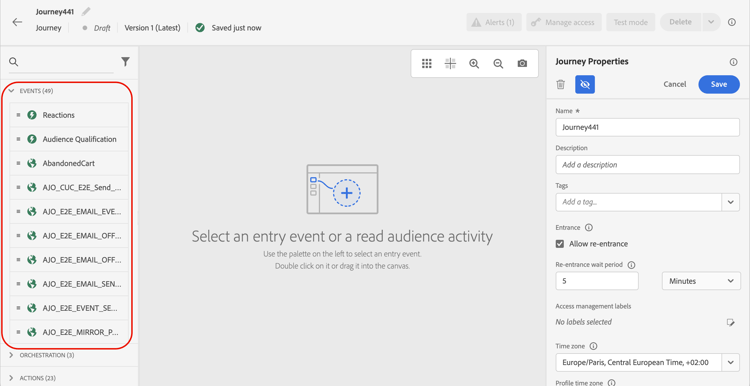
要开始您的历程,请拖放事件活动。 您还可以双击该图标。
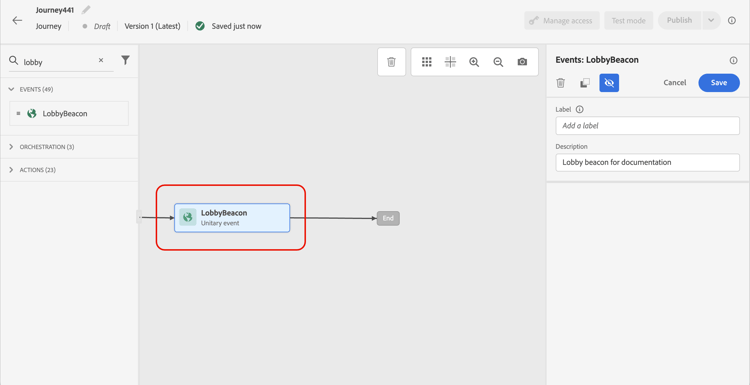
编排活动 orchestration-activities
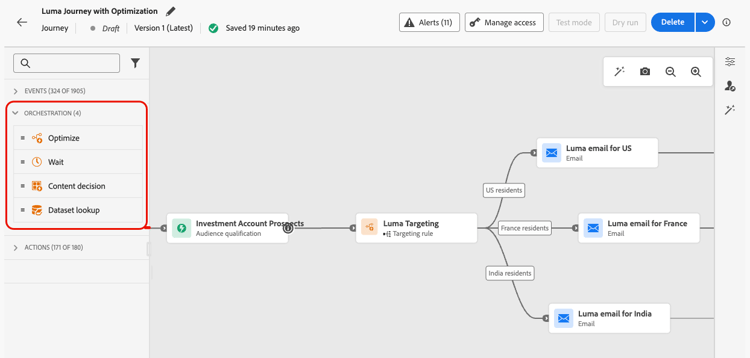
编排活动是有助于确定历程中下一步的条件。 这些条件可以包括此人是否拥有未结支持案例或完成购买。 还可以包括当地天气预报,或者该人是否达到1万忠诚点。
在屏幕左侧的面板中,提供了以下编排活动:
历程设计器中的
操作活动 action-activities
操作是指您希望因某种触发而发生的操作,例如发送消息。 它是客户体验的历程部分。
从屏幕左侧的调色板中,在 事件 和 编排 下方,可以找到 操作 类别。 可以使用以下操作活动:
历程设计器中的
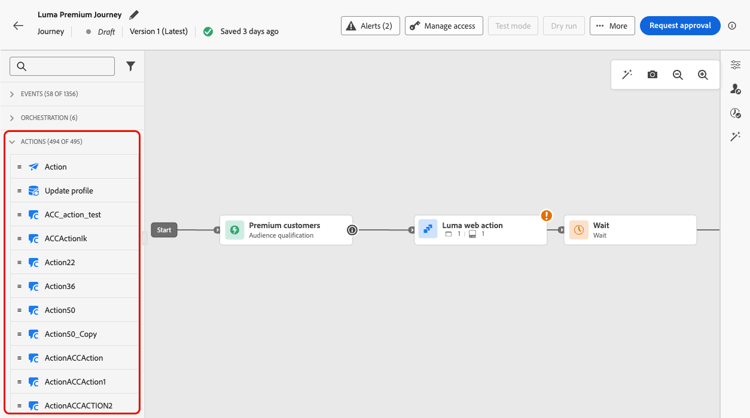
这些活动代表各种可用的通信渠道。 您可以将它们组合在一起,创建跨渠道方案。
您还可以设置用于发送消息的特定操作:
-
如果您使用第三方系统来发送消息,则可以创建特定的自定义操作。 了解详情
-
如果您在使用Adobe Campaign和Adobe Journey Optimizer,请参阅以下部分:
最佳实践 best-practices
使用这些建议可保持历程可读、一致且易于故障排除。
添加标签
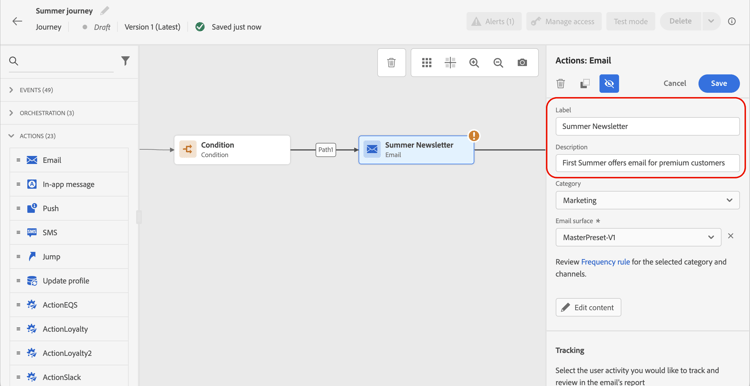
大多数活动允许您定义标签。 这会将后缀添加到画布中活动下显示的名称中。 如果您在历程中多次使用同一活动,并且希望更轻松地识别它们,则此功能非常有用。 它还使得在发生错误时能够更轻松地进行调试,并使报告更易于阅读。 您还可以添加可选的描述。
历程活动属性中的
管理高级参数 advanced-parameters
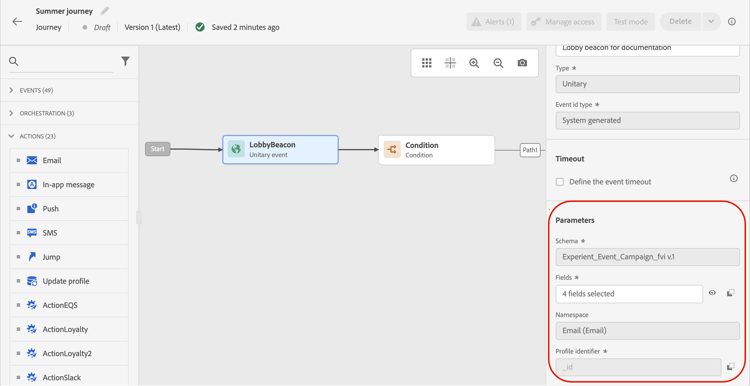
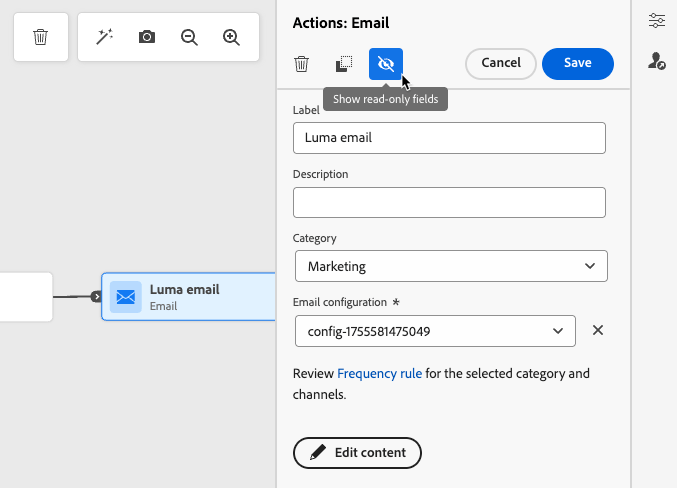
大多数活动会显示许多您无法修改的高级和/或技术参数。
历程活动属性中的
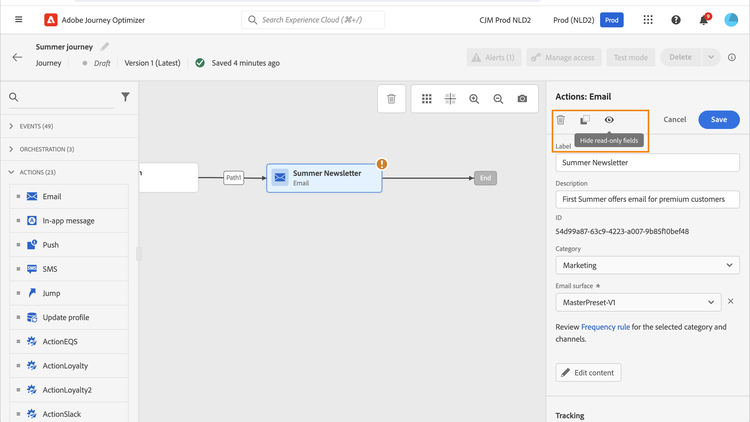
为了提高可读性,请使用右窗格顶部的 隐藏只读字段 按钮来隐藏这些参数。
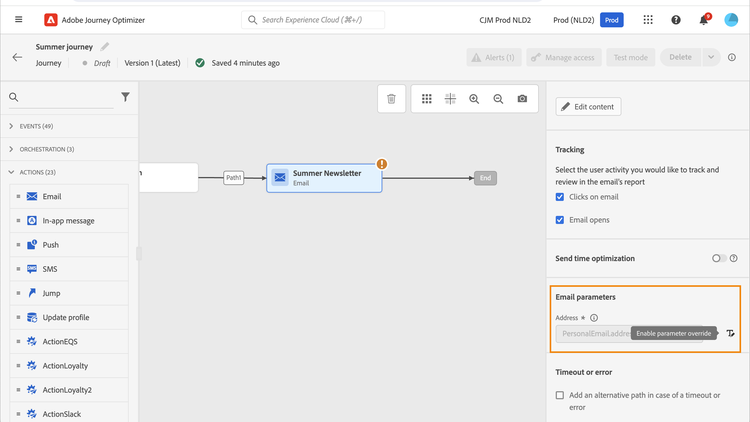
在某些特定上下文中,您可以覆盖这些参数的值以供特定使用。 要强制使用某个值,请单击字段右侧的 启用参数覆盖 图标。 了解详情
添加替代路径
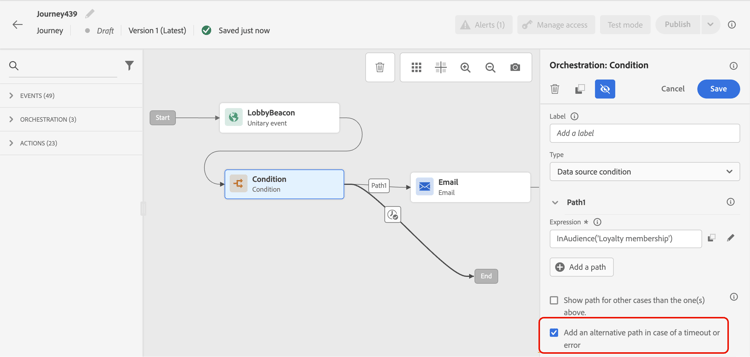
当操作或条件中发生错误时,个体历程将停止。 使其继续的唯一方法是选中框在超时或错误的情况下添加替代路径。 请参阅此部分
疑难解答 troubleshooting
在测试或发布之前,单击历程标题中的验证。 解决“警报”面板中的任何错误并再次验证,然后继续。 了解历程验证。
在此页面🔗上了解如何对活动和历程中的错误进行故障排除。
另请参阅监视和故障排除
This section contains structured knowledge intended to support interpretation, retrieval, and question answering related to this topic.
For complete understanding, this information should be combined with the documentation on this page. Neither source is intended to stand alone; the page describes the feature, while this section provides additional context that helps disambiguate terminology, intent, applicability, and constraints.
- TL;DR: This page introduces the three categories of journey activities — events, orchestration, and actions — and explains best practices for labeling, managing parameters, and handling errors in Adobe Journey Optimizer journeys.
Intents:
- Identify and distinguish between event, orchestration, and action activities in a journey
- Add labels and descriptions to journey activities for easier identification and reporting
- Configure an alternative path to handle timeouts or errors in a journey activity
- Override advanced parameters on a specific journey activity
- Combine multiple activity types to build cross-channel journey scenarios
- Troubleshoot activity configuration errors before publishing a journey
Glossary:
- Event activity: An activity used to start a journey; when the event arrives, the journey triggers and each profile follows its defined steps (product-specific)
- Orchestration activity: An activity that helps determine the next step in the journey; examples include Optimize, Read Audience, and Wait (product-specific)
- Action activity: An activity representing what happens as a result of a trigger, such as sending a message (product-specific)
- Custom action: A specific action that can be created when using a third-party system to send messages (product-specific)
- Alternative path: A fallback branch added to an activity so the journey continues even when a timeout or error occurs (product-specific)
Guardrails:
- Before testing or publishing, the journey must be validated. Errors in the Alerts panel must be resolved and validation rerun before continuing.
- Most activities display advanced or technical parameters that cannot be modified; in some particular contexts, their values can be overridden using Enable parameter override.
Terminology:
- Canonical name: journey activities. Categories: Event activities, Orchestration activities, Action activities.
- Do not confuse: “Orchestration activity” ≠ “Action activity” (orchestration helps determine the next step; actions represent what happens as a result of a trigger).
FAQ:
- Q: What is the difference between event, orchestration, and action activities? — Events trigger journey entry; orchestration activities help determine the next step; actions represent what happens as a result of a trigger, such as sending a message.
- Q: What does a label add to an activity? — The Label adds a suffix to the name under the activity in the canvas, helping identify repeated activities and making debugging and reports easier to read.
- Q: What happens when an error occurs in an action or condition activity? — The profile’s journey stops unless you check the “Add an alternative path in case of a timeout or an error” option on that activity.
- Q: How can I send messages using a third-party system? — Create a specific custom action when using a third-party system to send messages.
- Q: When can I override an advanced parameter on an activity? — In some particular contexts, click the Enable parameter override icon to the right of the field to force a value.