在此页面上:了解如何使用常规事件统一实时触发历程,并配置事件超时和超时路径以仅在定义的时段内侦听事件。
事件允许您统一触发历程,向流入历程的个人实时发送消息。
对于此类事件,只能添加标签和描述。 配置的其他部分无法编辑。 该操作由技术用户执行。 请参阅此页。
在本节中了解有关事件吞吐量和历程处理率的更多信息。
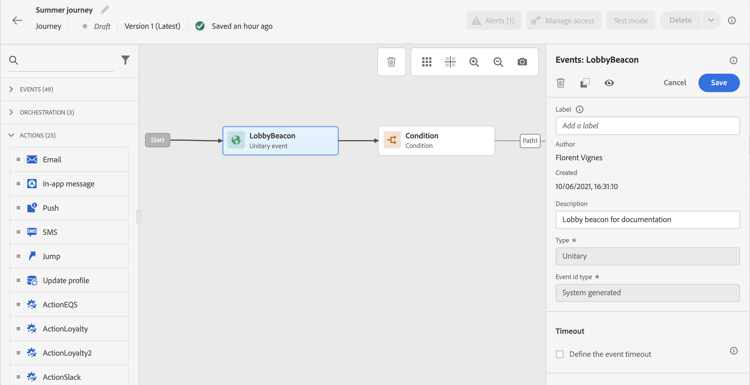
删除业务活动时,该活动会自动添加 读取受众 活动。 有关业务活动的详细信息,请参阅此部分
在特定时间监听事件 events-specific-time
位于历程中的事件活动可无限期地侦听事件。 要仅在特定时间内侦听事件,必须为事件配置超时。
然后,该历程将在超时指定的时间内侦听事件。 如果在该时间段内收到事件,则该人员将流入事件路径。 如果没有,则客户将流入超时路径(如果已定义),或将继续该历程。
如果未定义超时路径,则超时设置将充当等待活动,从而使配置文件等待一段时间,如果事件发生在该等待结束之前,则该时间可能会停止。 如果要在超时后从历程中排除用户档案,则必须设置超时路径。
要为事件配置超时,请执行以下步骤:
-
从事件属性激活 定义事件超时 选项。
-
指定历程将等待事件的时间量。 最长持续时间为90天。
-
如果在指定的超时时间内未收到任何事件,则最佳实践是将个人发送到超时路径中。 为此,启用 设置超时路径 选项。 在这种情况下,一旦达到超时,个人将继续该历程。 我们建议您始终启用 设置超时路径 选项。
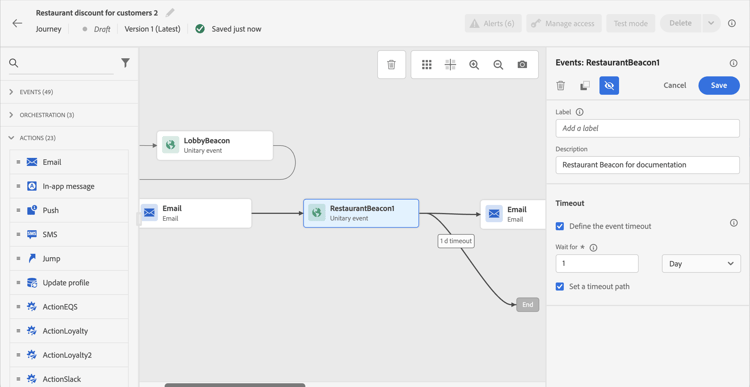
在此示例中,历程在客户进入大厅后向客户发送第一封欢迎电子邮件。 然后,仅当客户在隔天进入餐厅时,它才会发送餐饮折扣电子邮件。 因此,我们将restaurant事件配置为1天超时:
- 如果在欢迎电子邮件后不到1天收到餐厅事件,则发送餐饮折扣电子邮件。
- 如果在第二天未收到餐馆事件,则该人员将流过超时路径。
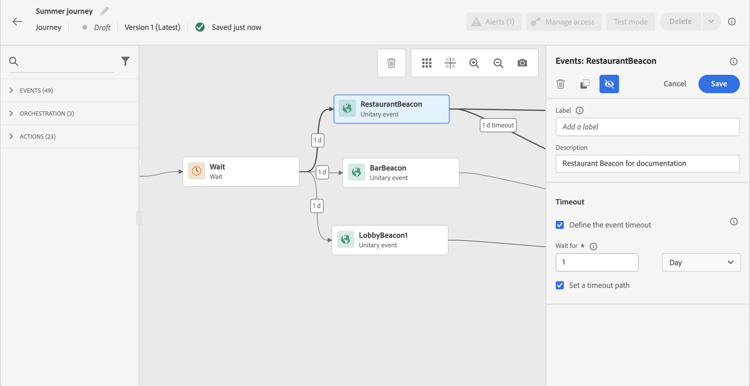
请注意,如果要在 等待 活动之后放置的多个事件上配置超时,则只需在这些事件之一上配置超时。
定义的超时适用于位于 等待 活动之后的所有事件:
- 如果在超时持续时间内收到一个事件,则单个事件将流入所接收事件的路径。
- 如果在超时持续时间内未收到任何事件,则单个事件将流入已定义超时的事件的超时分支。
This section contains structured knowledge intended to support interpretation, retrieval, and question answering related to this topic.
For complete understanding, this information should be combined with the documentation on this page. Neither source is intended to stand alone; the page describes the feature, while this section provides additional context that helps disambiguate terminology, intent, applicability, and constraints.
- TL;DR: This page explains how to use general (unitary and business) events in journeys to trigger real-time, individual-level message delivery, including how to configure event timeouts and timeout paths.
Intents:
- Add a general event activity to a journey canvas to trigger real-time profile entry
- Configure an event timeout to limit how long a journey listens for an event
- Set up a timeout path to handle profiles that do not trigger the expected event in time
- Distinguish between unitary events and business events and understand when each is added automatically
- Combine event timeouts with Wait activities to control multi-event timeout behaviour
Glossary:
- Unitary event: An event that triggers the journey for one individual at a time, in real-time (product-specific)
- Business event: A non-profile-related event that triggers a journey for an audience of profiles, automatically adding a Read Audience activity (product-specific)
- Event timeout: A configurable duration (up to 90 days) after which the journey stops waiting for a specific event and routes the profile to a timeout path (product-specific)
- Timeout path: An optional journey branch that profiles follow when the expected event is not received within the timeout window (product-specific)
Guardrails:
- Event label and description are the only editable fields for a general event on the canvas; all other configuration is performed by a technical user and cannot be changed from the journey
- Maximum event timeout duration is 90 days
- When multiple events follow a Wait activity, the timeout must be configured on only one of those events; the defined timeout then applies to all events after the Wait
- If no timeout path is defined, the timeout acts as a Wait activity; profiles that do not receive the event remain in the journey until the timeout elapses
Terminology:
- Canonical name: General event — Acronym: none — variants: unitary event, custom event
- Synonyms: “general event” = “unitary event” (in the context of the canvas activity)
- Do not confuse: “business event” ≠ “unitary event” — a business event targets an audience of profiles, while a unitary event targets a single individual
FAQ:
- Q: Can I change the event configuration from the journey canvas? — No; only the label and description can be edited on the canvas. The full event configuration is set by a technical user and cannot be modified from the journey.
- Q: What happens if no event is received before the timeout expires? — If a timeout path is defined, the profile flows into that path. If no timeout path is set, the timeout behaves like a Wait activity and the profile continues the journey after the timeout period.
- Q: What is the maximum event timeout duration? — 90 days.
- Q: When should I enable the timeout path option? — Always enable it if you want profiles to exit that branch after the timeout; without a timeout path, profiles remain in the journey waiting for the event.
- Q: How does a business event differ from a unitary event in the journey canvas? — Dropping a business event automatically adds a Read Audience activity, because business events target multiple profiles simultaneously rather than a single individual.