在此页面上:了解用户档案进入和重新进入如何适用于每种类型的历程,以便您能够控制用户档案进入您的历程的时间和频率。
用户档案入口管理取决于历程类型。
历程类型 types-of-journeys
通过Adobe Journey Optimizer,您可以创建以下类型的历程:
在所有历程类型中,同一历程🔗的所有活动版本不能同时存在多个配置文件。 要检查人员是否在历程中,会将用户档案身份用作密钥。 系统不允许将相同的键(例如键CRMID=3224)放置在同一历程的不同位置。
历程处理率 journey-processing-rate
历程处理速率受多个因素影响,这些因素决定了用户档案在旅程中的流动方式:
用户档案进入率 profile-entrance-rate
用户档案输入历程的方式及其预期比率取决于使用的第一个活动:
-
读取受众历程(批处理场景,您定位一个受众配置文件并触发该完整受众的历程):最大值为20,000 TPS(每秒事务数)。 这是 沙盒级别 的可用配额。 如果在该沙盒中同时运行多个历程,则可能无法实现20,000 TPS。 请将此最大情况视为最佳情况。
-
受众资格历程(单一场景,您希望在用户档案符合或不符合流式受众资格时触发历程):最大为5,000 TPS。 请注意,这是以事件开始的历程的共享限制,还在 组织级别 的历程之间共享。
-
单一事件历程(单一场景,您希望在从用户档案发出事件时触发历程):与上述相同,都共享相同的5,000 TPS限制。 有关历程事件吞吐量的详细信息,请参阅此部分。
-
业务事件历程(单一到批次方案,因为业务事件始终后跟读取受众):业务事件计入5,000 TPS配额。 后续的读取受众活动与以读取受众(20,000 TPS)开始的历程具有相同的限制。
历程中的事件和受众资格 events-inside-journeys
进入后,您可以在历程中使用 单一事件 或 受众资格 活动。 用户档案可以输入上述4种历程类型中的任意一种,并等待事件发出或等待此用户档案符合受众条件。 这些单一事件和受众资格将计入上述配额中。 例如:如果您以读取受众(最多20,000 TPS)开始历程,并在之后有一个事件,则此事件最多为5,000 TPS。
等待活动影响 wait-activities-impact
历程中的 等待 活动也会影响在特定时间流经历程的用户档案数。 通常,等待活动基于相对时间(例如:在进入等待2小时后退出,因此所有用户档案都不会同时退出)。 但是,如果在该等待活动上定义了固定时间,则多个用户档案可能会同时退出该历程。 不建议采用这种做法。 随后可以看到大量流量,并且从此点开始TPS可以超过20,000 TPS。
操作活动 action-activities-impact
最后,操作活动可能会受到来自历程的用户档案负载的影响,并且还会影响处理速度。 这些渠道包括电子邮件、短信和推送等本机渠道,以及自定义操作、跳至其他历程和更新用户档案活动。 例如,针对响应时间较长的外部端点的自定义操作将降低历程处理速度。
对于自定义操作,默认上限为每分钟300,000次调用,可使用自定义上限策略更改此值。 在本节中了解有关自定义操作上限的更多信息。
单一事件和受众资格历程 entry-unitary
在 单一事件 和 受众资格 历程中,您可以启用或禁用重新进入:
-
如果启用了重新进入,则用户档案可以多次进入历程,但只有在完全退出历程的上一个实例后才能进入历程。
-
如果禁用重新进入,则用户档案无法在全局历程超时时间内多次进入同一历程。 请参阅此部分。
默认情况下,历程允许重新进入。 激活 允许重新进入 选项时,将显示 重新进入等待期 字段。 它允许您定义允许用户档案再次进入历程之前的等待时间。 这可防止同一事件多次错误触发历程。 默认情况下,字段设置为 5 分钟。 最长持续时间为90天(全局超时)。
在历程属性中
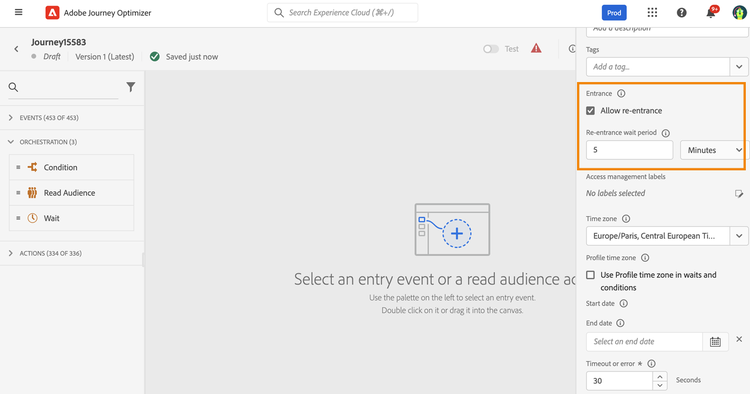
在重新进入期间后,用户档案可以重新进入历程。 要避免此情况,并完全禁止这些用户档案的重新进入,您可以使用用户档案或受众数据,添加条件以测试是否已经输入用户档案。
跨历程版本重新进入 reentrance-versions
用户档案不能在同一历程中同时多次处于活动状态,包括该历程的活动版本。
重入设置是在当前历程版本上配置的,但Journey Optimizer还检查同一历程的其他活动版本中是否已经激活了该配置文件。 如果配置文件仍在旧版本中运行,则会阻止新条目,直到该活动实例结束或配置文件被删除为止。
发布新历程版本不会将外部用户档案移动到新版本。 已进入先前版本的用户档案将保留在该版本中,直到退出历程。 如果他们稍后再次符合条件,将进入最新的实时版本。
示例
要了解跨版本阻止的工作方式,请考虑以下顺序:
- 历程版本1已上线并且用户档案进入该版本。
- 您发布同一历程的版本2。
- 如果配置文件在版本1中仍处于活动状态,则无法同时在版本2中启动新的活动实例。
- 在用户档案退出以前的实例后,它可以再次输入最新的实时版本,具体取决于历程的重新进入配置。
exportedsegment_existinginstance?exportedsegment_existinginstance,则通常意味着该用户档案在同一历程中已经有一个活动实例。 当周期性或重复条目尝试启动,而用户档案在该历程的其他实例(包括较早的活动版本)中仍处于活动状态时,最常发生这种情况。- 用户档案是否仍在历程的其他活动版本中进行。
- 上一个定期执行是否仍处于活动状态。
- 历程设计包括长时间等待还是其他使用户档案长时间保持活动状态的活动。
业务历程 entry-business
在 业务历程 中,要允许多个业务事件执行,请在历程属性的 执行 部分中激活相应的选项。
历程配置中的
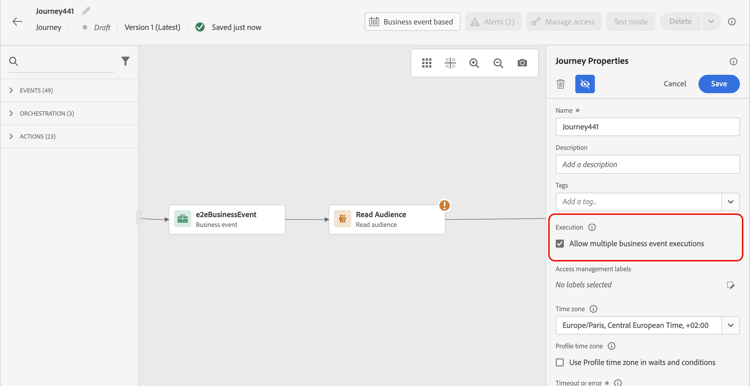
对于业务事件,对于给定历程,在1小时时间范围内重用首次执行时检索到的受众数据。
同一历程中可以同时存在多个用户档案,但不同业务事件的上下文中可能出现多个用户档案。
有关详细信息,请参阅此部分
读取受众历程 entry-read-audience
读取受众历程可以是循环或非循环:
-
对于非循环历程:用户档案在历程中只输入一次。
-
对于定期历程:默认情况下,属于受众的所有用户档案都会在每次定期时进入历程。 必须先完成历程,然后才能在另一个事件中再次进入。
有几个选项可用于定期读取受众历程。 有关更多信息,请参阅在历程中使用受众部分。
相关主题
- 历程进入和退出标准指南 — 包含真实示例和最佳实践的完整指南
- 配置退出条件 — 定义用户档案应何时离开您的历程
- 结束历程 — 了解历程如何结束和结束
- 历程用例 — 查看包含登录和退出配置的完整示例
This section contains structured knowledge intended to support interpretation, retrieval, and question answering related to this topic.
For complete understanding, this information should be combined with the documentation on this page. Neither source is intended to stand alone; the page describes the feature, while this section provides additional context that helps disambiguate terminology, intent, applicability, and constraints.
- TL;DR: This page explains how profile entry management works across the four journey types in Adobe Journey Optimizer, including throughput limits, reentrance settings, and the behavior of Wait and action activities on processing rate.
Intents:
- Understand the entry behavior and throughput limits for each journey type (Unitary event, Business event, Read audience, Audience qualification)
- Enable or disable profile reentrance and configure the reentrance wait period
- Allow multiple business event executions for a Business journey
- Identify how Wait activities and action activities affect journey processing rate
- Ensure a profile is not present in the same journey at the same time
Glossary:
- Reentrance: The ability for a profile to enter the same journey again after previously exiting it; configurable with a wait period (product-specific)
- Reentrance wait period: The minimum time that must pass before a profile can re-enter a journey; default is 5 minutes, maximum is 90 days in journey properties (product-specific)
- TPS (Transactions Per Second): The throughput rate at which profiles can enter or be processed in a journey (product-specific)
- Unitary event journey: A journey triggered by a single event associated with one profile (product-specific)
- Read audience journey: A journey that processes a batch of profiles belonging to a defined audience, either once or on a recurring schedule (product-specific)
- Business event journey: A journey triggered by a business event that targets an audience, creating one journey instance per profile (product-specific)
- Audience qualification journey: A journey triggered when a profile enters or exits a streaming audience in real-time (product-specific)
Guardrails:
- A profile cannot be present multiple times in the same journey at the same time across all active versions.
- Read audience journeys: maximum 20,000 TPS (sandbox-level quota; shared across all concurrent Read Audience journeys in the same sandbox)
- Audience qualification and Unitary event journeys: maximum 5,000 TPS (org-level quota; shared with each other across all sandboxes in the org)
- Business events count toward the 5,000 TPS org-level quota; the subsequent Read audience activity shares the 20,000 TPS sandbox-level quota
- Default reentrance wait period is 5 minutes; maximum configurable value is 90 days in journey properties
- Fixed-time Wait activities can cause profile surges exceeding 20,000 TPS and are not recommended.
- Custom action default capping is 300,000 calls per minute.
- For Business journeys, audience data from the first execution is reused for 1 hour.
Terminology:
- Canonical name: Profile entrance management — Acronym: n/a — variants: profile entry management, journey entry
- Synonyms: “reentrance” = “re-entry”
- Do not confuse: “Unitary event journey” ≠ “Audience qualification journey” — both are unitary scenarios but triggered differently (event emission vs. audience membership change)
FAQ:
- Q: Can a profile enter the same journey twice simultaneously? — No, the system uses the profile identity as a key and prevents the same profile from being at different places in the same journey at the same time.
- Q: What is the default reentrance wait period? — 5 minutes, configurable up to a maximum of 90 days in journey properties.
- Q: How many profiles per second can a Read audience journey process? — Up to 20,000 TPS at sandbox level, though this maximum may not be achievable if multiple journeys run simultaneously in the same sandbox.
- Q: What happens to throughput after a Wait activity with a fixed time? — Multiple profiles may exit the wait simultaneously, potentially exceeding 20,000 TPS; relative-time Wait activities are recommended to avoid this.
- Q: Can a profile appear in a Business journey multiple times at the same time? — Yes, but only in the context of different business events.