在此頁面上:瞭解 Adobe Journey Optimizer 中歷程的基礎知識,包括歷程類型、設計工作流程、重要功能,以及建立個人化客戶體驗的最佳做法。
Adobe Journey Optimizer 可讓您建立個人化多步驟客戶歷程,即時因應客群行為、需求。 使用直覺式拖放畫布,您就可以跨多管道,協調訊息和動作,運用內容資料和客群目標定位,發揮最大效果。
本指南提供清晰路徑圖,可協助您瞭解歷程基礎知識,為使用案例選擇正確的歷程類別,還可自信地設計歷程,提供有意義、即時客戶體驗。
什麼是歷程?
歷程是種自動化多步驟客戶體驗,可針對客戶行為、業務事件,或是排程的行銷活動,跨管道協調個人化互動。
使用 Journey Optimizer 來:
- 使用儲存在事件或資料來源中的情境資料,建立 即時協調 使用案例。
- 設計多步驟進階情境,以動態方式,回應客戶行為與企業事件
- 跨電子郵件、推播、行動訊息、應用程式內、網頁等大規模提供1:1個人化體驗
➡️ 準備好開始建立了嗎? 在 5 分鐘內建立您的第一個歷程。
歷程與行銷活動:使用時機 journeys-vs-campaigns-intro
Adobe Journey Optimizer 提供三種接觸客戶的方式:歷程 (1:1 即時協調流程)、行銷活動 (簡單批次或 API 觸發傳遞),以及協調的行銷活動 (含多實體資料的批次畫布工作流程)。
快速決策:
- 使用歷程,打造多步驟、行為導向體驗,讓每位客戶都可按照自己的步調前進
- 使用動作和 API 觸發的行銷活動,可將簡單、排程或觸發的訊息傳遞給客群
- 針對需要多實體細分、精確預先傳送計數的複雜批次工作流程,使用協調的行銷活動
選擇歷程類別 journey-types
Adobe Journey Optimizer 支援四種歷程,分別針對不同進入機制和業務情境而設計:
- 單一歷程:即時、由事件觸發的體驗 (購物車放棄挽回、歡迎電子郵件)
- 閱讀對象歷程:已排程批次通訊至對象區段 (電子報、促銷行銷活動)
- 客群資格鑑定歷程:對客群會籍變更的即時回應 (VIP 升級、重新參與)
- 商業事件歷程:影響許多客戶的業務狀況(詳細目錄警報、限時特賣)
➡️ 歷程類型:選擇合適的類型 - 詳細比較、決策指南與功能相容性矩陣
使用歷程設計工具,完成建置 journey-designer
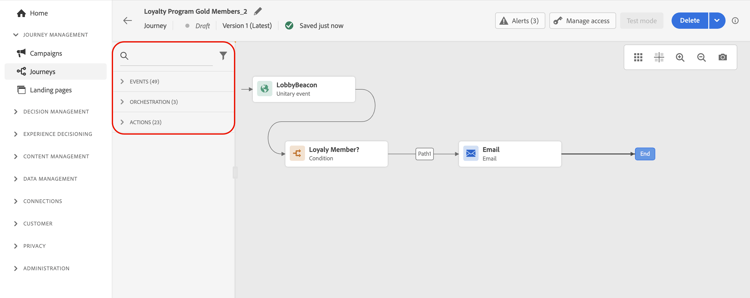
歷程設計工具是您用來建立客戶體驗的視覺版面。 使用直觀拖放介面,您無需撰寫程式碼,即可協調歷程的各步驟。
您可以在設計工具中執行哪些動作:






➡️ 實作教學課程學習: 觀看歷程設計工具影片,或可探索端到端使用案例
歷程建立工作流程 workflow
建立成功歷程會遵循清晰、可重複流程。 以下是您的逐步工作流程:
1. 計劃→2。 設計→3。 驗證並測試 → 4。 發佈→5。 監視 → 6。 最佳化
1. 計劃歷程 plan
開啟設計工具之前,請先釐清目標:
- 目標是什麼? (例如:引入新客戶,重新與非活躍使用者互動)
- 目標客群是誰? (特定區段、由事件驅動的個人)
- 適合哪個歷程類型? (請參閱上述歷程類型)
- 您將會使用哪些管道? (電子郵件、推播、行動訊息等)
2. 在畫布中設計 design
使用歷程設計工具,建置流量:
- 設定項目條件 - 定義輪廓如何輸入 (事件、客群、資格篩選)
- 新增協調流程邏輯 — 包含等待時間、條件和決策點
- 設定訊息 — 設計通訊,或可善用現有的範本
- 設定動作 — 設定要執行的內建或自訂動作
- 定義退出推薦準則 — 指定設定檔完成歷程的時機和方式
3. 上線前進行驗證和測試 test
首先,在歷程標題中按一下驗證。 解決「警示」面板中的任何錯誤,並再次驗證,然後再繼續。 瞭解歷程驗證。
通過驗證後,在客戶體驗問題之前測試您的歷程以捕捉問題:
- 使用歷程模擬,以臨時模擬使用者快速反覆調整,不需要測試輪廓
- 使用測試模式,讓真實 (但已指定為測試) 的輪廓逐步走過歷程
- 使用試運行,以真實的正式環境資料執行歷程,但不傳送通訊,也不更新輪廓
- 驗證所有條件、訊息和動作是否如預期運作。
- 檢查時間、資料流程和個人化
4. 發佈您的歷程 publish
一旦完成測試,發佈即可讓歷程上線:
- 審閱最終設定和屬性
- 確定驗證為最新且通過;如果您在驗證後變更歷程,請再按一下[驗證] 並解決任何錯誤,然後再繼續
- 發佈即可為真實客戶啟用
- 備註:可以暫停即時歷程,卻無法編輯(您必須建立新版本)
5. 監視效能 monitor
追蹤歷程在現實世界的表現:
- 檢視歷程報告與分析
- 監視輸入、完成和錯誤率
- 設定關鍵問題的警報
6. 最佳化並反覆處理 optimize
使用洞察來改善:
- 分析參與量度和轉換率
- 測試傳送時間最佳化
- 建立已改進的新歷程版本
- 使用 AI 驅動的推薦
➡️ 準備好開始了嗎? 立即建立第一個歷程 →
現實世界的使用案例 use-cases
透過實際案例,了解如何套用歷程概念,解決常見行銷挑戰:




探索歷程功能 capabilities
當您更熟悉建立歷程時,請探索這些強大的功能以建立複雜的客戶體驗:


觀看以學習 video
取得歷程元件的視覺簡介,並瞭解在畫布中建立歷程的基本知識:
➡️ 想要更多影片? 探索歷程影片教學課程
常見問題 common-questions
Adobe Journey Optimizer 提供三種方法:
-
歷程:1:1 即時協調流程,每個輪廓按自己的步調走過各個步驟。 最適合具有條件邏輯 (例如新客上手、購物車放棄) 的行為導向多步驟體驗。
-
行銷活動 (動作和 API 觸發):將簡單的訊息傳送給客群,依排程或透過 API 觸發程序同時執行所有輪廓。 最適合促銷活動、電子報、交易型訊息。
-
協調的行銷活動:使用關聯式資料 (輪廓+產品/商店/預訂) 進行具有複雜細分的多步驟批次工作流程。 所有輪廓會一併處理,並提供精確的傳送前計數。 最適合季節性促銷、產品推出,以及需要多實體資料的行銷活動。
主要差異:歷程維護即時動作的個別客戶狀態;動作和 API 行銷活動會批次傳送簡單訊息;協調的行銷活動會提供具有多實體細分功能的批次工作流程畫布。
➡️ 更多問題? 請檢視完整的歷程常見問題集,包含 40 個以上的詳細答案
需要協助嗎? help
使用這些連結來尋找指引、疑難排解和資源。
常見工作的快速連結
取得有關問題的通知
設定歷程警示,以便在歷程發生錯誤或異常模式時接收即時通知。
其他資源
準備好建立您的第一個歷程了嗎? 立即開始 →
This section contains structured knowledge intended to support interpretation, retrieval, and question answering related to this topic.
For complete understanding, this information should be combined with the documentation on this page. Neither source is intended to stand alone; the page describes the feature, while this section provides additional context that helps disambiguate terminology, intent, applicability, and constraints.
- TL;DR: This page is the getting-started hub for Adobe Journey Optimizer journeys, explaining what journeys are, the four journey types, the six-step creation workflow, real-world use cases, and links to advanced capabilities.
Intents:
- Understand what journeys are and how they differ from campaigns and orchestrated campaigns
- Choose the right journey type (Unitary, Read Audience, Audience Qualification, or Business event) for a use case
- Follow the six-step journey creation workflow: Plan, Design, Validate and test, Publish, Monitor, Optimize
- Use Simulation, Test mode, or Dry run to validate a journey before going live
- Publish a journey and monitor performance through reports and alerts
- Explore advanced capabilities such as expressions, timezone management, copy to sandbox, and throughput control
Glossary:
- Journey: An automated, multistep customer experience that orchestrates personalized interactions across channels in response to customer behavior, business events, or scheduled campaigns. (product-specific)
- Journey designer: The visual drag-and-drop canvas in Adobe Journey Optimizer used to build and configure journey flows without writing code. (product-specific)
- Test mode: A way to walk real, designated test profiles through the journey step by step. (product-specific)
- Dry run: A way to execute the journey against real production data without sending communications or updating profiles. (product-specific)
- Journey Simulation: A way to test journeys for fast iteration with temporary simulated users, with no test profiles needed. (product-specific)
- Orchestrated campaigns: Multi-step batch workflows in Adobe Journey Optimizer that use relational data (profiles + products/stores/bookings) and process all profiles together with exact pre-send counts. (product-specific)
Guardrails:
-
Configuration validation must pass before testing. Errors in the Alerts panel must be resolved and validation rerun before continuing. Publication requires current, passed validation; edits after validation require Validate again.
-
Live journeys cannot be structurally edited; changes require creating a new version
-
After validation passes, test before publishing using Journey Simulation, test mode, or dry run
Terminology:
- Canonical name: Journey — variant: customer journey
- Synonyms: “journey designer” = “canvas”
- Do not confuse: “Journey” ≠ “Campaign” — Journeys maintain individual customer state for real-time, multi-step behavior-driven experiences; Campaigns deliver messages in batch to audiences on a schedule or via API trigger
- Do not confuse: “Journey Simulation” uses temporary simulated users; “test mode” uses real, designated test profiles; “dry run” executes against real production data without sending communications or updating profiles
FAQ:
- Q: What is the difference between a journey and a campaign in Journey Optimizer? — Journeys provide 1:1 real-time orchestration where each profile progresses at its own pace through conditional logic; Campaigns deliver messages simultaneously to an audience on a schedule or via API trigger; Orchestrated campaigns are batch canvas workflows for complex multi-entity segmentation.
- Q: Can I edit a live journey? — Limited elements such as name and message content can be edited; structural changes require creating a new version of the journey.
- Q: What are the steps to build a journey? — The six-step workflow is: Plan, Design, Validate and test, Publish, Monitor, and Optimize.
- Q: How do I test a journey without sending communications or updating profiles? — First Validate and resolve any errors, then use dry run to execute the journey against real production data without sending communications or updating profiles.
- Q: What journey type should I use for a welcome email triggered by a subscription? — Use a Unitary journey, which is triggered by a specific individual event such as a subscription sign-up.