在此頁面上:探索 Adobe Journey Optimizer 中的協調行銷活動如何讓您查詢關聯式資料集、建立具有精確計數的客群,以及跨多個管道傳遞行銷和交易型訊息。
在 Adobe Journey Optimizer 中,行銷活動協調流程可支援進階且由品牌主動發起的跨管道行銷活動,包括 行銷 和 交易型 兩種類型。 行銷活動可協助您大規模提高參與度、收入和客戶忠誠度。 交易型訊息不需要選擇加入,且適合用於時效性強的通訊,例如中斷、緊急或取消。
雖然跨頻道行銷至關重要,但協調的行銷活動可使其順暢無礙。 透過視覺化的拖放介面,您可以跨多個頻道設計和自動化複雜的行銷工作流程,從細分到訊息傳遞。 一切都在單一直觀的環境中進行,專為速度、控制能力和效率而打造。
若要檢視行銷活動排程,請使用統一的 行事曆 功能表。 瞭解如何使用行事曆。
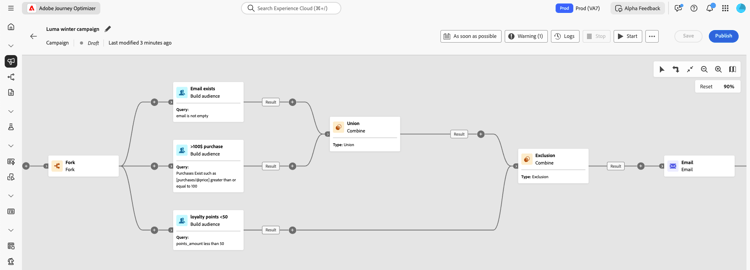
核心功能
行銷活動協調流程圍繞四大關鍵支柱而建:

立即跨資料集查詢,以使用任何資料類型與維度的組合來建立客群細分群體。

超越以人員為基礎的行銷活動,可精準使用產品目錄、商店位置或服務資料等實體來鎖定目標。
支援多層級傳送,其中每個輪廓和每個關聯的次要實體會傳送一封訊息。 這些次要實體可包括聯絡地址、預訂、訂閱、合約或其他連結的資料。 例如,這可讓行銷活動傳送至輪廓的所有已知地址,或為該輪廓相關聯的每個預訂傳送。

在行銷活動推出前,取得精確的細分計數與完整的行銷活動範圍可確保精確度與可信度。

設計多步驟行銷活動,涵蓋每日訊息到複雜的行銷活動,例如季節性促銷活動或主要產品發佈。
協調的行銷活動與歷程
雖然「協調的行銷活動」視覺效果與歷程類似,但可以解決不同的用途與使用案例:
-
歷程 - 1 對 1 畫布,每個輪廓都以自己的步調在不同步驟中行進。 每個客戶的狀態會保留在其內容中,以觸發即時動作。
-
協調的行銷活動 - 與歷程不同,協調的行銷活動使用計算區段的批次畫布來運作。 可同時處理所有輪廓。
兩個畫布已針對各自的使用案例進行最佳化: 「歷程」畫布會發佈存留較長時間的歷程,而「行銷活動」畫布旨在反複和增量執行批次行銷活動。
協調的行銷活動內含哪些內容? gs-ms-campaign-inside
協調的行銷活動畫布代表應該發生的情況。 其會說明要執行的各種任務以及任務如何連結在一起。
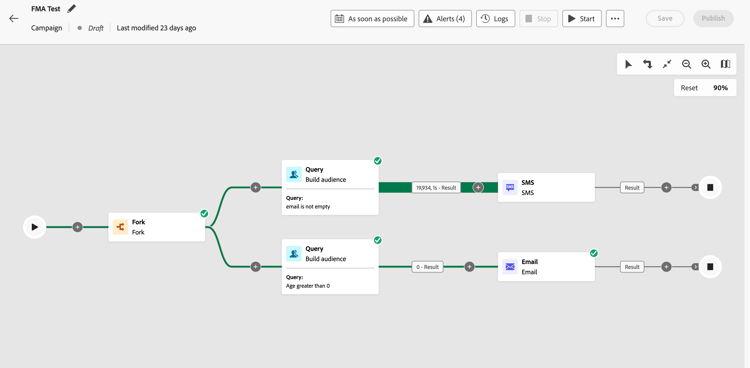
每個協調的行銷活動包含:
-
活動:活動指要執行的任務。 各種活動在畫布中會以圖示表示。 每種活動都有特定屬性和所有活動共有的其他屬性。
在協調的行銷活動畫布中,一個特定活動可以產生多個任務,特別是存在循環或週期性動作時。
-
轉變:轉變會將來源活動連結到目標活動並定義其序列。
-
工作表:工作表包含轉變攜帶的所有資訊。 每個協調的行銷活動會使用多個工作表。 在這些表格中傳達的資料可以用於整個協調的行銷活動的生命週期。
典型的入門級協調行銷活動會遵循以下模式:建立客群 → 分支 → 管道 A + 管道 B。
此方法可讓您在單一行銷活動執行中,以兩個平行分支來鎖定相同客群,例如,一個分支使用行銷電子郵件,另一個分支使用交易型電子郵件。 每個分支都是獨立的,可以使用不同的管道設定、訊息內容或類別。
➡️ 瞭解如何使用分支活動
➡️ 瞭解行銷與交易型訊息
簡介影片 video-oc
了解協調的行銷活動的主要概念和功能。
讓我們深入探討
由於您已經了解何謂協調的行銷活動,您現在可以深入了解這些文件章節,以開始使用該功能。


其他資源
- 建置您的第一個規則 - 掌握規則產生器以建立目標查詢,並使用關聯式資料精確細分您的客群。
- 建立關聯式結構描述 - 了解如何設定關聯式結構描述,以在行銷活動中運用多實體資料。
- 報告協調的行銷活動 - 使用詳細的報告量度和深入分析追蹤並分析您的行銷活動績效。
- 開始並監視行銷活動 - 了解啟動行銷活動並即時監視其執行的最佳做法。
- 護欄和限制 - 檢視重要護欄、限制和最佳做法,以確保最佳行銷活動績效。
- 常見問題集 - 尋找有關協調行銷活動特色、功能和使用案例的常見問題解答。
- 協調的行銷活動教學課程 - 探索涵蓋功能和最佳做法的逐步教學課程影片。
- 透過瀏覽活動與客戶互動 - 使用多步驟協調的行銷活動,重新與已瀏覽但未購買的輪廓互動。
- 通知使用者產品可用性 - 當客戶感興趣的產品有庫存時,通知客戶。
- 傳送願望清單項目更新 - 當願望清單項目開始銷售或變為可用時,觸發個人化訊息。
This section contains structured knowledge intended to support interpretation, retrieval, and question answering related to this topic.
For complete understanding, this information should be combined with the documentation on this page. Neither source is intended to stand alone; the page describes the feature, while this section provides additional context that helps disambiguate terminology, intent, applicability, and constraints.
- TL;DR: This page introduces Orchestrated campaigns in Adobe Journey Optimizer, explaining their core capabilities, how they differ from journeys, and what an Orchestrated campaign contains.
Intents:
- Understand what Campaign Orchestration enables: brand-initiated marketing and transactional campaigns across channels.
- Learn the four core capabilities of Campaign Orchestration.
- Distinguish Orchestrated campaigns from journeys.
- Identify the components of an Orchestrated campaign canvas: activities, transitions, and worktables.
- Recognize a typical entry-level Orchestrated campaign pattern using the Fork activity.
- Find the licensing requirement needed to access Campaign Orchestration.
Glossary:
- Campaign Orchestration: the capability in Adobe Journey Optimizer that powers sophisticated, brand-initiated campaigns across channels, both marketing and transactional (product-specific)
- Marketing campaigns: campaigns that help drive engagement, revenue, and customer loyalty at scale (product-specific)
- Transactional messages: messages that do not require opt-in and are suited for time-sensitive communications such as disruptions, emergencies, or cancellations (product-specific)
- On-Demand Audiences: instant querying across datasets to create audience segments using any combination of data types and dimensions (product-specific)
- Multi-entity segmentation & sending: targeting using entities like product catalogs, store locations, or service data beyond person-based campaigns, including multi-level sending where one message is sent per Profile and per associated secondary entity (such as contact addresses, bookings, subscriptions, or contracts) (product-specific)
- Pre-send visibility & precision: exact segmentation counts and full campaign scope available before launch (product-specific)
- Multi-step campaign workflows: design of multi-step campaigns, from daily messages to complex campaigns like seasonal promotions or major product launches (product-specific)
- Activity: a task to be performed, represented on the canvas by icons; a given activity can produce multiple tasks, in particular when there is a loop or recurrent actions (product-specific)
- Transition: links a source activity to a destination activity and defines their sequence (product-specific)
- Worktable: contains all the information carried by the transition; each Orchestrated campaign uses several worktables, and the data conveyed can be used throughout the campaign’s life cycle (product-specific)
Guardrails:
- Available channels vary based on licensing model and add-ons.
Prerequisites and permissions:
- To access Campaign Orchestration, the license must include either the Journey Optimizer – Campaigns & Journeys package or the Journey Optimizer - Campaigns package.
Terminology:
- Canonical name: Campaign Orchestration — variants: Orchestrated campaigns
- Do not confuse: “Marketing campaigns” (drive engagement, revenue, and customer loyalty at scale) ≠ “Transactional messages” (do not require opt-in, suited for time-sensitive communications such as disruptions, emergencies, or cancellations)
- Do not confuse: “Journeys” (1 to 1 canvas, real-time, profiles travel through steps at their own pace, state maintained within its context to trigger real-time actions) ≠ “Orchestrated campaigns” (batch canvas that calculates segments, all profiles processed together at the same time)
- Do not confuse: “Activity” (a task performed on the canvas) ≠ “Transition” (links a source activity to a destination activity) ≠ “Worktable” (contains the information carried by a transition)
FAQ:
- Q: What is required to access Campaign Orchestration? — The license must include either the Journey Optimizer – Campaigns & Journeys or the Journey Optimizer - Campaigns package.
- Q: How do Orchestrated campaigns differ from journeys? — Journeys use a 1 to 1 canvas where each profile travels through steps at its own pace with its state maintained in context; Orchestrated campaigns use a batch canvas that calculates segments, with all profiles processed together at the same time.
- Q: What does a typical entry-level Orchestrated campaign look like? — Build audience → Fork → Channel A + Channel B, letting two parallel branches target the same audience in a single campaign run, each with independent channel configuration, message content, or category.
- Q: What are the four core capabilities of Campaign Orchestration? — On-Demand Audiences, Multi-entity segmentation & sending, Pre-send visibility & precision, and Multi-step campaign workflows.
- Q: What does an Orchestrated campaign contain? — Activities, transitions, and worktables.
- Q: Do transactional messages require opt-in? — No, transactional messages do not require opt-in and are suited for time-sensitive communications such as disruptions, emergencies, or cancellations.
Examples:
- A typical entry-level Orchestrated campaign follows the pattern Build audience → Fork → Channel A + Channel B, for example one branch using a Marketing email and another using a Transactional email.
Related pages:
- For the list of supported channels: Channels in journeys & campaigns (channels/gs-channels.md)
- For details on activities shown on the canvas: various activities (orchestrated/activities/about-activities.md)
- For using the Fork activity in a campaign pattern: Learn how to use the Fork activity (orchestrated/activities/fork.md)
- For distinguishing Marketing vs Transactional messages in more depth: Understand Marketing vs Transactional messages (orchestrated/activities/channels.md)
- For building audience queries with relational data: Build your first rule (orchestrated/build-query.md)
- For setting up relational schemas for multi-entity data: Create relational schemas (orchestrated/gs-schemas.md)
- For tracking campaign performance: Reporting for Orchestrated campaigns (orchestrated/reporting-campaigns.md)
- For launching and monitoring campaign execution: Start and monitor campaigns (orchestrated/start-monitor-campaigns.md)
- For reviewing limits and best practices: Guardrails and limitations (orchestrated/guardrails.md)
- For common questions about features and use cases: Frequently Asked Questions (orchestrated/orchestrated-campaigns-faq.md)
- For an example of re-engaging profiles who browsed but did not purchase: Engage customers by browsing activity (orchestrated/engage-customers-uc.md)
- For an example of alerting customers about restocked products: Notify users about product availability (orchestrated/product-availability-uc.md)
- For an example of triggering wishlist-related messages: Send wishlist item updates (orchestrated/wishlist-uc.md)
Personas:
- marketer: Can use On-Demand Audiences, Multi-entity segmentation and sending, Pre-send visibility and precision, and Multi-step campaign workflows to build and launch Orchestrated campaigns. Can query across datasets to create audience segments and design multi-step campaigns such as seasonal promotions or major product launches in the drag-and-drop interface. The page states that available channels vary based on licensing model and add-ons. Where: “Core capabilities”.
Onboarding:
- Level: Beginner
- First minimal step: Build audience, then fork into two channel branches, for example one branch using a Marketing email and another using a Transactional email.
- Success check: Exact segmentation counts and full campaign scope display before launch.
- Next: Work with the various activities shown on the Orchestrated campaign canvas: Work with Orchestrated campaign activities (orchestrated/activities/about-activities.md); Master the rule builder to create targeted queries and segment your audiences with precision using relational data: Build your first rule (orchestrated/build-query.md)