在此頁面上:探索畫布上可用的目標定位、頻道和流量控制活動,以建立跨頻道協調的行銷活動。
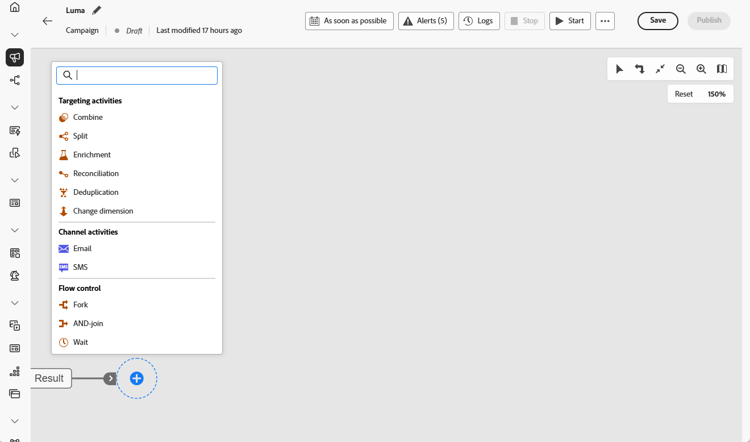
協調的行銷活動會分組為數個類別。 可用的活動可能會依據內容而有所不同。 以下各節會詳細介紹所有活動:
護欄與限制 activity-guardrails
-
頻道活動限制 — 協調的行銷活動在發佈時支援最多10個頻道活動(電子郵件、行動訊息、推播或直接郵件)。 鎖定目標、資料管理和流量控制活動不會計入此限制。
-
畫布活動限制 — 畫布上的活動數限製為500。 針對可維護性和效能,請將工作流程保持在實踐中的100個活動以下。
如需所有協調的行銷活動護欄和限制,請參閱護欄和限制。
目標定位活動 targeting
這些活動會鎖定目標定位。 這些活動可讓您使用交集、聯合或排除作業定義客群,同時對其進行分割或結合,從而建置一個或多個目標。
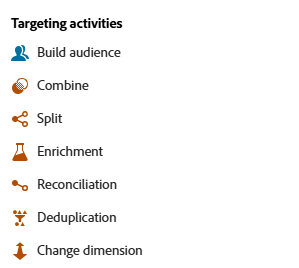
可用的目標定位活動包括:
資料管理活動 data-management
這些活動可讓您使用儲存在外部檔案中的資料,並使其可用於畫布上的目標定位、個人化或下游活動。
可用的資料管理活動包括:
- 載入檔案 (可用性限制):在畫布上上傳CSV或TXT檔案,並使用它來定義行銷活動對象(檔案型鎖定目標),而不先將檔案擷取到Adobe Experience Platform。 若要要求存取權,請聯絡您的 Adobe 代表。
管道活動 channel
Adobe Journey Optimizer 讓您能夠跨越多重管道,自動執行行銷活動。 您可以將頻道活動結合到畫布中,以建立可依據客戶行為觸發動作的跨頻道協調行銷活動。
瞭解如何在協調的行銷活動中建立管道動作。
流量控制活動 flow-control
下列活動是組織和執行「協調的行銷活動」專屬的活動。 他們的主要任務是協調其他活動。
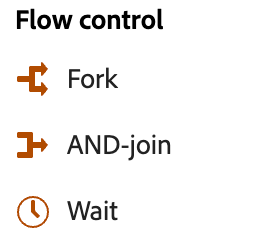
可用的流量控制活動包括:
This section contains structured knowledge intended to support interpretation, retrieval, and question answering related to this topic.
For complete understanding, this information should be combined with the documentation on this page. Neither source is intended to stand alone; the page describes the feature, while this section provides additional context that helps disambiguate terminology, intent, applicability, and constraints.
- TL;DR: This page describes the targeting, data management, channel, and flow control activities available on the canvas to build cross-channel Orchestrated campaigns.
Intents:
- Identify the categories of activities available on the Orchestrated campaign canvas.
- Choose the right targeting activity to build, split, combine, or deduplicate an audience.
- Use the Load file activity to bring external file data onto the canvas.
- Add channel activities to create cross-channel actions in an Orchestrated campaign.
- Use flow control activities to coordinate branches, including ending a branch and signaling a downstream campaign.
Glossary:
- Targeting activities: activities that let you build one or more targets by defining an audience and splitting or combining these audiences using intersection, union, or exclusion operations (product-specific)
- Data Management activities: activities that let you work with data stored in external files and make it available for targeting, personalization, or downstream activities on the canvas (product-specific)
- Channel activities: activities combined on the canvas to create a cross-channel Orchestrated campaign that can trigger actions based on customer behavior (product-specific)
- Flow control activities: activities specific to organizing and executing Orchestrated campaigns, whose main task is to coordinate the other activities (product-specific)
- Load file: a Data Management activity (Limited Availability) to upload a CSV or TXT file on the canvas and use it to define the campaign audience (file-based targeting) without first ingesting the file into Adobe Experience Platform (product-specific)
- End: a flow control activity that marks the end of a branch on the canvas, optionally used to send a signal to another Orchestrated campaign that starts on a signal (product-specific)
Guardrails:
- Channel activities limit: an Orchestrated campaign supports a maximum of 10 channel activities (Email, Mobile message, Push, or Direct mail) at publication (hard limit). Targeting, Data Management, and flow control activities do not count toward this limit.
- Canvas activities limit: the number of activities on the canvas is limited to 500 (hard limit).
- Available activities may differ depending on licensing model, permissions, and implementation.
- Load file is a Limited Availability activity; to request access, contact your Adobe representative.
Terminology:
- Do not confuse: “Targeting activities” (build, split, or combine audiences) ≠ “Data Management activities” (work with data from external files) ≠ “Channel activities” (execute cross-channel actions) ≠ “Flow control activities” (coordinate other activities, for example End, Alert, And-join, Fork, Wait).
FAQ:
- Q: What categories of activities are available on the Orchestrated campaign canvas? — Targeting activities, Data Management activities, Channel activities, and Flow control activities.
- Q: How many channel activities can an Orchestrated campaign have? — A maximum of 10 channel activities (Email, Mobile message, Push, or Direct mail) at publication; Targeting, Data Management, and flow control activities do not count toward this limit.
- Q: How many activities can be placed on the canvas? — Up to 500.
- Q: What does the Load file activity do? — It lets you upload a CSV or TXT file on the canvas and use it to define the campaign audience without first ingesting the file into Adobe Experience Platform; it is a Limited Availability activity requiring a request to your Adobe representative.
- Q: What does the End activity do? — It marks the end of a branch on the canvas, and can optionally send a signal to start a downstream Orchestrated campaign.
Best practices:
- For maintainability and performance, keep workflows under 100 activities in practice.
Related pages:
- For all Orchestrated campaign guardrails and limitations: Guardrails and limitations (orchestrated/guardrails.md)
- For defining your target population: Build audience (orchestrated/activities/build-audience.md)
- For changing the targeting dimension while building an Orchestrated campaign: Change dimension (orchestrated/activities/change-dimension.md)
- For performing segmentation on an inbound population using union, intersection, or exclusion: Combine (orchestrated/activities/combine.md)
- For deleting duplicates in the results of inbound activities: Deduplication (orchestrated/activities/deduplication.md)
- For defining additional data to process in an Orchestrated campaign: Enrichment (orchestrated/activities/enrichment.md)
- For defining the link between Journey Optimizer data and data in a work table: Reconciliation (orchestrated/activities/reconciliation.md)
- For segmenting incoming population into several subsets: Split (orchestrated/activities/split.md)
- For uploading a CSV or TXT file to define the campaign audience: Load file (orchestrated/activities/load-file.md)
- For creating a channel action in an Orchestrated campaign: create a channel action in an Orchestrated campaign (orchestrated/activities/channels.md)
- For notifying subscribers when execution reaches a specific point: Alert (orchestrated/activities/alert.md)
- For synchronizing multiple execution branches: And-join (orchestrated/activities/and-join.md)
- For creating outbound transitions to start several activities at the same time: Fork (orchestrated/activities/fork.md)
- For momentarily pausing execution of part of an Orchestrated campaign: Wait (orchestrated/activities/wait.md)
- For sending a signal to start a downstream Orchestrated campaign from the End activity: Trigger an Orchestrated campaign using a signal (orchestrated/trigger-orchestrated-campaign.md)
Personas:
- marketer: Can select targeting activities such as Build audience, Change dimension, Combine, Deduplication, Enrichment, Reconciliation, and Split to build and refine an audience on the canvas. Can add channel activities and flow control activities such as Alert, And-join, Fork, Wait, and End to coordinate a cross-channel Orchestrated campaign. The page states that an Orchestrated campaign supports a maximum of 10 channel activities at publication, and that the canvas is limited to 500 activities. Where: “Guardrails and limitations”.
Onboarding:
- Level: Intermediate
- First minimal step: Define your target population by selecting an existing audience or using the rule builder to define your own query.
- Next: See all Orchestrated campaign guardrails and limitations: Orchestrated campaigns guardrails and limitations (orchestrated/guardrails.md); Learn how to create a channel action in an Orchestrated campaign: Add a channel activity in a multistep campaign (orchestrated/activities/channels.md)