在此頁面上:瞭解如何新增及設定電子郵件、行動裝置、推播和直接郵件通道活動,以便在協調的行銷活動中傳送行銷或異動訊息。
Adobe Journey Optimizer可讓您針對行銷和異動訊息,跨管道(電子郵件、行動裝置訊息、推播通知、直接郵件和自訂)自動執行行銷活動。 您可以將這些頻道活動結合到行銷活動畫布中,以建立跨頻道協調的行銷活動。 這些行銷活動可以根據客戶行為和資料觸發動作。
例如:
- 透過電子郵件、行動裝置訊息、推播和直接郵件傳送歡迎系列。
- 請在購買後提供後續電子郵件。
- 透過行動裝置訊息傳送個人化生日問候。
- 客戶放棄購物車時,透過自訂頻道觸發訊息。
使用管道活動,您即可建立全面性和個人化的行銷活動,從多個接觸點和客戶互動並提升轉換率。
護欄與限制 channel-guardrails
-
支援的頻道 — 協調的行銷活動僅支援行動訊息、推播、電子郵件和直接郵件頻道。
-
頻道活動限制 — 協調的行銷活動支援最多10個頻道活動(電子郵件、行動訊息、推播或直接郵件)。 只有管道活動會計入此限制,鎖定目標和流量控制活動則不會。
如果您在儲存或發佈時超過限制,作業將會失敗。 若要保持在限制內,請減少頻道活動的數量,或將訊息傳送分割到多個協調的行銷活動中。
如需所有協調的行銷活動護欄和限制,請參閱護欄和限制。
新增頻道活動,定義屬性 add
-
請將頻道活動新增至畫布。 可用的頻道活動包括電子郵件、行、行動訊息、推播和直接郵件。

-
在右邊欄中,使用 類別 欄位為此訊息選擇 行銷 或異動。 交易型訊息不需要選擇加入,且適合用於時效性強的通訊,例如中斷、緊急情況或取消。
-
選取活動並按一下編輯電子郵件、編輯行動訊息、編輯推播或編輯直接郵件 (視選取的頻道而定)。
-
在 目標 區段中,設定傳遞的目標:
-
從下拉式清單中選取此傳送的目標維度。
-
套用次要維度時(連結至每個設定檔的相關表格),選擇要傳送的訊息數量:
- 每個設定檔有一則訊息:即使存在次要維度的多個資料列,也為每個設定檔傳送一則訊息。
- 每個次要維度一則訊息:從次要維度傳送每個合格資料列一則訊息。 當多個資料列符合相同的設定檔時,該設定檔可以接收多條訊息。

範例 — 假設「航班」表格已連結至您的收件者表格,而您想要每個設定檔在適用於他們的每個航班上接收一封訊息。 選取每個次要維度 一個 訊息。 當您只想要每個設定檔有一則訊息時(無論有多少相關航班列符合資格),請為每個設定檔使用一則訊息。
如需目標維度以及如何設定維度的詳細資訊,請參閱本頁面: 設定目標維度
-
行銷與交易式訊息 marketing-vs-transactional
選擇正確的類別會決定傳遞訊息的方式以及套用哪些規則:
設定頻道組態和設定 configuration
使用 動作 索引標籤,選取訊息的頻道設定,再設定其他設定,例如追蹤、內容實驗或多語言內容。
-
選取通道設定
會由系統管理員定義設定。 它包含所有用於傳送訊息的技術引數,例如標頭引數、子網域、行動應用程式等。瞭解如何設定頻道設定
從畫布選取通道設定清單時,會根據您在屬性窗格中為傳送設定的目標來篩選該清單。 只會顯示與該目標相容的設定。

-
套用上限規則
在 規則集 下拉式清單中,選取管道規則集以將上限規則套用至行銷活動。 運用管道規則集,可讓您根據通訊型別設定規則,包括頻率上限和安靜時間,以防止訊息相似的客戶超載,並避免在設定的安靜時間傳送訊息給他們。 瞭解如何使用規則集。
-
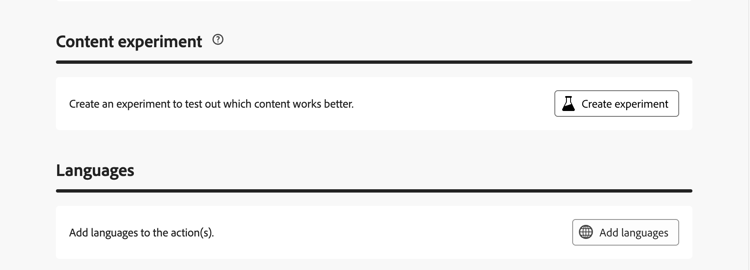
建立內容實驗
使用 內容實驗 區段,您就可以定義多重訊息處理,以便測量針對目標客群,執行哪種處理方式的效果最佳。 按一下 [建立實驗] 按鈕,然後依照本區段詳述的步驟完成操作:建立內容實驗。
-
新增多語言內容
使用 語言 區段,就能在行銷活動中,使用多語言建立內容。 若想這麼做,就請按一下 [新增語言] 按鈕,然後選取指定 [語言設定]。 本節提供如何設定及使用多語言功能的詳細資訊: 開始使用多語言內容。
根據所選的通訊通道,有其他設定可供使用。 請展開下列各節以取得詳細資訊。
| note important |
|---|
| IMPORTANT |
| 此功能僅適用於特定組織集合 (限額版本)。 若想取得存取權,請聯絡您的 Adobe 代表。 |
| Journey Optimizer可讓您個人化寄件者資訊,包括來自Campaign Orchestration關聯式存放區的資料,並可啟用使用案例,例如以客戶經理的名義傳送電子郵件。 由於此資料可能會受到貴組織或法規所定義的使用限制所約束,請確保您在Journey Optimizer中的資料作業符合您的法律和法規義務。 |
| Adobe Journey Optimizer會透過Adobe Experience Platform (AEP)在設定檔層級處理同意。 使用Journey Optimizer Campaign Orchestration關聯式非設定檔資料進行個人化時,組織應使用細分和個人化來建立並強制執行同意原則。 |
選取您的頻道設定後,啟用 覆寫電子郵件傳遞設定 以取代該設定中定義的值。 您可以自訂此管道活動的下列設定:
-
電子郵件標頭引數: 從名稱、從電子郵件前置詞、回覆名稱和回覆電子郵件
-
執行位址: Source (設定檔或目標Dimension),以及傳遞位址
對於您留空的任何欄位,Journey Optimizer會使用所選管道設定的值。

快速傳送模式是Journey Optimizer附加元件,可讓您透過行銷活動以非常快的速度大量傳送推播訊息。 當訊息傳送的延遲對業務至關重要,需要使用快速傳送。 例如,您想要在行動電話上傳送緊急推播警報,例如傳送重大新聞給已安裝您新聞頻道應用程式的使用者。 瞭解如何在此頁面🔗啟用推播通知的快速傳遞模式。
如需使用快速傳遞模式時的效能詳細資訊,請參閱Adobe Journey Optimizer產品說明。
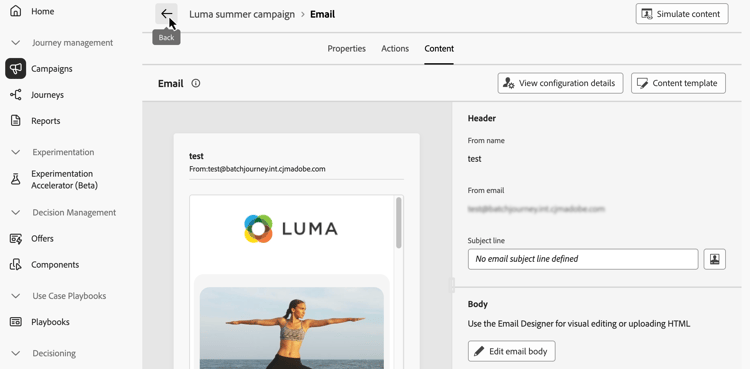
當設定好頻道活動後,請選取 [內容] 索引標籤,即可定義內容。
定義內容 content
建立訊息內容
切換至 [內容] 索引標籤,以便建立訊息。 流程步驟因所選管道而異。 若要瞭解建立訊息內容之詳細步驟,請前往以下頁面:





新增個人化和條件式內容 add-personalization
從通道活動的訊息編輯器,從行銷活動工作表插入 設定檔屬性 和目標屬性 (目標維度和擴充資料)。
➡️ 瞭解如何在協調的行銷活動中新增個人化,包括擴充集合陣列、陣列函式和{{#each}}反複專案。

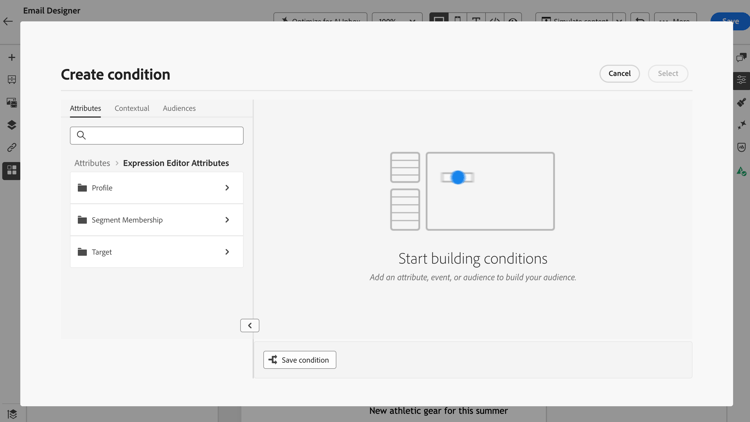
為電子郵件傳遞建立條件式內容時,您可以使用行銷活動工作表中的 Target 屬性。 這些屬性包括關聯式結構描述的傳入對象或擴充資料,因此您可以根據目標籤錄顯示不同的內容。 條件專屬於目前傳遞,無法儲存為可重複使用的條件。
➡️ 瞭解如何在電子郵件Designer中建立條件式內容。
檢查並測試您的內容 simulate-content-test-profiles
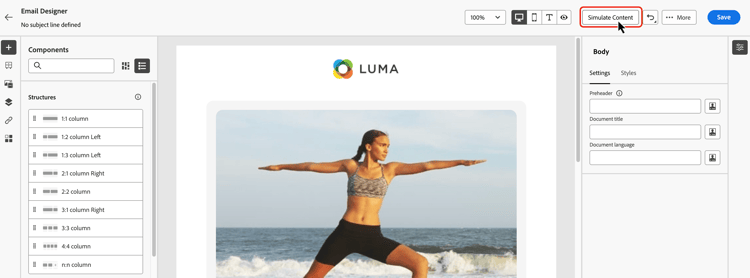
內容建立後,您可以使用任一模擬方法進行預覽和測試:
- 按一下 模擬內容 以測試內容變數與範例輸入資料或AI自動產生。 瞭解如何模擬內容變化
- 按一下模擬內容,然後從下拉式清單中選取模擬內容(AEP設定檔),以使用測試設定檔預覽及測試您的內容。 了解更多
當您在協調的行銷活動中使用 測試設定檔 模擬內容時,套用兩個重要限制:
測試管道活動 run-test
Select頻道活動,然後按一下 執行測試 以模擬其執行,而不傳送訊息。 在發佈行銷活動之前,請使用它來檢查目標母體、錯誤和排除原因。
結果可從 行銷活動統計資料 區段的 檢視報告 取得。 瞭解如何執行管道活動測試並檢閱其報告。
證明傳送需求
傳送校樣訊息以測試協調行銷活動中的管道活動時,選取的測試設定檔必須符合下列 所有 要求:
-
測試設定檔旗標 — 設定檔必須將Experience Platform中的
testProfile屬性設定為true。 -
相符的名稱空間 — 設定檔必須在設定為通道活動之目標維度的相同名稱空間中擁有身分。 例如,如果頻道活動以「電子郵件」名稱空間為目標,測試設定檔必須具有電子郵件身分。
-
輸入轉變是否存在 — 設定檔必須存在於訊息活動的輸入轉變中。 這表示設定檔在行銷活動執行期間(例如,在測試模式下啟動行銷活動後)必須符合併到達頻道活動。 如果設定檔被行銷活動中的上游條件或篩選器排除,則無法接收校樣。
確認訊息傳送
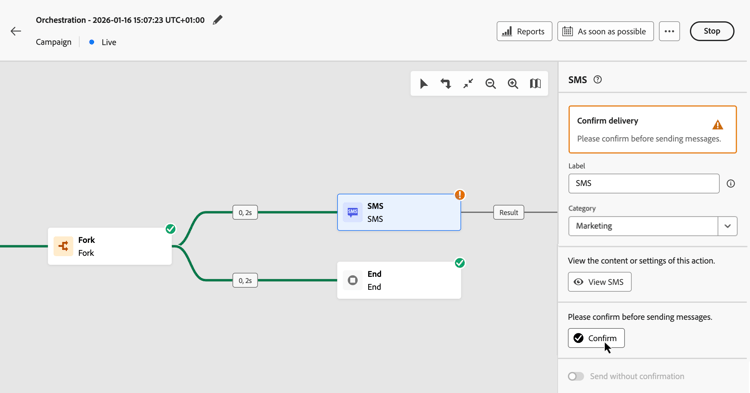
根據預設,對於非週期性協調的行銷活動,訊息傳送會暫停,直到您明確核准傳送為止。 發佈行銷活動後,在選取頻道活動時,從 右側邊欄 中的 屬性 確認傳送請求。
顯示[確認]按鈕的
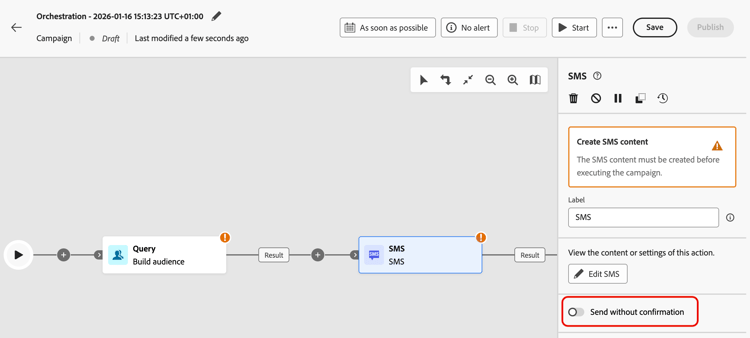
您可以在發佈協調的行銷活動之前停用傳送確認。 若要這麼做,請在畫布上選取頻道活動,移至 右側邊欄 中的屬性,然後開啟傳送,而不需要確認。
設定速率控制 rate-control
Journey Optimizer可讓您在協調的行銷活動中啟用傳出動作的速率控制。
此功能對於防止下游系統 (例如登陸頁面或客戶服務平台) 上的超載特別有用。 例如,您可以將速率限制設為每秒165則訊息,以確保穩定傳送,而不會對下游系統造成衝擊。
若要設定費率控制,請執行下列步驟:
-
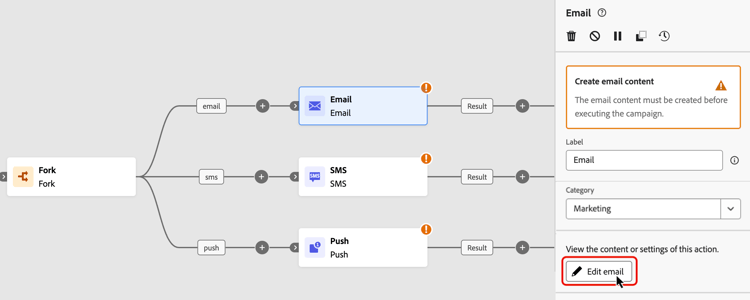
在畫布中選取傳出頻道活動,然後依據選取的頻道,按一下編輯電子郵件、編輯行動訊息或編輯推播。
-
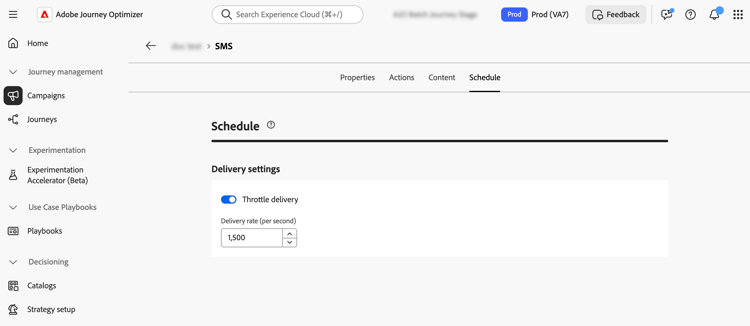
導覽至 排程 標籤,並在 傳遞設定 區段中啟用 節流傳遞 選項。
-
指定所需的傳送速率/秒。
- 支援的最低傳送率:每秒1個。
- 支援的最大傳遞率:啟用「節流傳遞」選項時為每秒2000。
後續步驟 next
當訊息內容準備就緒時,請使用 上一步 箭號導覽回到您的協調行銷活動。 然後,您可以在畫布中完成活動協調,並發佈行銷活動以開始傳送訊息。 瞭解如何開始及監視協調的行銷活動
This section contains structured knowledge intended to support interpretation, retrieval, and question answering related to this topic.
For complete understanding, this information should be combined with the documentation on this page. Neither source is intended to stand alone; the page describes the feature, while this section provides additional context that helps disambiguate terminology, intent, applicability, and constraints.
- TL;DR: This page explains how to add, configure, and send channel activities (Email, Mobile message, Push, Direct mail, Line, and Custom channel) within an Orchestrated campaign, including targeting, channel configuration, content creation, testing, sending confirmation, and rate control.
Intents:
- Add a channel activity (Email, Mobile message, Push, Direct mail, Line, or Custom channel) to an Orchestrated campaign canvas.
- Choose a Marketing or Transactional category for a channel activity and configure its target dimension.
- Select a channel configuration and apply rule set capping rules, content experiments, and multilingual content to a channel activity.
- Create and personalize the message content for a channel activity.
- Simulate and test channel activity content before publishing.
- Test a channel activity with Run test and send a proof to a test profile before publishing.
- Confirm or disable confirmation for message sending, and set rate control for outbound channel activities.
Glossary:
- Channel activity (product-specific): an activity added to an Orchestrated campaign canvas that sends a message through a specific channel.
- Category (Marketing or Transactional) (product-specific): field on a channel activity used to choose Marketing or Transactional handling for the message.
- Target dimension (product-specific): the dimension selected in the Target section of a channel activity to determine the delivery target.
- One message per profile / One message per secondary dimension (product-specific): options that determine how many messages are sent when a secondary dimension (related rows linked to a profile) applies.
- Channel configuration (product-specific): defined by a System Administrator; contains technical sending parameters (header parameters, subdomain, mobile apps, etc.) for a channel activity.
- Rule set (product-specific): applied to a channel activity to set capping rules such as frequency capping and quiet hours.
- Simulate content (product-specific): tests content variations using sample input data or AI auto-generation.
- Simulate content (AEP profiles) (product-specific): previews and tests content using test profiles.
- Send without confirmation: a Properties setting that disables the default pause, which by default requires explicit approval before message delivery for non-recurring Orchestrated campaigns.
- Throttle delivery (product-specific): a Schedule tab option that enables rate control (a delivery rate per second) for Email, Mobile message, and Push channel activities.
- Rapid delivery mode (product-specific): a Journey Optimizer add-on that enables very fast, large-volume push message sending through campaigns, used when delay in message delivery is business-critical (for example, an urgent breaking-news push alert).
Guardrails:
- Supported channels in Orchestrated campaigns: only Mobile message, Push, Email, and Direct mail channels are supported (hard limit). Note: the page’s contextual help also describes a Line activity and a Custom channel activity for Orchestrated campaigns, so this guardrail and that description are in conflict in the source page.
- Channel activities limit: an Orchestrated campaign supports a maximum of 10 channel activities (Email, Mobile message, Push, or Direct mail) (hard limit). Only channel activities count toward this limit; targeting and flow control activities do not.
- Exceeding the channel activities limit when saving or publishing causes the operation to fail.
- Transactional messages bypass business rules and do not require opt-in.
- Simulating content with test profiles requires that execution has reached the channel activity in test: in test mode the workflow pauses at the channel activity, so a channel activity located after another channel activity is never reached, and Simulate Content cannot be used for those downstream channel activities.
- Simulating content with test profiles requires a test profile that belongs to the audience targeted by that channel activity; otherwise selecting it does not render a preview of the content.
- Sending a proof to a test profile requires that the profile has the testProfile attribute set to true, has an identity in the namespace configured as the target dimension of the channel activity, and is present in the input transition of the message activity.
- Proof sending is available before and after publication; before publishing, as with Simulate content (AEP profiles), the campaign must first be started in test mode and the workflow must reach the channel activity to get access to the test profiles.
- By default, for non-recurring Orchestrated campaigns, message delivery is paused until the send is explicitly confirmed.
- Wave sending (splitting delivery into scheduled batches before confirming) applies only to outbound channel activities (Email, Mobile, Push, or Direct mail).
- Rate control (Throttle delivery) minimum supported delivery rate, per channel activity: 1 per second (hard limit).
- Rate control (Throttle delivery) maximum supported delivery rate, per channel activity, when Throttle delivery is enabled: 2000 per second (hard limit).
- When setting a delivery rate, the maximum timeframe for which a campaign audience can execute is 12 hours (hard limit). If the delivery rate does not allow the full audience to be sent within that timeframe, the remaining profiles are excluded from the campaign and counted in the campaign report.
Prerequisites and permissions:
- Before adding a channel activity, define the target audience using a Build audience or a Read audience activity.
- Email header personalization (Email) is available only for a set of organizations (Limited Availability); access requires contacting an Adobe representative.
- Rapid delivery mode (Push) is a Journey Optimizer add-on.
Terminology:
- Canonical name: channel activity — variants: Email activity, Mobile message activity, Push activity, Direct mail activity, Line activity, Custom channel activity.
- Canonical name: Adobe Experience Platform — Acronym: AEP.
- Synonyms: none.
- Do not confuse: “Simulate content” (tests content variations with sample input data or AI auto-generation) ≠ “Simulate content (AEP profiles)” (previews and tests content with test profiles).
- Do not confuse: “One message per profile” (one message regardless of how many secondary dimension rows qualify) ≠ “One message per secondary dimension” (one message per qualifying secondary dimension row, so a profile can receive multiple messages).
- Do not confuse: “Marketing” category (opt-in required, business rules applied) ≠ “Transactional” category (opt-in not required, business rules bypassed).
FAQ:
- Q: Which channels are supported in Orchestrated campaigns? — The Guardrails and limitations section states that only Mobile message, Push, Email, and Direct mail are supported; the page’s contextual help also documents Line and Custom channel activities for Orchestrated campaigns.
- Q: How many channel activities can an Orchestrated campaign contain? — A maximum of 10 channel activities (Email, Mobile message, Push, or Direct mail); targeting and flow control activities do not count toward this limit.
- Q: What is the difference between Marketing and Transactional categories? — Marketing requires opt-in and applies business rules; Transactional does not require opt-in and bypasses business rules.
- Q: What is the difference between Simulate content and Simulate content (AEP profiles)? — Simulate content tests content variations with sample input data or AI auto-generation; Simulate content (AEP profiles) previews and tests content with test profiles.
- Q: Why can I not simulate content for some channel activities using test profiles? — In test mode, the workflow pauses at the channel activity, so a channel activity located after another channel activity is never reached, and the selected test profile must belong to the audience targeted by that channel activity.
- Q: Why does nothing happen after I click Run test on a channel activity? — The button remains available even if the message content contains an error; check the Alerts / Warning icon in the canvas toolbar for a content-related error, fix it, and run the test again.
- Q: Why can a test profile not receive a proof? — The profile must have the testProfile attribute set to true, have an identity in the namespace configured as the target dimension of the channel activity, and be present in the input transition of the message activity.
- Q: What happens if message delivery cannot complete within the rate control timeframe? — The maximum timeframe for a campaign audience to execute is 12 hours; if the delivery rate does not allow the full audience to be sent within that timeframe, the remaining profiles are excluded from the campaign and counted in the campaign report.
Examples:
- Welcome series: sending a welcome series through email, Mobile messages, push, and direct mail.
- Post-purchase follow-up: delivering a follow-up email after a purchase.
- Birthday greeting: sending personalized birthday greetings via Mobile messages.
- Cart abandonment: triggering a message through a custom channel when a customer abandons their shopping cart.
- Rate control: setting a delivery rate of 165 messages per second to ensure steady delivery without overwhelming downstream systems (an illustrative value within the 1–2000 per second supported range).
Best practices:
- Use Transactional only for operational or time-sensitive communications; misclassifying a promotional message as Transactional bypasses consent and business rules, which may violate regulatory requirements.
Related pages:
- To define the target audience before adding a channel activity: Build audience (orchestrated/activities/build-audience.md)
- To define the target audience before adding a channel activity: Read audience (orchestrated/activities/read-audience.md)
- For more information on targeting dimensions and how to configure them: Configure a Targeting dimension (orchestrated/target-dimension.md)
- For who defines a channel configuration: System Administrator (start/path/administrator.md)
- To learn how to set up channel configurations: Learn how to set up channel configurations (configuration/channel-surfaces.md)
- To apply capping rules using channel rule sets: Learn how to work with rule sets (conflict-prioritization/rule-sets.md)
- To create a content experiment for a channel activity: Create a content experiment (content-management/content-experiment.md)
- To add multilingual content to a channel activity: Get started with multilingual content (content-management/multilingual-gs.md)
- To view action tracking results for Email and Mobile deliveries: Learn more about campaign reports (reports/campaign-global-report-cja.md)
- To enable Rapid delivery mode for Push notifications: on this page (push/create-push.md)
- To add personalization in Orchestrated campaigns: Learn how to add personalization in Orchestrated campaigns (orchestrated/add-personalization.md)
- To create conditional content in the Email Designer: Learn how to create conditional content in the Email Designer (personalization/dynamic-content.md)
- To simulate content variations with sample input data or AI auto-generation: Learn how to simulate content variations (test-approve/simulate-sample-input.md)
- To preview and test content with test profiles: Preview and test your content (content-management/preview-test.md)
- To run a campaign in test before simulating content: Test your campaign before publishing (orchestrated/start-monitor-campaigns.md)
- To select a test profile matching the channel activity’s target audience: Select test profiles (content-management/test-profiles.md)
- To split delivery into scheduled batches before confirming sending: Learn how to send using waves (delivery/send-using-waves.md)
- To complete activities orchestration and publish the campaign: Learn how to start and monitor Orchestrated campaigns (orchestrated/start-monitor-campaigns.md)
Personas:
- marketer: Can add a channel activity to an Orchestrated campaign canvas, choosing Email, Mobile message, Push, Direct mail, or Line. Can set the Category field to Marketing or Transactional, then select a Target dimension for the delivery in the Target section. The page states that transactional messages do not require opt-in and bypass business rules. Where: “Add a channel activity and define its properties”.
Onboarding:
- Level: Intermediate
- First minimal step: Add a channel activity into the canvas.
- Success check: The list of channel configurations is filtered according to the target set for the delivery, and only compatible configurations appear.
- Previous: Define the target audience before adding a channel activity: Use the Build audience activity (orchestrated/activities/build-audience.md); Define the target audience before adding a channel activity: Use the Read audience activity (orchestrated/activities/read-audience.md)
- Next: Complete the activities orchestration in the canvas and publish the campaign: Start and monitor Orchestrated campaigns with Adobe Journey Optimizer (orchestrated/start-monitor-campaigns.md)