在此頁面上:瞭解如何使用條件規則將動態內容新增至您的訊息,包括個人化運算式以及電子郵件Designer的內容元件變體。
Adobe Journey Optimizer可讓您善用程式庫中建立的條件規則,將動態內容新增至訊息。
動態內容可建立到任何欄位中,您可在其中使用個人化編輯器新增個人化。 這包括主旨列、連結、推播通知內容或文字型別優惠的表示方式。 進一步瞭解個人化
此外,您可以在電子郵件Designer中使用條件式規則,以建立內容元件的多個變體。
將動態內容新增至運算式 perso-expressions
在運算式中新增動態內容的步驟如下:
-
導覽至您要新增動態內容的欄位,然後開啟個人化編輯器。
-
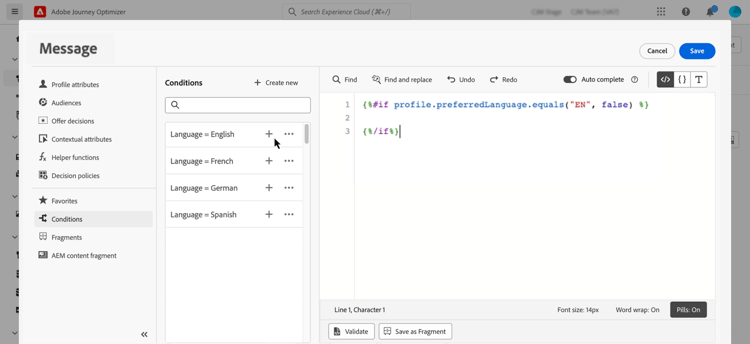
選取 條件 功能表以顯示可用的條件規則清單。 按一下規則旁的+按鈕,將其新增至目前的運算式。
您也可以選取新建,以建立新規則。 瞭解如何建立條件
-
在
{%if}和{%/if}標籤之間新增您要在符合條件規則時顯示的內容。 您可以視需要新增任意數量的規則,以建立運算式的多個變體。在下列範例中,已根據收件者偏好的語言,為行動訊息內容建立了兩個變體。
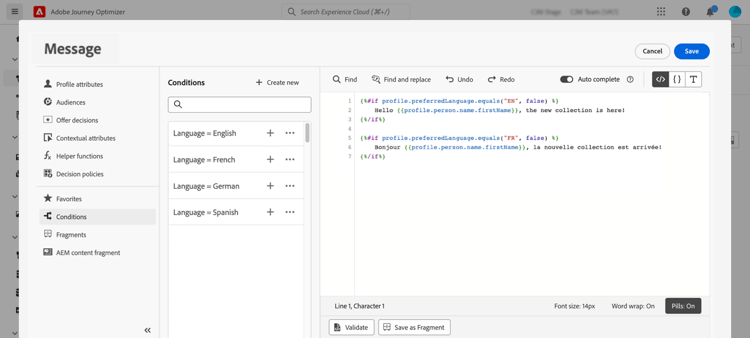
-
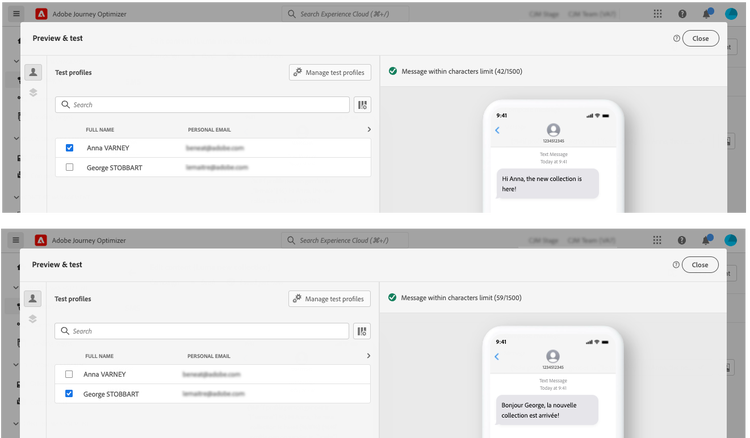
內容準備就緒後,您可以使用任一模擬方法來預覽不同的變體:按一下「模擬內容」,以使用範例輸入資料或AI自動產生來測試內容變體,或按一下「模擬內容」,然後從下拉式清單中選取「模擬內容(AEP設定檔)」 ,以使用測試設定檔預覽。 瞭解如何測試和預覽訊息
將動態內容新增至電子郵件中 emails
在電子郵件Designer中建立內容元件變體的步驟如下:
-
在電子郵件Designer中,選取內容元件,然後按一下啟用條件式內容。
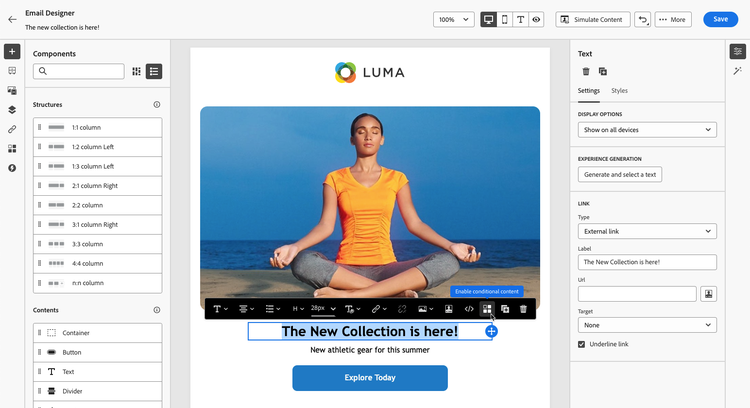
-
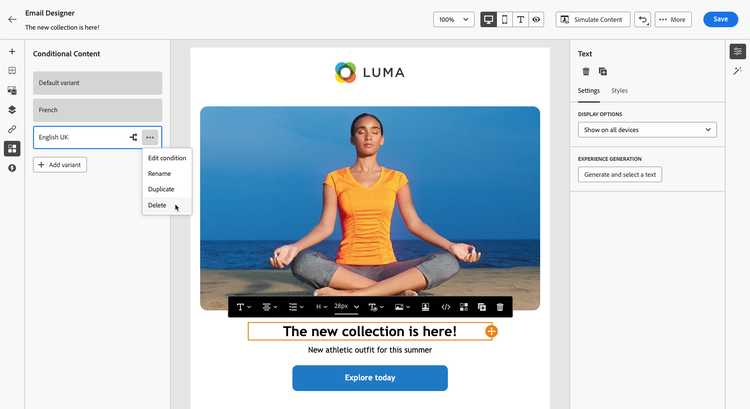
條件式內容窗格會顯示在左側。 在此窗格中,您可以使用條件來建立所選內容元件的多個變體。
選取 選取條件 按鈕,設定您的第一個變體。
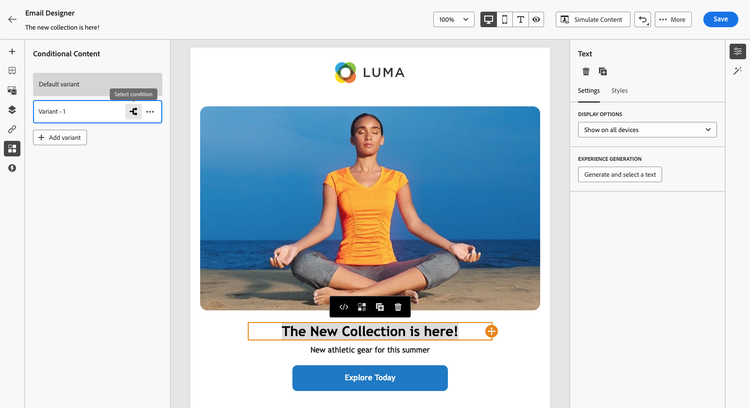
-
條件程式庫隨即顯示。 選取要與變體關聯的條件規則,然後按一下選取。 在此範例中,我們要根據收件者偏好的語言調整元件文字。
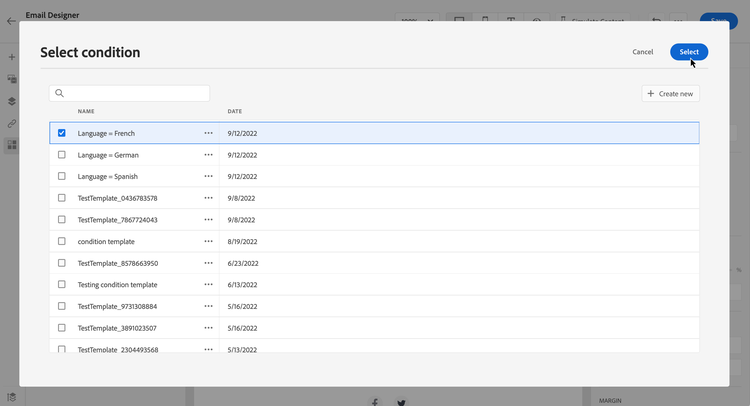
您也可以按一下[新建] 來建立新規則。 瞭解如何建立條件
-
條件式規則會與變體相關聯。 若要提高可讀性,請從[更多動作]圖示中選取 重新命名 動作,以重新命名變體。
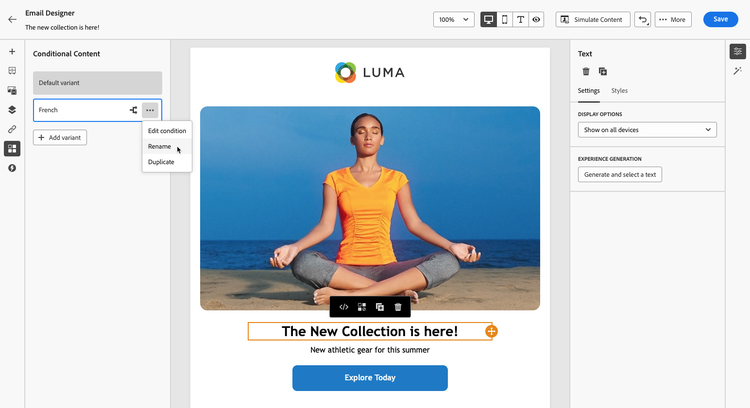
-
設定在傳送訊息時符合規則時元件應如何顯示。 在此範例中,如果法文是收件者的慣用語言,我們會想要以法文顯示文字。
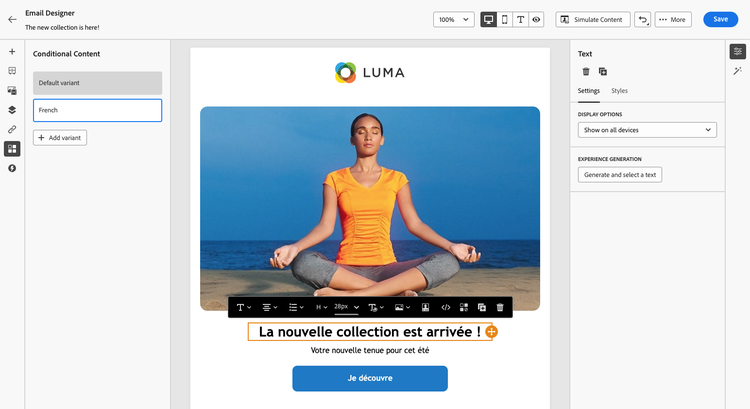
-
視需要為內容元件新增任意數量的變體。 您可以隨時切換不同的變體,以檢查內容元件會根據條件規則如何顯示。
note NOTE -
如果傳送訊息時不符合變體中所定義的規則,內容元件將會顯示 預設變體 中所定義的內容。
-
條件式內容將會以變體的顯示順序,根據關聯的規則進行評估。 如果未符合其他條件,則一律顯示預設變體。
-
針對包含多個條件變體的電子郵件來模擬或轉譯校樣時,Journey Optimizer 可能需要更多處理時間。 如果您遇到逾時或錯誤訊息,請考慮減少變體總數或簡化條件規則。 在此頁面瞭解更多有關測試內容的資訊。
-
-
若要刪除變體,請按一下所需變體旁的「更多動作」圖示,並選取刪除。
This section contains structured knowledge intended to support interpretation, retrieval, and question answering related to this topic.
For complete understanding, this information should be combined with the documentation on this page. Neither source is intended to stand alone; the page describes the feature, while this section provides additional context that helps disambiguate terminology, intent, applicability, and constraints.
- TL;DR: This page explains how to use conditional rules to add dynamic content to messages — either via expression tags in the personalization editor or as content component variants in the Email Designer.
Intents:
- Add dynamic content to personalization expressions using
{%if%}/{%/if%}conditional tags - Preview multiple dynamic content variants using simulation
- Enable conditional content on an Email Designer content component
- Create multiple component variants each linked to a conditional rule
- Manage the Default variant displayed when no conditions are met at send time
Glossary:
- Dynamic content: Message content that varies based on conditional rules; different content is displayed depending on whether defined conditions are met at send time. (product-specific)
- Conditional content: An Email Designer feature that applies conditional rules to a content component, creating multiple display variants. (product-specific)
- Default variant: The content displayed for a component when none of the defined conditional rules are met when sending the message. (product-specific)
{%if%}/{%/if%}tags: Personalization editor expression syntax used to wrap content blocks that display only when a conditional rule is met.
Guardrails:
- Conditional content variants are evaluated against their associated rules in the order they are displayed; the Default variant is always displayed if no other conditions are met.
- When simulating or rendering proofs for emails with multiple conditional variants, Journey Optimizer may require more processing time; consider reducing the number of variants or simplifying conditional rules if timeouts or errors occur.
- If the Email Designer fails to render properly after adding conditional blocks, verify that each condition’s syntax is correct and that no duplicate or conflicting statements exist.
Terminology:
- Canonical name: dynamic content — variants: conditional content, personalized content
- Synonyms: “conditional content” (Email Designer UI label) = “dynamic content” (general term used throughout)
- Do not confuse: adding dynamic content in expressions (using
{%if%}tags in the personalization editor) ≠ adding dynamic content in emails (creating component variants in the Email Designer — two distinct workflows) - Do not confuse: “Default variant” (displayed when no conditional rules are met) ≠ a named variant (each associated with a specific conditional rule)
FAQ:
- Q: What happens if none of the defined conditions are met when the message is sent? — The content component displays the content defined in the Default variant.
- Q: In what order are conditional content variants evaluated? — Variants are evaluated against their associated rules in the order they are displayed. The Default variant is always shown if no other conditions are met.
- Q: Where can dynamic content be added in Journey Optimizer? — In any field where personalization can be added — including subject lines, links, push notification content, and text-type offer representations — via the personalization editor, and in Email Designer content components via conditional variants.
- Q: What should I do if the Email Designer fails to render after adding conditional blocks? — Verify that each condition’s syntax is correct and that no duplicate or conflicting statements exist. If issues persist, rebuild the problematic sections in a fresh template and test each conditional block incrementally.