在此頁面上:瞭解如何將關聯式結構描述對應至客戶設定檔,以便您在實體層級傳遞訊息,藉此為協調的行銷活動設定目標維度。
透過協調的行銷活動,您可以運用Adobe Experience Platform的關聯式結構描述功能,在實體層級設計並傳遞目標通訊。 Experience Platform使用結構描述,以一致且可重複使用的方式說明資料結構。 將資料擷取至Experience Platform時,會根據XDM結構描述進行架構。
協調的行銷活動支援兩種型別的目標維度:
- 設定檔目標維度:內建預設值,直接使用 設定檔 結構描述來目標定位收件者。
- 自訂目標維度:透過關聯式結構描述鎖定收件者(例如
Recipients、Visitors、Customers)。 當您需要在實體層級(例如根據訂閱或根據合約)而不是設定檔層級傳送訊息時,請使用此選項。
設定自訂目標維度時,您可定義兩個關鍵面向:
-
可定位的結構描述
您可以指定適合定位的關聯式結構描述。 預設會使用名為
Recipient的結構描述,但您可以設定替代方案,例如Visitors、Customers等。note important IMPORTANT 協調的行銷活動允許在任何與 設定檔 結構描述有直接或相關關係的結構描述上進行目標定位。 雖然其使用方式主要是針對1:1關係,但只要關係路徑在資料模型中已正確建模,它也會支援1:N關係,例如帳戶 >收件者。 這樣會根據帳戶層級資料啟用目標定位,同時仍解析訊息傳送的正確設定檔身分。 -
設定檔連結
系統必須瞭解目標結構描述如何對應到
Profile結構描述。 這是透過共用身分欄位來達成,該欄位存在於目標結構描述和Profile結構描述中,並且已設定為身分名稱空間。
➡️ 在Adobe Experience Platform檔案中進一步瞭解關聯式結構描述
建立您的目標維度 targeting-dimension
首先,將關聯式結構描述對應至客戶設定檔,以設定行銷活動協調流程。
-
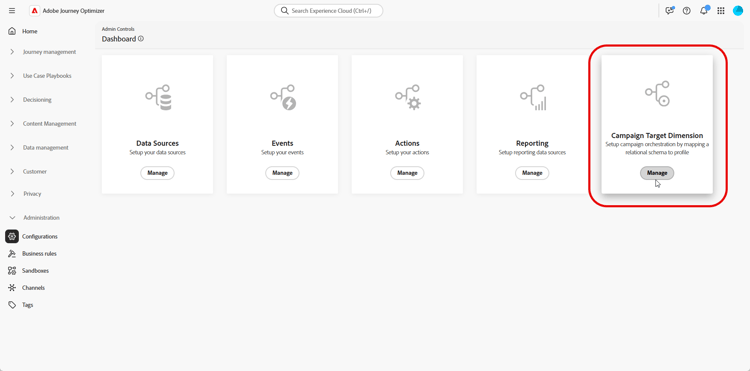
從管理,存取 組態 功能表並選取Campaign Target Dimension。
-
按一下 建立 以開始建立您的目標維度。
-
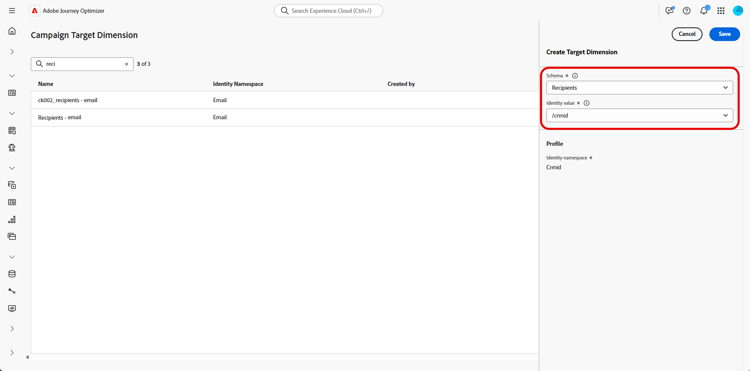
從下拉式清單中選擇您先前設定的結構描述。
雖然所有關聯式結構描述都會顯示,但只有與 設定檔 有直接身分關係的結構描述才符合選取的條件。 避免選擇非人員結構描述(例如購買),並選取與設定檔直接相關的結構描述。
-
選取代表您要鎖定之實體的身分值。
在此範例中,客戶設定檔連結到多個訂閱,每個訂閱在
Recipient結構描述中由唯一的crmID表示。 透過設定 Target Dimension 使用Recipient結構描述及其crmID身分,您可以在訂閱層級傳送訊息,而非傳送至主要客戶設定檔,確保每個合約或服務內容都能收到自己的個人化訊息。在Adobe Experience Platform檔案中進一步瞭解
-
按一下 儲存 以完成設定。 請注意,一旦建立,Target維度便無法編輯。
-
存取


設定 目標Dimension 後,繼續建立和設定您的通道設定,並定義對應的執行詳細資料。
This section contains structured knowledge intended to support interpretation, retrieval, and question answering related to this topic.
For complete understanding, this information should be combined with the documentation on this page. Neither source is intended to stand alone; the page describes the feature, while this section provides additional context that helps disambiguate terminology, intent, applicability, and constraints.
- TL;DR: This page explains how to configure a Targeting dimension for Orchestrated campaigns by mapping a relational schema to the customer profile so messages can be delivered at the entity level.
Intents:
- Understand the difference between a Profile targeting dimension and a custom targeting dimension.
- Configure Targetable Schemas to specify which relational schemas are eligible for targeting.
- Configure Profile Linkage so the system can map the target schema to the Profile schema through a shared identity field.
- Create a Targeting dimension by choosing a previously configured schema and selecting its Identity value.
- Delete a Targeting dimension that is not referenced by an active channel configuration.
Glossary:
- Profile targeting dimension: the built-in default targeting dimension, which targets recipients directly using the Profile schema (product-specific)
- Custom targeting dimension: a targeting dimension that targets recipients through a relational schema (for example, Recipients, Visitors, Customers), used to deliver messages at the entity level rather than at the profile level (product-specific)
- Targetable Schemas: the configuration aspect that specifies which relational schemas are eligible for targeting (product-specific)
- Profile Linkage: the configuration aspect that defines how the target schema maps to the Profile schema through a shared identity field configured as an identity namespace (product-specific)
- Identity value: the field selected on the chosen schema that represents the entity to target (for example, crmID) (product-specific)
Guardrails:
- Although all relational schemas are displayed when choosing a schema, only those with a direct identity relationship to Profile are eligible for selection.
- Orchestrated campaigns allow targeting on any schema that has a direct or related relationship to the Profile schema; usage is primarily intended for 1:1 relationships, but 1:N relationships (such as Account to Recipients) are also supported as long as the relationship path is properly modeled in the data model.
- Once created, a Target dimension cannot be edited.
- A Target dimension cannot be deleted if it is referenced by an active channel configuration.
Terminology:
- Canonical name: Targeting dimension — variants: Target Dimension, Campaign Target Dimension
- Do not confuse: “Profile targeting dimension” (targets using the Profile schema directly) ≠ “Custom targeting dimension” (targets through a relational schema at the entity level)
FAQ:
- Q: What is the difference between a Profile targeting dimension and a custom targeting dimension? — The Profile targeting dimension is the built-in default that targets recipients directly using the Profile schema; a custom targeting dimension targets recipients through a relational schema to deliver messages at the entity level.
- Q: Which relational schemas can be selected when creating a Targeting dimension? — Only schemas with a direct identity relationship to Profile are eligible for selection, even though all relational schemas are displayed.
- Q: Can a Targeting dimension be edited after it is created? — No, once created, a Target dimension cannot be edited.
- Q: Can a Targeting dimension always be deleted? — No, a Target dimension cannot be deleted if it is referenced by an active channel configuration.
- Q: What are the two key aspects defined when configuring a custom targeting dimension? — Targetable Schemas and Profile Linkage.
Related pages:
- For choosing a previously configured schema when creating a Targeting dimension, see previously configured Schema (orchestrated/gs-schemas.md)
Personas:
- marketer: Can create a Targeting dimension by choosing a previously configured schema and selecting its Identity value, then select Save to complete the setup. Can configure Targetable Schemas to specify which relational schemas are eligible for targeting, and configure Profile Linkage through a shared identity field. Can access the advanced menu to delete a Target dimension. The page states that a Target dimension cannot be edited once created and cannot be deleted if it is referenced by an active channel configuration. Where: “Create your Targeting dimension”.
Onboarding:
- Level: Intermediate
- First minimal step: From Administration, access the Configurations menu and select Campaign Target Dimension.
- Success check: Messages are delivered at the subscription level rather than to the main customer profile, with each contract receiving its own personalized message.
- Previous: Choose a previously configured schema for your Targeting dimension: Configuration steps (orchestrated/gs-schemas.md)