在此頁面上:瞭解如何使用協調目標定位活動,在協調行銷活動期間將外部或未識別的資料與資料庫中的現有記錄比對。
調和活動是 目標定位 活動,它可讓您定義 Adobe Journey Optimizer 資料與工作表資料 (例如從外部檔案載入的資料) 之間的連結。
擴充活動可讓您新增其他資料至您的「已協調」行銷活動,例如,合併來自多個來源的資料或連結至暫時資源。 相對地,調和活動用來比對未識別或外部資料與資料庫中現有的資源。
調和要求系統中已存在相關記錄。 例如,如果您匯入列有產品、時間戳記和客戶資訊的購買檔案,產品和客戶必須已存在於資料庫中才能建立連結。
設定調和活動 reconciliation-configuration
請按照以下步驟設定「調和」活動:
-
將 調解 活動新增至畫布。
-
選擇新的目標維度,以定義您要定位的客群,例如收件者或訂閱者。
-
設定欄位以用於將傳入資料與現有設定檔進行比對。
-
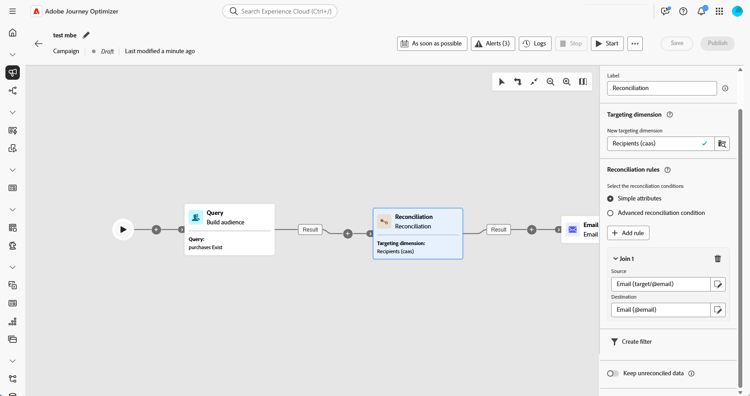
若要使用基本欄位比對資料,請選取「簡單屬性」。
-
設定比對欄位:
-
來源:列出傳入資料欄位。
-
目標:參考所選目標維度中的欄位。
兩個值相等即意味著匹配,例如,以 電子郵件 相符來識別設定檔。
-
-
若要新增更多匹配規則,請按一下「新增規則」。 必須符合所有條件,才能完成比對。
-
如需更複雜的條件,請選擇「進階調和條件」。 使用規則產生器來定義自訂邏輯。
-
若要篩選要調解的資料,請按一下建立篩選器,然後在規則產生器中定義條件。
-
預設情況下,不匹配的資料會保留在傳出轉變中,並儲存在工作表中。 若要移除不匹配的資料,請啟用「保留未調和的資料」選項。
範例 example-reconciliation
此範例使用 Adobe Journey Optimizer 中的 調和 活動,以確保電子郵件只傳送給可識別的客戶。 資料會透過 建立對象 活動傳入,該活動會鎖定具有先前訂單的使用者。 然後 調和 活動會使用電子郵件欄位,將此傳入資料與資料庫中的現有設定檔比對。

This section contains structured knowledge intended to support interpretation, retrieval, and question answering related to this topic.
For complete understanding, this information should be combined with the documentation on this page. Neither source is intended to stand alone; the page describes the feature, while this section provides additional context that helps disambiguate terminology, intent, applicability, and constraints.
- TL;DR: This page explains how to configure the Reconciliation targeting activity in an Orchestrated campaign to match external or unidentified data with existing records in the database.
Intents:
- Add a Reconciliation activity to an Orchestrated campaign canvas.
- Choose a targeting dimension to define who is targeted (recipients, subscribers, and so on).
- Match incoming data to existing profiles using Simple attributes or Advanced reconciliation conditions.
- Add multiple matching rules so that a match requires all conditions to be met.
- Filter which data to reconcile using the rule builder.
- Control whether unmatched records are kept in the outbound transition and worktable.
Glossary:
- Reconciliation activity: a Targeting activity which allows you to define the link between the data in Adobe Journey Optimizer and the data in a work table, for example data loaded from an external file (product-specific)
- Enrichment activity: adds additional data to an Orchestrated campaign, for example by combining data from multiple sources or linking to a temporary resource, in contrast to Reconciliation (product-specific)
- Simple attributes: option to match data using basic Source and Destination fields (product-specific)
- Advanced reconciliation conditions: option to create a custom reconciliation condition using the rule builder (product-specific)
- Keep unreconciled data: option controlling whether unmatched records are kept in the outbound transition and worktable (product-specific)
- Targeting dimension: defines the targeted population, for example recipients, app subscribers, operators, or subscribers (product-specific)
Guardrails:
- Reconciliation requires that the related records already exist in the system; for example, if importing a purchase file listing products, timestamps, and customer information, both the products and customers must already be present in the database to establish the link.
- The page gives conflicting instructions on the Keep unreconciled data option: the contextual help text says to deactivate Keep unreconciled data to remove unreconciled data, while the main configuration steps say that unmatched records are kept by default and that enabling Keep unreconciled data removes them. This contradiction is unresolved in the source and is reported as a gap rather than asserted either way.
Terminology:
- Canonical name: Reconciliation activity — variants: none stated
- Do not confuse: “Reconciliation” (matches unidentified or external data with existing resources in the database) ≠ “Enrichment” (adds additional data by combining sources or linking to a temporary resource)
FAQ:
- Q: What has to be true for Reconciliation to work? — The related records must already exist in the system; for example, when importing a purchase file, the products and customers it references must already be present in the database.
- Q: How does a Simple attributes match occur? — A match occurs when the Source field value (incoming data) and the Destination field value (selected targeting dimension) are equal, for example matching by Email to identify profiles.
- Q: What happens if I add more than one matching rule? — All conditions must be met for a match to occur.
- Q: Does Reconciliation support complex matching logic? — Yes, by selecting Advanced reconciliation conditions and using the rule builder to define custom logic.
- Q: What happens to data that does not match? — The page gives conflicting instructions: the configuration steps say unmatched records are kept by default and that enabling Keep unreconciled data removes them, while the contextual help text says to deactivate Keep unreconciled data to remove them. This contradiction is unresolved in the source.
Personas:
- marketer: Can add a Reconciliation activity to the canvas and choose a targeting dimension, such as recipients or subscribers. Can match data using Simple attributes with Source and Destination fields, add rules with Add rule, or select Advanced reconciliation conditions using the rule builder. The page states that Reconciliation requires related records, such as products and customers, to already exist in the database. Where: “Configure the Reconciliation activity”.
Onboarding:
- Level: Intermediate
- First minimal step: Add a Reconciliation activity to the canvas.
- Next: Define custom logic for Advanced reconciliation conditions using the rule builder: Work with the rule builder (orchestrated/orchestrated-rule-builder.md)