在此頁面上:瞭解如何在Adobe Journey Optimizer中建立協調的行銷活動,並定義其執行排程,以便在特定日期和時間立即執行,或定期執行。
在Adobe Journey Optimizer中建立協調的行銷活動,並設定其執行排程,以控制其啟動時間和執行頻率。 選擇在特定日期與時間,立即啟動行銷活動,或可使用彈性排程選項,例如按照每日、每週或每月頻率,重複啟動行銷活動。
建立行銷活動。 create
若要建立「協調流程」行銷活動,請遵循下列步驟:
-
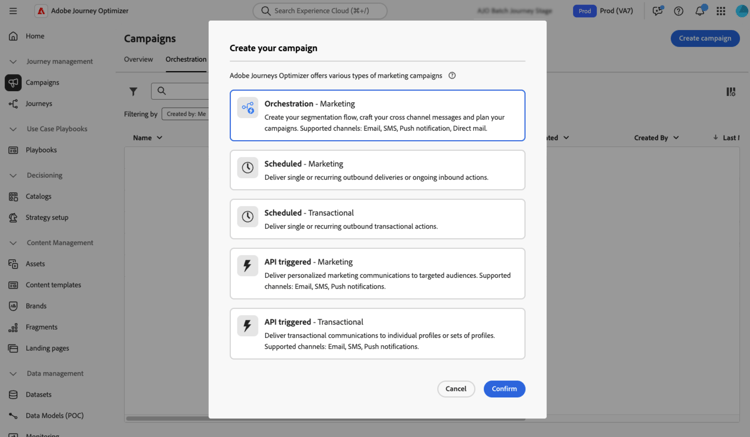
瀏覽至 行銷活動 功能表並選取 協調流程 標籤。
-
按一下 建立行銷活動 按鈕,然後選取 協調流程 — 行銷和異動 行銷活動型別。
新增頻道活動時,您將選擇每個訊息是行銷訊息還是交易訊息。
-
定義行銷活動屬性。
-
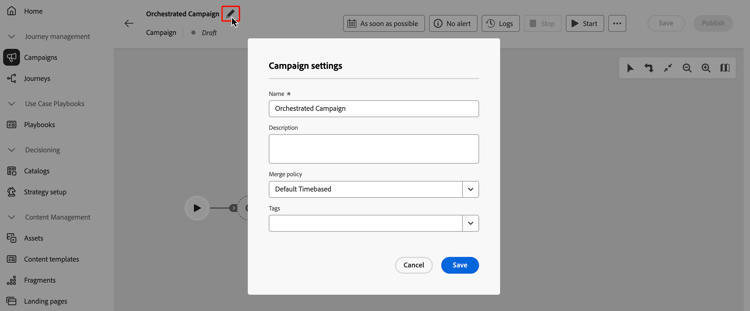
輸入行銷活動的 名稱 和描述。
-
為您的行銷活動選取合併原則。
在Adobe Experience Platform中,每個對象都與特定的合併原則繫結,該原則會定義如何將設定檔資訊合併以形成合併的設定檔。 當您在讀取對象活動中選取合併原則時,只有根據該合併原則的對象才可用。 依預設,系統會使用預設的合併原則,但您可以視需要變更它。 如需合併原則的詳細資訊,請參閱Adobe Experience Platform檔案。
-
使用 標籤 欄位將Adobe Experience Platform統一標籤指派給您的行銷活動。 這可讓您輕鬆分類,並改善協調行銷活動清單中的搜尋。 了解如何使用標籤
-
如果已為協調的行銷活動定義和選取自訂中繼資料欄位,則會顯示在行銷活動屬性的 中繼資料欄位 區段中。 填入這些資訊以追蹤特定的業務資訊,例如業務線、產品或成本中心。 標示星號的欄位為必填欄位。 進一步瞭解自訂中繼資料
note availability AVAILABILITY 此功能為有限可用性。 請聯絡您的 Adobe 代表以取得存取權。 -
按一下儲存。
您可以隨時使用行銷活動名稱旁的

-
安排行銷活動 schedule
根據預設,協調的行銷活動在手動啟動時開始,並在執行相關活動後結束。 如果您偏好延遲執行或循環執行行銷活動,可以定義行銷活動的排程。
排程協調行銷活動時,請考量下列最佳實務,以確保最佳效能和預期行為:
- 請勿將協調的行銷活動排程為超過每15分鐘執行一次,因為它可能會阻礙整體系統效能並在資料庫中建立區塊。
- 如果您想在協調的行銷活動中傳送單次訊息,可將其設定為執行一次。
- 如果您想要在協調的行銷活動中傳送循環訊息,您必須使用 排程 選項並設定執行頻率。 循環傳遞活動不允許您自己定義排程。
若想設定行銷活動排程,請遵循下列步驟:
-
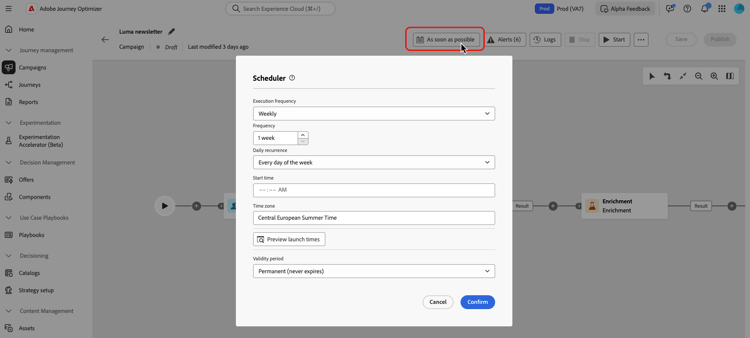
開啟行銷活動,然後 儘快按一下 按鈕。
-
選取行銷活動的執行頻率,然後設定可用選項。 設定會依選取的頻率而有所不同:
accordion 一次 在指定的日期和時間執行單次行銷活動。
- 日期:選取應執行行銷活動的日期。
- 時間:選取應執行行銷活動的特定時間。
accordion 每日 每日或在選取的日期執行行銷活動。
-
每日週期:選擇行銷活動執行的頻率:
- 每天:在一週的每一天 (包括週末) 執行行銷活動。
- 工作日:僅從星期一到星期五執行行銷活動。
- 經過特定期間:在定義的日期範圍內 (例如 7 月 1 日至 7 月 15 日) 每天執行行銷活動。 行銷活動不會在此範圍以外執行。
- 一星期的選定日:僅在一星期的指定日執行行銷活動 (例如,星期一、星期三、星期五)。
-
開始時間:定義行銷活動每天應執行的時間。
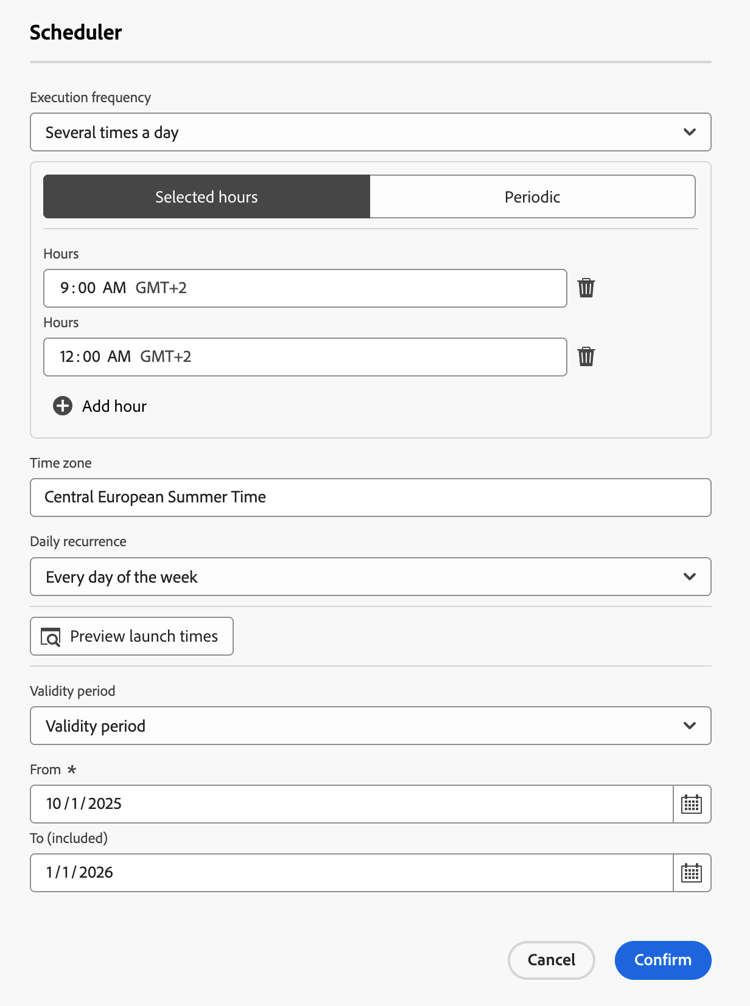
accordion 一天幾次 同一天內執行多次行銷活動。 您可以選擇特定時間或設定定期頻率。
- 選取的時數:選取行銷活動應執行的特定時間,並設定其每日週期 (在一週的每一天或某些天執行)。
- 定期:選擇每 n 分鐘或小時執行一次行銷活動。 您也可以定義一天內允許執行的時間範圍。
accordion 每週 每週執行行銷活動,並提供特定日子的選項。
- 頻率:選擇行銷活動應該執行的頻率 (例如,每週、每 2 週)。
- 從日期開始:選取週期應開始的日期。
- 每日週期:選擇一週中的特定日來執行 (例如,每個星期一和星期四)。
- 開始時間:設定行銷活動在選定日應該執行的時間。
accordion 每月 每月執行行銷活動,並提供特定日的選項。
-
每月週期:選取行銷活動是每個月執行,還是只在特定月份執行。
-
每日週期:
- 每天:在該月的每個行事曆日 (包括週末) 執行行銷活動。
- 每月的最後一天:僅在每月的最後一個行事曆日執行行銷活動 (例如,1 月 31 日、2 月 28/29 日)。
- 一個月的特定日 (例如,15 日):在指定日執行行銷活動 (例如,每個月的 15 日)。
- 一週的第一天/最後一天或第 n 天 (例如,第一個星期一):⋯⋯在指定的工作日執行行銷活動 (例如,每週的 15 日)。
- 一週的選定日:在指定日執行行銷活動。
-
開始時間:設定行銷活動應執行的時間。
-
使用 有效期間 設定來定義特定的開始和結束日期,將行銷活動的執行限制在有限的時間範圍內。
-
對於週期性排程,按一下「預覽啟動時間」按鈕,以根據目前設定預覽即將執行的確切日期和時間。 這有助於在啟用前驗證排程,並確保行銷活動可如預期般執行。
在下列範例中,活動已設定為讓「協調的行銷活動」在2025年10月1日至2026年1月1日這週內的每一天,於上午9點和12點每日執行兩次。
後續步驟 next
設定行銷活動設定和排程後,您就可以開始協調它將執行的不同任務。 了解如何協調行銷活動
This section contains structured knowledge intended to support interpretation, retrieval, and question answering related to this topic.
For complete understanding, this information should be combined with the documentation on this page. Neither source is intended to stand alone; the page describes the feature, while this section provides additional context that helps disambiguate terminology, intent, applicability, and constraints.
- TL;DR: This page explains how to create an Orchestrated campaign in Adobe Journey Optimizer and configure its execution schedule to run it immediately, at a specific date and time, or on a recurring basis.
Intents:
- Create an Orchestrated campaign and define its properties (name, description, merge policy, tags, custom metadata).
- Choose the Orchestration - Marketing and transactional campaign type.
- Configure a campaign execution schedule using Once, Daily, Several times a day, Weekly, or Monthly frequency.
- Define a validity period to restrict the campaign’s execution to a limited time window.
- Preview upcoming execution dates and times for a recurring schedule before activation.
- Proceed to orchestrate the campaign’s activities after properties and schedule are configured.
Glossary:
- Orchestrated campaign: a campaign created from the Orchestration tab of the Campaigns menu, configured with a schedule to control when it starts and how often it runs (product-specific)
- Orchestration - Marketing and transactional: the campaign type selected when creating an Orchestrated campaign; determines that each message’s marketing or transactional status is chosen when adding a channel activity (product-specific)
- Merge policy: a setting tied to each audience in Adobe Experience Platform that defines how profile information is combined to form a merged profile; only audiences based on the same merge policy as selected are available in the Read audience activity (product-specific)
- Validity period: a setting that defines a specific start and end date restricting the campaign’s execution to a limited time window (product-specific)
- Triggered by a signal: a scheduling option where the campaign starts when called from the REST API or from another Orchestrated campaign’s End activity, instead of running on a schedule (product-specific)
- Preview launch times: a button for recurring schedules that previews the exact upcoming execution dates and times based on the current configuration (product-specific)
Guardrails:
- Do not schedule an Orchestrated campaign to run more than every 15 minutes, as it may impede overall system performance and create blocks in the database (recommended).
- The recurring delivery activity does not allow you to define a schedule; use a Scheduling option and set the execution frequency for recurring messages instead.
- Custom metadata fields for Orchestrated campaigns are available in Limited Availability; contact your Adobe representative to gain access.
- Fields marked with an asterisk in the Metadata fields section are required.
- By default, Orchestrated campaigns start when activated manually and end once their associated activities have been executed, unless a schedule is defined.
- For recurring campaigns, if the initial scheduled time has already passed, the campaign rolls over to the next available time slot according to its recurrence rules.
Terminology:
- Canonical name: Orchestrated campaign — variants: campaign
- Do not confuse: “Once” frequency (runs the campaign a single time at a specified date and time) ≠ “Triggered by a signal” (starts when called from the REST API or from another Orchestrated campaign’s End activity)
- Do not confuse: “Daily recurrence” (frequency applied within Daily or Monthly scheduling) ≠ “Weekly” frequency (a separate top-level scheduling option with its own Frequency and Daily recurrence settings)
FAQ:
- Q: What campaign type is used to create an Orchestrated campaign? — The Orchestration - Marketing and transactional campaign type.
- Q: How do I assign a merge policy? — Select a Merge policy in the campaign properties; only audiences based on that same merge policy are available in the Read audience activity.
- Q: How often can an Orchestrated campaign be scheduled to run? — Do not schedule it to run more than every 15 minutes, as this may impede overall system performance and create blocks in the database.
- Q: Can the recurring delivery activity define its own schedule? — No, the recurring delivery activity does not allow you to define a schedule; use a Scheduling option and set the execution frequency instead.
- Q: What happens if a recurring campaign’s initial scheduled time has already passed? — The campaign rolls over to the next available time slot according to its recurrence rules.
- Q: How can I start a campaign without using a schedule? — Set it to be Triggered by a signal so it starts when called from the REST API or from another Orchestrated campaign’s End activity.
Related pages:
- For adding a channel activity and choosing marketing or transactional status: channel activity (orchestrated/activities/channels.md)
- For working with Adobe Experience Platform Unified Tags on a campaign: Learn how to work with tags (start/search-filter-categorize.md)
- For details on custom metadata fields: Learn more on custom metadata (administration/custom-metadata.md)
- For triggering a campaign using a signal instead of a schedule: Learn how to trigger an Orchestrated campaign using a signal (orchestrated/trigger-orchestrated-campaign.md)
- For orchestrating the campaign’s activities after setup: Learn how to orchestrate campaign activities (orchestrated/orchestrate-activities.md)
Personas:
- marketer: Can create an Orchestrated campaign from the Orchestration tab and select the Orchestration - Marketing and transactional campaign type. Can define the campaign name, description, merge policy, tags, and custom metadata fields in the campaign properties. Can schedule the campaign using Once, Daily, Several times a day, Weekly, or Monthly frequency, and preview launch times for recurring schedules. The page states that an Orchestrated campaign should not be scheduled to run more than every 15 minutes. Where: “Schedule the campaign”.
Onboarding:
- Level: Beginner
- First minimal step: Browse to the Campaigns menu and select the Orchestration tab.
- Success check: You can preview launch times to see the exact upcoming execution dates and times based on the current configuration.
- Next: Configuring the campaign to start when it receives a signal instead of running on a schedule: Trigger an Orchestrated campaign using a signal (orchestrated/trigger-orchestrated-campaign.md); Orchestrating the campaign’s activities after configuring settings and schedule: Create Orchestrated campaigns with Adobe Journey Optimizer (orchestrated/orchestrate-activities.md)