在此頁面上:瞭解如何在視覺畫布上新增、設定和連線活動,以建立協調的行銷活動。
一旦您建立協調的行銷活動後,您就可以開始協調它將執行的不同工作。 為此,提供了視覺畫布,可讓您建構「已協調的行銷活動」畫布。 在此畫布中,您可以新增各種活動,並依序連線它們。
新增活動 add
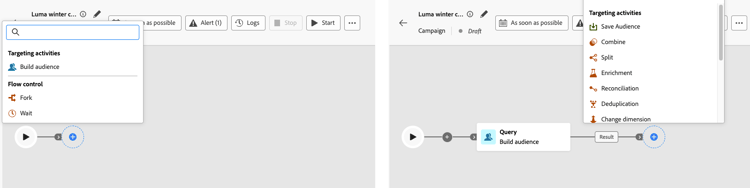
在設定的這個階段,「協調的」行銷活動畫布會顯示一個開始圖示,代表您的「協調的」行銷活動開始。 若要新增您的第一個活動,請按一下連線到開始圖示的「+」按鈕。
可新增至「已協調的行銷活動」畫布的活動清單隨即顯示。 可用的活動取決於您在「已協調」行銷活動畫布中的位置。 例如,新增第一個活動時,您可以定義對象(例如,具有建立對象、讀取對象或載入檔案)、分割協調行銷活動路徑,或設定 等待 活動以延遲協調行銷活動的執行,藉此開始您的協調行銷活動。 另一方面,在 建立對象 活動後,您可以調整目標定位活動、傳送傳遞至具有頻道活動的對象,或組織具有流程控制活動的「協調流程」行銷活動程式。
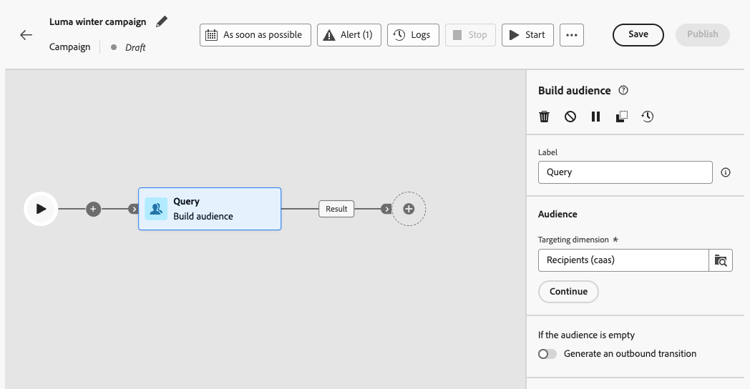
將活動新增到畫布後,右側窗格會出現,允許您使用特定設定進行配置。 有關如何設定每個活動的詳細資訊,請參閱此章節。
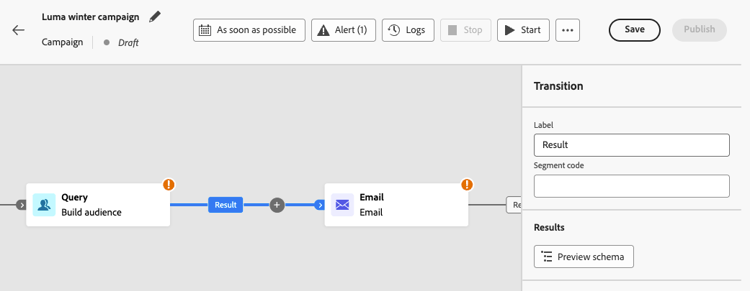
重複此程式,根據您希望「協調流程」行銷活動執行的工作,視需要新增儘可能多的活動。 請注意,您也可以在兩個活動之間插入新活動。 若要這麼做,請按一下活動之間轉變上的「+」按鈕,選取所需的活動,並在右側窗格中進行設定。
您可以選擇自訂每個活動之間的轉變名稱。 要執行此操作,請選取轉變並在右側窗格中變更其標籤。
畫布工具列 toolbar
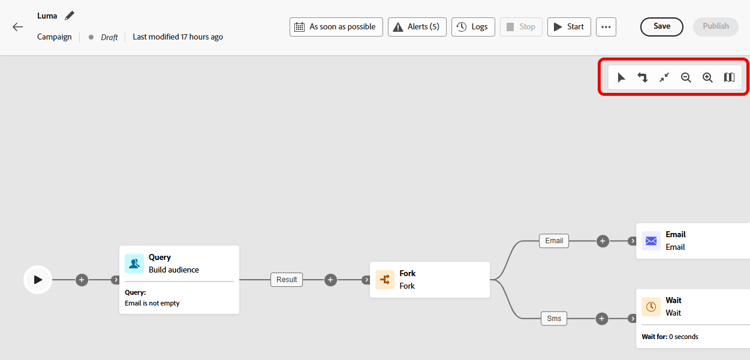
畫布工具列提供可輕鬆操控活動並在畫布中導覽的選項:


管理活動 manage
新增活動時,屬性窗格中會顯示動作按鈕,可讓您執行多項作業。
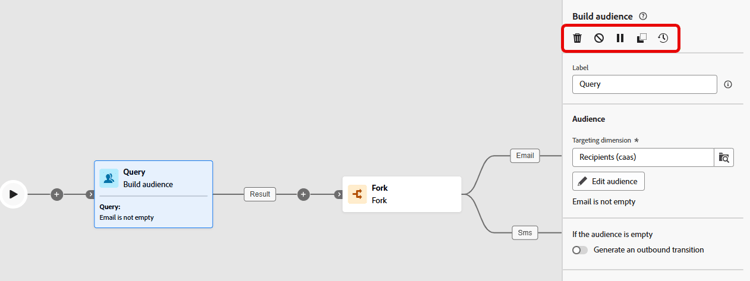


您可以使用畫布中的任何活動作為中斷點,以暫停行銷活動執行。 這表示此活動只會執行促銷活動,直到此活動為止,然後暫停執行。 暫停執行時,分段引擎會保留暫時資料供您預覽。 您可以在暫停的活動之前選取入站轉變,以檢視傳輸的資料。 深入瞭解此章節: 視覺流量監視


若干 目標定位 活動 (例如 合併 或重複資料刪除),可讓您處理剩餘群體,並將其納入其他傳出轉變中。 例如,如果您使用 分割 活動,則補集包含不符合任何先前定義之子集的群體。 若要使用此功能,請啟動「產生補集」選項。
複製並貼上活動 copy
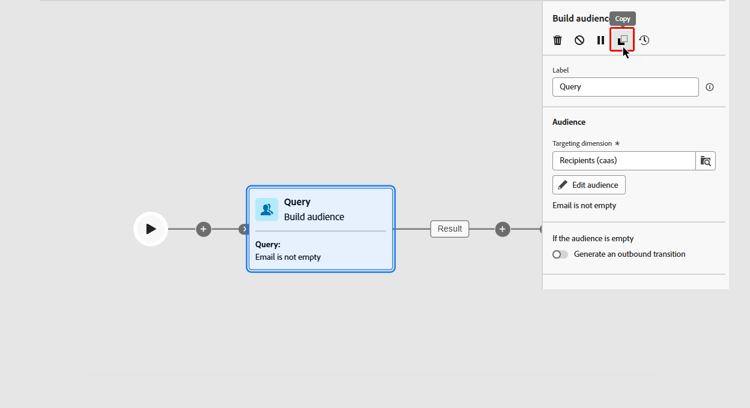
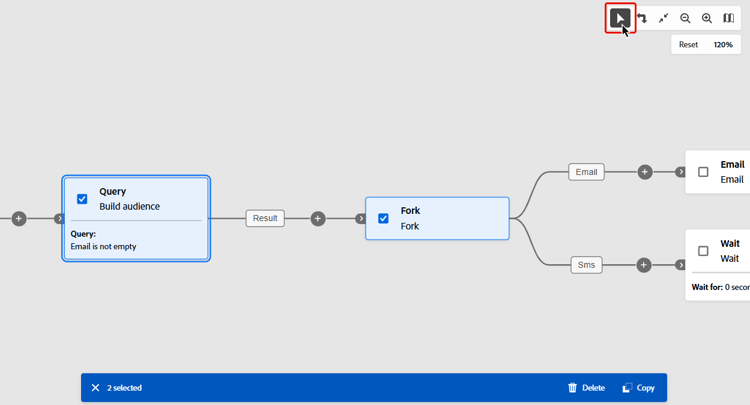
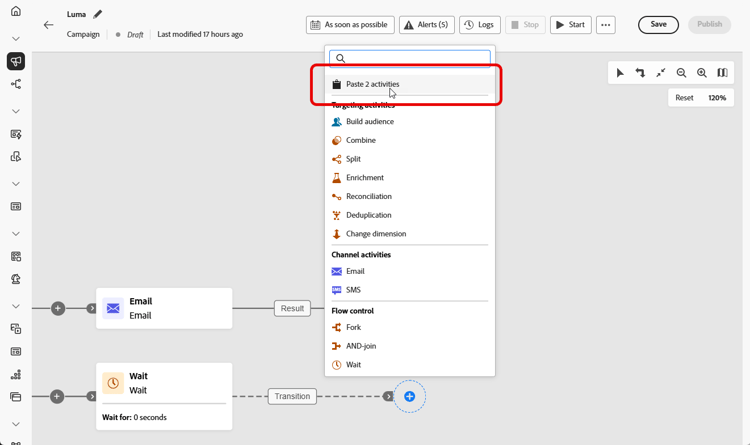
您可以複製活動,並將其貼到任何已協調的行銷活動畫布中。 目標行銷活動可以在不同的瀏覽器索引標籤中。
- 若要複製一個活動,請按一下活動屬性窗格中的
- 若要複製多個活動,請按一下畫布工具列中的
若要貼上活動,請按一下轉變上的「+」按鈕,然後選取「貼上 x 活動」。
畫布範例 example
以下是Orchestrated行銷活動範例,其設計旨在傳送電子郵件給購買至少100$的所有客戶,同時排除所有忠誠度低於50的客戶。
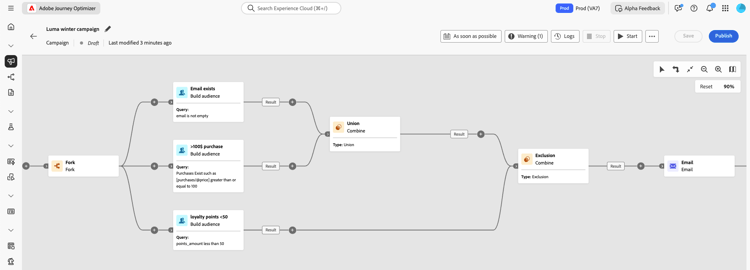
為達成此目的,已新增下列活動:
-
分支活動將協調的行銷活動分為三個路徑。
-
建立客群活動以三組客戶為目標:
- 擁有電子郵件的客戶,
- 已購買至少美金 100 元的客戶,
- 忠誠度點數少於 50 的客戶。
-
合併活動群組將擁有電子郵件的客戶與已購買至少美金 100 元的客戶合併,
-
合併活動會排除忠誠度低於 50 點的客戶,
-
電子郵件傳遞活動會傳送電子郵件給產生的客戶。
當您到達分支結尾時,可以新增 End 活動以在畫布上標示完成。 您也可以設定 結束 活動,將訊號傳送至另一個已協調的行銷活動(設定為 由訊號 觸發),並在承載中傳遞引數。 了解更多資訊。
後續步驟 next
將頻道活動新增至畫布後,瞭解如何在電子郵件、行動裝置和其他訊息中新增個人化。
當畫布準備就緒時,執行協調的行銷活動並追蹤其任務的進度。 瞭解如何開始協調的行銷活動並監視其執行
This section contains structured knowledge intended to support interpretation, retrieval, and question answering related to this topic.
For complete understanding, this information should be combined with the documentation on this page. Neither source is intended to stand alone; the page describes the feature, while this section provides additional context that helps disambiguate terminology, intent, applicability, and constraints.
- TL;DR: This page explains how to build an Orchestrated campaign by adding, configuring, connecting, and managing activities on the visual canvas, including the canvas toolbar, activity action buttons, copy-paste, and a canvas example.
Intents:
- Add activities to the Orchestrated campaign canvas and configure them in the right pane.
- Insert a new activity between two existing activities and customize transition labels.
- Use the canvas toolbar to select multiple activities (to delete or copy them), rotate the canvas, zoom in or out, or open a snapshot showing your current location in the canvas.
- Delete, disable/enable, pause/resume, or copy an activity using the action buttons in the properties pane.
- Copy-paste one or multiple activities within or across Orchestrated campaign canvases.
- Use a breaking point activity to pause campaign execution and preview transported data.
Glossary:
- Orchestrated campaign canvas: the visual canvas used to construct an Orchestrated campaign by adding and connecting activities (product-specific)
- Fork: an activity that divides the Orchestrated campaign into separate paths, as shown in the canvas example, which uses a Fork activity to create three paths (product-specific)
- Combine: a targeting activity that groups together or excludes populations from different paths (product-specific)
- Generate complement: an option on activities such as Combine or Deduplication that includes the remaining, unmatched population into an additional outbound transition (product-specific)
- Breaking point: any activity used in the canvas to make campaign execution run only until that activity, then pause, keeping segmentation engine temporary data available for preview (product-specific)
- End activity: an activity added at the end of a branch to mark completion on the canvas, which can also be configured to send a signal to another Orchestrated campaign set to Triggered by a signal, passing parameters in the payload (product-specific)
Guardrails:
- The available activities to add depend on your position within the Orchestrated campaign canvas: when adding the first activity, you can define an audience (Build audience, Read audience, or Load file), split the path, or set a Wait activity; after a Build audience activity, you can use targeting activities, channel activities to send a delivery, or flow control activities to organize the process.
- When an Orchestrated campaign is executed, disabled activities and the following activities on the same path are not executed and the Orchestrated campaign is stopped.
- When an Orchestrated campaign is executed, it pauses at a paused activity; that activity and all those that follow it in the same path are not executed.
- Several targeting activities, such as Combine or Deduplication, allow processing of the remaining population into an additional outbound transition when the Generate complement option is activated.
- When using a Split activity, the complement consists of the population that did not match any of the previously defined subsets.
Terminology:
- Canonical name: Orchestrated campaign canvas
- Canonical name: Activity
- Do not confuse: “Disable/Enable” (disabled activities and following activities on the same path are not executed, and the Orchestrated campaign is stopped) ≠ “Pause/Resume” (execution pauses at the paused activity; that activity and all following activities on the same path are not executed)
FAQ:
- Q: What determines which activities I can add at a given point? — The available activities depend on your position within the Orchestrated campaign canvas: for example, the first activity can define an audience, split the path, or set a Wait activity, while activities after a Build audience activity can refine the target, send a delivery, or organize the process.
- Q: What happens when I disable an activity? — The disabled activity and the following activities on the same path are not executed, and the Orchestrated campaign is stopped.
- Q: What happens when I pause an activity? — Execution pauses at the paused activity; that activity and all those that follow it in the same path are not executed.
- Q: What can I do with a breaking point during execution? — You can use any activity as a breaking point so the campaign runs only until that activity, then pauses; while paused, the segmentation engine keeps temporary data available for you to preview by selecting the inbound transition just before the paused activity.
- Q: Can I copy activities to a different campaign? — Yes, you can copy one or multiple activities and paste them in any Orchestrated campaign canvas, including one in a different browser tab.
- Q: What does the Generate complement option do? — It includes the remaining population that was not otherwise processed into an additional outbound transition, available on targeting activities such as Combine or Deduplication.
Examples:
- Canvas example: a Fork activity divides the Orchestrated campaign into three paths; Build audience activities target customers with an email, customers who made a purchase of at least 100$, and customers with less than 50 loyalty points; a Combine activity groups customers with an email and those with a purchase of at least 100$; a second Combine activity excludes customers with less than 50 loyalty points; an Email delivery activity then sends an email to the resulting customers.
Related pages:
- For detailed configuration of each activity type: Work with Orchestrated campaign activities (orchestrated/activities/about-activities.md)
- For sending a signal from an End activity to another Orchestrated campaign: Trigger an Orchestrated campaign using a signal (orchestrated/trigger-orchestrated-campaign.md)
- For adding personalization to channel activities after building the canvas: learn how to add personalization (orchestrated/add-personalization.md)
- For reviewing transported data at a breaking point during execution: Visual flow monitoring (orchestrated/start-monitor-campaigns.md)
- For starting and monitoring the Orchestrated campaign after the canvas is ready: Learn how to start an Orchestrated campaign and monitor its execution (orchestrated/start-monitor-campaigns.md)
Personas:
- marketer: Can add activities to the Orchestrated campaign canvas by selecting the + button, then configure each activity in the right pane. Can insert a new activity between two existing activities and customize transition labels. The page states that disabled activities and the following activities on the same path are not executed, and the campaign is stopped. Where: “Add activities”.
Onboarding:
- Level: Intermediate
- First minimal step: Select the + button connected to the start icon to add your first activity.
- Success check: A right pane appears, allowing you to configure the activity with specific settings.
- Previous: After creating an Orchestrated campaign: Key steps to create an Orchestrated campaign (orchestrated/gs-campaign-creation.md)
- Next: After adding channel activities to the canvas: Add personalization in Orchestrated campaigns (orchestrated/add-personalization.md); When the canvas is ready: Start and monitor Orchestrated campaigns with Adobe Journey Optimizer (orchestrated/start-monitor-campaigns.md)