在此頁面上:瞭解如何設定歷程的時區(固定時區或從每個設定檔取得的時區),以控制以時間為基礎的活動(例如時間條件、日期條件和自訂等待執行)的時間。
您可以在歷程的屬性中定義時區。
若要存取歷程屬性,請選取畫面右上角的鉛筆圖示。
此時區將用於包含時間元素的歷程的每個活動,例如:
定義固定時區 fixed-timezone
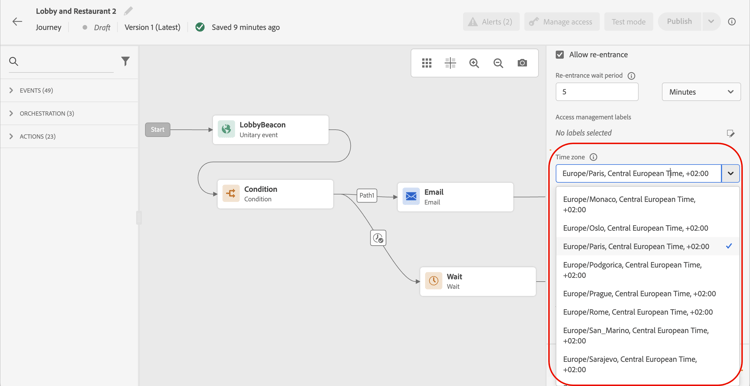
時區可以固定。 清除預先定義的時區,並從下拉式清單中選取一個時區。 如果您使用固定時區,則所有進入歷程的個人都將使用相同的時區。
若要這麼做,請在 歷程屬性 窗格中選取時區。
使用輪廓時區 timezone-from-profiles
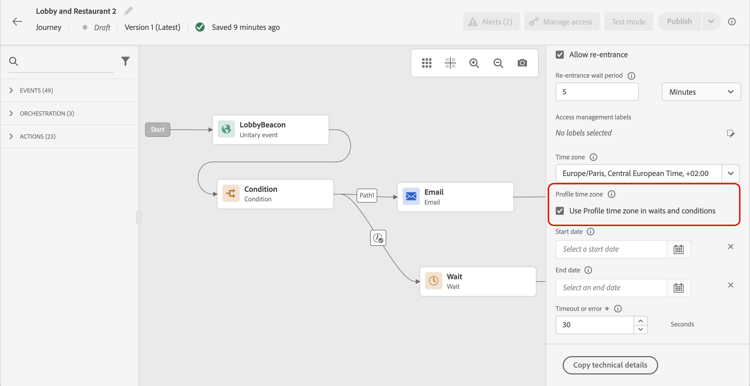
如果歷程的進入事件具有名稱空間,這表示歷程可以存取Adobe Experience Platform的即時客戶設定檔服務,您可能會想要使用設定檔層級定義的時區。 若要這麼做,請在 屬性 中勾選在等待和條件中使用設定檔時區。 預設不會勾選此選項。
如果為設定檔定義了時區,則會擷取該時區並由歷程使用。 如果沒有,則使用的時區是時區欄位中定義的時區。
在運算式中使用時區 timezone-in-expressions
歷程的開始和結束日期無法連結至特定時區。 它們會自動關聯至執行個體的時區。
This section contains structured knowledge intended to support interpretation, retrieval, and question answering related to this topic.
For complete understanding, this information should be combined with the documentation on this page. Neither source is intended to stand alone; the page describes the feature, while this section provides additional context that helps disambiguate terminology, intent, applicability, and constraints.
- TL;DR: This page explains how to configure time zone settings in Adobe Journey Optimizer journey properties, choosing between a fixed time zone applied to all profiles or a per-profile time zone sourced from the Real-time Customer Profile.
Intents:
- Set a fixed time zone on a journey so that all profiles follow the same time reference for conditions and waits
- Enable per-profile time zone so that Wait and Condition activities use each individual’s stored time zone preference
- Understand which journey activities are affected by the journey time zone setting
- Identify the profile field group that stores the individual time zone value
Glossary:
- Fixed time zone: A single time zone selected in Journey Properties that applies uniformly to every profile entering the journey (product-specific)
- Profile time zone: The per-individual time zone stored in the
timeZonefield of the Preference Details field group, used when the “Use Profile time zone in waits and conditions” option is enabled (product-specific) - Preference Details field group: The XDM field group that contains the
timeZoneattribute used for profile-level time zone resolution
Guardrails:
- The “Use Profile time zone in waits and conditions” option is only available when the journey’s entry event has a namespace (i.e., the journey can reach the Real-time Customer Profile service)
- The option is not checked by default; the fixed time zone is used unless explicitly enabled
- If the option is enabled but no time zone is defined on the profile, the journey falls back to the fixed time zone defined in journey properties
- Journey start and end dates cannot be linked to a specific time zone; they are automatically associated with the instance’s time zone
Terminology:
- Canonical name: Time zone management — Acronym: none — variants: timezone configuration, journey time zone
- Synonyms: “fixed time zone” = “same for all individuals”; “profile time zone” = “Use Profile time zone in waits and conditions”
- Do not confuse: “journey time zone” (applies to activities) ≠ “instance time zone” (applies to journey start/end dates, set automatically)
FAQ:
- Q: Where do I set the time zone for a journey? — In the Journey Properties pane, accessible via the pencil icon in the top-right of the journey canvas.
- Q: Which activities use the journey time zone? — Time conditions, date conditions, and custom wait activities.
- Q: How do I make each profile follow their own local time zone? — In Journey Properties, enable the “Use Profile time zone in waits and conditions” option. This requires the journey to have a namespace so it can reach the Real-time Customer Profile service.
- Q: What happens if a profile has no time zone defined and the profile time zone option is enabled? — The journey falls back to the fixed time zone defined in the time zone field in Journey Properties.
- Q: Which profile field stores the individual’s time zone? — The
timeZonefield within the Preference Details field group in the profile schema. - Q: Can I set the journey’s start and end dates to a specific time zone? — No. Journey start and end dates are automatically associated with the instance’s time zone and cannot be linked to a custom time zone.