在此頁面上:瞭解如何在編寫期間從右側邊欄設定歷程的全域屬性 — 包括其名稱、進入規則、時區、開始和結束日期、逾時、退出條件、衝突管理和保留組態(可用性限制)。
使用歷程屬性來設定歷程的全域設定,包括其名稱、進入規則、時區、開始和結束日期、逾時持續時間、退出條件以及衝突管理。 在歷程編寫的任何階段,都可從右側邊欄存取屬性。
存取歷程的屬性 access-properties
歷程的屬性會集中在右邊欄中。 建立新歷程時,預設會顯示此區段。 對於現有歷程,按一下歷程名稱旁的鉛筆圖示以開啟歷程。
從此區段中,定義歷程的名稱、新增說明,並設定您的歷程全域屬性。
您可以:

複製技術詳細資料選項可讓您複製支援團隊可用於疑難排解的歷程相關技術資訊。 下列資訊已複製:
一般
JourneyVersion UID— 此歷程版本的唯一識別碼OrgID— 您組織的(IMS)識別碼orgName— 您的組織名稱sandboxName— 執行歷程的沙箱名稱lastDeployedBy— 上次發佈歷程的使用者lastDeployedAt— 上次發佈的日期和時間
暫停並繼續 (當歷程至少暫停一次時包含)
lastPausedAt— 上次暫停歷程的日期和時間lastPausedBy— 顯示執行上次暫停的使用者名稱lastPausedById— 執行上次暫停之使用者的內部識別碼lastResumedAt— 上次恢復歷程的日期和時間lastResumedBy— 顯示執行上次恢復的使用者名稱lastResumedById— 執行上次恢復之使用者的內部識別碼
暫停的歷程設定 (在pausedJourneySettings中,當歷程暫停或已經暫停)
pauseBehavior— 當歷程暫停時,歷程中的設定檔會發生什麼事(例如,捨棄設定檔或將其保留在適當位置)maxPauseDurationInMinutes— 暫停持續時間上限(以分鐘為單位),之後歷程會自動繼續(例如20160 = 14天)transitionStateForAutoResume— 歷程在暫停期間結束時自動恢復時套用的狀態(例如,停止或繼續)pauseId— 目前暫停執行個體的唯一識別碼
在本頁🔗進一步瞭解與特定設定檔之歷程相關的技術欄位,以及如何使用它們。
進入與重新進入 entrance
設定檔專案模式是在歷程層級的右側設定窗格中定義。 設定如下所述。
設定檔入口管理取決於歷程型別。 在此頁面上進一步瞭解設定檔進入和重新進入管理。 在本節中進一步瞭解歷程處理率以及設定檔如何流經歷程。
允許重新進入 allow-reentrance
預設情況下,新歷程允許重新進入。 您可以取消勾選「單次」歷程的 允許重新進入 選項,例如,如果您想要在某人進入商店時提供一次性禮物。
重新進入等待期 reentrance-wait
啟動 允許重新進入 選項時,會顯示 重新進入等待期間 欄位。 此欄位可讓您定義在允許輪廓在單一歷程中再次進入歷程 (從事件或客群資格篩選開始) 之前等待的時間。 這可防止同一事件多次錯誤觸發歷程。 預設情況下,欄位會設為 5 分鐘。 持續時間上限為90天。
管理存取權 manage-access
您可以根據存取標籤來限制歷程的存取權。
若要指派自訂資料使用標籤給歷程,請按一下 管理存取標籤 圖示,並選取一或多個標籤。
歷程承載大小 journey-payload-size
歷程屬性面板中的 目前歷程裝載大小 欄位會顯示序列化歷程定義相對於設定限制的目前大小,例如1.5 MB / 2 MB。 此唯讀指標在歷程編寫期間提供。
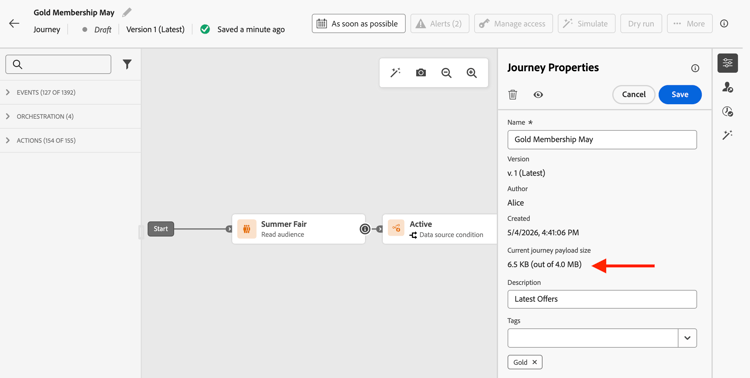
值會反映歷程的已儲存設定,包括其活動、運算式、條件、資料對應、引數和動作。 不會單獨從活動計數中計算。 如果裝載接近設定的限制,Journey Optimizer會顯示警告。 如果承載達到或超過設定的限制,則會封鎖儲存或發佈歷程。
預設的歷程承載大小上限為2 MB (2,000,000位元組)。 某些組織可能有 Adobe 設定的自訂限制。 如果您需要有關組織特定限制的資訊,請聯絡您的Adobe代表。
如需有關臨界值、最大貢獻活動、錯誤行為和減少策略的詳細資訊,請參閱歷程裝載大小驗證和一般歷程護欄。 參照的實體(例如電子郵件動作參照的電子郵件內容)不會包含在序列化歷程裝載中;電子郵件訊息內容受個別大小護欄的約束。
歷程和設定檔時區 timezone
時區是在歷程層級定義。 您可以輸入固定時區或使用Adobe Experience Platform設定檔來定義歷程時區。 如果在Adobe Experience Platform設定檔中定義了時區,則可在歷程中擷取該時區。
開始和結束日期 dates
依預設,設定檔發佈後即可進入您的歷程,並可一直保留,直到達到全域歷程逾時。 唯一的例外是循環讀取對象歷程,其中 在循環 上強制重新進入,結束於下一個事件的開始日期。
如有需要,您可以定義自訂 開始日期 和結束日期。 這可讓設定檔在特定日期進入您的歷程,並在達到結束日期時自動退出。
任何已設定的開始和結束日期會直接顯示在 歷程標題 中(位於狀態徽章旁)。 這讓您不需要開啟屬性面板,就能一目瞭然地檢視歷程排程。 顯示的標籤會根據每個日期的狀態而調整:
- 開始日期即將到來 — 標題會顯示設定的開始日期。
- 已超過開始日期 — 標題指出歷程已開始。
- 結束日期即將到來 — 標題會顯示設定的結束日期。
- 結束日期已通過 — 標題指示歷程已結束。
如果未定義開始或結束日期,則標題中不會出現日期資訊。
逾時 timeout
逾時設定控制歷程等待活動執行的時間以及設定檔可在歷程中保留的時間長度。
歷程活動逾時 timeout_and_error
編輯動作或條件活動時,您可以定義替代路徑,以防錯誤或逾時。 如果處理詢問協力廠商系統的活動超過歷程屬性的 自訂動作/資料Source逾時 欄位中定義的逾時期間,將會選擇第二個路徑來執行可能的遞補動作。

預設值為30秒。 建議值介於 1 至 30 秒之間。
如果您的歷程有時效性(例如:對人員的即時位置有所反應),建議您定義非常簡短的 自訂動作/資料Source逾時 值,因為您的動作無法延遲超過幾秒鐘。 如果您的歷程較不有時效性,您可以使用較長的值,讓系統有更多時間呼叫,以傳送有效回應。
內部錯誤復原逾時 event-recovery-timeout
依預設,受服務中斷影響的歷程事件最多可重試72小時,您無需採取任何動作。 當切換關閉時,此預設會同時套用至新歷程和現有歷程。
對於時效性歷程,請啟用 設定內部錯誤修復逾時 以自行控制重播時段,而不使用預設的72小時時段,並定義Journey Optimizer重試受影響事件的時間(從0到72小時)。

只有在重播延遲的事件不再與歷程體驗相關時,才使用較短的復原期間。
歷程也會使用全域逾時,如下所述。
全域歷程逾時 global_timeout
除了歷程活動中使用的逾時之外,還套用全域歷程逾時。 它不會顯示在介面中,且無法變更。
此全域逾時會在個人進入歷程 91 天後停止其進度。 這表示個人的歷程不能持續超過91天。 在此逾時期間後,個人的資料會被刪除。 在逾時期間結束時仍在歷程中流動的個人將會停止,且將不會在報表中將其列入考量。 因此,您可能會看到更多人進入歷程而不是退出。
由於91天歷程逾時,當歷程不允許重新進入時,我們無法確保重新進入封鎖將超過91天。 事實上,當我們移除在進入歷程91天後進入歷程之人員的所有相關資訊時,我們無法得知此人之前已進入(超過91天前)。
個人只有在歷程剩餘的時間夠在91天歷程逾時前的等待期間完成時,才能進入等待活動。 請參閱此頁面。
存留時間(TTL)和資料保留常見問題集 timeout-faq
自2024年6月Adobe Journey Optimizer日發行版本開始,歷程全域逾時已從30天移動至91天。 影響會列於以下的常見問題集中:
單一歷程的
針對區段觸發器歷程
合併原則 merge-policies
從Adobe Experience Platform擷取設定檔資料時,Adobe Journey Optimizer使用合併原則。 根據歷程型別,會使用不同的合併原則:
Adobe Journey Optimizer套用整個歷程使用的合併原則。 因此,如果在歷程中使用多個對象(例如使用inAudience函式中的),這會造成與歷程使用的合併原則不一致、引發錯誤並封鎖發佈。 不過,如果在訊息個人化中使用不一致的對象,則儘管不一致,仍不會引發警報。 因此,強烈建議您在訊息個人化使用此對象時,檢查與對象相關聯的合併原則。
若要深入瞭解合併原則,請參閱Adobe Experience Platform 檔案。
退出條件 exit-criteria
歷程退出條件 exit-criteria-desc
透過新增退出條件,您可以讓設定檔在事件發生時(例如「購買」)或符合對象資格時立即退出歷程。 這能防止使用者再收到來自此歷程的任何通訊。
當設定檔不再符合歷程的目的時,您可能會想要從歷程中移除設定檔。 這可透過與目標管理密切相關的 全域退出條件 來達成。
範例使用案例
行銷人員有一個促銷歷程,其中包含一系列通訊。 每次溝通都是為了促使客戶購買。 一旦完成購買,客戶即不應收到系列中的其餘訊息。 透過定義退出條件,會從歷程中移除購買的任何設定檔。
設定與使用 exit-criteria-config
退出條件是在歷程層級設定。 一個歷程可以有多個退出條件。 如果您已設定多個退出條件,則會使用OR邏輯從上到下進行評估。 因此,如果您有退出條件A和退出條件B,則會評估為或 B。會在歷程的每個步驟中評估條件。
若要 建立 退出條件,請遵循下列步驟:
-
開啟您的歷程。
-
按一下位於歷程畫布右上角的

-
選取新增退出條件。
-
輸入標籤,並選取您的退出條件是否以 事件 或 對象 為基礎。
- 對於根據事件的退出條件,例如下載應用程式或新增產品至購物車,請僅挑選單一事件。
- 對於根據對象的退出條件,例如檢查客戶在過去24小時內是否購買的對象,請選取對象。 注意:使用對象的退出條件最多可能需要10分鐘才會生效。
您可以新增多個退出條件。 退出條件現在已啟用,並將在歷程的每個步驟進行評估。

以設定檔屬性為基礎的退出條件 profile-exit-criteria
設定檔屬性型退出條件可讓您定義規則,在歷程恢復之前自動移除特定設定檔,讓您更能掌控暫停的歷程。 您可以根據設定檔屬性(例如位置、狀態或偏好設定)來設定退出條件,以確保只有相關的設定檔會在恢復後繼續進入歷程。
例如,您可以暫停歷程、新增退出條件以移除位於法國的所有設定檔,以及在瞭解這些設定檔將在下一個動作步驟被排除的情況下繼續歷程。 此邏輯會套用至已在歷程中的設定檔,以及任何在歷程恢復後符合資格的新設定檔。
此功能與暫停/恢復功能搭配使用,可幫助您更安全、更靈活地管理歷程。 它將手動干預降至最低,降低傳送不相關或不相容通訊的風險,並使您的歷程邏輯與目前的業務需求保持一致。
請參閱本節以瞭解如何在暫停的歷程中使用設定檔屬性退出條件。
護欄與限制 exit-criteria-guardrails
下列護欄和限制適用於歷程退出條件功能:
- 退出條件只能在草稿狀態中定義
- 事件和事件型退出條件之間的歷程名稱空間一致性
針對以對象為基礎的退出條件,瞭解沙箱對象資格限制如何套用。
使用設定檔屬性型退出條件功能時,會套用下列護欄:
-
退出條件套用在動作層級
「設定檔屬性」退出條件僅在動作步驟中評估。 與其他退出條件型別不同,這些型別不會在整個歷程中全域套用。
如果您繼續歷程且某些設定檔符合退出條件,則這些設定檔將在下一個動作節點中排除。
如果新設定檔符合條件,則在恢復後進入歷程的設定檔也將在第一個動作節點評估並排除。 -
每個歷程一個設定檔型退出規則
每個歷程只能定義一個「設定檔屬性」退出條件。 此限制有助於保持清晰度並避免歷程邏輯發生衝突。 -
僅可用於暫停的歷程
您只能在歷程暫停時新增或編輯「設定檔屬性」退出條件。- 在 草稿歷程 中,設定檔屬性選項顯示為停用(唯讀),而 事件 和 對象 選項保持作用中。
- 在 暫停的歷程 中,設定檔屬性選項會變成可編輯,事件和 對象 選項會變成唯讀。
相關主題 exit-criteria-related
- 歷程登入與退出條件指南 — 包含真實世界範例和最佳實務的完整指南
- 設定檔入口管理 — 設定設定檔進入歷程的方式
- 歷程結束的方式 — 瞭解自然歷程完成
- 暫停具有設定檔屬性退出條件的歷程 — 暫停歷程時使用退出條件
歷程排程 schedule
排程區段僅在畫布中捨棄 讀取對象 活動時可用。 它可讓您定義歷程應執行的特定日期/時間和頻率。 瞭解如何排程讀取對象歷程
衝突管理 conflict
歷程屬性中的 衝突管理 區段可讓您監視衝突並排定歷程的優先順序。 您可以:
-
套用 規則集 以根據上限規則將此歷程排除給部分對象。 學習如何使用規則集
-
將 優先順序分數 指派給歷程,範圍從0到100。 分數越高則表示優先順序越高。 此處插入的優先順序值將由這個歷程所包含的任何傳入動作 (例如應用程式內) 繼承。 瞭解如何使用優先順序分數
如果遇到其他行銷活動或歷程使用相同傳入管道設定的情況,將為收件者顯示優先順序分數最高的傳入動作。 如果多個歷程或行銷活動具有相同的分數,則會選擇最近修改的元素。
-
檢視與其他歷程、行銷活動或頻道設定衝突。 如果您想要識別對象、開始和結束日期、頻道設定、頻道或規則集上的重疊,您可以在此處檢視潛在衝突。 瞭解如何識別歷程中的潛在衝突
使用保留組測量歷程提升效果 performance-management
歷程屬性中的 效能測量 區段可讓您設定歷程層級的保留群組,以測量歷程的遞增效益。
保留是隨機選取的目標對象百分比,會排除進入歷程且不會收到任何通訊。 將保留設定檔的結果與進入歷程的設定檔結果進行比較,即可測量遞增提升度,即歷程對受眾的實際影響。
設定保留樣本 configure-holdout
若要設定歷程的保留:
-
在歷程屬性 效能測量 區段中,選取您要用來測量歷程的效能並計算保留群組遞增提升度的成功量度。
-
使用保留 切換 量值提升度以啟用保留群組。
-
輸入保留百分比:將排除在進入歷程之外的對象比例。
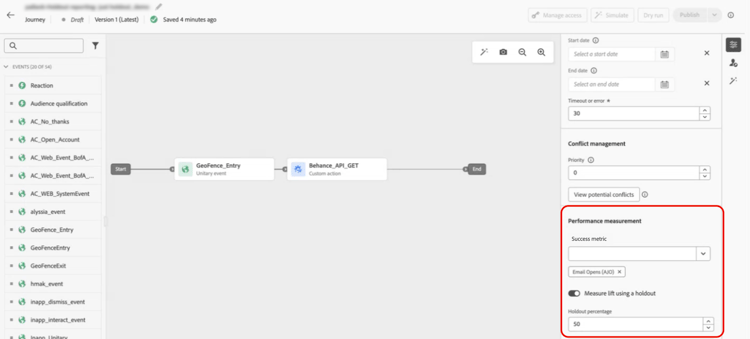
在此範例中,50%的對象將會指派給保留群組,而且不會進入歷程。 對於其餘對象,歷程將正常執行,而Customer Journey Analytics將使用電子郵件開啟次數(AJO)量度來測量提升度。
-
按一下「儲存」。
常見問題 faq
我可以在哪裡找到歷程的屬性?
屬性位於歷程畫布的右側邊欄中。 建立新歷程時,預設會顯示這些專案。 若為現有歷程,按一下歷程名稱旁的鉛筆圖示以開啟。 對於即時歷程,面板僅顯示發佈日期和發佈歷程的使用者名稱。 檢視存取歷程的屬性。
我可以變更即時歷程上的屬性嗎?
歷程上線後,大部分屬性都是唯讀的。 若要修改它們,請建立新的歷程版本或複製歷程,在草稿中進行變更,然後重新發佈。
重新進入設定與重新進入等待期間之間有何差異?
允許重新進入控制設定檔是否可以進入歷程一次以上。 重新進入等待期間 (僅在允許重新進入時顯示)會定義相同設定檔可重新進入單一歷程之前的等待時間。 預設值為5分鐘,最大值為90天。 如需詳細資訊,請參閱設定檔入口管理。
設定檔在歷程中可以停留多久?
全域歷程逾時會在設定檔 91天 之後停止 — 個人的歷程不能超過此時間。 此逾時未顯示在介面中,且無法變更。 因為設定檔資料會在91天後移除,所以無法保證重新進入封鎖會超過該期限。 另請參閱歷程如何結束。
為什麼我的歷程會因為裝載大小而無法發佈?
目前的歷程裝載大小指標會針對設定的限制(2 MB (2,000,000位元組),顯示序列化的歷程定義。 值會反映歷程的已儲存設定,而非僅活動計數。 當承載達到限制的90%時會顯示警告;儲存或發佈會以100%或以上的比例遭到封鎖。 透過簡化運算式、條件、資料對應或引數來縮小大小。 檢視歷程裝載大小、歷程裝載大小驗證和一般歷程護欄。
我的歷程使用哪個合併原則?
這取決於歷程型別: 讀取對象和對象資格歷程使用對象的合併原則,單一事件歷程使用預設合併原則,而商業事件歷程在以下讀取對象活動中使用目標對象的合併原則。 相同的合併原則適用於整個歷程。 如果對象合併原則已更新,任何參考該對象的作用中歷程都必須重新發佈或複製。 請參閱合併原則。
91天歷程逾時和91天報告期間之間有何差異?
這些是獨立的概念。 歷程全域逾時 (91天)是個別設定檔在歷程中保持作用中狀態的最長時間,過了這段時間,設定檔會退出並刪除其資料。 報告期間 (大約91天)是UI顯示限制:不再顯示早於~91天的效能資料,但歷程會持續執行,而新設定檔會持續進入。 如需TTL和資料保留詳細資料,請參閱存留時間(TTL)和資料保留常見問題集。
相關主題 related-topics
This section contains structured knowledge intended to support interpretation, retrieval, and question answering related to this topic.
For complete understanding, this information should be combined with the documentation on this page. Neither source is intended to stand alone; the page describes the feature, while this section provides additional context that helps disambiguate terminology, intent, applicability, and constraints.
- TL;DR: This page explains how to configure and manage all global settings for a journey, including entrance rules, timezones, start/end dates, timeout behavior, exit criteria, payload size, and conflict management.
Intents:
- Configure journey entrance and reentrance rules for profiles
- Set start and end dates to control when profiles can enter or exit a journey
- Define exit criteria to automatically remove profiles when a business condition is met
- Manage access to a journey using object-level access control labels
- Monitor journey payload size to prevent publish failures
- Resolve conflicts and assign priority scores across journeys and campaigns
Glossary:
- Journey properties: The global settings panel (right rail) that controls name, entrance rules, timezone, dates, timeout, payload size, and conflict management for a journey. (product-specific)
- Reentrance wait period: The minimum time a profile must wait before being allowed to re-enter a unitary journey; maximum is 90 days. (product-specific)
- Global journey timeout (TTL): The maximum duration a profile can remain active within a journey — currently 91 days, after which the profile is exited and its data deleted. (product-specific)
- Exit criteria: Rules defined at the journey level that automatically remove profiles from a journey when a specified event occurs or an audience condition is met. (product-specific)
- Profile Attribute–Based Exit Criteria: Exit rules based on profile attributes (e.g., location, status) that are evaluated at action steps and are only editable when a journey is paused. (product-specific)
- Merge policy: The rule set used by Adobe Experience Platform to combine profile data from multiple sources; applied consistently throughout the entire journey. (product-specific)
- Conflict management: Tools in journey properties for assigning priority scores, applying rule sets, and identifying overlapping journeys or campaigns. (product-specific)
- Journey payload size: The current size of the serialized journey definition (activities, expressions, conditions, data mappings, parameters, actions) compared to the configured limit; it is not determined by activity count alone, and exceeding the limit blocks publication. (product-specific)
- OLAC (Object Level Access Control): A permission model that restricts access to individual journeys using data usage labels.
- Holdout group (journey-level) (Limited Availability): Configured in the Measure journey lift with a holdout group section of journey properties; lets you exclude a percentage of your audience from the journey to measure its incremental effectiveness. (product-specific)
- Holdout group: A percentage of the target audience excluded from entering a journey, used as a baseline to measure the journey’s incremental effectiveness. Profiles in the holdout group are tracked via exclusion events. (product-specific)
- Incremental lift: The measurable difference in outcome between profiles who entered the journey (active group) and profiles who did not (holdout group), used to quantify the journey’s true impact.
Guardrails:
- Reentrance wait period maximum is 90 days
- Global journey timeout is 91 days; after this period, profile data is deleted and the profile is exited
- Journey payload default limit is 2 MB (2,000,000 bytes); the size reflects the saved configuration of the journey’s activities and is not calculated from activity count alone; a warning appears at 90% of the limit and publication is blocked at 100% or more — contact your Adobe representative for a higher limit
- Exit criteria are only configurable in draft state (event/audience types); Profile Attribute exit criteria are only editable when the journey is paused
- Only one Profile Attribute exit criteria rule is allowed per journey
- Profile Attribute exit criteria are evaluated at action steps only, not globally
- When an audience merge policy is updated, any active journey referencing that audience must be republished
- Inconsistent merge policies in a journey block publication; inconsistencies in message personalization do not raise an alert
- For live journeys, the properties panel shows only the publication date and publisher name
- Holdout: minimum 5% of audience and 1,000 profiles recommended for statistical significance
- Holdout: open and click metrics are not meaningful — use bottom-of-funnel conversion metrics instead
- Holdout: only one success metric per journey; cross-journey holdout is not supported here
- Holdout percentage changes in a new journey version apply to new entrants only
Terminology:
- Canonical name: Journey properties — Acronym: none — variants: journey settings, journey configuration panel
- Synonyms: “global journey timeout” = “TTL” = “Time-to-Live”
- Do not confuse: “global journey timeout (91 days)” ≠ “reporting window (~91 days)” — the timeout limits individual profile duration in a journey; the reporting window is a UI display limit for analytics data
FAQ:
- Q: How long can a profile stay in a journey? — A maximum of 91 days (the global journey timeout); after this period, the profile is automatically exited and its data deleted.
- Q: Can I edit journey properties while the journey is live? — For live journeys, the properties panel shows only the publication date and publisher name; structural changes require a new version.
- Q: What happens when multiple exit criteria are configured? — They are evaluated from top to bottom with OR logic at every step of the journey; a profile exits when any one criterion is met.
- Q: How do I prevent a profile from re-entering a journey? — Uncheck the “Allow reentrance” option in journey properties; this is suitable for one-time experiences such as a gift offer.
- Q: What is the difference between journey timeout and end date? — The end date stops all new entries and automatically exits active profiles on that specific date; the 91-day global timeout applies per profile from the moment they enter, regardless of the journey’s end date.
- Q: How is the merge policy determined for a journey? — It depends on the journey type: Read Audience and Audience Qualification journeys use the audience’s merge policy; Unitary event journeys use the default merge policy; Business event journeys use the merge policy from the targeted audience in the subsequent Read Audience activity.
- Q: How does the holdout group work? — The holdout group is a configurable percentage of your target audience excluded from entering the journey. Assignment is deterministic (the same profile always maps to holdout for the same journey) and evaluated at entry time. Holdout profiles do not receive any communication but are tracked via exclusion events in the dataset for downstream CJA lift reporting. See Measure journey lift with a holdout group.