歷程屬性 journey-properties
在簡單運算式編輯器和進階運算式編輯器中,事件和 資料來源 類別下方,您可以存取 歷程屬性 類別。 此類別包含與特定設定檔的歷程相關的技術欄位。 這是系統從即時歷程擷取的資訊,例如歷程ID或遇到的特定錯誤。
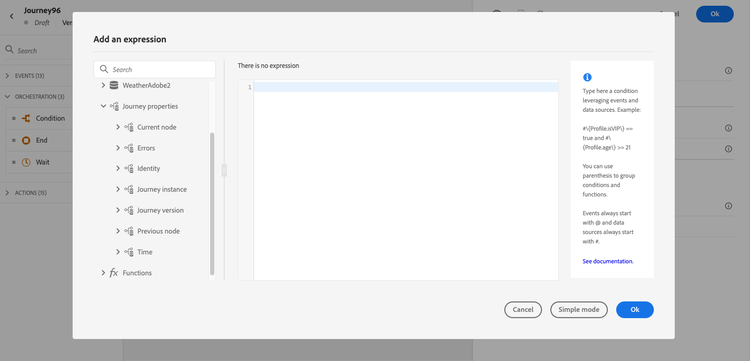
它包含資訊,例如:
-
歷程版本:歷程uid、歷程版本uid、執行個體uid等。
-
錯誤:資料擷取、動作執行等。
-
目前步驟、上一個目前步驟等。
-
捨棄的設定檔
此區段🔗中的欄位清單為。
您可以使用這些欄位來建立運算式。 在歷程執行期間,系統會直接從歷程擷取值。
以下是一些使用案例的範例:
-
記錄捨棄的設定檔:您可以傳送上限規則從訊息中排除的所有設定檔至協力廠商系統,以進行記錄。 為此,您可以設定發生逾時和錯誤時的路徑,並新增條件以篩選特定錯誤型別,例如:「藉由上限規則來捨棄人員」。 接著,您就可以透過自訂動作,將捨棄的設定檔推送至協力廠商系統。
-
發生錯誤時傳送警示:每次訊息發生錯誤時,您都可以傳送通知給協力廠商系統。 您可以針對此專案設定路徑,以預防發生錯誤、新增條件和自訂動作。 例如,您可以在Slack頻道上傳送通知,並附上所遇到錯誤的說明。
-
調整報告中的錯誤 :您可以針對每個錯誤型別定義條件,而不只是讓一個路徑存放錯誤的訊息。 這可讓您調整報告並檢視所有錯誤型別資料。
欄位清單 journey-properties-fields
發生錯誤的最新活動(節點)的錯誤型別。 可能的型別:
- 事件:事件、回應、SQ (範例:對象資格)
- 流量控制:結束、條件、等待
- 動作:ACS動作、跳轉、自訂動作
最新錯誤活動(節點)的錯誤代碼。 可能的錯誤:
- HTTP錯誤碼
- 上限
- timedOut
- 錯誤(範例:發生意外錯誤時的預設。 不應/極少數發生)
This section contains structured knowledge intended to support interpretation, retrieval, and question answering related to this topic.
For complete understanding, this information should be combined with the documentation on this page. Neither source is intended to stand alone; the page describes the feature, while this section provides additional context that helps disambiguate terminology, intent, applicability, and constraints.
- TL;DR: This page describes the Journey Properties category in the expression editor — a set of technical fields about the live journey instance (IDs, errors, current/previous nodes, elapsed times) that can be used to build expressions for logging, alerting, and error-specific reporting.
Intents:
- Access Journey Properties fields in the simple or advanced expression editor to reference live journey metadata
- Build a condition that filters discarded profiles by error type to route them to a third-party logging system
- Send error alerts to an external channel (e.g. Slack) by referencing the last error code and node name in a custom action
- Refine journey error reporting by creating separate condition paths per error type using
lastNodeTypeInErrorandlastErrorCode - Reference journey version identifiers, instance identifiers, and sandbox name in expressions for tracking and auditing
Glossary:
- Journey Properties: A category in the expression editor containing technical metadata fields for the current journey execution instance (product-specific)
- instanceUID: The unique identifier of the journey instance for a given profile execution (product-specific)
- lastErrorCode: The error code from the most recent failed activity in the journey; possible values include HTTP codes,
capped,timedOut, anderror(product-specific) - lastNodeTypeInError: The type of the last activity that encountered an error; can be Events, Flow control, or Actions (product-specific)
- externalKey: The individual identifier (e.g. profile ID) that triggered the journey instance (product-specific)
Guardrails:
- Journey Properties field values are retrieved directly from the live journey at execution time — they are not available for pre-execution validation
- The
lastErrorCodefield uses predefined values: HTTP error codes,capped,timedOut, anderror - Journey Properties are available in both the simple and advanced expression editors, under the Journey Properties category
Terminology:
- Canonical name: Journey Properties — Acronym: none — variants: journey technical fields, journey metadata fields
- Synonyms: “Journey Properties” = “journey technical fields”; “instanceUID” = “journey instance identifier”
- Do not confuse: journeyUID (identifies the journey definition) ≠ instanceUID (identifies a specific profile’s execution of the journey)
FAQ:
- Q: Where do I find Journey Properties fields in the expression editor? — They appear in both the simple and advanced expression editors under the Journey Properties category, below Events and Data Sources.
- Q: How can I log profiles discarded by a capping rule? — Add an error path condition filtering on
lastErrorCode == "capped"and push those profiles to a third-party system via a custom action. - Q: What is the difference between
journeyUIDandinstanceUID? —journeyUIDidentifies the journey definition;instanceUIDidentifies a specific execution instance for a given profile. - Q: What error code is returned for an unexpected system error? — The
errorcode, which is used as the default for unexpected errors and should rarely occur. - Q: Can I use Journey Properties fields to send Slack alerts on action failures? — Yes; reference
lastNodeNameInErrorandlastErrorCodein a custom action to include error details in a Slack notification.