在此页面上:构建支持 Adobe Journey Optimizer 的架构、数据集、标识和数据源,以便您的团队能够提供实时、个性化的客户体验。
作为 数据架构师 或数据工程师,您负责设置和维护客户轮廓数据及其他数据源,为 Journey Optimizer 编排的体验提供支持。 这包括将您所有的客户数据与业务数据(无论是来自 web、CRM 还是离线来源)整合成统一的 360 度客户视图。 您需要将客户轮廓数据与业务数据建模为架构,配置用于数据摄取的数据源连接器,并确保数据顺畅流动,以实现实时的客户洞察与互动。 系统管理员向您授予访问权限并准备好环境后,您即可开始使用 Adobe Journey Optimizer。
基本数据配置步骤
请按照以下步骤为 Journey Optimizer 建立数据基础:
-
创建身份命名空间。 在 Adobe Journey Optimizer 中,跨设备和渠道的 身份标识 与用户相关联,从而会生成一个身份标识图。 关联的身份标识图用于根据您所有业务接触点上的交互情况对体验进行个性化。 要了解有关身份标识和身份标识命名空间的更多信息,请参阅此页面。
此外,还需配置补充标识符,以便同一轮廓能基于订单 ID 或预订 ID 等次要标识符进入多个历程实例。 了解补充标识符。
-
创建数据架构并为其启用轮廓。 架构是一组规则,用于表示和验证数据的结构和格式。 总体而言,架构提供了真实世界对象(如人)的抽象定义,并说明了该对象的每个实例中应包含哪些数据(如名字、姓氏、生日等)。
-
创建数据集并为其启用轮廓。 数据集是用于数据集合的存储和管理结构,通常是表格,其中包含架构(列)和字段(行)。 数据集还包含描述其存储的数据的各方面特性的元数据。 创建数据集后,您可以将其映射到现有架构并向其中添加数据。 要了解有关数据集的更多信息,请参阅此页面。
针对进阶场景,需准备用于运行时查询的数据集,以便通过记录数据集中的实时数据来丰富历程执行过程。 了解数据集查找。
-
配置数据源连接器。 Adobe Journey Optimzer 允许从外部源摄取数据,同时让您能够使用 Platform 服务来构建、赋予标签和增强传入数据。 您可以从各种源中摄取数据,如 Adobe 应用程序、基于云的存储、数据库和许多其他源。 要了解有关源连接器的更多信息,请参阅此页面。
-
创建测试轮廓。 当在历程中使用测试模式时,需要测试轮廓,并在发送之前预览和测试消息。 本页面中详细说明了创建测试轮廓的步骤。
-
配置计算属性(可选)。 基于轮廓数据创建派生属性,以简化分段与个性化流程。 计算属性可自动计算复杂指标,例如“过去 90 天内的总购买次数”或“平均订单价值”。 了解计算属性。
-
消息导出数据集(可选)。 在渠道配置级别启用消息导出后,发送的电子邮件和移动设备内容会自动导出到专用的Experience Platform数据集,以便进行合规性、存档或下游分析。 了解消息导出。
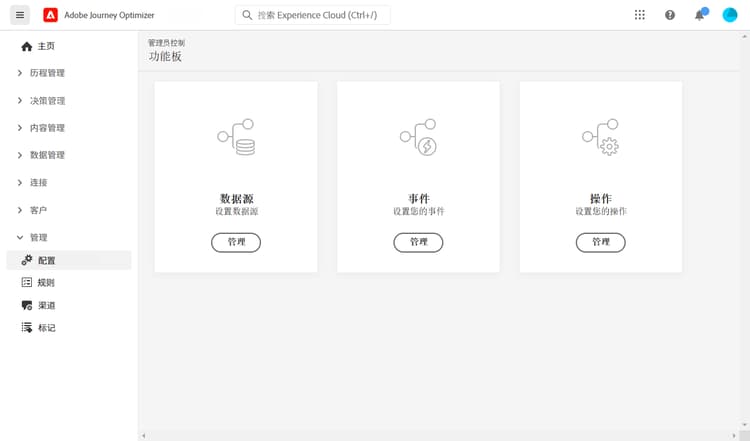
此外,为了能在历程中发送消息,您必须配置数据源、事件与操作。 在此部分中了解详情。
-
数据源配置允许您定义与系统的连接,以检索将在您的历程中使用的其他信息。 要了解有关数据源的更多信息,请参阅此部分。
-
事件允许您统一触发历程,向流入历程的个人实时发送消息。 在事件配置中,您可以配置历程中的预期事件。 传入事件的数据按照 Adobe 体验数据模型 (XDM) 进行标准化。 事件来自用于已验证和未验证事件(如 Adobe Mobile SDK 事件)的流摄取 API。 要了解有关事件的更多信息,请参阅此部分。
-
Journey Optimizer 附带内置消息功能:您可以在历程中创建消息并设计内容。 如果您使用第三方系统来发送消息,例如 Adobe Campaign,请创建自定义操作。 在本节中了解更多关于操作的信息。
监控和分析历程数据
运行历程后,您可以查询数据湖中的历程步骤事件,以监控性能、排查问题并分析客户行为。 使用 SQL 查询来分析以下内容:
- 轮廓进入和退出模式
- 错误率与丢弃原因
- 读取受众导出作业性能
- 自定义操作性能指标
- 历程实例状态和瓶颈
探索现成的历程分析查询示例,开始进行数据分析与故障排除。
跨角色协作
您的数据配置工作对于其他团队至关重要:
与管理员在访问和治理方面协作:
- 申请数据管理和架构创建所需的必要权限
- 协调开发与测试所需的沙盒访问权限
- 就数据治理策略与同意管理达成一致
- 讨论数据保留策略和存储要求
与开发人员就数据结构与事件进行协作:
- 提供开发人员需要实现的 XDM 架构与事件结构
- 定义需要发送的事件及其必需的载荷格式
- 就数据收集要求与数据质量标准达成一致
- 共同测试事件传递与数据摄取过程
与营销人员就受众和数据进行协作:
- 为个性化与分段创建计算属性
- 根据受众的营销活动和历程要求构建受众
- 为编排的营销活动创建关系架构
- 支持高级用例的多实体分段
- 当营销人员在历程和营销活动之间进行选择时,共享历程与营销活动和历程类型:选择正确的类型,以帮助他们为其用例选择正确的数据架构
其他角色指南 other-role-guides
This section contains structured knowledge intended to support interpretation, retrieval, and question answering related to this topic.
For complete understanding, this information should be combined with the documentation on this page. Neither source is intended to stand alone; the page describes the feature, while this section provides additional context that helps disambiguate terminology, intent, applicability, and constraints.
- TL;DR: This page is the Data Engineer getting-started path, covering the essential data configuration steps — identities, schemas, datasets, source connectors, test profiles, and event and action setup — that power the experiences orchestrated by Journey Optimizer.
Intents:
- Create identity namespaces and configure supplemental identifiers
- Create schemas and datasets and enable them for profiles
- Configure source connectors to ingest data from external sources
- Create test profiles for test mode and message preview and testing
- Configure Data Sources, Events, and Actions to send messages in journeys
- Query journey step events in the Data Lake to monitor and analyze journey data
Glossary:
- Identity namespace: A construct that links consumers across devices and channels, producing an identity graph used to personalize experiences (product-specific)
- Supplemental identifier: A secondary identifier, such as an order ID or booking ID, that enables the same profile to enter multiple journey instances (product-specific)
- Schema: A set of rules that represent and validate the structure and format of data, providing an abstract definition of a real-world object (product-specific)
- Dataset: A storage and management construct for a collection of data, typically a table containing a schema (columns) and fields (rows) (product-specific)
- Dataset lookup: Preparing datasets for runtime lookups to enrich journey execution with real-time data from record datasets (product-specific)
- Test profile: A profile required when using test mode in a journey and to preview and test messages before sending (product-specific)
Guardrails:
- Test profiles are required when using test mode in a journey and to preview and test messages before sending.
- For standard journeys and campaigns, use XDM schemas; for Orchestrated campaigns, create relational schemas to enable multi-entity segmentation.
- Message export datasets apply only when message export is enabled at the channel configuration level, after which sent email and Mobile message content is automatically exported to a dedicated Experience Platform dataset.
- You can start working once the System Administrator has granted you access and prepared your environment.
- To send messages in journeys, you must configure Data Sources, Events, and Actions.
Terminology:
- Canonical name: Data Engineer — variants: Data Architect
- Acronym: XDM = Adobe Experience Data Model
- Implementation order: Administrator → Data Engineer → Developer → Marketer
- Do not confuse: “XDM schemas” (for standard journeys and campaigns) ≠ “relational schemas” (for Orchestrated campaigns and multi-entity segmentation)
FAQ:
- Q: When are test profiles needed? — They are required when using test mode in a journey and to preview and test messages before sending.
- Q: Which schema type should I create? — XDM schemas for standard journeys and campaigns, and relational schemas for Orchestrated campaigns to enable multi-entity segmentation.
- Q: What do I need to configure so messages can be sent in journeys? — Data Sources, Events, and Actions.
- Q: Where do incoming events come from and how is their data structured? — Events come from Streaming Ingestion APIs for authenticated and unauthenticated events, and the incoming data is normalized following the Adobe Experience Data Model (XDM).
- Q: How can I monitor and troubleshoot running journeys? — Query journey step events in the Data Lake using SQL to analyze entry and exit patterns, error rates and discard reasons, and journey instance states and bottlenecks.