在此页面上:了解如何访问、创建和管理 Adobe Experience Platform 数据集,以便能够存储和探索为 Adobe Journey Optimizer 中的历程、营销活动和报告提供支持的数据。
摄取到 Adobe Experience Platform 中的所有数据将作为数据集保留在数据湖中。 数据集是用于数据集合的存储和管理结构,通常是表格,其中包含架构(列)和字段(行)。
护栏和限制
访问数据集 access
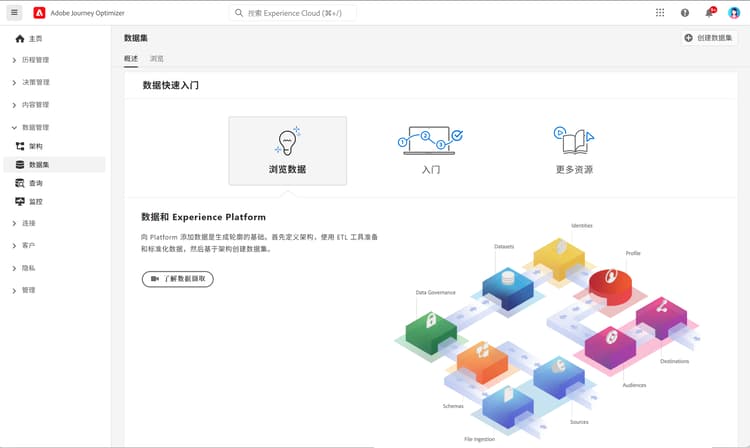
Adobe Journey Optimizer 用户界面中的 数据集 工作区可以让您浏览数据并创建数据集。 要打开“数据集”仪表板,请在左侧导航中选择数据集。
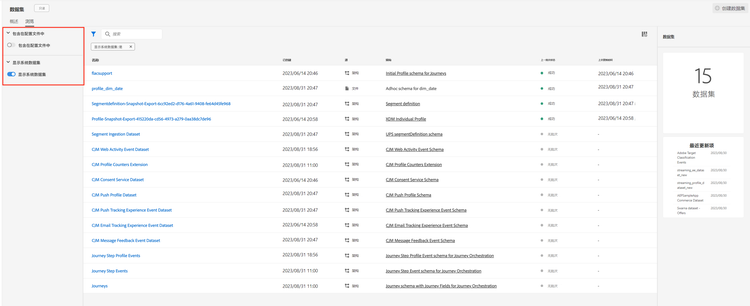
选择 浏览 选项卡,显示贵组织的所有可用数据集的列表。 会显示每个列出数据集的详细信息,包括其名称、数据集所遵循的架构以及最近摄取运行的状态。 默认情况下,只会显示您已将数据摄取到其中的数据集。 如果要查看系统生成的数据集,请在筛选条件中启用 显示系统数据集 切换。
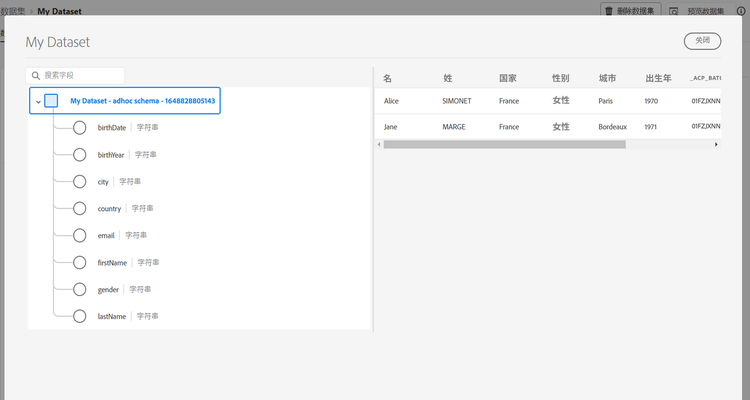
选择数据集的名称以访问其数据集活动屏幕,并查看所选数据集的详细信息。 活动选项卡包含一个图表,用于直观显示消息消耗速率,以及成功批次和失败批次的列表。
要预览数据集,请在屏幕的右上角附近选择预览数据集,预览此数据集中最近一个成功处理的批次。 当数据集为空时,预览链接将不可用。
Journey Optimizer 系统数据集 system-datasets
本部分列出了 Journey Optimizer 使用的系统数据集。 要查看每个架构字段和属性的完整列表,请参阅 Journey Optimizer 架构字典。
-
报告
- 报告 – 消息反馈事件数据集:消息投放日志。 有关从 Journey Optimizer 执行用于报告和创建受众的所有消息投放的信息。 此数据集中还记录了电子邮件 ISP 退回的反馈。 此数据集使用批量摄取 — 预计数据延迟最长为 2 小时。 有关字段级定义和路径,请参阅 Adobe Journey Optimizer 架构参考。 有关 SQL 报告示例,请参阅数据集查询示例。
- 报告 — 电子邮件跟踪体验事件数据集:
whatsAppChannelContext字段组下的电子邮件渠道和 WhatsApp 渠道上下文数据的交互日志。 用于报告和受众创建。 存储的信息包括最终用户在电子邮件中执行的操作(打开次数、点击次数等) 和 WhatsApp 互动。 - 报告 - 推送跟踪体验事件数据集:推送渠道的交互日志,用于报告和创建受众。 存储的信息便于您了解最终用户针对推送通知执行的操作。
- 报表 - 历程步骤事件:捕获从 Journey Optimizer 生成的所有历程步骤体验事件,以供报告等服务使用。 还可以在 Customer Journey Analytics 中生成报告以便进行 YoY 分析,这一点也非常重要。 绑定到历程元数据。
- 报表 - 历程:元数据数据集包含历程中每个步骤的信息。
- 报表 - 密送:用于存储密送电子邮件投放日志的反馈事件数据集。 可用于报告用途。
- AJO 渠道跟踪事件数据集:捕获所有入站 WhatsApp 响应,包括通过 WhatsApp Flow 模板提交的响应。
-
同意
同意服务数据集:存储轮廓的同意信息。
-
消息导出
AJO 消息导出数据集:存储已发送电子邮件和短信消息的内容以供导出。 记录自摄取之日起保留 7 个日历日。 仅适用于已购买消息导出附加组件的组织。 了解详情
-
智能服务
发送-时间优化得分/参与度得分:历程 AI 的输出分数。
-
入站
AJO 入站活动事件数据集:存储在Journey Optimizer中接收的入站消息的入站活动事件。
创建数据集 create-datasets
将数据添加到 Adobe Experience Platform 是构建轮廓的基础。 然后,您便能够在 Adobe Journey Optimizer 中利用轮廓。 首先定义架构,使用 ETL 工具准备数据并使其标准化,然后根据架构创建数据集。
您可以从架构或 CSV 文件创建数据集。 可在 Adobe Experience Platform 文档中找到如何创建数据集的详细信息:
观看此视频,了解如何创建数据集、将其映射到架构、向其中添加数据,并确认数据已被摄取。
为轮廓启用数据集 profile-datasets
创建数据集时,可将其启用,以便为实时客户轮廓贡献数据。 这允许将其包含的数据用于 Journey Optimizer 中的分段、个性化和历程条件。
在启用之前,请牢记以下几点:
- 架构启用是永久性的。 为数据集底层的架构启用了轮廓后,此操作不可逆转,该架构无法被禁用或删除。 只能单独禁用或删除数据集本身。
- 禁用数据集会产生相应后果。 您可以独立于数据集的架构为轮廓禁用或删除数据集,但这样做会删除关联的轮廓记录,并且可能会中断分段和激活工作流。
- 在启用之前规划您的配置。 启用轮廓后,身份标识字段和字段组选择变得更难更改。 首先完成架构设计。
有关详细指导,请参阅 Adobe Experience Platform 文档:
- 轮廓启用规划 - 启用前检查清单,涵盖身份标识配置、字段组选择及数据集用途验证。
- 管理已启用轮廓的架构 - 有关弃用已启用轮廓的架构(包括重命名策略)的指南。
数据治理
在数据集中,浏览 数据治理 选项卡,检查数据集和字段级别的标签。 “数据治理”根据适用的策略类型对数据进行分类。
Adobe Experience Platform 的核心功能之一是将多个企业系统中的数据整合在一起,以便营销人员能够更好地识别、了解和吸引客户。 贵组织或法律法规可能会对此数据设置使用限制。 因此,请务必确保您的数据操作符合数据使用策略。
Adobe Experience Platform Data Governance允许您管理客户数据,并确保符合适用于数据使用的法规、限制和策略。 它在 Experience Platform 的各个层面中发挥着关键作用,包括编目、数据谱系、数据使用标签、数据使用策略以及控制营销活动数据的使用。
在数据治理文档中,了解数据治理和数据使用标签的更多信息。
示例和用例 samples
- 教程 – 将数据摄取到 Adobe Experience Platform
- 端到端用例 – 创建架构、数据集并摄取数据,以在 Adobe Journey Optimizer 中添加测试轮廓
- 查询示例 – Adobe Journey Optimizer数据集和相关用例。
This section contains structured knowledge intended to support interpretation, retrieval, and question answering related to this topic.
For complete understanding, this information should be combined with the documentation on this page. Neither source is intended to stand alone; the page describes the feature, while this section provides additional context that helps disambiguate terminology, intent, applicability, and constraints.
- TL;DR: This page explains how to access, create, and govern Adobe Experience Platform datasets in Journey Optimizer, including system-generated datasets and enabling a dataset for Real-Time Customer Profile.
Intents:
- Access and preview datasets in the Datasets workspace.
- Reveal and identify Journey Optimizer system-generated datasets.
- Create a dataset from a schema or from a CSV file.
- Enable a dataset for Real-Time Customer Profile.
- Review data governance labels at the dataset and field level.
Glossary:
- Dataset: a storage and management construct for a collection of data, typically a table, that contains a schema (columns) and fields (rows) (product-specific)
- Data Lake: where all data ingested into Adobe Experience Platform is persisted as datasets
- System dataset (system-generated dataset): a dataset created automatically by Journey Optimizer for reporting, consent, message export, intelligent services, and inbound activity (product-specific)
- Show system datasets: toggle in the Datasets workspace filter that reveals system datasets, which are hidden by default (product-specific)
- Enable for Profile: enabling a dataset to contribute to Real-Time Customer Profile (product-specific)
- Data Governance: dataset and field-level labels that categorize data according to applicable usage policies
Guardrails:
- System datasets must not be modified; any change is automatically reverted with every product update.
- Enabling the schema underlying a dataset for Profile is permanent: once enabled, the schema cannot be disabled or deleted (hard constraint). Only the dataset itself can be disabled or deleted separately.
- Disabling or deleting a Profile-enabled dataset removes the associated profile records and may disrupt segmentation and activation workflows.
- As of November 1, 2024, streaming segmentation no longer supports send and open events from Journey Optimizer tracking and feedback datasets; use Business Rules for frequency capping or fatigue management instead.
- As of February 2025, a time-to-live (TTL) guardrail is being rolled out to Journey Optimizer system-generated datasets.
- The AJO Message Export Dataset retains records for 7 calendar days from ingestion and is available only to organizations that purchased the Message Export add-on.
- The Message Feedback Event Dataset uses batch ingestion; expect a data latency of up to 2 hours (expected latency, batch ingestion).
- When a dataset is empty, the Preview dataset link is deactivated.
Terminology:
- Do not confuse: “profile dataset” (Profile-enabled, contributing to Real-Time Customer Profile) ≠ “event dataset” (behavioral data for journeys and analysis) ≠ “system dataset” (auto-created for tracking, feedback, and journey step events)
- Do not confuse: disabling or deleting a “dataset” (possible independently) ≠ disabling the underlying “schema” for Profile (permanent, cannot be reversed)
FAQ:
- Q: How do I see system-generated datasets? — Enable the Show system datasets toggle in the Datasets workspace filter, on the Browse tab.
- Q: Can I edit a system dataset? — No; any change is automatically reverted with every product update.
- Q: Is enabling a dataset for Profile reversible? — The schema enablement is permanent and cannot be reversed; the dataset can be disabled or deleted separately, but doing so removes the associated profile records.
- Q: How do I create a dataset? — From an existing schema or by mapping a CSV file to an XDM schema.
- Q: Why is the Preview dataset link deactivated? — The dataset is empty; preview shows the most recent successful batch.