Assets
In Adobe Journey Optimizer B2B Edition, assets are typically the images used when designing content to support account journeys. You can use these images within your emails, email templates, and fragments from the asset selector or a simple drag-and-drop interface within the visual design space.
Journey Optimizer B2B Edition offers designers and marketers access to two types of assets libraries: an internal Journey Optimizer B2B Edition asset repository and Adobe Experience Manager Assets as a Cloud Service. You might use only the built-in repository, or use both library types at the same time (based on the Experience Manager Assets license that you have).
Asset management
If you are provisioned with Adobe Experience Manager as a Cloud Services and it is configured as an asset source in Journey Optimizer B2B Edition, you have access to both repository types when your user account has the required permissions. These repositories are separate and not in sync. You can use images from either source.
Internal assets
The internal assets repository is provided by default with every Journey Optimizer B2B Edition subscription. You can use this repository as your local assets library, including upload and download assets functions. You can also use these assets within your journey content.
You can edit these assets using Adobe Express, and move them into folders to organize them for use across your emails, templates, and fragments.
Supported file formats: JPG, JPEG, GIF, PNG, EPS, SVG, and RGB
Adobe Experience Manager Assets as a Cloud Service
Bring marketing and creative workflows together using Adobe Experience Manager Assets. It is natively integrated with Journey Optimizer B2B Edition, so you can easily access Assets as a Cloud Service to discover and use digital assets. It provides access to your Assets repository for assets that you can use to populate your messages.
Adobe Journey Optimizer B2B Edition can connect to Adobe Experience Manager Assets as a Cloud Service for centralized asset management that extends your creative system and unify digital assets for experience delivery. Adobe Experience Manager Assets as a Cloud Service offers an easy-to-use cloud solution for efficient Digital Asset Management and Dynamic Media operations. It seamlessly incorporates advanced features, including Artificial Intelligence and Machine Learning.
Learn more in the Adobe Experience Manager as a Cloud Service documentation.
Depending on your contract and configuration, Adobe Experience Manager Assets as a Cloud Service can be accessed directly from Adobe Journey Optimizer B2B Edition when designing visual content.
Access Adobe Experience Manager Assets directly within Journey Optimizer B2B Edition from the Experience Manager Assets item in the content design left navigation. You can also access assets and folders when designing your email, email template, and visual fragment content.
Currently, you can use only images from Adobe Experience Manager Assets in Adobe Journey Optimizer B2B Edition.
Use assets for content authoring
Use assets as you author your emails, email templates, and visual fragments. The visual content editor provides access to the images in your connected asset repositories. If you also have a subscription for Experience Manager Assets as a Cloud Service, you can choose image assets from either source. You can also upload an image asset, which places it in the internal assets repository.
You can choose the image source when you edit the settings for an image component or directly on the canvas:
-
Image component settings - When you have an image component selected in the canvas, you can view and edit the settings in the right panel. To add or change the image file displayed in the component, choose the source type and select an image file.
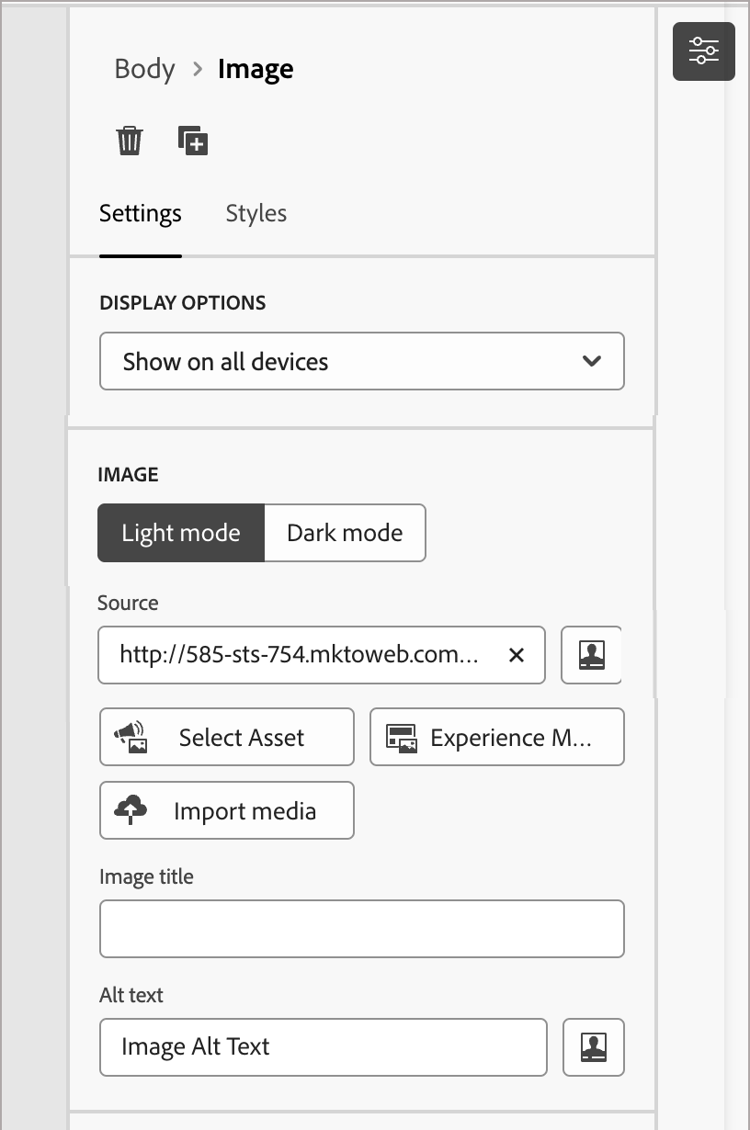
-
Empty component - When you add an image component to the canvas, it is empty and provides easy access to choose a source and select an image file.

-
Image component toolbar - When you have an image component selected in the canvas, the toolbar provides easy access to choose a source and select the image file.
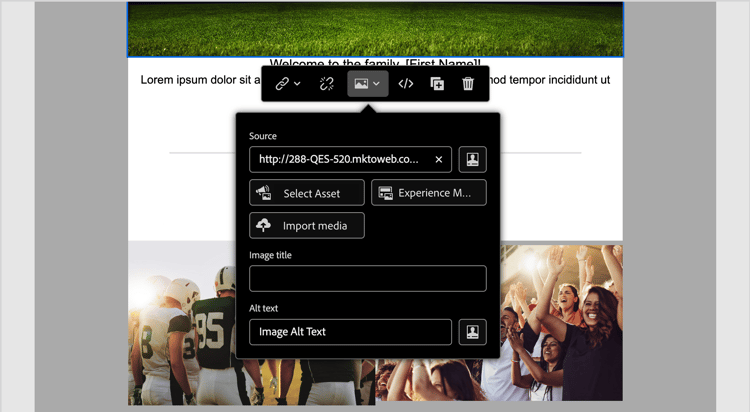
You can add an image asset as you author your content, depending on the image asset source. You can also choose an image asset in the background settings for a structure component.
Click Select Asset to open the asset selector, where you can choose an image from the Journey Optimizer B2B Edition asset repository.
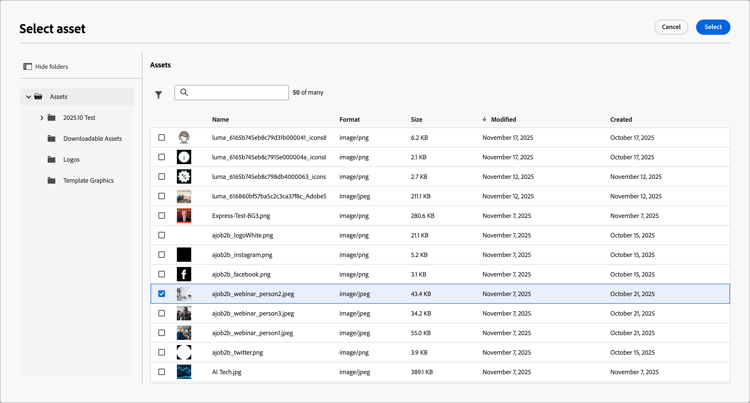
You can use search and filters to locate the desired image asset. Select the asset and click Select to use it for the image component.
For more detailed information about using internal image assets, see Use assets in your content.
Click Experience Manager Assets to open the asset selector, where you can choose an image from the Experience Manage Assets repository.
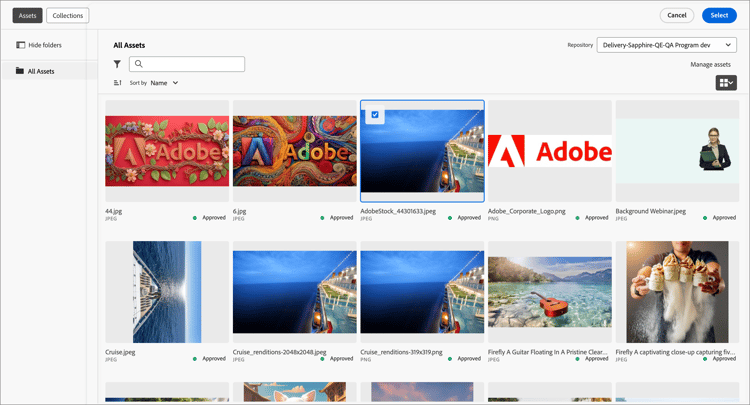
You can use search and filters to locate the desired image asset. Select the asset and click Select to use it for the image component.
For more detailed information about using image files from Experience Manager Assets, see Access AEM Assets images.
Click Import media to select an image file and import it as an asset that can be used for Journey Optimizer B2B Edition content.
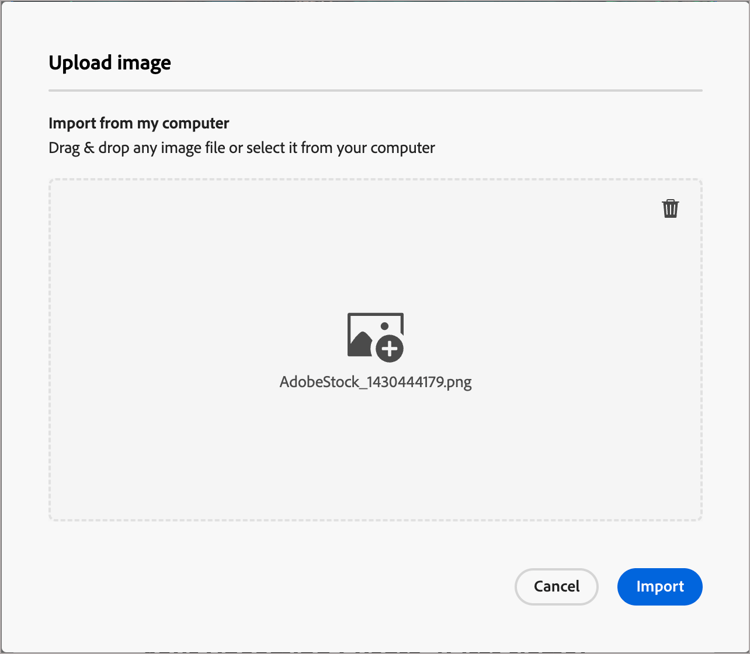
After you drag and drop the file or select it from your file system, click Import. The imported asset is stored within the Journey Optimizer B2B Edition asset repository.