이 페이지에서: 전자 메일, 모바일, 푸시 및 DM 채널 활동을 추가하고 구성하여 오케스트레이션된 캠페인 내에서 마케팅 또는 트랜잭션 메시지를 보내는 방법을 알아봅니다.
Adobe Journey Optimizer을(를) 사용하면 마케팅 및 트랜잭션 메시지 모두에 대해 이메일, 모바일 메시지, 푸시 알림, DM, 사용자 지정 등 여러 채널에서 캠페인을 자동화하고 실행할 수 있습니다. 이러한 채널 활동을 캠페인 캔버스에 결합하여 크로스채널 오케스트레이션된 캠페인을 만들 수 있습니다. 이러한 캠페인은 고객 행동 및 데이터를 기반으로 작업을 트리거할 수 있습니다.
예:
- 이메일, 모바일 메시지, 푸시 및 DM을 통해 환영 시리즈를 보냅니다.
- 구매 후에 후속 이메일을 전달합니다.
- 모바일 메시지를 통해 개인화된 생일 인사말을 보냅니다.
- 고객이 장바구니를 중단하면 사용자 지정 채널을 통해 메시지를 트리거합니다.
채널 활동을 사용하여 여러 터치포인트에서 고객을 참여시키고 전환을 유도하는 포괄적인 맞춤형 캠페인을 만들 수 있습니다.
가드레일 및 제한 사항 channel-guardrails
-
지원되는 채널 - 오케스트레이션된 캠페인에서는 모바일 메시지, 푸시, 이메일 및 DM 채널만 지원됩니다.
-
채널 활동 제한 - 오케스트레이션된 캠페인은 최대 10개의 채널 활동(전자 메일, 모바일 메시지, 푸시 또는 DM)을 지원합니다. 채널 활동만 이 제한으로 계산되며 타기팅 및 흐름 제어 활동은 계산되지 않습니다.
저장 또는 게시 시 한도를 초과하면 작업이 실패합니다. 이 한도를 유지하려면 채널 활동 수를 줄이거나 오케스트레이션된 여러 캠페인에 메시지 게재를 분할합니다.
오케스트레이션된 모든 캠페인 보호 및 제한 사항에 대해서는 보호 및 제한 사항을 참조하십시오.
채널 활동 추가 및 속성 정의 add
-
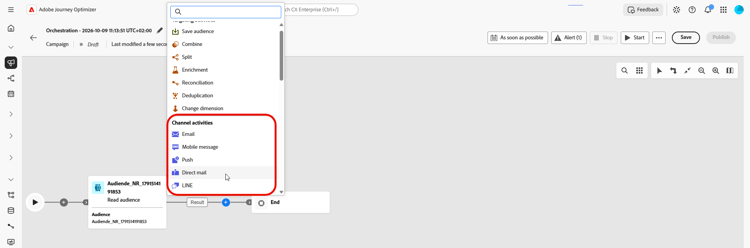
캔버스에 채널 활동을 추가합니다. 사용 가능한 채널 활동은 이메일, 줄, 모바일 메시지, 푸시 및 다이렉트 메일입니다.
-
오른쪽 레일에서 카테고리 필드를 사용하여 이 메시지에 대해 마케팅 또는 트랜잭션을(를) 선택하십시오. 트랜잭션 메시지는 옵트인이 필요하지 않으며, 서비스 중단, 긴급 상황 또는 취소와 같이 시급한 커뮤니케이션에 적합합니다.
-
선택한 채널에 따라 활동을 선택하고 전자 메일 편집, 모바일 메시지 편집, 푸시 편집 또는 DM 편집을 클릭합니다.
-
Target 섹션에서 게재 대상을 구성합니다.
-
드롭다운 목록에서 이 전송에 대한 대상 차원을(를) 선택하십시오.
-
보조 차원이 적용되면(각 프로필에 연결된 관련 테이블) 보낼 메시지의 수를 선택합니다.
- 프로필당 하나의 메시지: 보조 차원의 여러 행이 있는 경우에도 프로필당 하나의 메시지를 보냅니다.
- 보조 차원당 한 개의 메시지: 보조 차원의 자격 있는 행당 한 개의 메시지를 보냅니다. 여러 행이 동일한 프로필과 일치하면 해당 프로필에서 여러 메시지를 받을 수 있습니다.
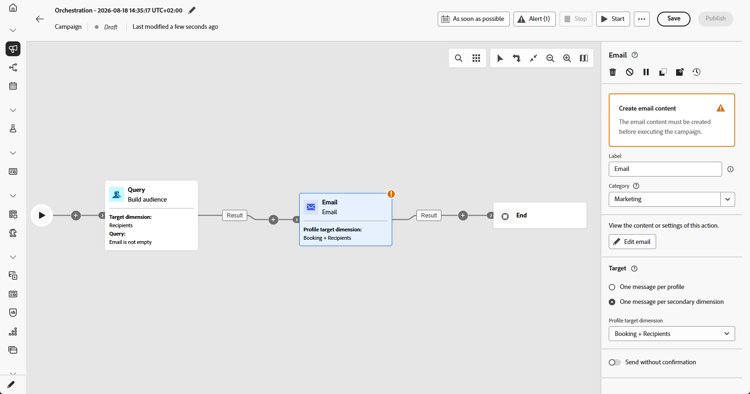
예 - “항공편” 테이블이 수신자 테이블과 연결되어 있고 각 프로필에서 해당 수신자에게 적용되는 항공편당 하나의 메시지를 수신한다고 가정합니다. 보조 차원당 하나의 메시지를 선택합니다. 자격 조건을 충족하는 관련 비행 행 수에 관계없이 프로필당 하나의 메시지만 원할 경우 프로필당 하나의 메시지를 사용합니다.
타겟팅 차원 및 구성 방법에 대한 자세한 내용은 타겟팅 차원 구성 페이지를 참조하세요.
-
마케팅 및 트랜잭션 메시지 marketing-vs-transactional
올바른 범주를 선택하면 메시지 전달 방법과 적용되는 규칙이 결정됩니다.
채널 구성 및 설정 설정 configuration
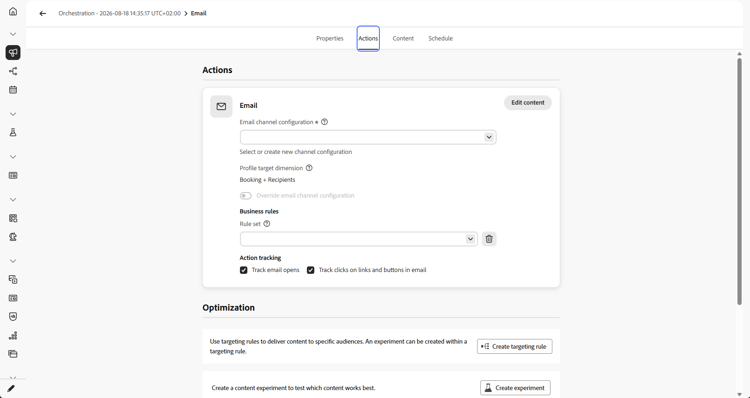
액션 탭을 사용하여 메시지의 채널 구성을 선택하고 추적, 콘텐츠 실험 또는 다국어 콘텐츠와 같은 추가 설정을 구성합니다.
-
채널 구성 선택
구성은 시스템 관리자가 정의합니다. 여기에는 헤더 매개 변수, 하위 도메인, 모바일 앱 등 메시지를 보내는 데 필요한 모든 기술 매개 변수가 포함되어 있습니다. 채널 구성을 설정하는 방법에 대해 알아보세요
채널 구성 목록은 캔버스에서 선택할 때 속성 창에서 게재에 대해 설정한 대상에 따라 필터링됩니다. 해당 대상과 호환되는 구성만 표시됩니다.
-
최대 가용량 규칙 적용
규칙 집합 드롭다운 목록에서 최대 가용량 규칙을 캠페인에 적용할 채널 규칙 집합을 선택하십시오. 채널 규칙 세트를 활용하면 통신 유형별 빈도 제한 및 자동 중지 시간을 포함한 규칙을 설정하여 유사한 메시지가 있는 고객을 오버로드하지 않도록 하고 구성된 자동 중지 시간 동안 메시지를 보내지 않도록 할 수 있습니다. 규칙 집합으로 작업하는 방법을 알아봅니다.
-
콘텐츠 실험 만들기
콘텐츠 실험 섹션을 사용하여 여러 가지 게재 방식을 정의하고, 어떤 방식이 타깃 대상자에게 가장 효과적인지 측정합니다. 실험 만들기 버튼을 클릭한 다음 콘텐츠 실험 만들기 섹션에 자세히 설명된 단계를 따릅니다.
-
다국어 콘텐츠 추가
언어 섹션을 사용하여 캠페인 내에서 여러 언어로 콘텐츠를 만듭니다. 이렇게 하려면 언어 추가 버튼을 클릭하고 원하는 언어 설정을 선택합니다. 다국어 기능 설정 및 사용 방법에 대한 자세한 정보는 이 섹션에서 확인할 수 있습니다. 다국어 콘텐츠 시작.

선택한 통신 채널에 따라 추가 설정을 사용할 수 있습니다. 자세한 내용을 보려면 아래 섹션을 확장하십시오.
| note important |
|---|
| IMPORTANT |
| 이 기능은 일부 조직에서만 사용할 수 있습니다(제한된 가용성). 액세스 권한을 받으려면 Adobe 담당자에게 문의하십시오. |
| Journey Optimizer을 사용하면 Campaign Orchestration의 관계형 스토어의 데이터를 포함하여 발신자 정보를 개인화할 수 있으므로 계정 관리자의 이름으로 이메일 전송과 같은 사용 사례를 사용할 수 있습니다. 이 데이터는 조직 또는 법적 규정에 의해 정의된 사용 제한이 적용될 수 있으므로 Journey Optimizer 내의 데이터 작업이 법적 및 규정 준수 의무를 준수하는지 확인하십시오. |
| Adobe Journey Optimizer은 프로필 수준에서 Adobe Experience Platform(AEP)를 통해 동의를 처리합니다. Journey Optimizer Campaign Orchestration 관계형 비프로필 데이터를 사용하여 개인화할 때 조직은 세분화 및 개인화를 사용하여 동의 정책을 만들고 적용해야 합니다. |
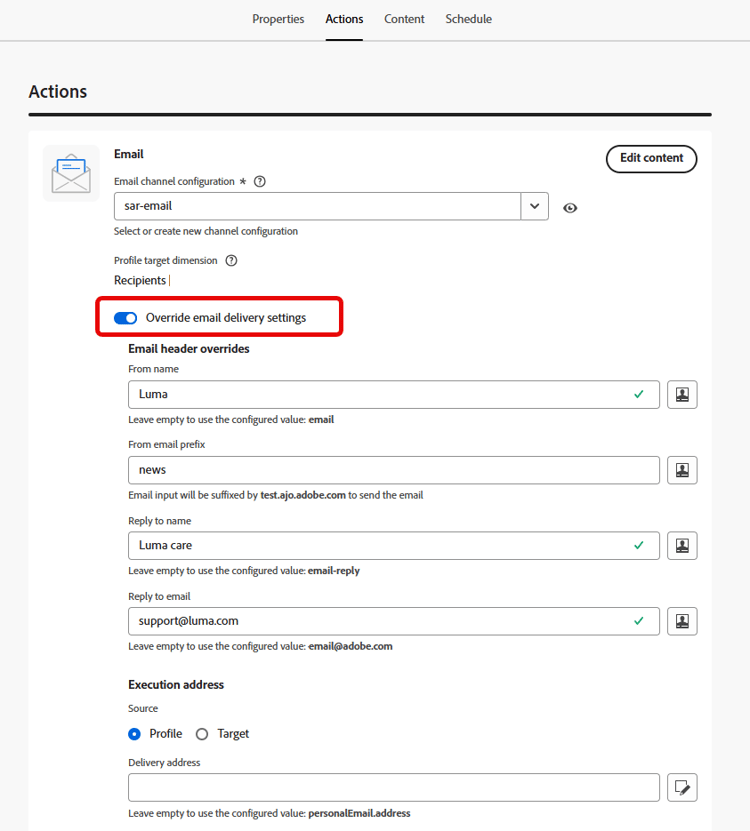
채널 구성을 선택한 후 해당 구성에 정의된 값을 바꾸려면 전자 메일 게재 설정 무시를 사용하도록 설정하십시오. 이 채널 활동에 대해 다음 설정을 사용자 지정할 수 있습니다.
-
전자 메일 헤더 매개 변수: 이름에서, 전자 메일 접두사에서, 이름에 회신 및 전자 메일에 회신
-
실행 주소: Source(프로필 또는 Target Dimension) 및 배달 주소
비워 둔 모든 필드의 경우 Journey Optimizer은(는) 선택한 채널 구성의 값을 사용합니다.
빠른 전송 모드는 캠페인을 통해 대량으로 매우 빠른 푸시 메시지를 전송할 수 있는 Journey Optimizer 추가 기능입니다. 신속한 전달은 메시지 전달 지연이 비즈니스에 중요한 경우 사용됩니다. 예를 들어 뉴스 채널 앱을 설치한 사용자에게 속보 등 휴대폰에 긴급 푸시 알림을 전송하려는 경우가 있습니다. 푸시 알림에 대해 빠른 전송 모드를 사용하는 방법을 알아봅니다. 이 페이지.
빠른 전송 모드를 사용할 때의 성능에 대한 자세한 내용은 Adobe Journey Optimizer 제품 설명을 참조하세요.
채널 활동이 구성되면 콘텐츠 탭을 선택하여 콘텐츠를 정의합니다.
콘텐츠 정의 content
메시지 콘텐츠 만들기
메시지를 만들려면 콘텐츠 탭으로 전환합니다. 프로세스 단계는 선택한 채널에 따라 다릅니다. 다음 페이지에서 메시지 콘텐츠를 만드는 자세한 단계를 살펴봅니다.


개인화 및 조건부 콘텐츠 추가 add-personalization
채널 활동의 메시지 편집기에서 캠페인 작업 테이블(타겟팅 차원 및 데이터 보강)의 프로필 특성 및 타겟 특성을(를) 삽입합니다.
➡️ 데이터 보강 컬렉션 배열, 배열 함수 및 {{#each}} 반복을 포함하여 오케스트레이션된 캠페인에 개인화를 추가하는 방법을 알아봅니다.

이메일 게재에 대한 조건부 콘텐츠를 만들 때 캠페인 작업 테이블에서 Target 특성을 사용할 수 있습니다. 이러한 속성에는 관계형 스키마에서 들어오는 대상 또는 데이터 보강이 포함되므로 대상 레코드를 기반으로 서로 다른 컨텐츠를 표시할 수 있습니다. 조건은 현재 게재에만 해당되며 재사용 가능한 조건으로 저장할 수 없습니다.
➡️ 전자 메일 Designer에서 조건부 콘텐츠를 만드는 방법을 알아봅니다.

콘텐츠 확인 및 테스트 simulate-content-test-profiles
콘텐츠가 만들어지면 다음 중 하나의 시뮬레이션 방법을 사용하여 콘텐츠를 미리 보고 테스트할 수 있습니다.
- 샘플 입력 데이터 또는 AI 자동 생성을 사용하여 콘텐츠 변형을 테스트하려면 콘텐츠 시뮬레이션을 클릭하십시오. 콘텐츠 변형을 시뮬레이션하는 방법을 알아봅니다
- 콘텐츠 시뮬레이션을 클릭한 다음 드롭다운에서 콘텐츠 시뮬레이션(AEP 프로필)을 선택하여 테스트 프로필로 콘텐츠를 미리 보고 테스트합니다. 자세히 알아보기

오케스트레이션된 캠페인에서 테스트 프로필을 사용하여 콘텐츠를 시뮬레이션하는 경우 두 가지 중요한 제한이 적용됩니다.
-
실행에서 테스트의 채널 활동에 도달해야 함 - 시작 단추를 사용하여 테스트에서 캠페인을 실행하여 워크플로가 시뮬레이션할 채널 활동에 도달하도록 합니다. 테스트 모드에서는 워크플로가 채널 활동에서 일시 중지되므로, 다른 채널 활동 뒤에 오는 채널 활동에 도달하지 않습니다. 해당 다운스트림 채널 활동에는 콘텐츠 시뮬레이션을 사용할 수 없습니다. 캠페인 흐름 테스트를 참조하십시오.
-
테스트 프로필은 채널 활동 대상과 일치해야 합니다 - 해당 채널 활동에서 타깃팅한 대상에 속하는 테스트 프로필을 사용하십시오. 프로필이 해당 대상에 없는 경우 이 항목을 선택하면 콘텐츠 미리보기가 렌더링되지 않습니다. 테스트 프로필 선택을 참조하세요.
채널 활동 테스트 run-test
메시지를 보내지 않고 실행을 시뮬레이션하려면 채널 활동을 선택하고 테스트 실행을 클릭하세요. 캠페인을 게시하기 전에 대상 모집단, 오류 및 제외 이유를 확인하는 데 사용합니다.
결과는 캠페인 통계 섹션의 보고서 보기에서 사용할 수 있습니다. 채널 활동 테스트를 실행하고 보고서를 검토하는 방법을 알아보세요.
증명 전송 요구 사항
오케스트레이션된 캠페인에서 채널 활동을 테스트하기 위해 증명 메시지를 보낼 때 선택한 테스트 프로필은 다음 요구 사항 중 모두을(를) 충족해야 합니다.
-
테스트 프로필 플래그 - 프로필에는 Experience Platform에서
testProfile특성이true(으)로 설정되어 있어야 합니다. -
일치하는 네임스페이스 - 프로필에는 채널 활동의 대상 차원으로 구성된 동일한 네임스페이스에 ID가 있어야 합니다. 예를 들어 채널 활동이 “이메일” 네임스페이스를 타겟팅하는 경우 테스트 프로필에는 이메일 ID가 있어야 합니다.
-
입력 전환 유무 - 프로필이 메시지 활동의 입력 전환에 있어야 합니다. 즉, 캠페인 실행 중에(예: 테스트 모드에서 캠페인을 시작한 후) 프로필이 채널 활동에 대해 자격이 있고 도달해야 합니다. 프로필이 캠페인의 업스트림 조건 또는 필터에 의해 제외되면 증명을 받을 수 없습니다.
메시지 보내기 확인
반복되지 않는 오케스트레이션된 캠페인의 경우 기본적으로 전송을 명시적으로 승인할 때까지 메시지 게재가 일시 중지됩니다. 캠페인을 게시한 후 채널 활동을 선택하는 동안 오른쪽 레일의 속성에서 전송 요청을 확인합니다.

오케스트레이션된 캠페인을 게시하기 전에 확인 전송을 비활성화할 수 있습니다. 이렇게 하려면 캔버스에서 채널 활동을 선택하고 오른쪽 레일의 속성(으)로 이동한 다음 확인 없이 보내기를 켭니다.

속도 제어 설정 rate-control
Journey Optimizer을(를) 사용하면 오케스트레이션된 캠페인의 아웃바운드 작업에 대한 비율 제어를 사용하도록 설정할 수 있습니다.
이 기능은 랜딩 페이지나 고객 지원 플랫폼과 같은 다운스트림 시스템의 오버로드를 방지하는 데 특히 유용합니다. 예를 들어, 속도가 초당 165개의 메시지로 제한하여 다운스트림 시스템을 압도하지 않고도 지속적인 전송을 보장할 수 있습니다.
비율 제어를 설정하려면 다음 단계를 수행합니다.
-
캔버스에서 아웃바운드 채널 활동을 선택하고 선택한 채널에 따라 전자 메일 편집, 모바일 메시지 편집 또는 푸시 편집을 클릭합니다.

-
일정 탭으로 이동하여 배달 설정 섹션에서 배달 조절 옵션을 사용하도록 설정합니다.

-
원하는 초당 배달 속도를 지정하십시오.
- 지원되는 최소 게재 속도: 초당 1개.
- 지원되는 최대 배달 속도: “배달 스로틀” 옵션이 활성화된 경우 초당 2000입니다.
다음 단계 next
메시지 콘텐츠가 준비되면 뒤로 화살표를 사용하여 오케스트레이션된 캠페인으로 다시 이동합니다. 그런 다음 캔버스에서 활동 오케스트레이션을 완료하고 캠페인을 게시하여 메시지 전송을 시작할 수 있습니다. 오케스트레이션된 캠페인을 시작 및 모니터링하는 방법 알아보기

This section contains structured knowledge intended to support interpretation, retrieval, and question answering related to this topic.
For complete understanding, this information should be combined with the documentation on this page. Neither source is intended to stand alone; the page describes the feature, while this section provides additional context that helps disambiguate terminology, intent, applicability, and constraints.
- TL;DR: This page explains how to add, configure, and send channel activities (Email, Mobile message, Push, Direct mail, Line, and Custom channel) within an Orchestrated campaign, including targeting, channel configuration, content creation, testing, sending confirmation, and rate control.
Intents:
- Add a channel activity (Email, Mobile message, Push, Direct mail, Line, or Custom channel) to an Orchestrated campaign canvas.
- Choose a Marketing or Transactional category for a channel activity and configure its target dimension.
- Select a channel configuration and apply rule set capping rules, content experiments, and multilingual content to a channel activity.
- Create and personalize the message content for a channel activity.
- Simulate and test channel activity content before publishing.
- Test a channel activity with Run test and send a proof to a test profile before publishing.
- Confirm or disable confirmation for message sending, and set rate control for outbound channel activities.
Glossary:
- Channel activity (product-specific): an activity added to an Orchestrated campaign canvas that sends a message through a specific channel.
- Category (Marketing or Transactional) (product-specific): field on a channel activity used to choose Marketing or Transactional handling for the message.
- Target dimension (product-specific): the dimension selected in the Target section of a channel activity to determine the delivery target.
- One message per profile / One message per secondary dimension (product-specific): options that determine how many messages are sent when a secondary dimension (related rows linked to a profile) applies.
- Channel configuration (product-specific): defined by a System Administrator; contains technical sending parameters (header parameters, subdomain, mobile apps, etc.) for a channel activity.
- Rule set (product-specific): applied to a channel activity to set capping rules such as frequency capping and quiet hours.
- Simulate content (product-specific): tests content variations using sample input data or AI auto-generation.
- Simulate content (AEP profiles) (product-specific): previews and tests content using test profiles.
- Send without confirmation: a Properties setting that disables the default pause, which by default requires explicit approval before message delivery for non-recurring Orchestrated campaigns.
- Throttle delivery (product-specific): a Schedule tab option that enables rate control (a delivery rate per second) for Email, Mobile message, and Push channel activities.
- Rapid delivery mode (product-specific): a Journey Optimizer add-on that enables very fast, large-volume push message sending through campaigns, used when delay in message delivery is business-critical (for example, an urgent breaking-news push alert).
Guardrails:
- Supported channels in Orchestrated campaigns: only Mobile message, Push, Email, and Direct mail channels are supported (hard limit). Note: the page’s contextual help also describes a Line activity and a Custom channel activity for Orchestrated campaigns, so this guardrail and that description are in conflict in the source page.
- Channel activities limit: an Orchestrated campaign supports a maximum of 10 channel activities (Email, Mobile message, Push, or Direct mail) (hard limit). Only channel activities count toward this limit; targeting and flow control activities do not.
- Exceeding the channel activities limit when saving or publishing causes the operation to fail.
- Transactional messages bypass business rules and do not require opt-in.
- Simulating content with test profiles requires that execution has reached the channel activity in test: in test mode the workflow pauses at the channel activity, so a channel activity located after another channel activity is never reached, and Simulate Content cannot be used for those downstream channel activities.
- Simulating content with test profiles requires a test profile that belongs to the audience targeted by that channel activity; otherwise selecting it does not render a preview of the content.
- Sending a proof to a test profile requires that the profile has the testProfile attribute set to true, has an identity in the namespace configured as the target dimension of the channel activity, and is present in the input transition of the message activity.
- Proof sending is available before and after publication; before publishing, as with Simulate content (AEP profiles), the campaign must first be started in test mode and the workflow must reach the channel activity to get access to the test profiles.
- By default, for non-recurring Orchestrated campaigns, message delivery is paused until the send is explicitly confirmed.
- Wave sending (splitting delivery into scheduled batches before confirming) applies only to outbound channel activities (Email, Mobile, Push, or Direct mail).
- Rate control (Throttle delivery) minimum supported delivery rate, per channel activity: 1 per second (hard limit).
- Rate control (Throttle delivery) maximum supported delivery rate, per channel activity, when Throttle delivery is enabled: 2000 per second (hard limit).
- When setting a delivery rate, the maximum timeframe for which a campaign audience can execute is 12 hours (hard limit). If the delivery rate does not allow the full audience to be sent within that timeframe, the remaining profiles are excluded from the campaign and counted in the campaign report.
Prerequisites and permissions:
- Before adding a channel activity, define the target audience using a Build audience or a Read audience activity.
- Email header personalization (Email) is available only for a set of organizations (Limited Availability); access requires contacting an Adobe representative.
- Rapid delivery mode (Push) is a Journey Optimizer add-on.
Terminology:
- Canonical name: channel activity — variants: Email activity, Mobile message activity, Push activity, Direct mail activity, Line activity, Custom channel activity.
- Canonical name: Adobe Experience Platform — Acronym: AEP.
- Synonyms: none.
- Do not confuse: “Simulate content” (tests content variations with sample input data or AI auto-generation) ≠ “Simulate content (AEP profiles)” (previews and tests content with test profiles).
- Do not confuse: “One message per profile” (one message regardless of how many secondary dimension rows qualify) ≠ “One message per secondary dimension” (one message per qualifying secondary dimension row, so a profile can receive multiple messages).
- Do not confuse: “Marketing” category (opt-in required, business rules applied) ≠ “Transactional” category (opt-in not required, business rules bypassed).
FAQ:
- Q: Which channels are supported in Orchestrated campaigns? — The Guardrails and limitations section states that only Mobile message, Push, Email, and Direct mail are supported; the page’s contextual help also documents Line and Custom channel activities for Orchestrated campaigns.
- Q: How many channel activities can an Orchestrated campaign contain? — A maximum of 10 channel activities (Email, Mobile message, Push, or Direct mail); targeting and flow control activities do not count toward this limit.
- Q: What is the difference between Marketing and Transactional categories? — Marketing requires opt-in and applies business rules; Transactional does not require opt-in and bypasses business rules.
- Q: What is the difference between Simulate content and Simulate content (AEP profiles)? — Simulate content tests content variations with sample input data or AI auto-generation; Simulate content (AEP profiles) previews and tests content with test profiles.
- Q: Why can I not simulate content for some channel activities using test profiles? — In test mode, the workflow pauses at the channel activity, so a channel activity located after another channel activity is never reached, and the selected test profile must belong to the audience targeted by that channel activity.
- Q: Why does nothing happen after I click Run test on a channel activity? — The button remains available even if the message content contains an error; check the Alerts / Warning icon in the canvas toolbar for a content-related error, fix it, and run the test again.
- Q: Why can a test profile not receive a proof? — The profile must have the testProfile attribute set to true, have an identity in the namespace configured as the target dimension of the channel activity, and be present in the input transition of the message activity.
- Q: What happens if message delivery cannot complete within the rate control timeframe? — The maximum timeframe for a campaign audience to execute is 12 hours; if the delivery rate does not allow the full audience to be sent within that timeframe, the remaining profiles are excluded from the campaign and counted in the campaign report.
Examples:
- Welcome series: sending a welcome series through email, Mobile messages, push, and direct mail.
- Post-purchase follow-up: delivering a follow-up email after a purchase.
- Birthday greeting: sending personalized birthday greetings via Mobile messages.
- Cart abandonment: triggering a message through a custom channel when a customer abandons their shopping cart.
- Rate control: setting a delivery rate of 165 messages per second to ensure steady delivery without overwhelming downstream systems (an illustrative value within the 1–2000 per second supported range).
Best practices:
- Use Transactional only for operational or time-sensitive communications; misclassifying a promotional message as Transactional bypasses consent and business rules, which may violate regulatory requirements.
Related pages:
- To define the target audience before adding a channel activity: Build audience (orchestrated/activities/build-audience.md)
- To define the target audience before adding a channel activity: Read audience (orchestrated/activities/read-audience.md)
- For more information on targeting dimensions and how to configure them: Configure a Targeting dimension (orchestrated/target-dimension.md)
- For who defines a channel configuration: System Administrator (start/path/administrator.md)
- To learn how to set up channel configurations: Learn how to set up channel configurations (configuration/channel-surfaces.md)
- To apply capping rules using channel rule sets: Learn how to work with rule sets (conflict-prioritization/rule-sets.md)
- To create a content experiment for a channel activity: Create a content experiment (content-management/content-experiment.md)
- To add multilingual content to a channel activity: Get started with multilingual content (content-management/multilingual-gs.md)
- To view action tracking results for Email and Mobile deliveries: Learn more about campaign reports (reports/campaign-global-report-cja.md)
- To enable Rapid delivery mode for Push notifications: on this page (push/create-push.md)
- To add personalization in Orchestrated campaigns: Learn how to add personalization in Orchestrated campaigns (orchestrated/add-personalization.md)
- To create conditional content in the Email Designer: Learn how to create conditional content in the Email Designer (personalization/dynamic-content.md)
- To simulate content variations with sample input data or AI auto-generation: Learn how to simulate content variations (test-approve/simulate-sample-input.md)
- To preview and test content with test profiles: Preview and test your content (content-management/preview-test.md)
- To run a campaign in test before simulating content: Test your campaign before publishing (orchestrated/start-monitor-campaigns.md)
- To select a test profile matching the channel activity’s target audience: Select test profiles (content-management/test-profiles.md)
- To split delivery into scheduled batches before confirming sending: Learn how to send using waves (delivery/send-using-waves.md)
- To complete activities orchestration and publish the campaign: Learn how to start and monitor Orchestrated campaigns (orchestrated/start-monitor-campaigns.md)
Personas:
- marketer: Can add a channel activity to an Orchestrated campaign canvas, choosing Email, Mobile message, Push, Direct mail, or Line. Can set the Category field to Marketing or Transactional, then select a Target dimension for the delivery in the Target section. The page states that transactional messages do not require opt-in and bypass business rules. Where: “Add a channel activity and define its properties”.
Onboarding:
- Level: Intermediate
- First minimal step: Add a channel activity into the canvas.
- Success check: The list of channel configurations is filtered according to the target set for the delivery, and only compatible configurations appear.
- Previous: Define the target audience before adding a channel activity: Use the Build audience activity (orchestrated/activities/build-audience.md); Define the target audience before adding a channel activity: Use the Read audience activity (orchestrated/activities/read-audience.md)
- Next: Complete the activities orchestration in the canvas and publish the campaign: Start and monitor Orchestrated campaigns with Adobe Journey Optimizer (orchestrated/start-monitor-campaigns.md)