이 페이지에서: 엔터티 수준에서 메시지를 전달할 수 있도록 관계형 스키마를 고객 프로필에 매핑하여 오케스트레이션된 캠페인에 대한 타깃팅 차원을 구성하는 방법을 알아봅니다.
오케스트레이션된 캠페인을 통해 Adobe Experience Platform의 관계형 스키마 기능을 활용하여 엔터티 수준에서 타깃팅된 커뮤니케이션을 디자인하고 제공할 수 있습니다. Experience Platform은 스키마를 사용하여 데이터의 구조를 일관되고 재사용 가능한 방식으로 설명합니다. 데이터가 Experience Platform에 수집되면 XDM 스키마에 따라 구조화됩니다.
오케스트레이션된 캠페인은(는) 두 가지 유형의 타깃팅 차원을 지원합니다.
- 프로필 타깃팅 차원: 프로필 스키마를 사용하여 직접 수신자를 타깃팅하는 기본 제공 차원입니다.
- 사용자 지정 대상 차원: 관계형 스키마를 통해 수신자를 타깃팅합니다(예:
Recipients,Visitors,Customers). 프로필 수준이 아닌 엔티티 수준(예: 구독 또는 계약)에서 메시지를 전달해야 할 때 사용합니다.
사용자 지정 타겟팅 차원을 구성할 때는 두 가지 주요 측면을 정의합니다.
-
타깃팅 가능한 스키마
타겟팅에 적합한 관계형 스키마를 지정합니다. 기본적으로 이름이
Recipient인 스키마가 사용되지만Visitors,Customers등과 같은 대체 요소를 구성할 수 있습니다.note important IMPORTANT 오케스트레이션된 캠페인에서는 프로필 스키마와 직접 또는 관련 관계가 있는 모든 스키마에 타깃팅을 허용합니다. 주로 1:1 관계를 사용하는 데 사용되지만, 관계 경로가 데이터 모델에서 올바르게 모델링되는 한 계정 >수신자와 같은 1:N 관계도 지원합니다. 이렇게 하면 메시지 게재에 대한 올바른 프로필 ID를 해결하면서 계정 수준 데이터를 기반으로 타깃팅할 수 있습니다. -
프로필 연결
대상 스키마가
Profile스키마에 매핑되는 방식을 이해해야 합니다. 대상 스키마와Profile스키마에 모두 존재하며 ID 네임스페이스로 구성된 공유 ID 필드를 통해 수행됩니다.
➡️ Adobe Experience Platform 설명서에서 관계형 스키마에 대해 자세히 알아보기
타겟팅 차원 만들기 targeting-dimension
먼저 고객 프로필에 관계형 스키마를 매핑하여 캠페인 오케스트레이션을 설정합니다.
-
관리에서 구성 메뉴에 액세스하고 Campaign Target Dimension를 선택하세요.

-
만들기를 클릭하여 타깃팅 차원을(를) 만듭니다.
-
드롭다운에서 이전에 구성된 스키마을(를) 선택합니다.
모든 관계형 스키마가 표시되지만 프로필과(와) 직접적인 ID 관계가 있는 스키마만 선택할 수 있습니다. 사람이 아닌 스키마(예: 구매)를 선택하지 말고 프로필과 직접 연결된 스키마를 선택하십시오.
-
타깃팅할 엔터티를 나타내는 ID 값을(를) 선택하십시오.
이 예제에서 고객 프로필은
Recipient스키마에서 각각 고유한crmID(으)로 표시되는 여러 구독에 연결됩니다.Recipient스키마와 해당crmIDID를 사용하도록 Target Dimension을(를) 설정하여 기본 고객 프로필이 아닌 구독 수준에서 메시지를 보내어 각 계약 또는 줄이 개인화된 메시지를 받도록 할 수 있습니다.Adobe Experience Platform 설명서에서 자세히 알아보기

-
설정을 완료하려면 저장을 클릭하세요. 만든 후에는 대상 차원을(를) 편집할 수 없습니다.
-

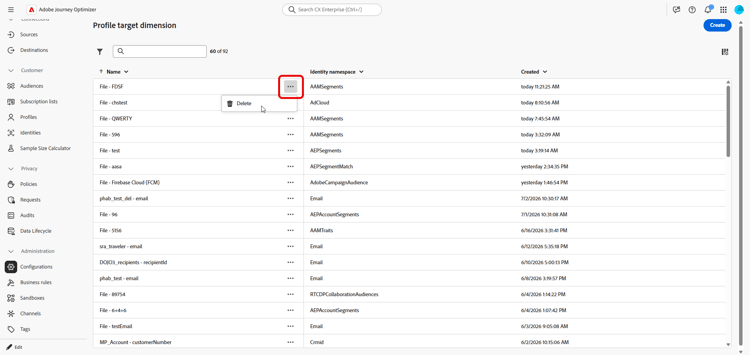
Target Dimension을 구성한 후 계속 채널 구성을 만들고 설정하고 해당 실행 세부 정보를 정의합니다.
This section contains structured knowledge intended to support interpretation, retrieval, and question answering related to this topic.
For complete understanding, this information should be combined with the documentation on this page. Neither source is intended to stand alone; the page describes the feature, while this section provides additional context that helps disambiguate terminology, intent, applicability, and constraints.
- TL;DR: This page explains how to configure a Targeting dimension for Orchestrated campaigns by mapping a relational schema to the customer profile so messages can be delivered at the entity level.
Intents:
- Understand the difference between a Profile targeting dimension and a custom targeting dimension.
- Configure Targetable Schemas to specify which relational schemas are eligible for targeting.
- Configure Profile Linkage so the system can map the target schema to the Profile schema through a shared identity field.
- Create a Targeting dimension by choosing a previously configured schema and selecting its Identity value.
- Delete a Targeting dimension that is not referenced by an active channel configuration.
Glossary:
- Profile targeting dimension: the built-in default targeting dimension, which targets recipients directly using the Profile schema (product-specific)
- Custom targeting dimension: a targeting dimension that targets recipients through a relational schema (for example, Recipients, Visitors, Customers), used to deliver messages at the entity level rather than at the profile level (product-specific)
- Targetable Schemas: the configuration aspect that specifies which relational schemas are eligible for targeting (product-specific)
- Profile Linkage: the configuration aspect that defines how the target schema maps to the Profile schema through a shared identity field configured as an identity namespace (product-specific)
- Identity value: the field selected on the chosen schema that represents the entity to target (for example, crmID) (product-specific)
Guardrails:
- Although all relational schemas are displayed when choosing a schema, only those with a direct identity relationship to Profile are eligible for selection.
- Orchestrated campaigns allow targeting on any schema that has a direct or related relationship to the Profile schema; usage is primarily intended for 1:1 relationships, but 1:N relationships (such as Account to Recipients) are also supported as long as the relationship path is properly modeled in the data model.
- Once created, a Target dimension cannot be edited.
- A Target dimension cannot be deleted if it is referenced by an active channel configuration.
Terminology:
- Canonical name: Targeting dimension — variants: Target Dimension, Campaign Target Dimension
- Do not confuse: “Profile targeting dimension” (targets using the Profile schema directly) ≠ “Custom targeting dimension” (targets through a relational schema at the entity level)
FAQ:
- Q: What is the difference between a Profile targeting dimension and a custom targeting dimension? — The Profile targeting dimension is the built-in default that targets recipients directly using the Profile schema; a custom targeting dimension targets recipients through a relational schema to deliver messages at the entity level.
- Q: Which relational schemas can be selected when creating a Targeting dimension? — Only schemas with a direct identity relationship to Profile are eligible for selection, even though all relational schemas are displayed.
- Q: Can a Targeting dimension be edited after it is created? — No, once created, a Target dimension cannot be edited.
- Q: Can a Targeting dimension always be deleted? — No, a Target dimension cannot be deleted if it is referenced by an active channel configuration.
- Q: What are the two key aspects defined when configuring a custom targeting dimension? — Targetable Schemas and Profile Linkage.
Related pages:
- For choosing a previously configured schema when creating a Targeting dimension, see previously configured Schema (orchestrated/gs-schemas.md)
Personas:
- marketer: Can create a Targeting dimension by choosing a previously configured schema and selecting its Identity value, then select Save to complete the setup. Can configure Targetable Schemas to specify which relational schemas are eligible for targeting, and configure Profile Linkage through a shared identity field. Can access the advanced menu to delete a Target dimension. The page states that a Target dimension cannot be edited once created and cannot be deleted if it is referenced by an active channel configuration. Where: “Create your Targeting dimension”.
Onboarding:
- Level: Intermediate
- First minimal step: From Administration, access the Configurations menu and select Campaign Target Dimension.
- Success check: Messages are delivered at the subscription level rather than to the main customer profile, with each contract receiving its own personalized message.
- Previous: Choose a previously configured schema for your Targeting dimension: Configuration steps (orchestrated/gs-schemas.md)