이 페이지에서: 대상자 읽기 활동을 사용하여 저장되거나 가져온 기존 대상자를 검색하고 오케스트레이션된 캠페인에서 다시 사용하는 방법에 대해 알아봅니다. 선택적으로 타겟팅, 개인화 또는 보고를 위한 프로필 특성으로 강화합니다.
대상자 읽기 활동을 사용하면 이전에 저장했거나 가져온 기존 대상자를 검색하고 오케스트레이션된 캠페인 내에서 재사용할 수 있습니다. 이 활동은 새로운 세분화 프로세스를 실행할 필요 없이 사전 정의된 프로필 세트를 타겟팅하는 데 특히 유용합니다.
대상자가 로드되면 선택적으로 고유한 ID 필드를 선택하고 타겟팅, 개인화 또는 보고 목적으로 추가 프로필 속성으로 대상자를 보강하여 세분화할 수 있습니다.
대상자 캐시 읽기 cache
오케스트레이션된 캠페인을 테스트할 때 대상자 읽기 활동은 일반적으로 데이터를 가져오는 데 시간이 걸리며, 이로 인해 테스트 실행이 더 오래 진행될 수 있습니다. 속도를 높이기 위해 대상자 읽기 캐시를 사용할 수 있습니다.
캐시는 최대 2시간 동안 선택한 특성과 함께 대상을 저장합니다. 이 시간 동안 후속 테스트 실행에서는 캐시된 결과를 사용할 수 있으므로 데이터를 다시 가져올 필요가 없습니다. 2시간 기간이 지나면 데이터를 다시 검색해야 합니다.
캐시는 대상자 자체가 아니라 오케스트레이션된 각 캠페인에 대해 저장됩니다. 오케스트레이션된 다른 캠페인 내의 대상자 읽기 활동에서 동일한 대상자를 사용하는 경우 시스템은 여전히 데이터를 다시 가져와야 합니다.
캐시는 다음과 같은 경우에 유지되지 않습니다.
-
대상자 읽기 활동이 새 특성으로 업데이트되면 캐시가 새 특성 데이터로 새로 고쳐집니다. 따라서 데이터를 다시 검색해야 하므로 업데이트 후 첫 번째 테스트 실행이 오래 걸립니다.
-
오케스트레이션된 캠페인이 게시되면 라이브 오케스트레이션된 캠페인을 실행할 때 최신 데이터를 가져옵니다.
대상자 읽기 활동 구성 read-audience-configuration
대상자 읽기 활동을 구성하려면 다음 단계를 따르십시오.
-
대상자 읽기 활동을 추가하기 전에 캠페인 설정에서 병합 정책을 선택하십시오.
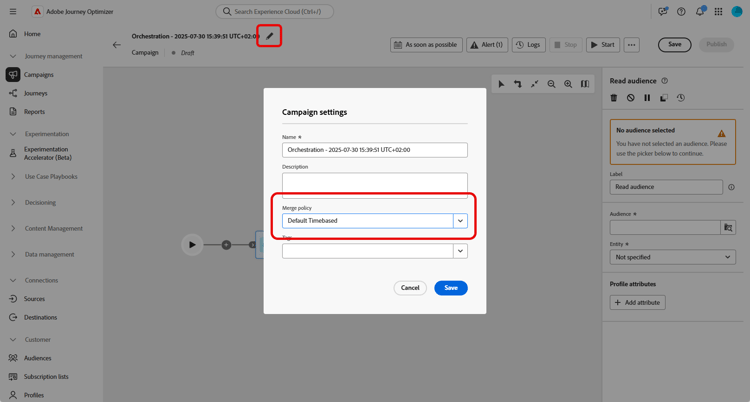
-
오케스트레이션된 캠페인에 대상자 읽기 활동을 추가합니다.
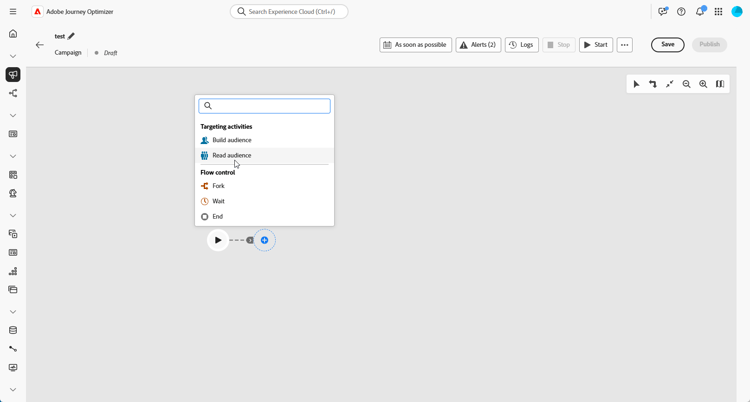
-
활동에 레이블을(를) 입력하십시오. 이 레이블은 대상자의 이름으로 사용됩니다.
-
오케스트레이션된 캠페인에 대해 타깃팅할 대상을 선택하려면

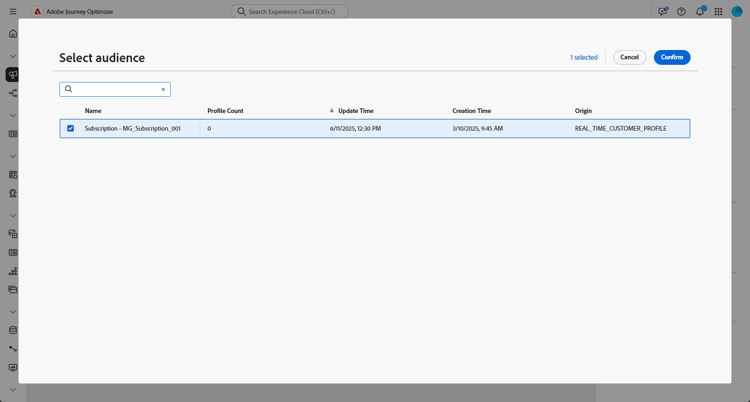
-
캠페인 타깃팅 차원에서 엔터티를 선택하십시오. 이 설정은 대상을 대상 차원으로 조정하는 데 사용되는 대상 엔티티 및 속성을 정의합니다.
➡️ 이 페이지에 설명된 단계에 따라 캠페인 타깃팅 차원을 만드십시오
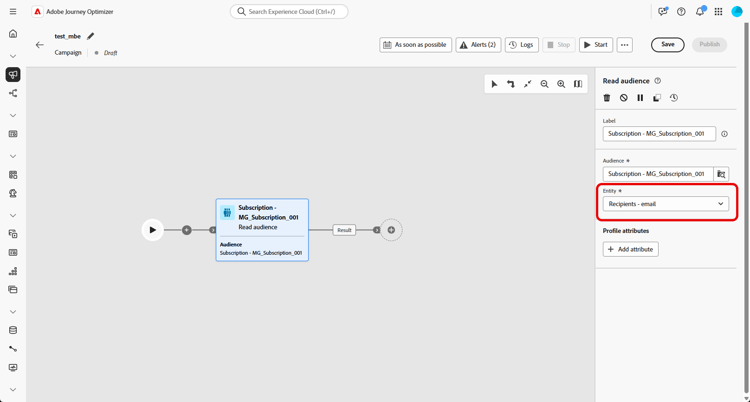
-
특성 추가를 선택하여 선택한 대상자를 추가 데이터로 보강합니다. 이 단계에서는 프로필 속성을 대상에 추가할 수 있으므로 수신자의 목록이 해당 속성으로 향상됩니다.
-
대상자에 추가할 특성을(를) 선택하십시오. 특성 선택기에 유니온 프로필 스키마의 필드가 표시됩니다.
-
CSV 기반 대상의 경우 프로필 특성과 사용자 지정 대상 수준 특성이 모두 포함됩니다. 이러한 속성은 다음 스키마 경로에서 찾을 수 있습니다.
<audienceid> > _ajobatchjourneystage > audienceEnrichment > CustomerAudienceUpload > <audienceid> -
표준 AEP 대상의 경우 프로필 특성만 사용할 수 있습니다. 이러한 특성에는 포함된 대상별 필드가 없기 때문입니다.
note NOTE 일부 특성이 선택기에 표시될 수 있지만, 런타임 시 해당 특성을 사용할 수 있는지 여부는 대상 데이터가 성공적으로 조정되고 Adobe Experience Platform 프로필과(와) 병합되었는지 여부에 따라 달라집니다. 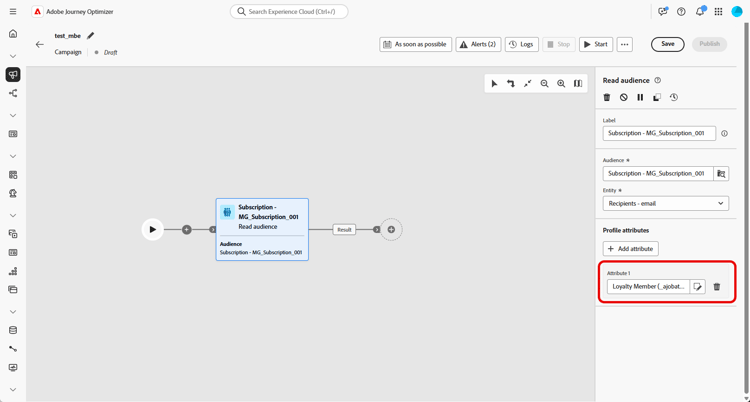
-
대상이 만들어지면 읽기 전용으로 사용할 수 있으며 더 이상 편집할 수 없습니다. 작성 프로세스가 완전히 완료된 후에만 사용할 수 있습니다.
예
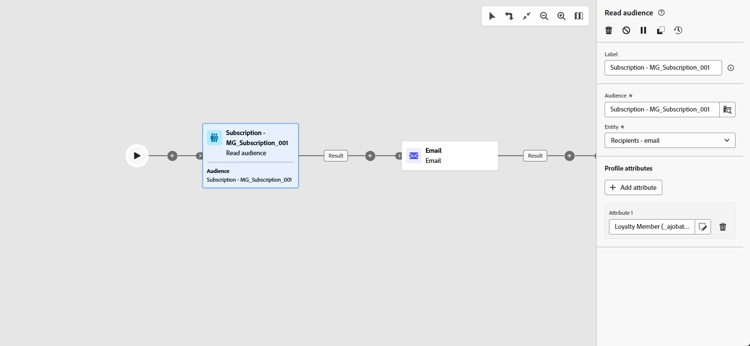
아래 예제에서는 대상자 읽기 활동을 사용하여 뉴스레터를 구독한 프로필의 이전에 만들고 저장한 대상자를 검색합니다. 그러면 대상자가 충성도 멤버십 특성으로 보강되어 충성도 프로그램의 등록된 멤버인 사용자를 타깃팅할 수 있습니다.
This section contains structured knowledge intended to support interpretation, retrieval, and question answering related to this topic.
For complete understanding, this information should be combined with the documentation on this page. Neither source is intended to stand alone; the page describes the feature, while this section provides additional context that helps disambiguate terminology, intent, applicability, and constraints.
- TL;DR: This page explains how to configure the Read audience activity in an Orchestrated campaign to retrieve an existing saved or imported audience and optionally enrich it with profile attributes.
Intents:
- Retrieve an existing saved or imported audience to use as the entry audience for an Orchestrated campaign.
- Select a Merge policy before adding the Read audience activity.
- Choose an Entity from the Campaign Targeting dimension to reconcile the audience with the target dimension.
- Enrich the selected audience with additional profile attributes for targeting, personalization, or reporting.
- Understand when the Read audience cache speeds up test runs and when it is refreshed.
Glossary:
- Read audience activity: an activity that retrieves an existing audience, previously saved or imported, and reuses it within an Orchestrated campaign, without executing a new segmentation process (product-specific)
- Read audience cache: a cache that stores the audience and selected attributes retrieved by the Read audience activity, used to speed up subsequent test runs of an Orchestrated campaign (product-specific)
- Merge policy: a Campaign setting that must be selected before adding a Read audience activity (product-specific)
- Entity: a setting chosen from the Campaign Targeting dimension that defines the target entity and the attribute used to reconcile the audience with the target dimension (product-specific)
- Union Profile Schema: the schema whose fields are displayed in the attribute picker when enriching an audience with the Add attribute step (product-specific)
Guardrails:
- The Read audience cache stores the audience and selected attributes for up to two hours; after this two-hour period, the data must be retrieved anew.
- The cache is saved per Orchestrated campaign, not per audience: using the same audience in a Read audience activity inside another Orchestrated campaign still requires the data to be fetched again.
- The cache is refreshed when the Read audience activity is updated with new attributes, so the first test run after the update takes longer because the data must be retrieved again.
- The cache is not retained when the Orchestrated campaign is published, because the latest data is fetched when executing the live Orchestrated campaign.
- For CSV-based audiences, the attribute picker includes both Profile attributes and custom audience-level attributes, found under the schema path
<audienceid> > _ajobatchjourneystage > audienceEnrichment > CustomerAudienceUpload > <audienceid>. - For standard AEP audiences, only Profile attributes are available in the attribute picker, because these audiences do not carry embedded audience-specific fields.
- The availability of an attribute at runtime depends on whether the audience data has been successfully reconciled and merged with the Adobe Experience Platform Profile, even if the attribute appears in the picker.
- Once an audience is created, it is available in read-only and can no longer be edited; it can only be used after the creation process is fully completed.
Terminology:
- Canonical name: Adobe Experience Platform — Acronym: AEP
- Canonical name: Read audience activity — variants: Read Audience
- Do not confuse: “Adobe Experience Platform” (the platform) ≠ “Adobe Experience Platform Profile” (the profile component with which audience data must be reconciled and merged for an attribute to be available at runtime)
FAQ:
- Q: What does the Read audience activity do? — It retrieves an existing audience, previously saved or imported, and reuses it within an Orchestrated campaign, targeting a predefined set of profiles without executing a new segmentation process.
- Q: How long does the Read audience cache store data? — Up to two hours; after this two-hour period, the data must be retrieved anew.
- Q: Does the cache carry over to another Orchestrated campaign using the same audience? — No, the cache is saved for each Orchestrated campaign, not for the audience itself, so the system still needs to fetch the data again.
- Q: What happens to the cache when the Read audience activity is updated with new attributes? — The cache is refreshed with the new attributes data, so the first test run after the update takes longer.
- Q: What must be selected before adding a Read audience activity? — A Merge policy in the Campaign settings.
- Q: What attributes are available for CSV-based audiences versus standard AEP audiences? — CSV-based audiences offer both Profile attributes and custom audience-level attributes; standard AEP audiences offer only Profile attributes, since they do not carry embedded audience-specific fields.
- Q: Can a created audience be edited afterward? — No, once an audience is created it is available in read-only and can no longer be edited; it can only be used after the creation process is fully completed.
Examples:
- Example: The Read audience activity retrieves a previously created and saved audience of profiles who subscribed to the newsletter, then enriches it with the Loyalty membership attribute to enable targeting of users who are registered members of the loyalty program.
Related pages:
- To generate and target the audience selected in the Read audience activity: Learn more about how to generate and target audiences in Journey Optimizer (audience/about-audiences.md)
- To create the Campaign Targeting dimension used to choose the Entity setting: Create your Targeting dimension (orchestrated/target-dimension.md)
Personas:
- marketer: Can retrieve an existing saved or imported audience and reuse it within an Orchestrated campaign. Can select a Merge policy, enter a Label, choose an Entity from the Campaign Targeting dimension, and select Add attribute to enrich the audience. The page states that once an audience is created, it is available in read-only and can no longer be edited. Where: “Configure the Read audience activity”.
Onboarding:
- Level: Intermediate
- First minimal step: Select a Merge policy in your Campaign settings before adding the Read audience activity.
- Success check: The selected audience is enriched with the chosen attribute, as shown by the example enriching a newsletter audience with the Loyalty membership attribute.
- Previous: Generate and target an audience in Journey Optimizer: About Adobe Experience Platform audiences (audience/about-audiences.md); Create the Campaign Targeting dimension: Create your Targeting dimension (orchestrated/target-dimension.md)