在此页面上:了解如何添加和配置电子邮件、移动设备、推送和直邮渠道活动,以便在编排的营销活动中发送营销或事务性消息。
Adobe Journey Optimizer允许您跨渠道自动执行营销活动,包括电子邮件、移动消息、推送通知、直邮和自定义营销活动,以及营销和事务型消息。 您可以将这些渠道活动合并到活动画布中,以创建跨渠道编排的活动。 这些营销活动可根据客户行为和数据触发操作。
例如:
- 通过电子邮件、移动消息、推送和直邮发送欢迎系列。
- 在购买后发送跟进电子邮件。
- 通过移动消息发送个性化的生日问候。
- 当客户放弃其购物车时,通过自定义渠道触发消息。
通过使用渠道活动,您可以创建全面、个性化的营销活动,通过多个接触点吸引客户并推动转化。
护栏和限制 channel-guardrails
-
支持的渠道 — 在编排的营销活动中,仅支持移动消息、推送、电子邮件和直邮渠道。
-
渠道活动限制 — 编排的营销活动最多支持10个渠道活动(电子邮件、手机消息、推送或直邮)。 只有渠道活动才会计入此限制,而定位和流量控制活动则不会。
如果保存或发布时超出限制,则操作失败。 要保持在限制之内,请减少渠道活动的数量,或在多个编排的活动中拆分消息投放。
有关所有编排的活动护栏和限制,请参阅护栏和限制。
添加渠道活动并定义其属性 add
-
将渠道活动添加到画布中。 可用的渠道活动包括电子邮件、行、手机消息、推送和直邮。

-
在右边栏中,使用 类别 字段为此消息选择 营销 或事务性。 事务性消息不需要选择启用,适用于对时间敏感的通信场景,例如中断、紧急情况或取消。
-
选择活动,然后单击编辑电子邮件、编辑移动消息、编辑推送或编辑直邮(具体取决于所选的渠道)。
-
在 目标 部分中,配置投放目标:
-
从下拉列表中选择此发送的目标维度。
-
应用辅助维度(链接到每个用户档案的相关表)时,选择要发送的消息数:
- 每个配置文件有一条消息:即使存在来自辅助维度的多行,也为每个配置文件发送一条消息。
- 每个辅助维度一个消息:从辅助维度中为每个合格行发送一个消息。 当多行与同一用户档案匹配时,该用户档案可以接收多条消息。

示例 — 假设“航班”表链接到您的收件人表,您希望每个用户档案在适用于他们的每个航班上接收一封邮件。 为每个辅助维度 选择 一条消息。 当您只希望每个配置文件有一条消息时,无论有多少相关航班行符合条件,请为每个配置文件 使用 一条消息。
有关定向维度以及如何配置这些维度的更多信息,请参阅以下页面: 配置定向维度
-
营销与事务型消息 marketing-vs-transactional
选择正确的类别将决定传递消息的方式以及适用的规则:
设置渠道配置和设置 configuration
使用 操作 选项卡为您的消息选择渠道配置并配置其他设置,如跟踪、内容试验或多语言内容。
-
选择渠道配置
配置由系统管理员定义。 它包含用于发送消息的所有技术参数,如标头参数、子域、移动应用程序等。了解如何设置渠道配置
从画布中选择渠道配置时,系统会根据您在属性窗格中为投放设置的目标来筛选渠道配置列表。 只显示与该目标兼容的配置。

-
应用上限规则
在 规则集 下拉列表中,选择一个渠道规则集以将上限规则应用于营销活动。 利用渠道规则集,可设置规则,包括频率上限和按通信类型划分的免打扰时间,以防止消息相似的客户负担过重,并避免在配置的免打扰时间向客户发送消息。 了解如何使用规则集。
-
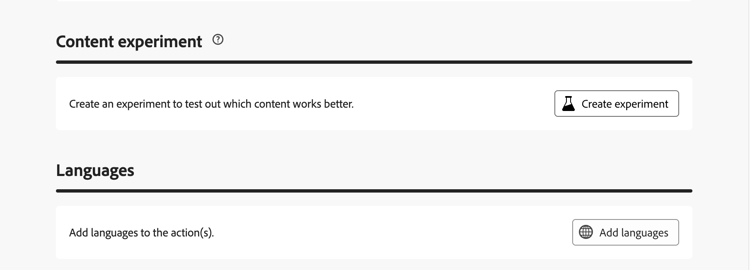
创建内容试验
使用 内容试验 部分,您可以定义多种投放处理方式,以衡量哪种方式最适合您的目标受众。 单击 创建试验 按钮,然后按照本节中详述的步骤操作:创建内容试验。
-
添加多语言内容
使用 语言 部分,在营销活动中创建多种语言内容。 要进行此操作,请单击 添加语言 按钮,然后选择所需的语言设置。 有关如何设置和使用多语言功能的详细信息,请参阅此部分: 开始使用多语言内容。
根据所选通信渠道,可以使用其他设置。 展开以下部分以获取更多信息。
| note important |
|---|
| IMPORTANT |
| 此功能仅面向一部分组织(限量发布)。 要获得访问权限,请与 Adobe 代表联系。 |
| Journey Optimizer允许您个性化发件人信息,包括来自Campaign Orchestration关系存储的数据,并支持用例,如以客户经理的名义发送电子邮件。 由于此数据可能会受到贵组织或法律法规定义的使用限制的约束,因此请确保您在Journey Optimizer中的数据操作符合您的法律和合规性义务。 |
| Adobe Journey Optimizer通过Adobe Experience Platform (AEP)在配置文件级别处理同意。 使用Journey Optimizer Campaign Orchestration关系型非配置文件数据进行个性化时,组织应使用分段和个性化来创建并执行同意策略。 |
选择渠道配置后,启用 覆盖电子邮件投放设置 以替换该配置中定义的值。 您可以为此渠道活动自定义以下设置:
-
电子邮件标头参数:来自名称,来自电子邮件前缀,回复名称和回复电子邮件
-
执行地址:Source (配置文件或目标Dimension)和投放地址
对于您保留为空的任何字段,Journey Optimizer都将使用来自所选渠道配置的值。

快速传递模式是一个Journey Optimizer加载项,它允许通过营销活动以非常快的速度大量发送推送消息。 当消息投放中的延迟对业务至关重要时,可使用快速投放。 例如,您希望在手机上发送紧急推送通知,例如向安装了您新闻频道应用程序的用户发送突发新闻。 了解如何在此页面🔗上为推送通知启用快速传递模式。
有关使用快速传递模式时性能的详细信息,请参阅Adobe Journey Optimizer产品说明。
配置渠道活动后,选择 内容 选项卡以定义其内容。
定义内容 content
创建消息内容
切换到 内容 选项卡,创建您的消息。 流程步骤因所选渠道而异。 在以下页面中了解创建消息内容的详细步骤。





添加个性化和条件内容 add-personalization
从渠道活动的消息编辑器中,插入营销活动工作表中的 配置文件属性 和目标属性(定向维度和扩充数据)。
➡️ 了解如何在编排的营销活动中添加个性化,包括扩充集合数组、数组函数和{{#each}}迭代。

为电子邮件投放创建条件内容时,您可以使用营销活动工作表中的 Target 属性。 这些属性包括来自关系架构的传入受众或扩充数据,因此您可以根据目标记录显示不同的内容。 条件特定于当前投放,不能另存为可重用条件。
➡️ 了解如何在电子邮件Designer中创建条件内容。

检查并测试您的内容 simulate-content-test-profiles
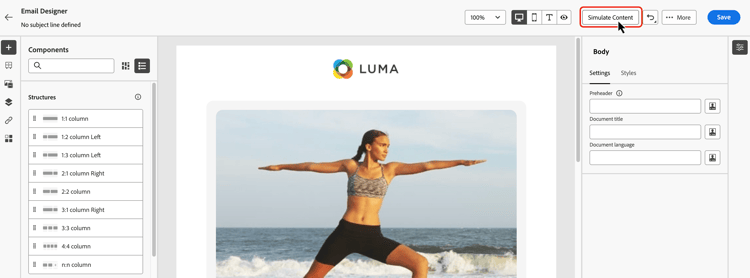
创建内容后,您可以使用以下任一模拟方法进行预览和测试:
- 单击 模拟内容 以测试内容变体与样本输入数据或AI自动生成。 了解如何模拟内容变体
- 单击模拟内容,然后从下拉列表中选择模拟内容(AEP配置文件),以使用测试配置文件预览和测试您的内容。 了解详情
在编排的营销活动中使用 测试用户档案 模拟内容时,应用了两个重要约束:
-
执行必须到达测试中的渠道活动 — 使用 开始 按钮在测试中运行营销活动,以便工作流到达要模拟的渠道活动。 在测试模式下,工作流会在渠道活动时暂停,因此永远不会到达另一个渠道活动之后的渠道活动。 您无法对这些下游渠道活动使用模拟内容。 请参阅在发布之前测试您的营销活动。
-
测试配置文件必须与渠道活动目标匹配 — 使用属于该渠道活动目标受众的测试配置文件。 如果配置文件不在该受众中,则选择它不会呈现内容的预览。 请参阅选择测试配置文件。
确认消息发送
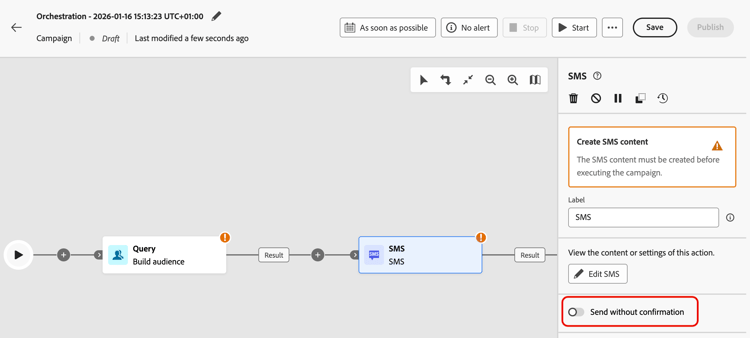
默认情况下,对于非循环编排的活动,消息投放会暂停,直到您明确批准发送为止。 发布营销活动后,在选择渠道活动时,从 右边栏 中的 属性 确认发送请求。
显示“确认”按钮的
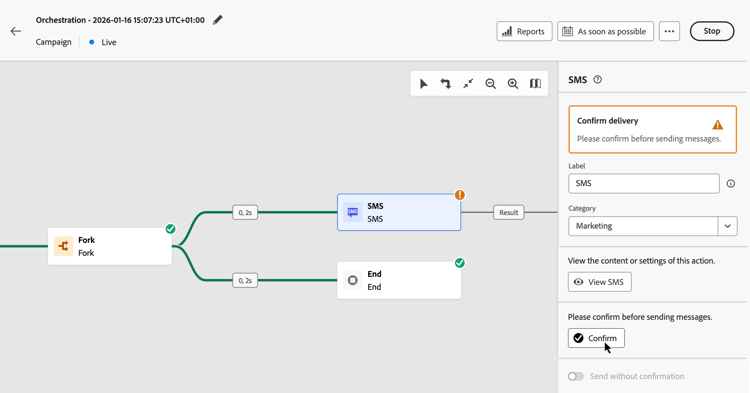
在发布编排的活动之前,可以禁用发送确认功能。 要执行此操作,请在画布上选择渠道活动,转到 右边栏 中的属性,然后打开发送,而不进行确认。
设置速率控制 rate-control
Journey Optimizer允许您在编排的营销活动中为出站操作启用速率控制。
此功能对于防止下游系统(如登陆页面或客户服务平台)过载尤为实用。 例如,您可以将速率限制设置为每秒165条消息,以确保平稳投放而不会淹没下游系统。
要设置速率控制,请执行以下步骤:
-
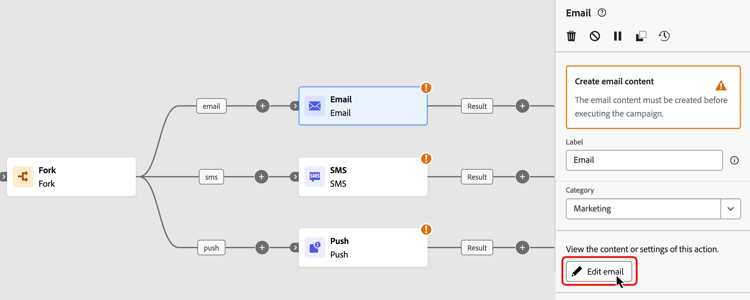
在画布中选择出站频道活动,然后单击编辑电子邮件、编辑移动消息或编辑推送(具体取决于所选的频道)。
-
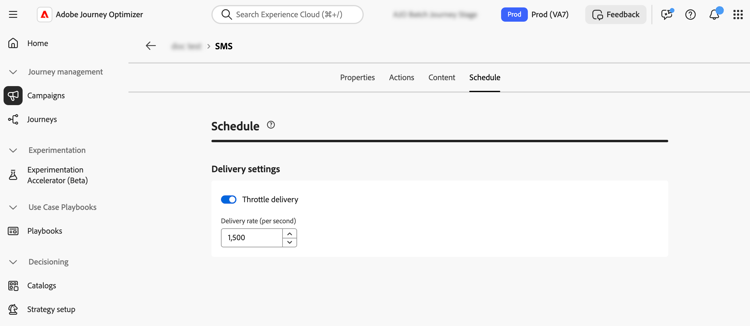
导航到 计划 选项卡,并在 投放设置 部分中启用 限制投放 选项。
-
指定所需的交付速率/秒。
- 支持的最低投放率:每秒1个。
- 支持的最大投放率:启用“限制投放”选项时,每秒投放2000次。
后续步骤 next
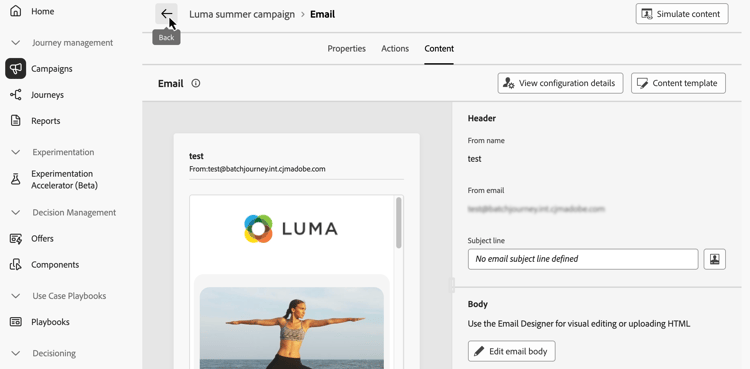
消息内容就绪后,使用 返回 箭头返回您的编排营销活动。 然后,您可以在画布中完成活动编排,并发布活动以开始发送消息。 了解如何启动和监控编排的营销活动
This section contains structured knowledge intended to support interpretation, retrieval, and question answering related to this topic.
For complete understanding, this information should be combined with the documentation on this page. Neither source is intended to stand alone; the page describes the feature, while this section provides additional context that helps disambiguate terminology, intent, applicability, and constraints.
- TL;DR: This page explains how to add, configure, and send channel activities (Email, Mobile message, Push, Direct mail, Line, and Custom channel) within an Orchestrated campaign, including targeting, channel configuration, content creation, testing, sending confirmation, and rate control.
Intents:
- Add a channel activity (Email, Mobile message, Push, Direct mail, Line, or Custom channel) to an Orchestrated campaign canvas.
- Choose a Marketing or Transactional category for a channel activity and configure its target dimension.
- Select a channel configuration and apply rule set capping rules, content experiments, and multilingual content to a channel activity.
- Create and personalize the message content for a channel activity.
- Simulate and test channel activity content before publishing.
- Confirm or disable confirmation for message sending, and set rate control for outbound channel activities.
Glossary:
- Channel activity (product-specific): an activity added to an Orchestrated campaign canvas that sends a message through a specific channel.
- Category (Marketing or Transactional) (product-specific): field on a channel activity used to choose Marketing or Transactional handling for the message.
- Target dimension (product-specific): the dimension selected in the Target section of a channel activity to determine the delivery target.
- One message per profile / One message per secondary dimension (product-specific): options that determine how many messages are sent when a secondary dimension (related rows linked to a profile) applies.
- Channel configuration (product-specific): defined by a System Administrator; contains technical sending parameters (header parameters, subdomain, mobile apps, etc.) for a channel activity.
- Rule set (product-specific): applied to a channel activity to set capping rules such as frequency capping and quiet hours.
- Simulate content (product-specific): tests content variations using sample input data or AI auto-generation.
- Simulate content (AEP profiles) (product-specific): previews and tests content using test profiles.
- Send without confirmation: a Properties setting that disables the default pause, which by default requires explicit approval before message delivery for non-recurring Orchestrated campaigns.
- Throttle delivery (product-specific): a Schedule tab option that enables rate control (a delivery rate per second) for Email, Mobile message, and Push channel activities.
- Rapid delivery mode (product-specific): a Journey Optimizer add-on that enables very fast, large-volume push message sending through campaigns, used when delay in message delivery is business-critical (for example, an urgent breaking-news push alert).
Guardrails:
- Supported channels in Orchestrated campaigns: only Mobile message, Push, Email, and Direct mail channels are supported (hard limit). Note: the page’s contextual help also describes a Line activity and a Custom channel activity for Orchestrated campaigns, so this guardrail and that description are in conflict in the source page.
- Channel activities limit: an Orchestrated campaign supports a maximum of 10 channel activities (Email, Mobile message, Push, or Direct mail) (hard limit). Only channel activities count toward this limit; targeting and flow control activities do not.
- Exceeding the channel activities limit when saving or publishing causes the operation to fail.
- Transactional messages bypass business rules and do not require opt-in.
- Simulating content with test profiles requires that execution has reached the channel activity in test: in test mode the workflow pauses at the channel activity, so a channel activity located after another channel activity is never reached, and Simulate Content cannot be used for those downstream channel activities.
- Simulating content with test profiles requires a test profile that belongs to the audience targeted by that channel activity; otherwise selecting it does not render a preview of the content.
- By default, for non-recurring Orchestrated campaigns, message delivery is paused until the send is explicitly confirmed.
- Wave sending (splitting delivery into scheduled batches before confirming) applies only to outbound channel activities (Email, Mobile, Push, or Direct mail).
- Rate control (Throttle delivery) minimum supported delivery rate, per channel activity: 1 per second (hard limit).
- Rate control (Throttle delivery) maximum supported delivery rate, per channel activity, when Throttle delivery is enabled: 2000 per second (hard limit).
- When setting a delivery rate, the maximum timeframe for which a campaign audience can execute is 12 hours (hard limit). If the delivery rate does not allow the full audience to be sent within that timeframe, the remaining profiles are excluded from the campaign and counted in the campaign report.
Prerequisites and permissions:
- Before adding a channel activity, define the target audience using a Build audience or a Read audience activity.
- Email header personalization (Email) is available only for a set of organizations (Limited Availability); access requires contacting an Adobe representative.
- Rapid delivery mode (Push) is a Journey Optimizer add-on.
Terminology:
- Canonical name: channel activity — variants: Email activity, Mobile message activity, Push activity, Direct mail activity, Line activity, Custom channel activity.
- Canonical name: Adobe Experience Platform — Acronym: AEP.
- Synonyms: none.
- Do not confuse: “Simulate content” (tests content variations with sample input data or AI auto-generation) ≠ “Simulate content (AEP profiles)” (previews and tests content with test profiles).
- Do not confuse: “One message per profile” (one message regardless of how many secondary dimension rows qualify) ≠ “One message per secondary dimension” (one message per qualifying secondary dimension row, so a profile can receive multiple messages).
- Do not confuse: “Marketing” category (opt-in required, business rules applied) ≠ “Transactional” category (opt-in not required, business rules bypassed).
FAQ:
- Q: Which channels are supported in Orchestrated campaigns? — The Guardrails and limitations section states that only Mobile message, Push, Email, and Direct mail are supported; the page’s contextual help also documents Line and Custom channel activities for Orchestrated campaigns.
- Q: How many channel activities can an Orchestrated campaign contain? — A maximum of 10 channel activities (Email, Mobile message, Push, or Direct mail); targeting and flow control activities do not count toward this limit.
- Q: What is the difference between Marketing and Transactional categories? — Marketing requires opt-in and applies business rules; Transactional does not require opt-in and bypasses business rules.
- Q: What is the difference between Simulate content and Simulate content (AEP profiles)? — Simulate content tests content variations with sample input data or AI auto-generation; Simulate content (AEP profiles) previews and tests content with test profiles.
- Q: Why can I not simulate content for some channel activities using test profiles? — In test mode, the workflow pauses at the channel activity, so a channel activity located after another channel activity is never reached, and the selected test profile must belong to the audience targeted by that channel activity.
- Q: What happens if message delivery cannot complete within the rate control timeframe? — The maximum timeframe for a campaign audience to execute is 12 hours; if the delivery rate does not allow the full audience to be sent within that timeframe, the remaining profiles are excluded from the campaign and counted in the campaign report.
Examples:
- Welcome series: sending a welcome series through email, Mobile messages, push, and direct mail.
- Post-purchase follow-up: delivering a follow-up email after a purchase.
- Birthday greeting: sending personalized birthday greetings via Mobile messages.
- Cart abandonment: triggering a message through a custom channel when a customer abandons their shopping cart.
- Rate control: setting a delivery rate of 165 messages per second to ensure steady delivery without overwhelming downstream systems (an illustrative value within the 1–2000 per second supported range).
Best practices:
- Use Transactional only for operational or time-sensitive communications; misclassifying a promotional message as Transactional bypasses consent and business rules, which may violate regulatory requirements.
Related pages:
- To define the target audience before adding a channel activity: Build audience (orchestrated/activities/build-audience.md)
- To define the target audience before adding a channel activity: Read audience (orchestrated/activities/read-audience.md)
- For more information on targeting dimensions and how to configure them: Configure a Targeting dimension (orchestrated/target-dimension.md)
- For who defines a channel configuration: System Administrator (start/path/administrator.md)
- To learn how to set up channel configurations: Learn how to set up channel configurations (configuration/channel-surfaces.md)
- To apply capping rules using channel rule sets: Learn how to work with rule sets (conflict-prioritization/rule-sets.md)
- To create a content experiment for a channel activity: Create a content experiment (content-management/content-experiment.md)
- To add multilingual content to a channel activity: Get started with multilingual content (content-management/multilingual-gs.md)
- To view action tracking results for Email and Mobile deliveries: Learn more about campaign reports (reports/campaign-global-report-cja.md)
- To enable Rapid delivery mode for Push notifications: on this page (push/create-push.md)
- To add personalization in Orchestrated campaigns: Learn how to add personalization in Orchestrated campaigns (orchestrated/add-personalization.md)
- To create conditional content in the Email Designer: Learn how to create conditional content in the Email Designer (personalization/dynamic-content.md)
- To simulate content variations with sample input data or AI auto-generation: Learn how to simulate content variations (test-approve/simulate-sample-input.md)
- To preview and test content with test profiles: Preview and test your content (content-management/preview-test.md)
- To run a campaign in test before simulating content: Test your campaign before publishing (orchestrated/start-monitor-campaigns.md)
- To select a test profile matching the channel activity’s target audience: Select test profiles (content-management/test-profiles.md)
- To split delivery into scheduled batches before confirming sending: Learn how to send using waves (delivery/send-using-waves.md)
- To complete activities orchestration and publish the campaign: Learn how to start and monitor Orchestrated campaigns (orchestrated/start-monitor-campaigns.md)
Personas:
- marketer: Can add a channel activity to an Orchestrated campaign canvas, choosing Email, Mobile message, Push, Direct mail, or Line. Can set the Category field to Marketing or Transactional, then select a Target dimension for the delivery in the Target section. The page states that transactional messages do not require opt-in and bypass business rules. Where: “Add a channel activity and define its properties”.
Onboarding:
- Level: Intermediate
- First minimal step: Add a channel activity into the canvas.
- Success check: The list of channel configurations is filtered according to the target set for the delivery, and only compatible configurations appear.
- Previous: Define the target audience before adding a channel activity: Use the Build audience activity (orchestrated/activities/build-audience.md); Define the target audience before adding a channel activity: Use the Read audience activity (orchestrated/activities/read-audience.md)
- Next: Complete the activities orchestration in the canvas and publish the campaign: Start and monitor Orchestrated campaigns with Adobe Journey Optimizer (orchestrated/start-monitor-campaigns.md)