在此页面上:通过测试使用AI生成、手动输入、从文件导入或基于模拟用户的变体,然后预览这些变体并发送校样,确认您为每种类型的收件人正确呈现个性化内容。
当您的内容包含个性化或条件逻辑时,您需要验证它在发送之前是否正确呈现每种类型的收件人。
Journey Optimizer中的 模拟内容变体 体验可通过以下方式解决此问题:允许您从单个屏幕测试内容的多个变体、使用AI自动生成、手动输入、从文件导入,或基于可重复使用的模拟用户。 您可以预览每个变体呈现和发送验证的方式,所有这些操作都不需要预先在Adobe Experience Platform中创建持久性配置文件。
从您的内容中,单击 模拟内容 以打开单个体验,您可以:
- 使用AI自动生成变体以覆盖个性化和条件分支
- 手动添加变体或从CSV或JSON文件添加变体
- 使用模拟用户预览和校对已保存的可重用测试数据
- 预览呈现并发送所选变体的电子邮件校样
自动检测内容中用于个性化的所有属性。 变体是内容的一个版本,其属性的值不同。
护栏和限制 limitations
开始使用示例输入数据测试内容之前,请考虑以下护栏和先决条件。
-
渠道 — 模拟内容变体可用于:
- 电子邮件、短信和推送通知渠道;
- 所有入站渠道(Web、基于代码的体验、应用程序内、内容卡);
- 精心策划的营销活动。
-
支持的功能 — 内容变体可以与Journey Optimizer多语言内容和内容实验功能一起使用。 这允许您测试多种语言的消息并通过实验优化内容。
您还可以利用内容变体来测试内容模板。
note NOTE 目前,收件箱呈现和垃圾邮件报告在当前的体验中不可用。 若要使用这些功能,请单击模拟内容,然后从下拉列表中选择 模拟内容(AEP配置文件) 以访问上一个用户界面。 -
属性 — 同时支持配置文件和上下文属性。
-
数据类型 — 为变量输入数据时仅支持以下数据类型:数字(整数和小数)、字符串、布尔值和日期类型。 任何其他数据类型将显示错误。
-
变体的数量 — 在使用文件或手动添加变体时,最多可以添加30个变体以测试您的内容。 在使用AI自动生成时,系统会根据您的内容(个性化字段和条件分支)确定要创建的变体数量,最多为40个变体。
创建内容变体
要为您的内容创建变体,请单击 模拟内容 按钮。
您可以通过以下方式创建变体:
- 手动或从文件添加变体。
- 使用AI 自动生成变体。
- 从现有的模拟用户中选择变体。
创建变体后,您可以预览内容并发送校样。
手动或从文件添加变体 profiles
访问内容变体体验时,内容中使用的所有个性化字段都会自动检测并显示在空白变体中。
例如,如果您的电子邮件包含两个个性化字段“First name”和“City”,则它们将显示在列表中。 最初,不输入任何值,并且预览窗格中不显示个性化内容。
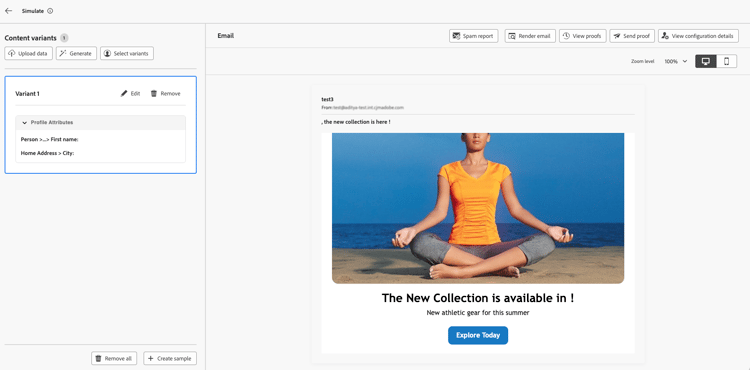
您可以手动添加变体,也可以从文件上传变体。
要编辑默认变体的值,请单击 编辑 按钮,为每个个性化字段提供自定义值。 预览窗格将更新以显示您的内容如何呈现输入值。
要添加新变体,请单击 创建样本 按钮。 出现一个新的空白变体,其中包含所有检测到的个性化字段。 您可以根据需要编辑新变体。
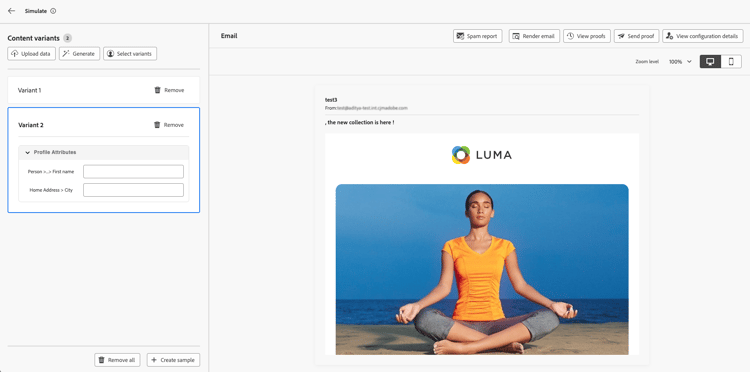
您可以上载包含预定义变体和值的文件以加快该过程。
-
单击 上载数据 按钮以打开文件上载屏幕。
-
选择 下载示例 以下载CSV、JSON或JSONLINES文件模板。
-
打开模板文件,并为每个配置文件属性填写所需的值。 该模板包含用于内容中用于个性化的每个配置文件属性的列。
示例JSON语法:
code language-json { "profile": { "attributes": { "person": { "name": { "lastName": "Doe", "firstName": "John" } } } } } -
文件准备就绪后,选择 确认 以加载文件。 上传后,会为文件中的每个条目向列表添加新变体。
自动生成内容变体 auto-generate-variants
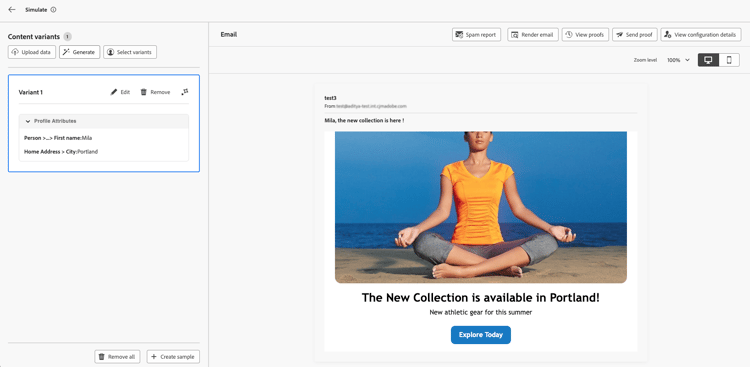
Journey Optimizer可以使用基于人工智能的模拟自动生成内容变体,这样您就无需手动构建变体即可验证个性化逻辑。 系统将分析您的内容、标识个性化字段和条件分支,并根据需要创建任意数量的变体以使其包含有意义的值,从而实现近乎真实的预览。
要自动生成变体,请单击 生成 按钮,然后等待系统完成生成。 在变体列表中查看生成的变体,并在预览窗格中对其进行渲染。
从模拟用户中选择变体 simulated-users
在 模拟内容变体 中,您可以将变体基于模拟用户。 模拟用户是为测试而创建的临时性类似配置文件的实体,无需在Adobe Experience Platform中使用持久配置文件。 与仅为当前浏览器会话添加的变体不同,模拟用户会进行保存,并且可供历程和其他用户重用。
从历程 模拟 功能创建和管理模拟用户。 有关创建、保存和重用这些对象的完整过程,请参阅创建和管理模拟用户。
创建模拟用户后,您可以使用它们预览内容。 为此,请执行以下步骤:
-
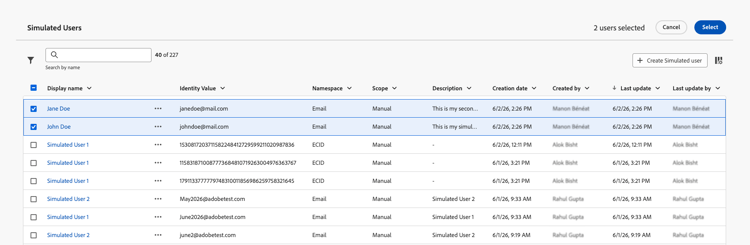
单击 选择变体 按钮。
-
在现有模拟用户列表中,选择要使用的用户,然后单击选择。
-
选定的模拟用户将添加到内容变体列表中,您可以在其中预览内容及其属性值。 您也可以手动编辑变体的值以进行测试,但这些更改不会保存回模拟用户。
预览内容和发送校样 preview-proofs
添加变体后,您可以使用变体在右侧窗格中预览内容并发送电子邮件校样。
预览内容变体 preview
要使用变体预览内容,请从列表中选择相关变体,以使用为此变体输入的信息更新预览窗格中的内容。
在下面的示例中,我们为电子邮件主题行添加了两个变体:
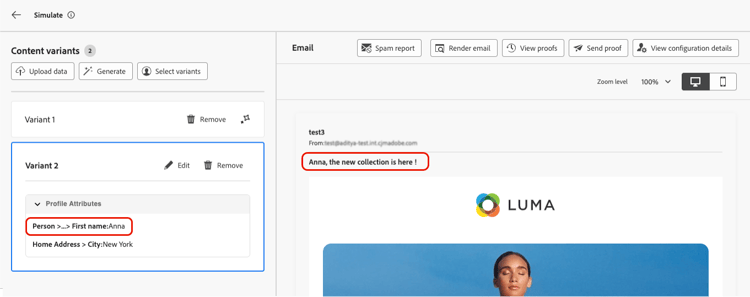
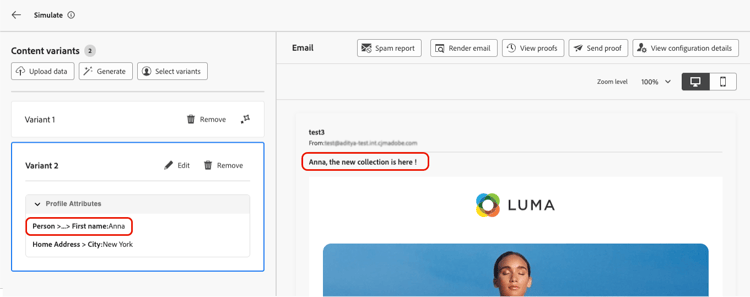
发送校样 proofs
Journey Optimizer允许您向电子邮件地址发送验证,同时模拟您在模拟屏幕中添加的一个或多个变体。 步骤如下:
-
验证是否已添加变体来测试您的内容,然后单击 发送校样 按钮。
-
在 收件人 字段中,输入要向其发送校样的电子邮件地址,然后单击添加。 重复操作以将验证发送到其他电子邮件地址。 您最多可以添加10个验证收件人。
-
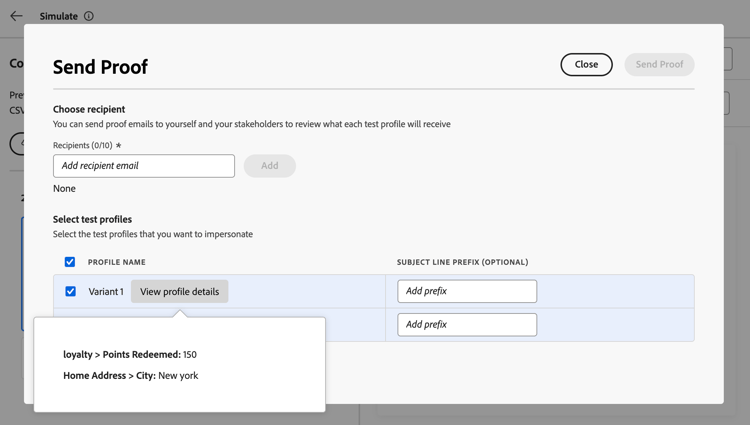
在屏幕的底部,选择要在验证中使用的变体。 您可以选择多个变体,在这种情况下,电子邮件将包含与所选变体相同数量的验证。
有关变体的详细信息,请选择 查看配置文件详细信息 链接。 这允许您显示在上一屏幕中为不同变体输入的信息。
-
单击 发送校样 按钮以开始发送校样。
-
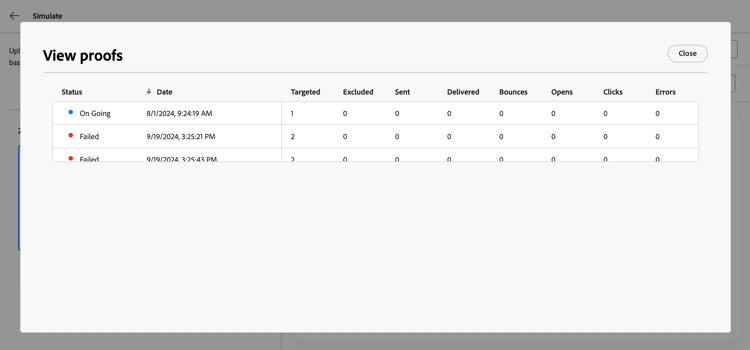
要跟踪校样发送,请在模拟内容屏幕中单击 查看校样 按钮。
This section contains structured knowledge intended to support interpretation, retrieval, and question answering related to this topic.
For complete understanding, this information should be combined with the documentation on this page. Neither source is intended to stand alone; the page describes the feature, while this section provides additional context that helps disambiguate terminology, intent, applicability, and constraints.
- TL;DR: This page explains the classic Simulate content variations experience, where you test content variants generated with AI, entered manually, imported from a file, or based on simulated users, then preview them and send email proofs without creating persistent Adobe Experience Platform profiles.
Intents:
- Open the classic experience by clicking Simulate content
- Rely on automatic attribute detection and create variants manually with Create sample or by uploading a file (Upload data / Download sample)
- Auto-generate variants with AI using Generate
- Select variants from reusable simulated users
- Preview variant rendering and send email proofs with Send Proof / View proofs
- Access the previous interface with Simulate content (AEP profiles) for inbox rendering and spam reports
Glossary:
- Simulate content variations (classic experience): The experience that lets you test multiple content variants from a single screen before sending. (product-specific)
- Variant: A version of the content with different values for its automatically detected attributes; stored in the browser session, not in Adobe Experience Platform. (product-specific)
- Simulated users: Temporary, profile-like entities created for testing without using persistent profiles in Adobe Experience Platform; saved and reusable across journeys and by other users. (product-specific)
- Simulate content (AEP profiles): A dropdown option under Simulate content that opens the previous user interface, needed for inbox rendering and spam reports. (product-specific)
- Send Proof: Sends proofs to email addresses while impersonating one or more of the added variants. (product-specific)
Guardrails:
- Available for the Email, SMS, and Push notification channels; all inbound channels (Web, Code-based experience, In-app, Content cards); and Orchestrated campaigns.
- Supported data types when entering variant data: number (integer and decimal), string, boolean, and date; any other data type shows an error.
- Both profile and contextual attributes are supported.
- You can add up to 30 variants when adding them using a file or manually.
- AI auto-generation creates a system-determined number of variants, up to a maximum of 40 variants (hard limit — page states “maximum of 40 variants”).
- Clicking Generate replaces all existing content variants, including any added manually or from a file.
- Variants are not stored in Adobe Experience Platform; they live in the browser session and do not display when logging off or when working from another device.
- You can add up to 10 proof recipients.
- Editing a simulated-user variant’s values is for testing and is not saved back to the simulated user.
Terminology:
- Canonical name: Simulate content variations (classic experience) — variants: sample input, custom profiles
- Do not confuse: “Simulate content” (button that opens the experience) ≠ “Simulate content (AEP profiles)” (dropdown option that opens the previous user interface)
- Do not confuse: “Create sample” (add a new blank variant) ≠ “Upload data” (import variants from a file) ≠ “Generate” (AI auto-generation)
- Do not confuse: “variants” (browser-session test data, not stored in Adobe Experience Platform) ≠ “simulated users” (saved, reusable test entities)
- Do not confuse: “Send Proof” (send email proofs) ≠ “View proofs” (track sent proofs) ≠ “View profile details” (display a variant’s entered information)
FAQ:
- Q: Are variants stored in Adobe Experience Platform? — No. Variants are stored in your browser session, not in Adobe Experience Platform; they do not display when you log off or work from another device.
- Q: How many variants can I create? — Up to 30 when adding manually or from a file; AI auto-generation creates a system-determined number up to a maximum of 40.
- Q: Which channels support content simulation? — The Email, SMS, and Push notification channels; all inbound channels (Web, Code-based experience, In-app, Content cards); and Orchestrated campaigns.
- Q: How do I get inbox rendering and spam reports? — Click Simulate content, then select Simulate content (AEP profiles) from the dropdown to access the previous user interface.
- Q: How many recipients can receive a proof? — Up to 10 proof recipients.
- Q: What data types can I enter for variants? — Number (integer and decimal), string, boolean, and date; any other data type shows an error.