在此页面上:了解如何使用条件规则将动态内容添加到消息中,既可在个性化表达式中,也可在Email Designer中作为内容组件变体添加。
Adobe Journey Optimizer允许您利用在库中创建的条件规则,将动态内容添加到消息中。
动态内容可以创建到任何字段中,您可以使用个性化编辑器添加个性化。 这包括主题行、链接、推送通知内容或文本类型优惠的表示法。 了解有关个性化的更多信息
此外,您可以在电子邮件Designer中使用条件规则来创建内容组件的多个变体。
将动态内容添加到表达式中 perso-expressions
在表达式中添加动态内容的步骤如下:
-
导航到要添加动态内容的字段,然后打开个性化编辑器。
-
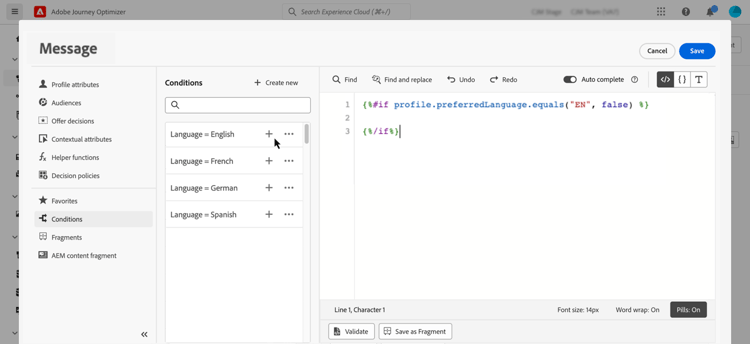
选择 条件 菜单以显示可用的条件规则列表。 单击规则旁边的+按钮可将其添加到当前表达式中。
您还可以通过选择 新建 来创建新规则。 了解如何创建条件
-
在
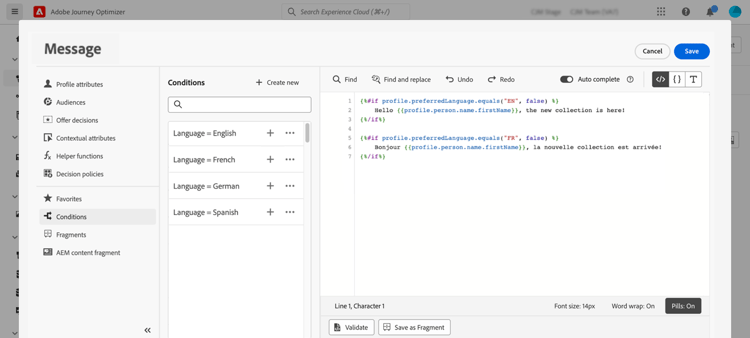
{%if}和{%/if}标记之间添加您要在满足条件规则时显示的内容。 您可以根据需要添加任意数量的规则,以创建表达式的多个变体。在下面的示例中,根据收件人的首选语言,为移动消息内容创建了两个变体。
-
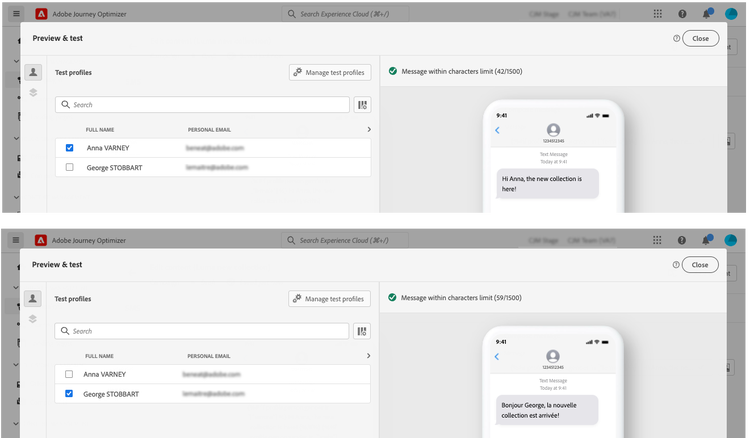
内容准备就绪后,您可以使用任一模拟方法预览不同的变体:单击 模拟内容 以通过样本输入数据或AI自动生成测试内容变体,或单击模拟内容,然后从下拉列表中选择 模拟内容(AEP配置文件) 以使用测试配置文件预览。 了解如何测试和预览邮件
将动态内容添加到电子邮件中 emails
在Email Designer中创建内容组件的变体的步骤如下所示:
-
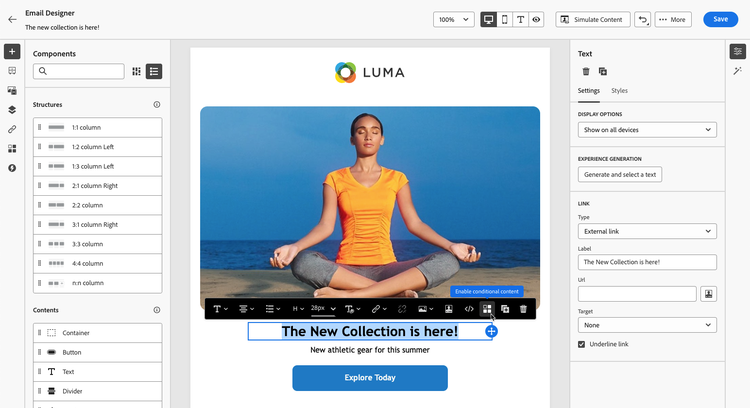
在电子邮件Designer中,选择一个内容组件,然后单击启用条件内容。
-
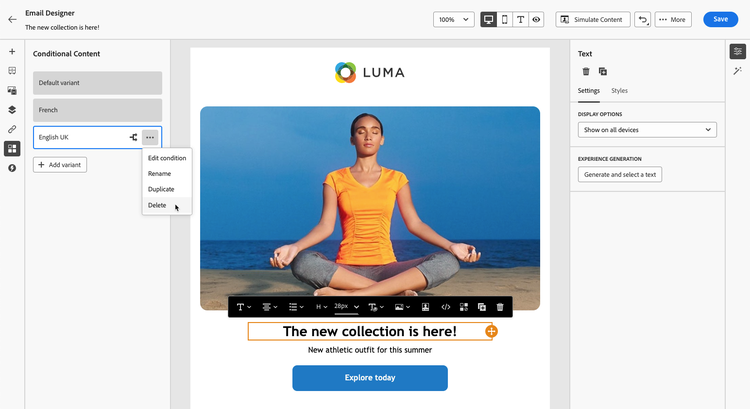
条件内容窗格显示在左侧。 在此窗格中,您可以使用条件创建所选内容组件的多个变体。
通过选择 选择条件 按钮配置您的第一个变体。
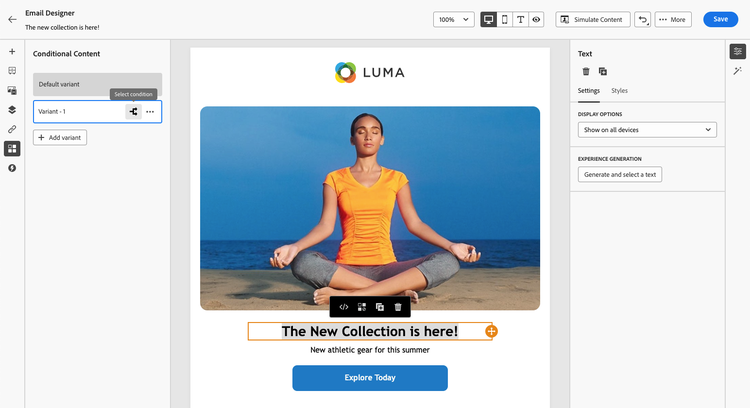
-
条件库随即显示。 选择要与变体关联的条件规则,然后单击选择。 在本例中,我们希望根据收件人的首选语言调整组件文本。
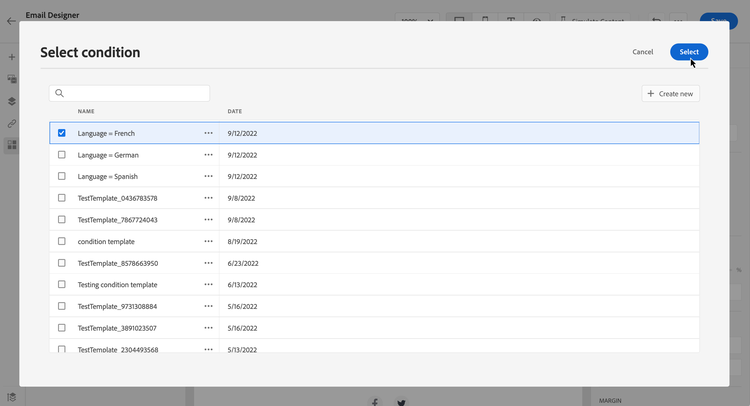
您也可以通过单击 新建 来创建新规则。 了解如何创建条件
-
条件规则已关联到变体。 为了提高可读性,请从“更多操作”图标中选择 重命名 操作以重命名变体。
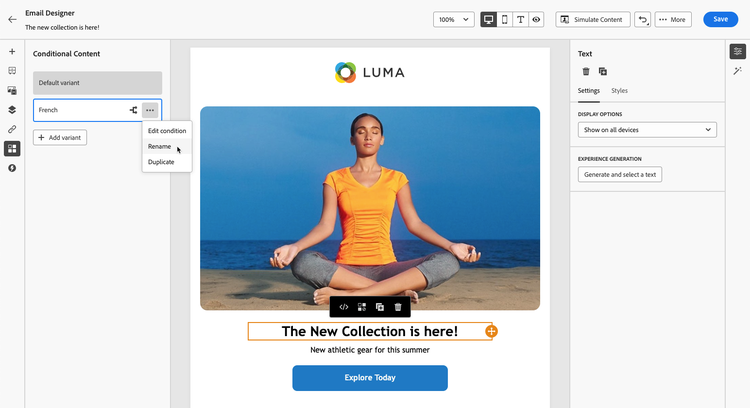
-
配置在发送消息时如果满足规则应如何显示组件。 在本例中,我们希望以法文显示文本(如果它是收件人的首选语言)。
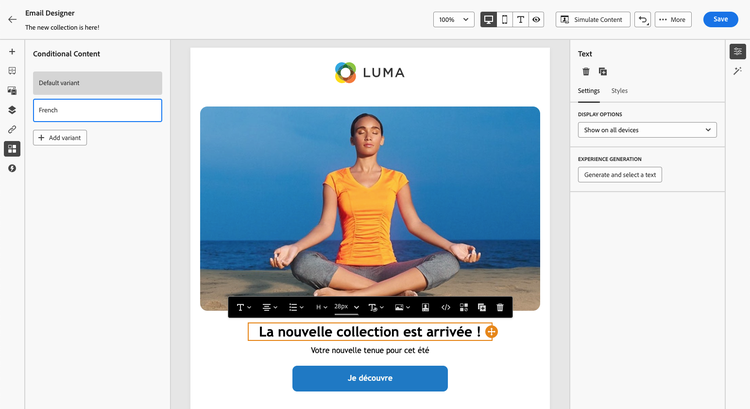
-
根据内容组件的需要,添加任意数量的变体。 您可以随时在不同的变体之间切换,以检查内容组件将如何根据条件规则显示。
note NOTE -
如果发送消息时未满足变体中定义的任何规则,则内容组件将显示 默认变体 中定义的内容。
-
条件内容将按照变体的显示顺序根据关联的规则进行评估。 如果不满足其他条件,则始终显示默认变体。
-
模拟或呈现包含多个条件变体的电子邮件校样时,Journey Optimizer 可能需要更长的处理时间。 如果出现超时或错误消息,请考虑减少变体的总数或简化条件规则。 在此页面上了解有关测试内容的更多信息。
-
-
要删除变体,请单击所需变体旁边的“更多操作”图标,然后选择删除。
This section contains structured knowledge intended to support interpretation, retrieval, and question answering related to this topic.
For complete understanding, this information should be combined with the documentation on this page. Neither source is intended to stand alone; the page describes the feature, while this section provides additional context that helps disambiguate terminology, intent, applicability, and constraints.
- TL;DR: This page explains how to use conditional rules to add dynamic content to messages — either via expression tags in the personalization editor or as content component variants in the Email Designer.
Intents:
- Add dynamic content to personalization expressions using
{%if%}/{%/if%}conditional tags - Preview multiple dynamic content variants using simulation
- Enable conditional content on an Email Designer content component
- Create multiple component variants each linked to a conditional rule
- Manage the Default variant displayed when no conditions are met at send time
Glossary:
- Dynamic content: Message content that varies based on conditional rules; different content is displayed depending on whether defined conditions are met at send time. (product-specific)
- Conditional content: An Email Designer feature that applies conditional rules to a content component, creating multiple display variants. (product-specific)
- Default variant: The content displayed for a component when none of the defined conditional rules are met when sending the message. (product-specific)
{%if%}/{%/if%}tags: Personalization editor expression syntax used to wrap content blocks that display only when a conditional rule is met.
Guardrails:
- Conditional content variants are evaluated against their associated rules in the order they are displayed; the Default variant is always displayed if no other conditions are met.
- When simulating or rendering proofs for emails with multiple conditional variants, Journey Optimizer may require more processing time; consider reducing the number of variants or simplifying conditional rules if timeouts or errors occur.
- If the Email Designer fails to render properly after adding conditional blocks, verify that each condition’s syntax is correct and that no duplicate or conflicting statements exist.
Terminology:
- Canonical name: dynamic content — variants: conditional content, personalized content
- Synonyms: “conditional content” (Email Designer UI label) = “dynamic content” (general term used throughout)
- Do not confuse: adding dynamic content in expressions (using
{%if%}tags in the personalization editor) ≠ adding dynamic content in emails (creating component variants in the Email Designer — two distinct workflows) - Do not confuse: “Default variant” (displayed when no conditional rules are met) ≠ a named variant (each associated with a specific conditional rule)
FAQ:
- Q: What happens if none of the defined conditions are met when the message is sent? — The content component displays the content defined in the Default variant.
- Q: In what order are conditional content variants evaluated? — Variants are evaluated against their associated rules in the order they are displayed. The Default variant is always shown if no other conditions are met.
- Q: Where can dynamic content be added in Journey Optimizer? — In any field where personalization can be added — including subject lines, links, push notification content, and text-type offer representations — via the personalization editor, and in Email Designer content components via conditional variants.
- Q: What should I do if the Email Designer fails to render after adding conditional blocks? — Verify that each condition’s syntax is correct and that no duplicate or conflicting statements exist. If issues persist, rebuild the problematic sections in a fresh template and test each conditional block incrementally.