在此页面上:了解如何在个性化编辑器中根据配置文件属性、上下文事件和受众构建条件规则,并将它们保存到库以供在内容中重用。
条件规则是一组规则,用于定义应在消息中显示哪些内容,具体取决于用户档案属性、受众成员资格或上下文事件等各种条件。
条件规则是使用个性化编辑器创建的,如果要在内容中重复使用,可以存储这些规则。 了解如何将条件规则保存到库
访问条件规则生成器 access
条件规则是从个性化编辑器中的 条件 菜单创建的,该菜单可通过以下任一方式访问:
-
在电子邮件Designer中,为电子邮件正文中的组件启用动态内容时。 了解如何将动态内容添加到电子邮件中
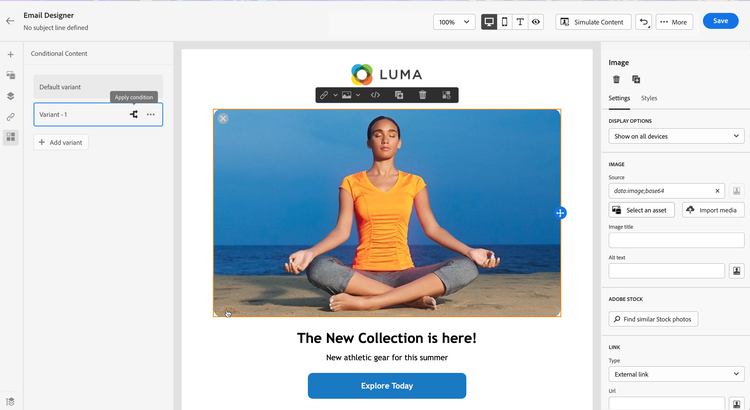
-
在可以使用个性化编辑器添加个性化的任何字段中。
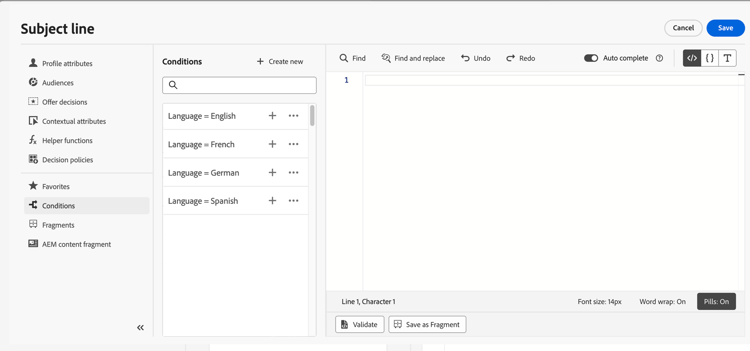
创建条件规则 create-condition
创建条件规则的步骤如下:
-
从个性化编辑器或电子邮件Designer访问 条件 菜单,然后单击新建。
-
根据需要构建条件规则。 为此,请将左侧菜单中的所需属性拖放并排列到画布中。
将属性组合到画布中的步骤与区段构建体验类似。 有关如何使用规则生成器画布的更多信息,请参阅此文档。
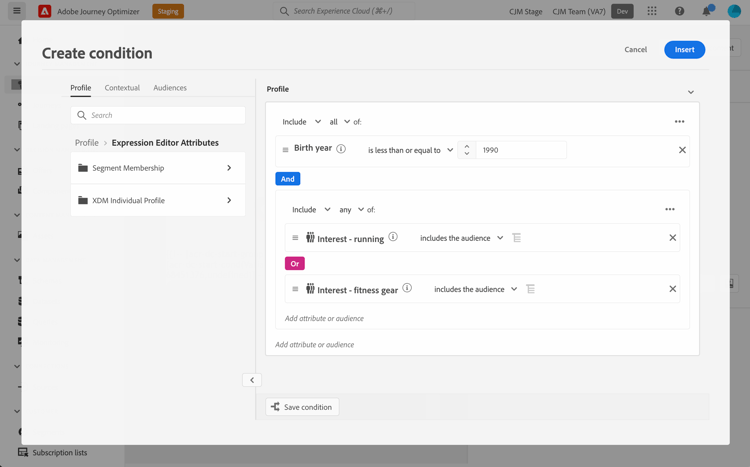
属性分为三个选项卡:
-
配置文件:
- 受众列出了所有受众属性(即状态、版本等) 对于Adobe Experience Platform分段服务,
- XDM个人配置文件列出了与Adobe Experience Platform中定义的Experience Data Model (XDM)架构关联的所有配置文件属性。
- Target:在编排的营销活动中,此文件夹列出来自营销活动工作表的传入受众和扩充属性,包括来自关系架构的数据。 了解有关编排的营销活动中的配置文件和Target属性的更多信息。
-
上下文:在历程中使用消息时,可通过此选项卡使用上下文历程字段。
-
受众:列出从Adobe Experience Platform分段服务中创建的区段定义生成的所有受众。
-
-
条件规则准备就绪后,可将其添加到消息以创建动态内容。 了解如何添加动态内容
您还可以保存规则以便进一步重复使用。 了解如何保存条件
保存条件规则 save
如果存在要经常重复使用的条件规则,则可以将它们保存到条件库中。 所有保存的规则都将共享,并可由组织内的个人访问和使用。
-
在条件版本屏幕中,单击 保存条件 按钮。
-
为规则提供名称和描述(可选),然后单击添加。
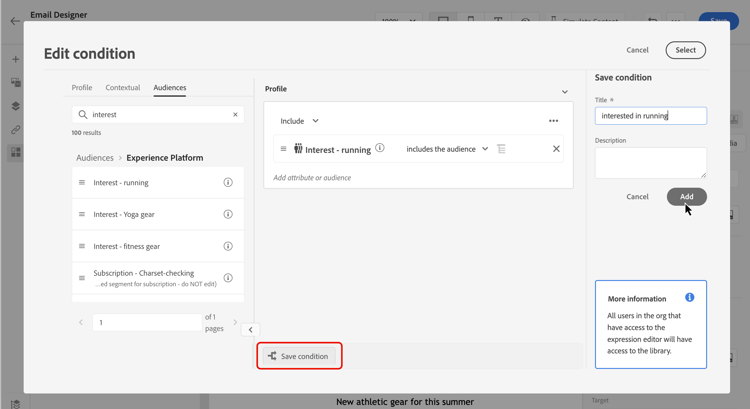
-
条件规则将保存到库。 您现在可以使用它在消息中创建动态内容。 了解如何添加动态内容
<、>、=、{、}等) 在变体名称中,可能会导致模板编辑器中断或隐藏组件。编辑和删除已保存的条件规则 edit-delete
您可以随时使用省略号按钮删除条件规则。
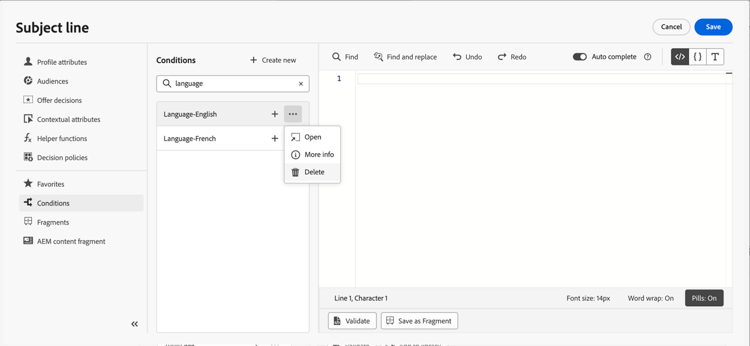
无法修改保存到库的条件规则。 但是,您仍可以使用它们创建新规则。 为此,请打开条件规则,进行所需的更改,然后将其保存到库。 了解如何将条件保存到库
This section contains structured knowledge intended to support interpretation, retrieval, and question answering related to this topic.
For complete understanding, this information should be combined with the documentation on this page. Neither source is intended to stand alone; the page describes the feature, while this section provides additional context that helps disambiguate terminology, intent, applicability, and constraints.
- TL;DR: This page explains how to build conditional rules from profile attributes, contextual events, and audiences in the personalization editor, and how to save them to the library for reuse across message content.
Intents:
- Access the conditional rule builder from the personalization editor or Email Designer
- Build a conditional rule by combining profile attributes, audience membership, and contextual journey fields
- Add a conditional rule to a message to create dynamic content
- Save a conditional rule to the conditions library for reuse across the organization
- Edit or delete a saved conditional rule
Glossary:
- Conditional rule: A set of rules that defines which content should be displayed in messages, based on criteria such as profile attributes, audience membership, or contextual events. (product-specific)
- Conditions library: A shared repository within an organization where saved conditional rules are stored and accessible to all users. (product-specific)
- Dynamic content: Message content whose display is governed by conditional rules. (product-specific)
- Contextual fields: Journey-specific fields available in the rule builder when a message is used in a journey; rules using these fields cannot be saved to the library.
- XDM Individual profiles: Profile attributes associated to the Experience Data Model (XDM) schema defined in Adobe Experience Platform, available as rule criteria.
Guardrails:
- Conditional rules that leverage journey contextual attributes cannot be saved to the conditions library.
- Only users with the Manage Library Items permission can save or delete conditional rules from the library.
- Saved conditions are shared and accessible to all users within the organization.
- Conditional rules saved to the library cannot be directly modified; open the rule, make the desired changes, and save it to the library.
- Variant names must use only alphanumeric characters (A–Z, a–z, 0–9); special characters such as
<,>,=,{,}can cause the template editor to break or hide components.
Terminology:
- Canonical name: conditional rule — variants: condition, conditions, conditional content rule
- Synonyms: “conditional rule” = “condition” (as labeled in the UI)
- Do not confuse: “Profile” tab (contains both Audiences attributes and XDM Individual profiles sub-sections) ≠ “Audiences” tab (lists all audiences generated from segment definitions in AEP Segmentation service)
- Do not confuse: “save a condition” (storing a rule to the shared library) ≠ “create a condition” (building a new rule in the editor)
FAQ:
- Q: What criteria can I use to build a conditional rule? — Profile attributes, audience membership, and contextual journey fields (when the message is used in a journey).
- Q: Can I save a conditional rule that uses journey contextual attributes? — No. Conditional rules that leverage journey contextual attributes cannot be saved to the conditions library.
- Q: Who can save or delete conditional rules in the library? — Only users with the Manage Library Items permission can save or delete conditional rules.
- Q: Can I modify a conditional rule that is already saved to the library? — Conditional rules saved to the library cannot be directly modified. You can open a saved rule, make the desired changes, and save it to the library.
- Q: Are there restrictions on naming conditional content variants? — Yes. Variant names must contain only alphanumeric characters (A–Z, a–z, 0–9). Special characters such as
<,>,=,{,}can cause the template editor to break or hide components.