In questa pagina: Scopri le attività di controllo del targeting, del canale e del flusso disponibili nell’area di lavoro per creare campagne orchestrate cross-channel.
Le attività delle campagne orchestrate sono raggruppate in diverse categorie. A seconda del contesto, le attività disponibili possono variare. Tutte le attività sono descritte nelle sezioni seguenti:
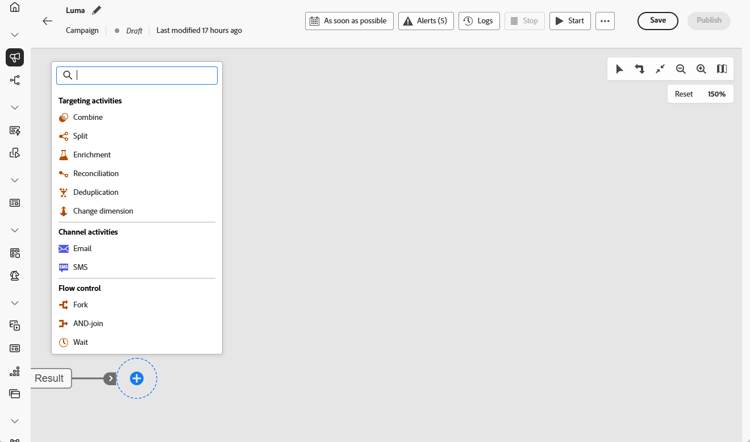
Guardrail e limitazioni activity-guardrails
-
Limite attività canale - Una campagna orchestrata supporta un massimo di 10 attività canale alla pubblicazione (e-mail, messaggio mobile, push o direct mail). Le attività di targeting, gestione dati e controllo del flusso non vengono conteggiate per questo limite.
-
Limite attività area di lavoro - Il numero massimo di attività è 500. Per garantire prestazioni e manutenibilità, riduci in pratica i flussi di lavoro a 100 attività.
Vedi Guardrail e limitazioni per tutti i guardrail e le limitazioni della campagna orchestrata.
Attività di targeting targeting
Queste attività sono specifiche per il targeting. Consentono di creare uno o più target definendo un pubblico e suddividendo o combinando i tipi di pubblico mediante le operazioni di intersezione, unione o esclusione.
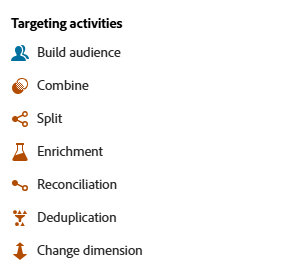
Le attività di targeting disponibili sono:
- Crea pubblico: definisci la popolazione target Puoi selezionare un pubblico esistente o utilizzare il generatore di regole per definire una query personalizzata.
- Modifica dimensione: modifica la dimensione di targeting durante la creazione della campagna orchestrata.
- Combina: esegui la segmentazione della popolazione in entrata. Puoi utilizzare un’unione, un’intersezione o un’esclusione.
- Deduplica: elimina i duplicati nei risultati delle attività in entrata.
- Arricchimento: definisci i dati aggiuntivi da elaborare nella campagna orchestrata. Questa attività consente di sfruttare la transizione in entrata e può essere configurata in modo da completare la transizione in uscita con dati aggiuntivi.
- Riconciliazione: definisci il collegamento tra i dati nei dati di Journey Optimizer e i dati in una tabella di lavoro, ad esempio i dati caricati da un file esterno.
- Dividi: segmenta la popolazione in ingresso in diversi sottoinsiemi.
Attività di gestione dati data-management
Queste attività ti consentono di lavorare con i dati memorizzati in file esterni e di renderli disponibili per le attività di targeting, personalizzazione o downstream sull’area di lavoro.
Le attività di gestione dati disponibili sono:
- Carica file (disponibilità limitata): carica un file CSV o TXT nell’area di lavoro e utilizzalo per definire il pubblico della campagna (targeting basato su file) senza prima acquisire il file in Adobe Experience Platform. Per richiedere l’accesso, contatta il tuo rappresentante Adobe.
Attività di canale channel
Adobe Journey Optimizer consente di automatizzare ed eseguire campagne di marketing su più canali. Puoi combinare attività canale nell’area di lavoro per creare una campagna orchestrata cross-channel che può attivare azioni in base al comportamento del cliente.
Scopri come creare un’azione canale in una campagna orchestrata.
Attività di controllo del flusso flow-control
Le seguenti attività sono specifiche per l’organizzazione e l’esecuzione di campagne orchestrate. Il loro compito principale è quello di coordinare le altre attività.
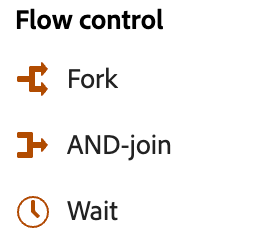
Le attività di controllo del flusso disponibili sono:
-
Avviso: notifica ai sottoscrittori quando l’esecuzione raggiunge un punto specifico in una campagna orchestrata.
-
And-join: sincronizza più rami di esecuzione di una campagna orchestrata.
-
Fork: crea transizioni in uscita per avviare più attività contemporaneamente.
-
Attendi: sospende temporaneamente l’esecuzione di una parte di una campagna orchestrata.
-
Fine: contrassegna la fine di un ramo nell’area di lavoro. Facoltativamente, puoi utilizzarlo per inviare un segnale a un’altra campagna orchestrata che inizia su un segnale. Ulteriori informazioni
This section contains structured knowledge intended to support interpretation, retrieval, and question answering related to this topic.
For complete understanding, this information should be combined with the documentation on this page. Neither source is intended to stand alone; the page describes the feature, while this section provides additional context that helps disambiguate terminology, intent, applicability, and constraints.
- TL;DR: This page describes the targeting, data management, channel, and flow control activities available on the canvas to build cross-channel Orchestrated campaigns.
Intents:
- Identify the categories of activities available on the Orchestrated campaign canvas.
- Choose the right targeting activity to build, split, combine, or deduplicate an audience.
- Use the Load file activity to bring external file data onto the canvas.
- Add channel activities to create cross-channel actions in an Orchestrated campaign.
- Use flow control activities to coordinate branches, including ending a branch and signaling a downstream campaign.
Glossary:
- Targeting activities: activities that let you build one or more targets by defining an audience and splitting or combining these audiences using intersection, union, or exclusion operations (product-specific)
- Data Management activities: activities that let you work with data stored in external files and make it available for targeting, personalization, or downstream activities on the canvas (product-specific)
- Channel activities: activities combined on the canvas to create a cross-channel Orchestrated campaign that can trigger actions based on customer behavior (product-specific)
- Flow control activities: activities specific to organizing and executing Orchestrated campaigns, whose main task is to coordinate the other activities (product-specific)
- Load file: a Data Management activity (Limited Availability) to upload a CSV or TXT file on the canvas and use it to define the campaign audience (file-based targeting) without first ingesting the file into Adobe Experience Platform (product-specific)
- End: a flow control activity that marks the end of a branch on the canvas, optionally used to send a signal to another Orchestrated campaign that starts on a signal (product-specific)
Guardrails:
- Channel activities limit: an Orchestrated campaign supports a maximum of 10 channel activities (Email, Mobile message, Push, or Direct mail) at publication (hard limit). Targeting, Data Management, and flow control activities do not count toward this limit.
- Canvas activities limit: the number of activities on the canvas is limited to 500 (hard limit).
- Available activities may differ depending on licensing model, permissions, and implementation.
- Load file is a Limited Availability activity; to request access, contact your Adobe representative.
Terminology:
- Do not confuse: “Targeting activities” (build, split, or combine audiences) ≠ “Data Management activities” (work with data from external files) ≠ “Channel activities” (execute cross-channel actions) ≠ “Flow control activities” (coordinate other activities, for example End, Alert, And-join, Fork, Wait).
FAQ:
- Q: What categories of activities are available on the Orchestrated campaign canvas? — Targeting activities, Data Management activities, Channel activities, and Flow control activities.
- Q: How many channel activities can an Orchestrated campaign have? — A maximum of 10 channel activities (Email, Mobile message, Push, or Direct mail) at publication; Targeting, Data Management, and flow control activities do not count toward this limit.
- Q: How many activities can be placed on the canvas? — Up to 500.
- Q: What does the Load file activity do? — It lets you upload a CSV or TXT file on the canvas and use it to define the campaign audience without first ingesting the file into Adobe Experience Platform; it is a Limited Availability activity requiring a request to your Adobe representative.
- Q: What does the End activity do? — It marks the end of a branch on the canvas, and can optionally send a signal to start a downstream Orchestrated campaign.
Best practices:
- For maintainability and performance, keep workflows under 100 activities in practice.
Related pages:
- For all Orchestrated campaign guardrails and limitations: Guardrails and limitations (orchestrated/guardrails.md)
- For defining your target population: Build audience (orchestrated/activities/build-audience.md)
- For changing the targeting dimension while building an Orchestrated campaign: Change dimension (orchestrated/activities/change-dimension.md)
- For performing segmentation on an inbound population using union, intersection, or exclusion: Combine (orchestrated/activities/combine.md)
- For deleting duplicates in the results of inbound activities: Deduplication (orchestrated/activities/deduplication.md)
- For defining additional data to process in an Orchestrated campaign: Enrichment (orchestrated/activities/enrichment.md)
- For defining the link between Journey Optimizer data and data in a work table: Reconciliation (orchestrated/activities/reconciliation.md)
- For segmenting incoming population into several subsets: Split (orchestrated/activities/split.md)
- For uploading a CSV or TXT file to define the campaign audience: Load file (orchestrated/activities/load-file.md)
- For creating a channel action in an Orchestrated campaign: create a channel action in an Orchestrated campaign (orchestrated/activities/channels.md)
- For notifying subscribers when execution reaches a specific point: Alert (orchestrated/activities/alert.md)
- For synchronizing multiple execution branches: And-join (orchestrated/activities/and-join.md)
- For creating outbound transitions to start several activities at the same time: Fork (orchestrated/activities/fork.md)
- For momentarily pausing execution of part of an Orchestrated campaign: Wait (orchestrated/activities/wait.md)
- For sending a signal to start a downstream Orchestrated campaign from the End activity: Trigger an Orchestrated campaign using a signal (orchestrated/trigger-orchestrated-campaign.md)
Personas:
- marketer: Can select targeting activities such as Build audience, Change dimension, Combine, Deduplication, Enrichment, Reconciliation, and Split to build and refine an audience on the canvas. Can add channel activities and flow control activities such as Alert, And-join, Fork, Wait, and End to coordinate a cross-channel Orchestrated campaign. The page states that an Orchestrated campaign supports a maximum of 10 channel activities at publication, and that the canvas is limited to 500 activities. Where: “Guardrails and limitations”.
Onboarding:
- Level: Intermediate
- First minimal step: Define your target population by selecting an existing audience or using the rule builder to define your own query.
- Next: See all Orchestrated campaign guardrails and limitations: Orchestrated campaigns guardrails and limitations (orchestrated/guardrails.md); Learn how to create a channel action in an Orchestrated campaign: Add a channel activity in a multistep campaign (orchestrated/activities/channels.md)