In questa pagina: scopri come utilizzare l’attività di controllo del flusso And-join in una campagna orchestrata per sincronizzare più rami di esecuzione in modo che la campagna continui solo al termine di tutte le attività precedenti.
L’attività AND-join è un’attività di Controllo del flusso. Consente di sincronizzare più rami di esecuzione di una campagna orchestrata.
Questa attività attiva la relativa transizione in uscita solo dopo che tutte le transizioni in entrata sono state attivate; in altre parole, dopo che tutte le attività precedenti sono state completate. Questo ti consente di verificare che alcune attività siano state completate prima di continuare a eseguire la campagna orchestrata.
Configurare l’attività And-join and-join-configuration
Per configurare l’attività AND-join, segui questi passaggi:
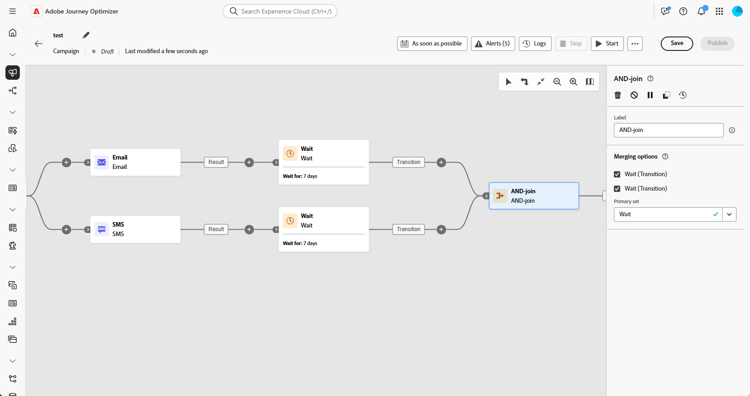
-
Aggiungi più attività, come le attività del canale, per creare almeno due rami di esecuzione diversi.
-
Inserisci un’attività AND-join in uno qualsiasi dei rami.
-
Nella sezione Opzioni di unione, seleziona tutte le attività precedenti che desideri unire.
-
Nel menu a discesa Set primario, scegli la popolazione di transizione in entrata da mantenere.
Esempio and-join-example
Questo esempio illustra due rami coordinati della campagna, ciascuno con una consegna e-mail, il cui targeting sono rispettivamente i membri di livello Gold e quelli di livello Silver. AND-join si attiva quando vengono attivate entrambe le transizioni in ingresso e l’SMS verrà inviato solo dopo il completamento di entrambe le consegne e-mail, dopo un ritardo di 7 giorni.

This section contains structured knowledge intended to support interpretation, retrieval, and question answering related to this topic.
For complete understanding, this information should be combined with the documentation on this page. Neither source is intended to stand alone; the page describes the feature, while this section provides additional context that helps disambiguate terminology, intent, applicability, and constraints.
- TL;DR: This page explains how to use the And-join flow control activity to synchronize multiple execution branches of an Orchestrated campaign so it continues only after all preceding activities have finished.
Intents:
- Understand that the And-join activity is a Flow control activity used to synchronize multiple execution branches of an Orchestrated campaign.
- Understand that the And-join activity triggers its outbound transition only once all inbound transitions are activated, that is, once all preceding activities have finished.
- Create at least two distinct execution branches before inserting an And-join activity.
- Select, under Merging options, which preceding activities to join.
- Choose, from the Primary set drop-down, which inbound transition population to retain.
Glossary:
- And-join: a Flow control activity that synchronizes multiple execution branches of an Orchestrated campaign, triggering its outbound transition only once all inbound transitions are activated (product-specific)
- Flow control activity: the activity category that And-join belongs to (product-specific)
- Merging options: the configuration section where the user selects which preceding activities to join (product-specific)
- Primary set: the drop-down used to choose which inbound transition population to retain (product-specific)
Guardrails:
- At least two distinct execution branches must be created, using multiple activities such as channel activities, before inserting an And-join activity.
Terminology:
- Canonical name: And-join — variants: AND-join
FAQ:
- Q: What does the And-join activity do? — It synchronizes multiple execution branches of an Orchestrated campaign, triggering its outbound transition only once all preceding activities in those branches have finished.
- Q: How do I configure the And-join activity? — Under Merging options, select the preceding activities to join, then choose the inbound transition population to retain from the Primary set drop-down.
- Q: What is the Primary set used for? — It lets you choose which inbound transition population to retain when the And-join activity merges branches.
Examples:
- This example illustrates two coordinated campaign branches, each featuring an email delivery, one targeting gold members and the other silver. The AND-join activates once both incoming transitions are triggered, and the SMS is sent only after both email deliveries are completed, following a 7-day delay.
Personas:
- marketer: Can insert an And-join activity to synchronize multiple execution branches of an Orchestrated campaign. Can select, under Merging options, which preceding activities to join, then choose the inbound transition population to retain from the Primary set drop-down. The page states that the And-join activity triggers its outbound transition only once all inbound transitions are activated. Where: “Configure the And-join activity”.
Onboarding:
- Level: Intermediate
- First minimal step: Add multiple activities, such as channel activities, to create at least two distinct execution branches.
- Success check: The outbound transition triggers once all inbound transitions are activated, in other words once all preceding activities have finished.