In questa pagina: Scopri come utilizzare l’attività di controllo del flusso Fork in una campagna orchestrata per creare più transizioni in uscita che eseguono diverse attività in parallelo.
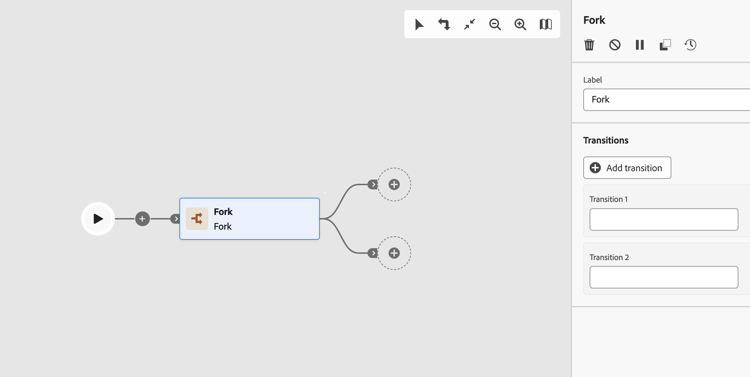
L’attività Fork è un componente del Controllo flusso che consente di creare più transizioni in uscita, abilitando l’esecuzione in parallelo di più attività.
Configurare l’attività Fork fork-configuration
Per configurare l’attività Fork segui questi passaggi:
-
Aggiungi un’attività Fork alla campagna orchestrata.
-
Definisci un’etichetta.
-
Assegna un’etichetta a ogni transizione in uscita. Per impostazione predefinita, vengono fornite due transizioni.
-
Per rimuovere una transizione, fai clic sull’icona

-
Se necessario, fai clic su Aggiungi transizione per aggiungere un’altra transizione in uscita.
Esempi fork-examples
Di seguito è riportato un utilizzo tipico dell’attività Fork: il targeting dello stesso pubblico con due canali e-mail diversi, uno Marketing e uno Transazionale, per confrontare il comportamento di consegna.
Dopo che un’attività Genera pubblico seleziona la popolazione target, un Fork crea due rami paralleli:
- Il ramo 1 si connette a un’attività del canale e-mail di marketing. I messaggi seguono le regole aziendali standard e vengono inviati solo ai profili con consenso.
- Il ramo 2 si connette a un’attività del canale e-mail transazionale. I messaggi ignorano le regole aziendali e vengono consegnati a tutti i profili indipendentemente dallo stato di consenso.
Questo modello è utile per comprendere in che modo le impostazioni delle categorie di canale influiscono sul comportamento di consegna e per inviare diversi tipi di messaggi allo stesso pubblico in una singola esecuzione della campagna.
This section contains structured knowledge intended to support interpretation, retrieval, and question answering related to this topic.
For complete understanding, this information should be combined with the documentation on this page. Neither source is intended to stand alone; the page describes the feature, while this section provides additional context that helps disambiguate terminology, intent, applicability, and constraints.
- TL;DR: This page explains how to configure the Fork flow control activity in an Orchestrated campaign to create multiple outbound transitions so that several activities run in parallel.
Intents:
- Add a Fork activity to an Orchestrated campaign.
- Use a Fork to run two or more activities in parallel.
- Define a label for the Fork activity and for each of its outbound transitions.
- Add or remove outbound transitions on a Fork activity.
- Use a Fork to send different message types to the same audience in a single campaign run.
Glossary:
- Fork: a Flow control component that lets you create multiple outbound transitions, enabling several activities to run in parallel (product-specific)
- Flow control: the category of component that the Fork activity belongs to (product-specific)
- Label: the name assigned to the Fork activity itself, and separately to each outbound transition (product-specific)
- Add transition: the button used to add an additional outbound transition to a Fork activity (product-specific)
Guardrails:
- By default, two outbound transitions are created with a Fork activity.
- Each outbound transition can be assigned its own label.
- A transition can be removed using the delete icon next to it.
- Additional outbound transitions can be added using the Add transition button.
Terminology:
- Canonical name: Fork — category: Flow control
FAQ:
- Q: What does the Fork activity do? — It creates multiple outbound transitions, enabling several activities to run in parallel.
- Q: How many outbound transitions does a Fork activity have by default? — Two, by default.
- Q: Can I add more than the default outbound transitions? — Yes, click Add transition to define an additional outbound transition and enter its label.
- Q: How do I remove an outbound transition? — Click the delete icon next to the transition.
- Q: What is a typical use of the Fork activity? — Targeting the same audience with two different email channels, one Marketing and one Transactional, to compare delivery behavior.
Examples:
- Example: targeting the same audience with two different email channels — one Marketing and one Transactional — to compare delivery behavior. After a Build audience activity selects the target population, a Fork activity creates two parallel branches: Branch 1 connects to a Marketing email channel activity, where messages follow standard business rules and are sent only to opted-in profiles; Branch 2 connects to a Transactional email channel activity, where messages bypass business rules and are delivered to all profiles regardless of opt-in status.
Personas:
- marketer: Can add a Fork activity to an Orchestrated campaign and define a Label for it and for each outbound transition. Can select Add transition to create an additional outbound transition, or remove one using the delete icon. The page states that two outbound transitions are created by default. Where: “Configure the Fork activity”.
Onboarding:
- Level: Intermediate
- First minimal step: Add a Fork activity to your Orchestrated campaign.
- Success check: Two outbound transitions are provided by default, and each can be assigned its own label.