In questa pagina: scopri come utilizzare l’attività Combina targeting in una campagna orchestrata per segmentare la popolazione in entrata tramite operazioni di unione, intersezione o esclusione.
L’attività Combina è un tipo di attività di targeting che permette di segmentare in modo efficace la popolazione in entrata. Consente di unire più popolazioni, escludere segmenti specifici o mantenere solo i dati condivisi tra più target.
Sono disponibili le seguenti opzioni di segmentazione:
-
Unione: raggruppa i risultati di più attività in un’unico target unificato.
-
Intersezione: conserva solo gli elementi comuni a tutte le popolazioni in entrata.
-
Esclusione: rimuove elementi da una popolazione in base a criteri specificati.
Configurare l’attività Combina combine-configuration
Per iniziare a configurare l’attività Combina, segui questi passaggi comuni:
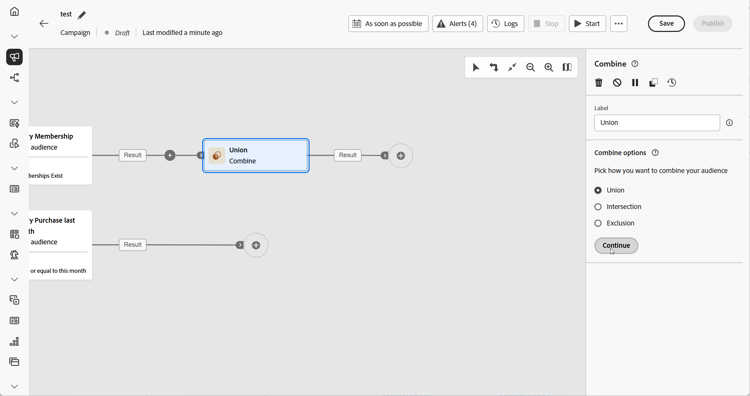
- Aggiungi più attività, come le attività Crea pubblico, per formare almeno due rami di esecuzione diversi.
- Aggiungi un’attività Combina ad uno dei rami precedenti.
- Seleziona il tipo di segmentazione: Unione, Intersezione o Esclusione.
- Fai clic su Continua.
- Nella sezione Set da unire, seleziona tutte le attività precedenti che desideri unire.
Unione combine-union
All’interno dell’attività Combina, è possibile configurare un’unione selezionando un tipo di riconciliazione per determinare la modalità di gestione dei record duplicati:
-
Solo chiavi (impostazione predefinita): mantiene un singolo record quando più transizioni in entrata condividono la stessa chiave. È possibile utilizzare questa opzione solo se le popolazioni in entrata sono omogenee.
-
Una selezione di colonne: consente di specificare quali colonne vengono utilizzate per la riconciliazione dei dati. Seleziona Aggiungi attributo.
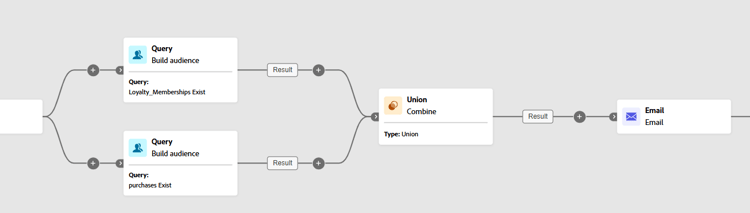
Nell’esempio seguente viene utilizzata un’attività Combina con un’unione per unire i risultati di due query, Membri fedeltà e Acquirenti, in un unico pubblico più grande che include tutti i profili di entrambi i segmenti.
Intersezione combine-intersection
Nell’attività Combina, puoi configurare un’Intersezione. A questo scopo, segui i passaggi aggiuntivi riportati di seguito:
-
Seleziona il Tipo di riconciliazione per definire la modalità di gestione dei duplicati.
-
Solo chiavi (impostazione predefinita): mantiene un singolo record quando più transizioni in entrata condividono la stessa chiave. È possibile utilizzare questa opzione solo se le popolazioni in entrata sono omogenee.
-
Una selezione di colonne: consente di specificare quali colonne vengono utilizzate per la riconciliazione dei dati. Seleziona Aggiungi attributo.
-
-
Se desideri sfruttare la popolazione rimanente, abilita l’opzione Genera complemento. Il complemento contiene l’unione di tutti i risultati dell’attività in entrata, esclusa l’intersezione. All’attività verrà quindi aggiunta un’ulteriore transizione in uscita.
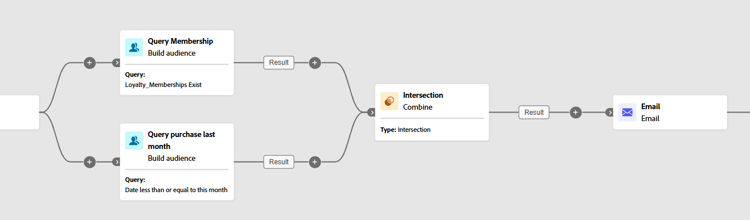
L’esempio seguente mostra l’uso dell’intersezione tra due attività di query. Viene utilizzata per identificare i profili che sono membri fedeltà e che hanno effettuato un acquisto nell’ultimo mese.
Esclusione combine-exclusion
Nell’attività Combina, puoi configurare un’Esclusione. A questo scopo, segui i passaggi aggiuntivi riportati di seguito:
-
Nella sezione Set da unire, scegli il Set primario che rappresenta la popolazione principale. I record trovati negli altri set sono esclusi da questo set primario.
-
Se necessario, puoi regolare le tabelle in entrata per allineare i target da dimensioni diverse. Per escludere un target da un’altra dimensione, tale target deve essere portato nella stessa dimensione targeting della popolazione principale. A tale scopo, fai clic su Aggiungi una regola e definisci le condizioni per la modifica della dimensione. La riconciliazione viene quindi eseguita utilizzando un attributo o un’unione.
-
Se desideri sfruttare la popolazione rimanente, abilita l’opzione Genera complemento. Il complemento contiene l’unione di tutti i risultati dell’attività in entrata, esclusa l’intersezione. All’attività verrà quindi aggiunta un’ulteriore transizione in uscita.
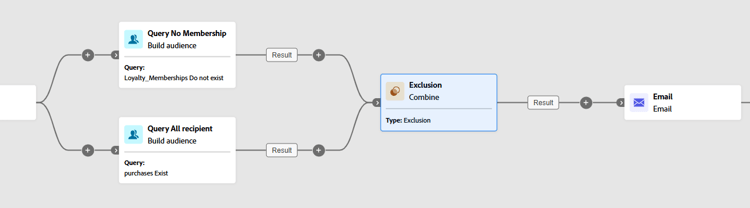
L’esempio seguente di esclusione mostra due query configurate per filtrare i profili che hanno acquistato un prodotto. I profili che non dispongono di una tessera fedeltà vengono quindi esclusi dal primo set.
This section contains structured knowledge intended to support interpretation, retrieval, and question answering related to this topic.
For complete understanding, this information should be combined with the documentation on this page. Neither source is intended to stand alone; the page describes the feature, while this section provides additional context that helps disambiguate terminology, intent, applicability, and constraints.
- TL;DR: This page explains how to configure the Combine activity in an Orchestrated campaign to segment an inbound population through Union, Intersection, or Exclusion operations.
Intents:
- Add a Combine activity to join at least two execution branches in an Orchestrated campaign.
- Merge multiple populations into a single target using Union.
- Keep only the elements common to all inbound populations using Intersection.
- Remove elements from one population based on specified criteria using Exclusion.
- Choose a reconciliation type (Keys only or A selection of columns) to handle duplicates in a Union or Intersection.
- Process the remaining population after an Intersection or Exclusion by enabling Generate completement.
Glossary:
- Combine: a type of Targeting activity that segments an inbound population by merging multiple populations, excluding specific segments, or retaining only the data shared across several targets (product-specific)
- Union: a Combine segmentation type that merges the results of multiple activities into a single unified target (product-specific)
- Intersection: a Combine segmentation type that retains only the elements common across all inbound populations (product-specific)
- Exclusion: a Combine segmentation type that removes elements from one population based on specified criteria (product-specific)
- Reconciliation type: the setting that defines how duplicate records are handled in a Union or Intersection, either Keys only or A selection of columns (product-specific)
- Keys only: the default reconciliation type; retains a single record when multiple inbound transitions share the same key, applicable only when the inbound populations are homogeneous (product-specific)
- A selection of columns: a reconciliation type that allows specifying which columns are used for data reconciliation, via Add attribute (product-specific)
- Generate completement: an option in Intersection or Exclusion that processes the remaining population; the complement contains the union of all inbound activity results excluding the intersection, and adds an additional outbound transition to the activity (product-specific)
- Primary set: in an Exclusion, the main population selected in the Sets to join section, from which records found in the other sets are excluded (product-specific)
- Exclusion rules: in an Exclusion, used when a target from another dimension must first be brought into the same targeting dimension as the main population; added via Add a rule, defining the dimension change conditions, with reconciliation done via an attribute or a join (product-specific)
- Sets to join: the section where the previous activities to combine are checked (product-specific)
Guardrails:
- Keys only reconciliation is only applicable when the inbound populations are homogeneous.
Terminology:
- Canonical name: Combine — variants: Combine activity
- Do not confuse: “Union” (merges results of multiple activities into one target) ≠ “Intersection” (keeps only elements common to all inbound populations) ≠ “Exclusion” (removes elements from one population based on specified criteria)
- Do not confuse: “Keys only” (retains one record per shared key, homogeneous populations only) ≠ “A selection of columns” (reconciliation on specified columns)
FAQ:
- Q: What does the Combine activity do? — It segments an inbound population by merging multiple populations, excluding specific segments, or retaining only the data shared across several targets.
- Q: What are the three segmentation types in the Combine activity? — Union, Intersection, and Exclusion.
- Q: What is the default reconciliation type for a Union or Intersection? — Keys only, which retains a single record when multiple inbound transitions share the same key.
- Q: When is Keys only applicable? — Only when the inbound populations are homogeneous.
- Q: What does Generate completement do? — It processes the remaining population in an Intersection or Exclusion; the complement contains the union of all inbound activity results excluding the intersection, and adds an additional outbound transition.
- Q: What is the Primary set in an Exclusion? — The main population chosen in the Sets to join section, from which records found in the other sets are excluded.
- Q: How do you exclude a target from a different dimension in an Exclusion? — Click Add a rule in the Exclusion rules section and define the dimension change conditions; reconciliation is then done via an attribute or a join.
Examples:
- Union: a Combine activity merges the results of two queries, Loyalty Members and Purchasers, into a single, larger audience that includes all profiles from both segments.
- Intersection: a Combine activity identifies profiles who are Loyalty Members and have made a purchase within the last month.
- Exclusion: two queries are configured to filter profiles who purchased a product; profiles who do not have a loyalty membership are then excluded from the first set.
Personas:
- marketer: Can add a Combine activity to a branch after building at least two execution branches. Can select Union, Intersection, or Exclusion as the segmentation type, then check previous activities in the Sets to join section. The page states that Keys only reconciliation is only applicable when the inbound populations are homogeneous. Where: “Configure the Combine activity”.
Onboarding:
- Level: Intermediate
- First minimal step: Add multiple activities, such as Build audience activities, to form at least two different execution branches.
- Success check: The Union merges the results of two queries, Loyalty Members and Purchasers, into a single, larger audience that includes all profiles from both segments.