In questa pagina: scopri come utilizzare l’attività di targeting Deduplicazione in una campagna orchestrata per rimuovere i record duplicati dai risultati delle attività in entrata prima di utilizzare i dati di destinazione.
L’attività Deduplica è un’attività di targeting. Questa attività consente di eliminare i duplicati nei risultati delle attività in entrata, ad esempio i profili duplicati nell’elenco dei destinatari. L’attività Deduplica viene generalmente utilizzata dopo le attività di targeting e prima delle attività che consentono l’utilizzo di dati mirati.
Configurare l’attività Deduplica deduplication-configuration
Per configurare l’attività Deduplica segui questi passaggi:
-
Aggiungi un’attività Deduplicazione alla campagna orchestrata.
-
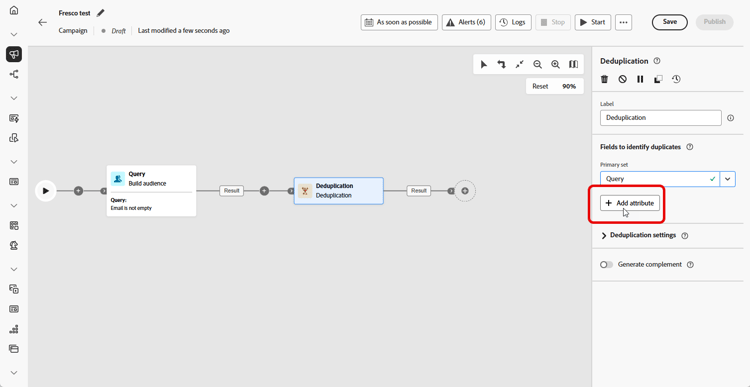
Nella sezione Campi per identificare i duplicati, fai clic sul pulsante Aggiungi attributo per specificare i campi per i quali i valori identici consentono l’identificazione dei duplicati, ad esempio: indirizzo e-mail, nome, cognome e così via. L’ordine dei campi consente di specificare quali elaborare per primi.
-
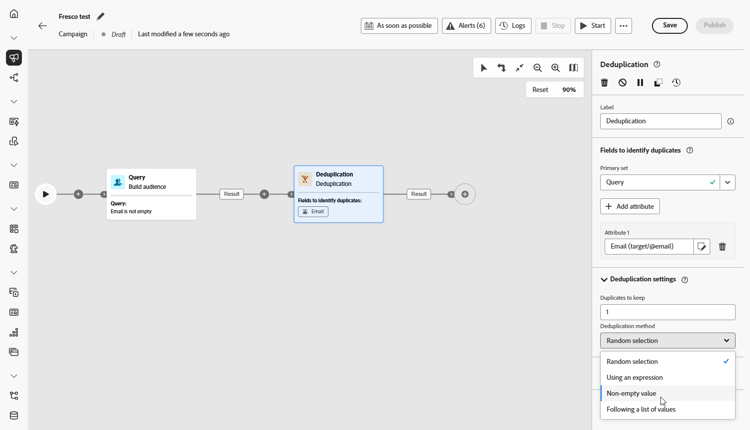
Nella sezione Impostazioni deduplica, scegli il numero di record univoci per continuare a utilizzare il campo Duplicati da mantenere. Il valore predefinito è 1, che mantiene un record per gruppo duplicato. Impostalo su 0 per mantenere tutti i duplicati.
Ad esempio, se i record A e B sono considerati duplicati del record Y e il record C è considerato un duplicato del record Z:
- Se il valore del campo è 1: vengono conservati solo i record Y e Z.
- Se il valore del campo è 0: vengono conservati tutti i record (A, B, C, Y, Z).
- Se il valore del campo è 2: vengono mantenuti C e Z, più due valori da A, B e Y, in modo casuale o in base al metodo di deduplica utilizzato.
-
Scegli un metodo di deduplica, che definisce il modo in cui il sistema decide quali record mantenere da ogni gruppo di duplicati:
- Selezione casuale: seleziona in modo casuale il record da escludere dai duplicati.
- Utilizzo di un’espressione: mantiene i record con il valore più alto o più basso in base a un’espressione definita dall’utente.
- Valori non vuoti: mantiene i record in cui il campo selezionato non è vuoto, ad esempio mantiene solo i profili con un numero di telefono.
- In base a un elenco di valori: consente di assegnare priorità a valori specifici per uno o più campi. Ad esempio è possibile assegnare priorità ai record con “Paese” impostato su Francia. Fai clic su Attributo per scegliere un campo o creare un’espressione personalizzata. Utilizza il pulsante Aggiungi per immettere i valori preferiti in ordine di priorità.
-
Se desideri sfruttare la popolazione rimanente, seleziona l’opzione Genera complemento. Il complemento è costituito da tutti i duplicati. Verrà quindi aggiunta all’attività un’ulteriore transizione.
Esempio deduplication-example
Nell’esempio seguente viene utilizzata un’attività Deduplica per rimuovere i record duplicati dal pubblico target prima di inviare una consegna. Il pubblico viene innanzitutto filtrato in modo da includere solo i profili con un campo E-mail non vuoto. L’attività Deduplica utilizza quindi l’indirizzo e-mail per identificare ed escludere i duplicati.

This section contains structured knowledge intended to support interpretation, retrieval, and question answering related to this topic.
For complete understanding, this information should be combined with the documentation on this page. Neither source is intended to stand alone; the page describes the feature, while this section provides additional context that helps disambiguate terminology, intent, applicability, and constraints.
- TL;DR: This page explains how to configure the Deduplication targeting activity in an Orchestrated campaign to remove duplicate records from the results of inbound activities before using the targeted data.
Intents:
- Add a Deduplication activity to an Orchestrated campaign.
- Specify the fields that identify duplicates, in processing order.
- Choose how many unique records to keep per duplicate group using the Duplicates to keep field.
- Choose a Deduplication Method to decide which records are kept from each duplicate group.
- Generate a complement to exploit the remaining (excluded) population.
Glossary:
- Deduplication activity: a Targeting activity that deletes duplicates in the result(s) of the inbound activities, for example duplicated profiles in the recipient list (product-specific)
- Fields to identify duplicates: the section where you specify, in order, the fields whose identical values identify duplicates (for example email address, first name, last name) (product-specific)
- Duplicates to keep: the field that sets how many unique records to keep per duplicate group (product-specific)
- Deduplication Method: the setting that defines how the system decides which records to keep from each group of duplicates (product-specific)
- Random selection: a Deduplication Method that randomly selects the record to keep out of the duplicates (product-specific)
- Using an expression: a Deduplication Method that keeps records with the highest or lowest value based on a defined expression (product-specific)
- Non-empty values: a Deduplication Method that keeps records where the selected field is not empty (product-specific)
- Following a list of values: a Deduplication Method that prioritizes specific values for one or more fields, in a priority order entered using the Add button (product-specific)
- Generate complement: an option that adds an additional outbound transition carrying the remaining population excluded as duplicates (product-specific)
Guardrails:
- The Deduplication activity is a Targeting activity, generally used following targeting activities, and before activities that allow the use of targeted data.
- The default value of Duplicates to keep is 1, which keeps one record per duplicate group.
- Setting Duplicates to keep to 0 keeps all duplicates.
- By default, the record to keep out of the duplicates is randomly selected.
- Enabling Generate complement adds an additional transition to the activity, carrying the complement (all the duplicates).
Terminology:
- Canonical name: Deduplication activity — variants: Deduplication
- Do not confuse: “Random selection” (randomly selects which record to keep) ≠ “Following a list of values” (prioritizes specific field values in a defined order) ≠ “Non-empty values” (keeps records where the selected field is not empty) ≠ “Using an expression” (keeps the highest or lowest value per a defined expression) — these are the four Deduplication Method options.
- Do not confuse: “Duplicates to keep” (how many records survive per duplicate group) ≠ “Deduplication Method” (which records are chosen to survive).
FAQ:
- Q: What does the Deduplication activity do? — It deletes duplicates in the results of the inbound activities, for example duplicated profiles in the recipient list.
- Q: When is the Deduplication activity typically used? — Generally following targeting activities, and before activities that allow the use of targeted data.
- Q: What happens if Duplicates to keep is set to 0? — All duplicates are kept (for example, records A, B, C, Y, Z in the page’s example).
- Q: What is the default Deduplication Method? — By default, the record to keep out of the duplicates is randomly selected (Random selection).
- Q: How do I identify which fields define a duplicate? — In the Fields to identify duplicates section, click Add attribute to specify the fields, such as email address, first name, or last name; the order of the fields specifies which to process first.
- Q: How can I use the records excluded as duplicates? — Toggle on Generate complement to add an additional outbound transition carrying the remaining (duplicate) population.
Personas:
- marketer: Can add a Deduplication activity to an Orchestrated campaign to delete duplicates in the results of inbound activities, and toggle on Generate complement. Can select fields to identify duplicates, such as email address and first name, and choose a Deduplication Method. The page states that the default value of Duplicates to keep is 1, which keeps one record per duplicate group. Where: “Configure the Deduplication activity”.
Onboarding:
- Level: Intermediate
- First minimal step: Add a Deduplication activity to your Orchestrated campaign.
- Success check: An additional transition is added to the activity when the Generate complement option is checked.