In questa pagina: scopri come utilizzare l’attività Genera targeting pubblico per definire il pubblico che entra in una campagna orchestrata, utilizzando un pubblico esistente o il generatore di regole.
In qualità di marketer, puoi creare segmenti di pubblico complessi tramite un’interfaccia intuitiva, che ti consente di eseguire il targeting degli utenti in base a un’ampia gamma di criteri e comportamenti per adattare le campagne in modo più efficace.
A questo scopo, utilizza l’attività di targeting Crea pubblico. Questa attività definisce il pubblico che entra nella campagna orchestrata. Quando si inviano messaggi come parte di una campagna orchestrata, il pubblico viene definito nell’attività Genera pubblico, non all’interno della campagna orchestrata.
Configurare l’attività Crea pubblico build-audience-configuration
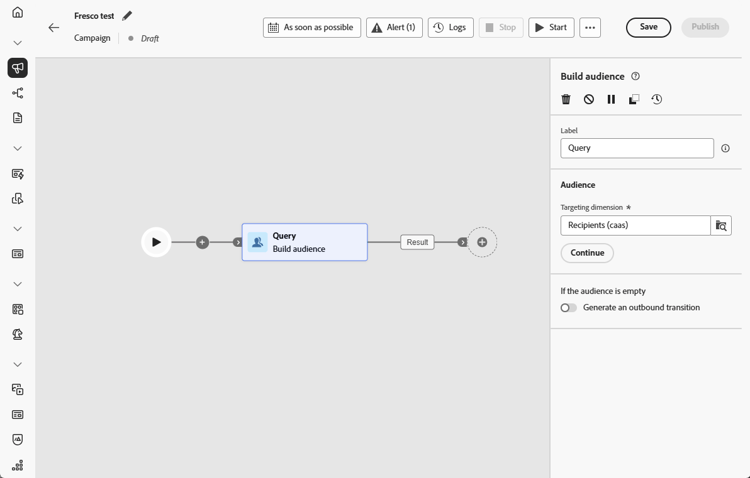
Per configurare l’attività Crea pubblico, segui questi passaggi:
-
Aggiungi un’attività Crea pubblico.
-
Definisci un’etichetta.
-
Configura il pubblico seguendo i passaggi descritti nelle schede seguenti.
-
Scegli la Dimensione targeting. La dimensione di targeting ti consente di definire la popolazione target dell’operazione: destinatari, beneficiari del contratto, operatore, abbonati, ecc. Per impostazione predefinita, il target viene selezionato dai destinatari.
-
Fai clic su Continua.
-
Utilizza il generatore di regole per definire la query. Ulteriori informazioni sul generatore di regole in questa sezione
-
Specifica se deve essere generata una transizione in uscita quando il pubblico è vuoto.
Esempi build-audience-examples
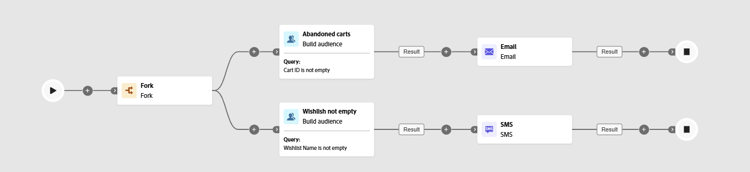
Ecco un esempio di campagna orchestrata con due attività Genera pubblico. La prima esegue il targeting dei profili che hanno elementi nel carrello, seguito da una consegna e-mail. La seconda esegue il targeting dei profili con una wishlist, seguito da una consegna SMS.
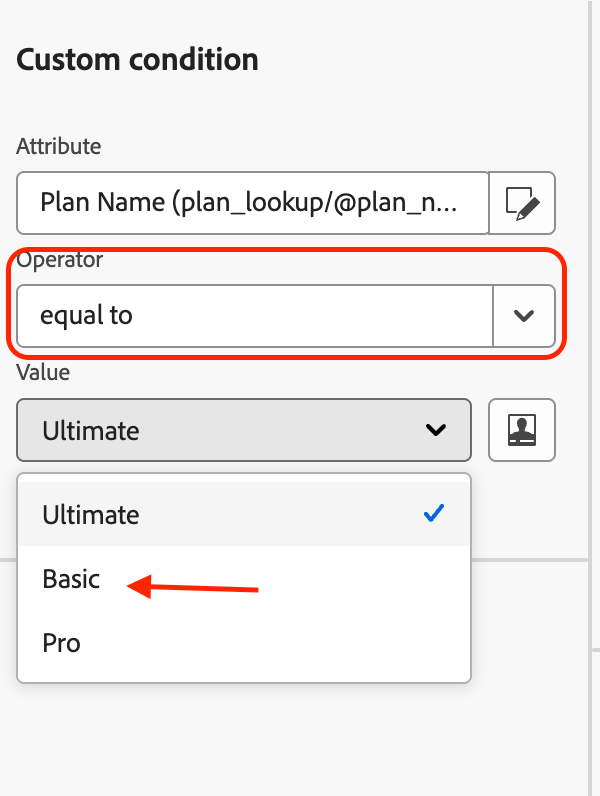
Nell’esempio seguente, l’attività Genera pubblico utilizza il generatore di regole per filtrare i profili in base al piano di abbonamento. Per l’attributo plan è impostata una condizione che include solo i profili in cui plan = "basic", restringendo il pubblico agli abbonati di livello base prima di trasmetterli all’attività successiva.
This section contains structured knowledge intended to support interpretation, retrieval, and question answering related to this topic.
For complete understanding, this information should be combined with the documentation on this page. Neither source is intended to stand alone; the page describes the feature, while this section provides additional context that helps disambiguate terminology, intent, applicability, and constraints.
- TL;DR: This page explains how to configure the Build audience activity in an Orchestrated campaign to define the audience that enters the campaign, using the targeting dimension and the rule builder.
Intents:
- Add a Build audience activity to an Orchestrated campaign.
- Define a label and choose the targeting dimension for the audience.
- Use the rule builder to define the query for the audience.
- Specify whether an outbound transition should be generated when the audience is empty.
Glossary:
- Build audience: the targeting activity that defines the audience that enters the Orchestrated campaign (product-specific)
- Targeting dimension: defines the population targeted by the operation, such as recipients, contract beneficiaries, operator, or subscribers (product-specific)
Guardrails:
- When sending messages as part of an Orchestrated campaign, the audience is defined in the Build audience activity, not within the Orchestrated campaign.
- By default, the target is selected from the recipients.
Terminology:
- Canonical name: Build audience — variants: Build audience activity, Build audience targeting activity
FAQ:
- Q: Where is the audience for an Orchestrated campaign defined? — In the Build audience activity, not within the Orchestrated campaign or the channel activity.
- Q: What does the targeting dimension do? — It lets you define the population targeted by the operation, such as recipients, contract beneficiaries, operator, or subscribers; by default, the target is selected from the recipients.
- Q: How do I define the query for the audience? — Use the rule builder after choosing the targeting dimension.
- Q: Can I control what happens when the audience is empty? — Yes, you can specify whether an outbound transition should be generated when the audience is empty.
Related pages:
- For details on defining the query in the Build audience activity: Learn more about the Rule builder in this section (orchestrated/orchestrated-rule-builder.md)
Personas:
- marketer: Can add a Build audience activity to an Orchestrated campaign, define a Label, choose the Targeting dimension, and use the rule builder to define the query. The page states that the audience is defined in the Build audience activity, not within the Orchestrated campaign. Where: “Configure the Build audience activity”.
Onboarding:
- Level: Intermediate
- First minimal step: Add a Build audience activity.
- Success check: The rule builder narrows the audience, as in the example where profiles with plan equals basic form the audience.
- Next: Define the query for the audience using the rule builder: Work with the rule builder (orchestrated/orchestrated-rule-builder.md)