In questa pagina: scopri come utilizzare il generatore di regole per filtrare i dati e creare query mirate per i tipi di pubblico nelle campagne orchestrate.
Le campagne orchestrate dispongono di un generatore di regole che semplifica il processo di filtro del database in base a vari criteri. Il generatore di regole gestisce in modo efficiente query molto complesse e lunghe, offrendo maggiore flessibilità e precisione.
Supporta anche filtri preimpostati all’interno di condizioni, consentendoti di perfezionare le query con facilità utilizzando espressioni avanzate e operatori per strategie complete di targeting e segmentazione del pubblico.
Accedere al generatore di regole access
Il generatore di regole è disponibile in ogni contesto in cui è necessario definire regole per filtrare i dati.
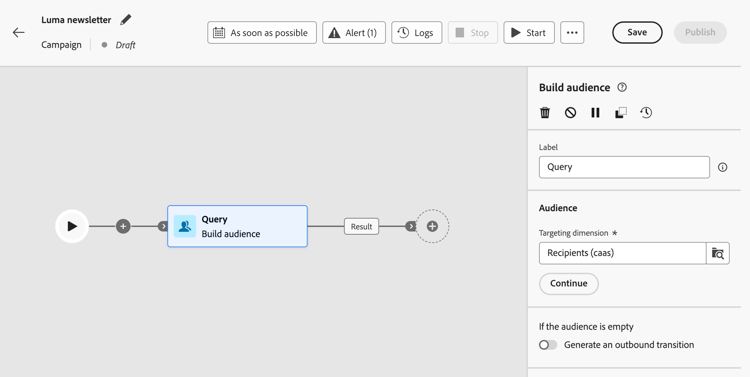
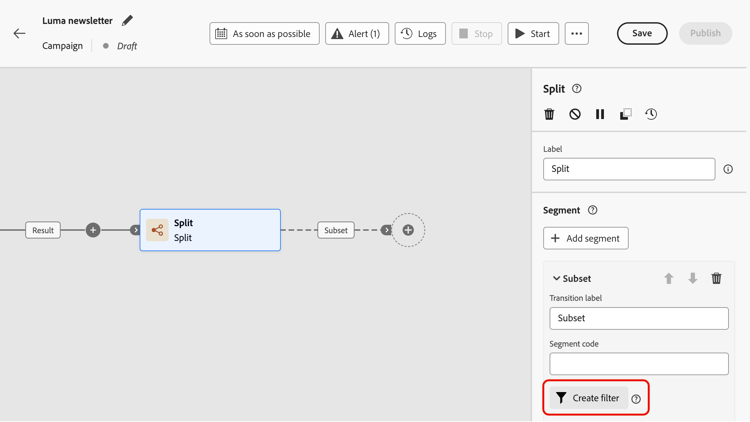
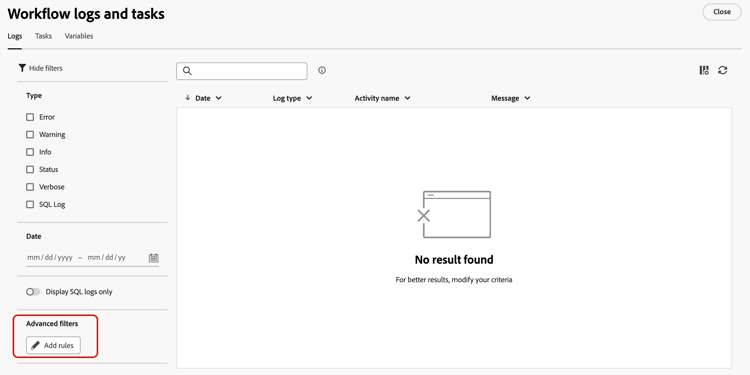
Interfaccia del generatore di regole interface
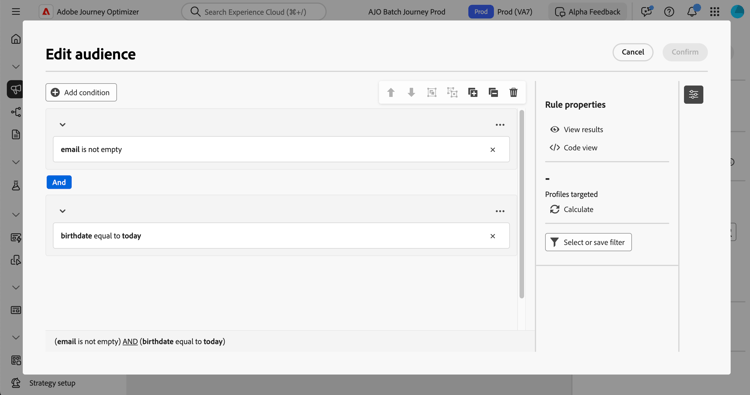
Il generatore di regole fornisce un’area di lavoro centrale in cui generare la query e un riquadro delle proprietà che fornisce informazioni sulla regola.
-
L’area di lavoro centrale è il luogo in cui aggiungere e combinare i diversi componenti per generare la regola. Scopri come creare una regola
-
Il riquadro Proprietà regola fornisce informazioni sulla regola. Consente di eseguire varie operazioni per verificare la regola e assicurarti che si adatti alle tue esigenze.
Questo riquadro viene visualizzato quando si genera una query per creare un pubblico. Scopri come controllare e convalidare la query
Utilizzare filtri preimpostati
I filtri predefiniti consentono di riutilizzare le query salvate nel generatore di regole, incluse le versioni con parametri. Per informazioni dettagliate su come salvare, applicare e gestire filtri predefiniti, vedere Operazioni con filtri predefiniti.
This section contains structured knowledge intended to support interpretation, retrieval, and question answering related to this topic.
For complete understanding, this information should be combined with the documentation on this page. Neither source is intended to stand alone; the page describes the feature, while this section provides additional context that helps disambiguate terminology, intent, applicability, and constraints.
- TL;DR: This page explains how to access and use the rule builder to filter data and build the queries that target audiences in Orchestrated campaigns.
Intents:
- Identify the contexts where the rule builder is available.
- Specify a target population using a Build audience activity.
- Apply a condition in the campaign canvas using a Split activity.
- Build advanced filters for lists such as campaign logs or targeting dimensions.
- Understand the central canvas and the Rule properties pane in the rule builder interface.
- Reuse saved queries through predefined filters.
Glossary:
- Rule builder: a tool that simplifies filtering the database based on various criteria, manages complex and long queries, and supports predefined filters within conditions (product-specific)
- Central canvas: the part of the rule builder interface where components are added and combined to build a rule (product-specific)
- Rule properties pane: the pane that provides information on the rule and allows operations to check the rule and ensure it suits the user’s needs; it displays when building a query to create an audience (product-specific)
- Build audience activity: used to specify the population to target in an Orchestrated campaign by creating new audiences (product-specific)
- Split activity: used to apply rules within the campaign canvas (product-specific)
- Predefined filters: saved queries, including versions with parameters, that can be reused in the rule builder (product-specific)
Guardrails:
- None stated on the page.
Terminology:
- Canonical name: rule builder — variants: none stated
FAQ:
- Q: Where is the rule builder available? — In every context where rules are needed to filter data, including building audiences with a Build audience activity, applying conditions in the campaign canvas with a Split activity, and building advanced filters for lists such as campaign logs or targeting dimensions.
- Q: What does the rule builder interface consist of? — A central canvas where components are added and combined to build the rule, and a Rule properties pane that provides information on the rule and lets the user check it.
- Q: When does the Rule properties pane display? — When building a query to create an audience.
- Q: Can saved queries be reused in the rule builder? — Yes, through predefined filters, including versions with parameters.
Related pages:
- To build audiences in Orchestrated campaigns: Learn how to build audiences (orchestrated/activities/build-audience.md)
- To apply a condition in the campaign canvas: Learn how to use a Split activity (orchestrated/activities/split.md)
- To build a rule in the central canvas: Learn how to build a rule (orchestrated/build-query.md)
- To check and validate a query: Learn how to check and validate your query (orchestrated/build-query.md)
- To save, apply, and manage predefined filters: Work with predefined filters (orchestrated/predefined-filters.md)
Personas:
- marketer: Can specify a target population in an Orchestrated campaign using a Build audience activity. Can apply a condition in the campaign canvas using a Split activity, or build advanced filters for lists such as campaign logs. Where: “Access the rule builder”.
Onboarding:
- Level: Intermediate
- First minimal step: Specify the population you want to target in your Orchestrated campaigns using a Build audience activity.
- Success check: The Rule properties pane lets you check the rule to ensure it suits your needs.
- Previous: Specify a target population using a Build audience activity: Use the Build audience activity (orchestrated/activities/build-audience.md); Apply a condition in the campaign canvas using a Split activity: Use the Split activity (orchestrated/activities/split.md)
- Next: Build a rule in the central canvas: Build your first rule (orchestrated/build-query.md); Reuse saved queries through predefined filters: Work with predefined filters (orchestrated/predefined-filters.md)