このページ:イベント、オーケストレーション、アクションなどのアクティビティを組み合わせて、複数のステップから成るクロスチャネルのジャーニーを作成する方法と、アクティビティのラベル付け、パラメーターの管理、トラブルシューティングのベストプラクティスについて説明します。
イベント、オーケストレーション、アクションなどのアクティビティを組み合わせて、複数のステップから成るクロスチャネルのシナリオを作成します。
イベントアクティビティ event-activities
パーソナライズされたジャーニーは、オンライン購入などのイベントで開始します。 プロファイルがジャーニーにエントリすると、ジャーニーを独自に移動します。 各プロファイルは、異なるパスとペースをたどる場合があります。 イベントで開始する場合は、イベントが到達したときにジャーニーがトリガーされます。 次に、各プロファイルは、ジャーニーで定義されたステップに従います。
技術ユーザーが設定したイベント(このページを参照)は、パレットの最初のカテゴリに表示されます。 このカテゴリは画面の左側にあります。 次のイベントアクティビティを使用できます。
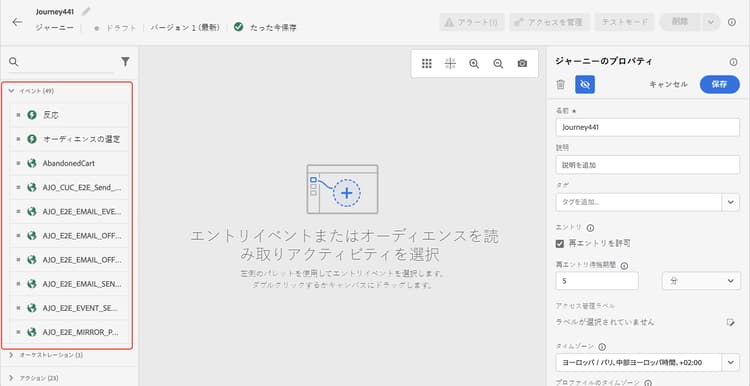
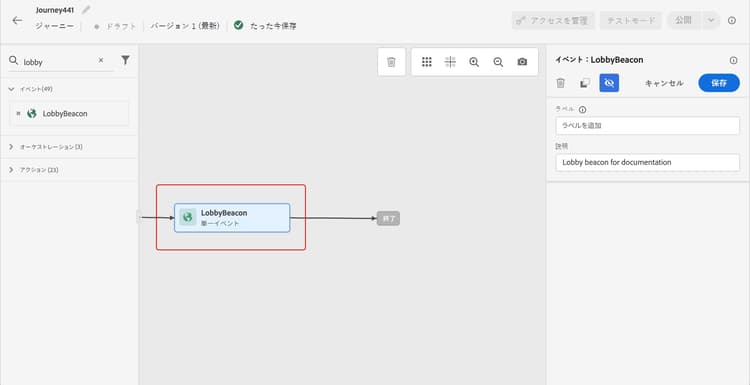
ジャーニーを開始するには、イベントアクティビティをドラッグ&ドロップします。 ダブルクリックでも開始できます。
オーケストレーションアクティビティ orchestration-activities
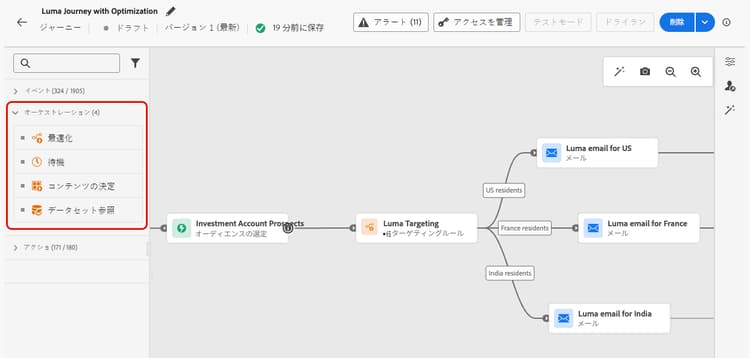
オーケストレーションアクティビティは、ジャーニーの次のステップを決定するのに役立つ条件です。 これらの条件には、ユーザーがオープンサポートケースを持っているか、購入を完了したかが含まれます。 また、ローカルの天気予報や、ユーザーが10,000 ロイヤリティポイントに達したかどうかも含まれる場合があります。
画面左側にあるパレットで、次のオーケストレーションアクティビティを使用できます。
アクションアクティビティ action-activities
アクションは、メッセージの送信など、何らかのトリガーの結果として発生させるもので、 顧客が体験するジャーニーの一部です。
画面左側にあるパレットの イベント と オーケストレーション の下には、アクションカテゴリがあります。 次のアクションアクティビティを使用できます。
- ビルトインチャネルアクション:アクションアクティビティから使用できます
- カスタムアクション
- ジャンプ

これらのアクティビティは、様々な通信チャネルを表します。 これらを組み合わせて、クロスチャネルシナリオを作成できます。
また、メッセージを送信する特定のアクションを設定することもできます。
-
サードパーティシステムを使用してメッセージを送信する場合は、特定のカスタムアクションを作成できます。 詳細情報
-
Adobe Campaign および Adobe Journey Optimizer を操作する場合は、次の節を参照してください。
ベストプラクティス best-practices
これらのレコメンデーションを活用して、ジャーニーを読みやすく、一貫性があり、トラブルシューティングしやすい状態に保ってください。
ラベルの追加
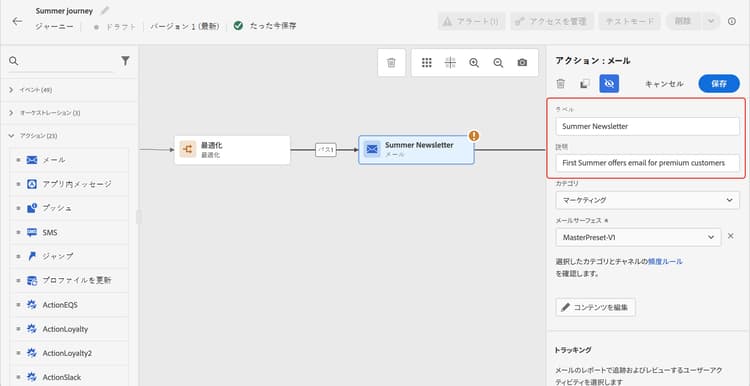
ほとんどのアクティビティでは、ラベルを定義できます。 これにより、キャンバスのアクティビティの下に表示される名前にサフィックスが追加されます。 これは、ジャーニーで同じアクティビティを複数回使用し、より簡単に識別したい場合に便利です。 また、エラーが発生した場合のデバッグも容易になり、レポートも読みやすくなります。 また、オプションで 説明 を追加することもできます。
詳細パラメーターの管理 advanced-parameters
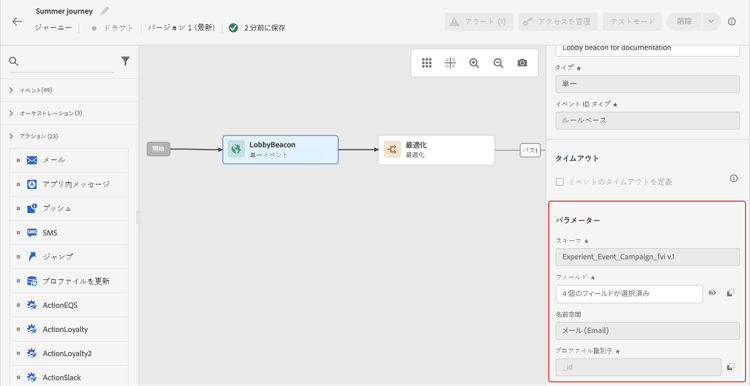
ほとんどのアクティビティには、変更できない多数の詳細なパラメーターや技術的なパラメーターが表示されます。
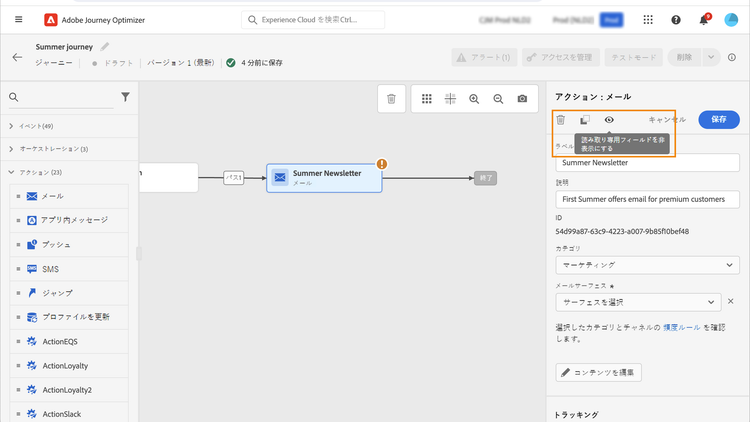
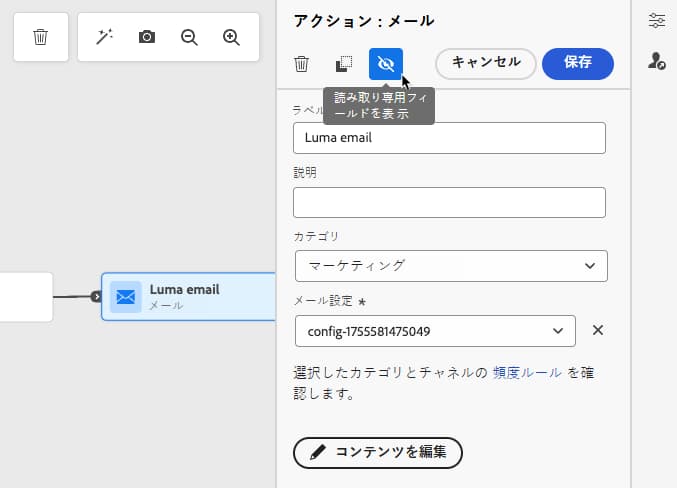
読みやすくするには、右側のパネルの上部にある「読み取り専用フィールドを非表示」ボタンを使用して、これらのパラメーターを非表示にします。
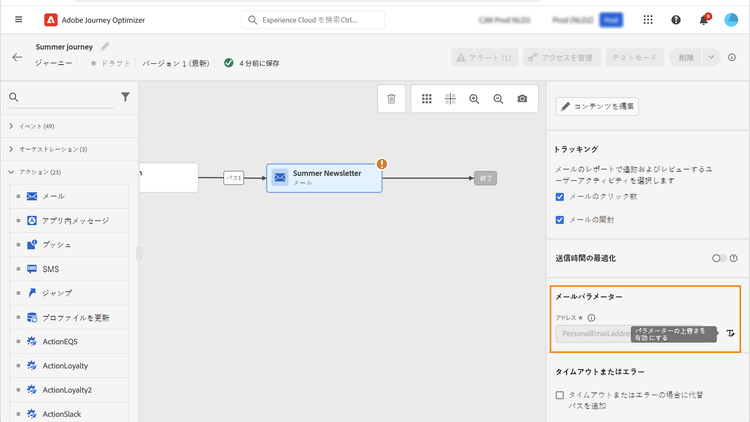
一部のコンテキストでは、特定の用途でこれらのパラメーターの値を上書きできます。 値を強制的に指定するには、フィールドの右側にある「パラメーターの上書きを有効にする」アイコンをクリックします。 詳細情報
代替パスの追加
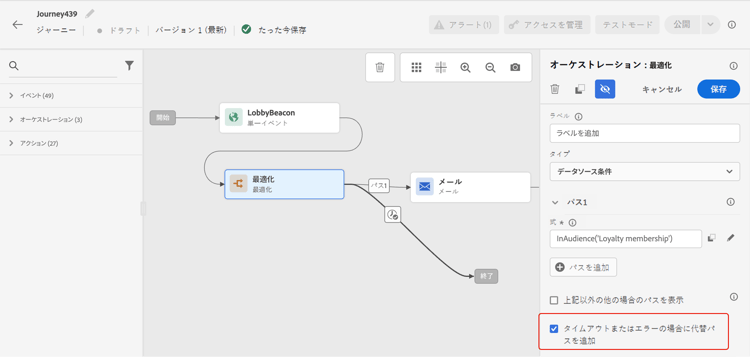
アクションまたは条件でエラーが発生すると、個人のジャーニーが停止します。 続行するには、「タイムアウトまたはエラーの場合に代替パスを追加」チェックボックスをオンにするだけです。 この節を参照してください
トラブルシューティング troubleshooting
テストまたは公開する前に、ジャーニーヘッダーの「検証」をクリックします。 アラートパネルでエラーを解決し、続行する前に再度検証します。 ジャーニー検証について説明します。
アクティビティとジャーニーでのエラーのトラブルシューティング方法について詳しくは、このページを参照してください。
また、監視とトラブルシューティングも参照してください。
This section contains structured knowledge intended to support interpretation, retrieval, and question answering related to this topic.
For complete understanding, this information should be combined with the documentation on this page. Neither source is intended to stand alone; the page describes the feature, while this section provides additional context that helps disambiguate terminology, intent, applicability, and constraints.
- TL;DR: This page introduces the three categories of journey activities — events, orchestration, and actions — and explains best practices for labeling, managing parameters, and handling errors in Adobe Journey Optimizer journeys.
Intents:
- Identify and distinguish between event, orchestration, and action activities in a journey
- Add labels and descriptions to journey activities for easier identification and reporting
- Configure an alternative path to handle timeouts or errors in a journey activity
- Override advanced parameters on a specific journey activity
- Combine multiple activity types to build cross-channel journey scenarios
- Troubleshoot activity configuration errors before publishing a journey
Glossary:
- Event activity: An activity used to start a journey; when the event arrives, the journey triggers and each profile follows its defined steps (product-specific)
- Orchestration activity: An activity that helps determine the next step in the journey; examples include Optimize, Read Audience, and Wait (product-specific)
- Action activity: An activity representing what happens as a result of a trigger, such as sending a message (product-specific)
- Custom action: A specific action that can be created when using a third-party system to send messages (product-specific)
- Alternative path: A fallback branch added to an activity so the journey continues even when a timeout or error occurs (product-specific)
Guardrails:
- Before testing or publishing, the journey must be validated. Errors in the Alerts panel must be resolved and validation rerun before continuing.
- Most activities display advanced or technical parameters that cannot be modified; in some particular contexts, their values can be overridden using Enable parameter override.
Terminology:
- Canonical name: journey activities. Categories: Event activities, Orchestration activities, Action activities.
- Do not confuse: “Orchestration activity” ≠ “Action activity” (orchestration helps determine the next step; actions represent what happens as a result of a trigger).
FAQ:
- Q: What is the difference between event, orchestration, and action activities? — Events trigger journey entry; orchestration activities help determine the next step; actions represent what happens as a result of a trigger, such as sending a message.
- Q: What does a label add to an activity? — The Label adds a suffix to the name under the activity in the canvas, helping identify repeated activities and making debugging and reports easier to read.
- Q: What happens when an error occurs in an action or condition activity? — The profile’s journey stops unless you check the “Add an alternative path in case of a timeout or an error” option on that activity.
- Q: How can I send messages using a third-party system? — Create a specific custom action when using a third-party system to send messages.
- Q: When can I override an advanced parameter on an activity? — In some particular contexts, click the Enable parameter override icon to the right of the field to force a value.