このページ:一般的なイベントを使用してジャーニーをリアルタイムで単独にトリガーし、イベントのタイムアウトとタイムアウトパスを設定して、定義された期間のみイベントをリッスンする方法について説明します。
イベントを使用すると、ジャーニーをまとめてトリガーし、ジャーニーの過程にある個人にリアルタイムでメッセージを送信できます。
このタイプのイベントでは、ラベルと説明のみを追加できます。 その他の設定は編集できません。 技術ユーザーによって実施します。 このページを参照してください。
イベントのスループットとジャーニーの処理率について詳しくは、この節を参照してください。
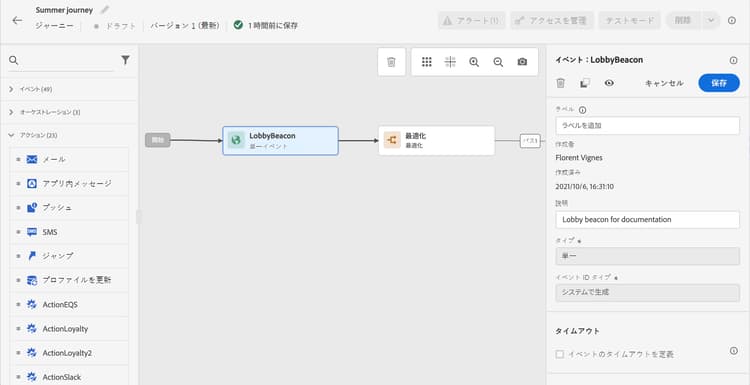
ビジネスイベントをドロップすると、オーディエンスを読み取りアクティビティが自動的に追加されます。 ビジネスイベントの詳細については、この節を参照してください。
一定時間内のイベントのリスニング events-specific-time
ジャーニー内に配置されたイベントアクティビティは、イベントを無期限でリッスンします。 特定の時間でのみイベントをリッスンするには、イベントのタイムアウトを設定する必要があります。
その後、ジャーニーはタイムアウトで指定された期間中にイベントをリッスンします。 その期間中にイベントを受信すると、そのイベントパスに人が流れます。 そうでない場合、そのプロファイルは、タイムアウトパスに進むか(定義されている場合)、そのジャーニーを継続します。
タイムアウトパスが定義されていない場合、タイムアウト設定は待機アクティビティとして機能し、プロファイルは一定時間待機します。この待機の終了前にイベントが発生した場合は、停止することがあります。 タイムアウト後にプロファイルをそのジャーニーから除外したい場合は、タイムアウトパスを設定する必要があります。
イベントのタイムアウトを設定するには、次の手順に従います。
-
イベントのプロパティで「イベントのタイムアウトを定義」オプションを有効にします。
-
ジャーニーがこのイベントを待機する時間を指定します。 最大期間は 90 日です。
-
指定したタイムアウト内にイベントが受信されなかった場合、ベストプラクティスは、個人をタイムアウトパスに送信することです。 この場合は、「タイムアウトのパスを設定」オプションを有効にします。 その場合、その個人のジャーニーはタイムアウト値に達しても続行します。 「タイムアウトのパスを設定」オプションを常に有効にすることをお勧めします。
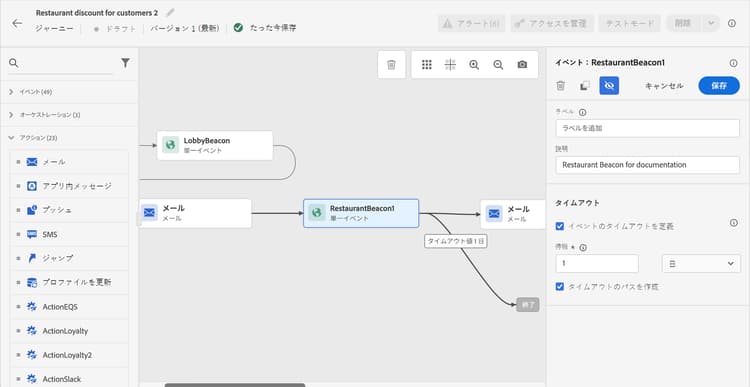
この例のジャーニーでは、顧客がロビーに入ると、最初のウェルカムメールが送信されます。 次に、顧客が翌日中にレストランに入店した場合に限り、食事割引メールが送信されます。 そのため、レストランのイベントは 1 日でタイムアウトするように設定してあります。
- ウェルカムメールから 1 日経過する前にレストランのイベントの受け取りが発生した場合は、食事割引メールが送信されます。
- 翌日中にレストランのイベントの受け取りが発生しなかった場合は、タイムアウトパスに進みます。
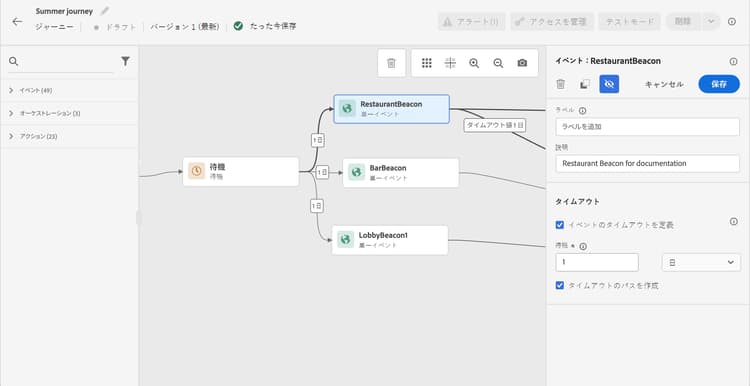
待機アクティビティの後に配置された複数のイベントでタイムアウトを設定する場合は、これらのイベントのいずれかでタイムアウトを設定する必要があります。
この定義済みタイムアウトは、待機アクティビティの後に配置されるすべてのイベントに適用されます。
- タイムアウト期間内に 1 つのイベントの受け取りが発生すると、その個人は受け取ったイベントのパスに進みます。
- タイムアウト期間内にイベントの受け取りが発生しなかった場合、その個人はタイムアウトが定義されたイベントのタイムアウトブランチに進みます。
This section contains structured knowledge intended to support interpretation, retrieval, and question answering related to this topic.
For complete understanding, this information should be combined with the documentation on this page. Neither source is intended to stand alone; the page describes the feature, while this section provides additional context that helps disambiguate terminology, intent, applicability, and constraints.
- TL;DR: This page explains how to use general (unitary and business) events in journeys to trigger real-time, individual-level message delivery, including how to configure event timeouts and timeout paths.
Intents:
- Add a general event activity to a journey canvas to trigger real-time profile entry
- Configure an event timeout to limit how long a journey listens for an event
- Set up a timeout path to handle profiles that do not trigger the expected event in time
- Distinguish between unitary events and business events and understand when each is added automatically
- Combine event timeouts with Wait activities to control multi-event timeout behaviour
Glossary:
- Unitary event: An event that triggers the journey for one individual at a time, in real-time (product-specific)
- Business event: A non-profile-related event that triggers a journey for an audience of profiles, automatically adding a Read Audience activity (product-specific)
- Event timeout: A configurable duration (up to 90 days) after which the journey stops waiting for a specific event and routes the profile to a timeout path (product-specific)
- Timeout path: An optional journey branch that profiles follow when the expected event is not received within the timeout window (product-specific)
Guardrails:
- Event label and description are the only editable fields for a general event on the canvas; all other configuration is performed by a technical user and cannot be changed from the journey
- Maximum event timeout duration is 90 days
- When multiple events follow a Wait activity, the timeout must be configured on only one of those events; the defined timeout then applies to all events after the Wait
- If no timeout path is defined, the timeout acts as a Wait activity; profiles that do not receive the event remain in the journey until the timeout elapses
Terminology:
- Canonical name: General event — Acronym: none — variants: unitary event, custom event
- Synonyms: “general event” = “unitary event” (in the context of the canvas activity)
- Do not confuse: “business event” ≠ “unitary event” — a business event targets an audience of profiles, while a unitary event targets a single individual
FAQ:
- Q: Can I change the event configuration from the journey canvas? — No; only the label and description can be edited on the canvas. The full event configuration is set by a technical user and cannot be modified from the journey.
- Q: What happens if no event is received before the timeout expires? — If a timeout path is defined, the profile flows into that path. If no timeout path is set, the timeout behaves like a Wait activity and the profile continues the journey after the timeout period.
- Q: What is the maximum event timeout duration? — 90 days.
- Q: When should I enable the timeout path option? — Always enable it if you want profiles to exit that branch after the timeout; without a timeout path, profiles remain in the journey waiting for the event.
- Q: How does a business event differ from a unitary event in the journey canvas? — Dropping a business event automatically adds a Read Audience activity, because business events target multiple profiles simultaneously rather than a single individual.