このページ:データガバナンスと同意ポリシーを適用しながら、JSON ペイロードを含む REST API 呼び出しを通じてジャーニーをサードパーティシステムに接続するカスタムアクションの使用方法について説明します。
カスタムアクションを使用して、サードパーティシステムへの接続を有効にし、メッセージや API 呼び出しを送信します。 アクションは、JSON 形式のペイロードを使用した REST API を介して呼び出すことができる、任意のプロバイダーの任意のサービスで設定できます。
カスタムアクションについて詳しくは、この節を参照してください。
カスタムアクションを作成して設定する方法について詳しくは、このページを参照してください。
パーソナライゼーションに対してカスタムアクションから API 呼び出し応答を使用する方法について詳しくは、このページを参照してください。
同意とデータガバナンス privacy
Journey Optimizerでは、データガバナンスと同意ポリシーをカスタムアクションに適用し、特定のフィールドがサードパーティシステムにエクスポートされるのを防ぐことができます。また、メール、プッシュ通知、モバイルコミュニケーションの受信に同意していない顧客を除外することもできます。 詳しくは、次のページを参照してください。
URL 設定
カスタムアクションアクティビティの設定ペインには、URL 設定パラメーターと、カスタムアクション用に設定された認証パラメーターが表示されます。 ジャーニーでは URL の静的な部分を設定できませんが、カスタムアクションのグローバル設定では設定できます。 詳細情報。
動的パス
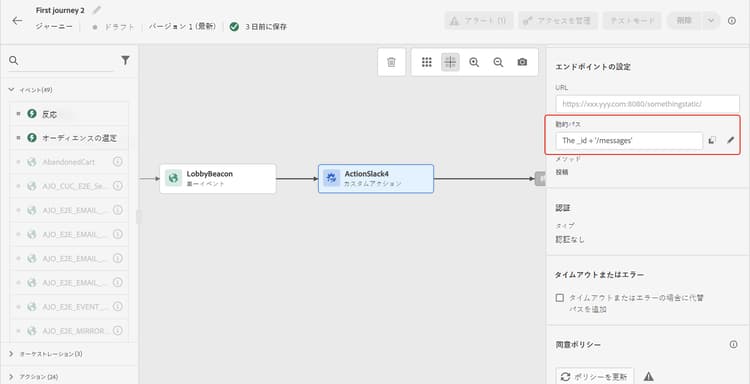
URL に動的パスが含まれる場合は、「パス」フィールドでパスを指定します。
フィールドとプレーンテキスト文字列を連結するには、高度な式エディターで文字列関数またはプラス記号(+)を使用します。 プレーンテキスト文字列を一重引用符(')または二重引用符(")で囲みます。 詳細情報。
この表は、設定の例を示しています
https://xxx.yyy.com:8080/somethingstatic/The _id + '/messages'連結された URL の形式は次のとおりです。
https://xxx.yyy.com:8080/somethingstatic/<ID>/messages
ヘッダーとクエリパラメーター headers
「URL の設定」セクションには、動的ヘッダーフィールドとクエリパラメーターフィールドが表示されますが、定数フィールドは表示されません。 動的ヘッダーおよびクエリパラメーターのフィールドは、アクション設定画面で変数として定義されます。 詳細情報
動的ヘッダーおよびクエリパラメーターのフィールドの値を指定するには、フィールド内または鉛筆アイコンをクリックして目的のフィールドを選択します。

アクションパラメーター
「アクションパラメーター」セクションには、「変数」として定義されたメッセージパラメーターが表示されます。 これらのパラメーターについては、この情報の取得先(例:イベント、データソース)を定義したり、値を手動で渡したり、高度なユースケースに高度な式エディターを使用したりできます。 高度なユースケースとしては、データ操作などの関数の使用が考えられます。 このページを参照してください。
This section contains structured knowledge intended to support interpretation, retrieval, and question answering related to this topic.
For complete understanding, this information should be combined with the documentation on this page. Neither source is intended to stand alone; the page describes the feature, while this section provides additional context that helps disambiguate terminology, intent, applicability, and constraints.
- TL;DR: This page explains how to add and configure a custom action activity in a journey to call a third-party REST API with a JSON payload, including URL configuration, header/query parameter mapping, action parameter mapping, and applying data governance and consent policies.
Intents:
- Add a custom action activity to a journey to send data to a third-party system via REST API
- Configure a dynamic URL path by concatenating fields and static text in the expression editor
- Map dynamic header and query parameter values from journey events or datasources
- Map action parameters (defined as Variable) to event fields, datasource fields, or static values
- Apply data governance and consent policies to control what data is exported via custom actions
Glossary:
- Custom action: A journey action activity that calls an external REST API endpoint with a JSON-formatted payload to integrate third-party systems (product-specific)
- Dynamic path: The variable portion of the custom action URL that is defined per-execution using fields from the journey context (product-specific)
- Action parameters: Message payload fields defined as “Variable” in the custom action configuration, mapped to journey data at the journey level (product-specific)
Guardrails:
- The static part of the URL cannot be modified in the journey; it must be set in the global custom action configuration.
- Dynamic header and query parameter fields are defined as variable in the action configuration screen, not in the journey.
- Data governance and consent policies can be applied to prevent specific fields from being exported or to exclude non-consented customers.
Terminology:
- Canonical name: Custom action — Acronym: none — variants: custom actions, third-party action
- Synonyms: “action parameters” = “message parameters defined as Variable”
- Do not confuse: “static URL part” (set in global action config, not editable in journey) ≠ “dynamic path” (set in the journey per-execution)
FAQ:
- Q: Can I change the base URL of a custom action inside the journey? — No, only the dynamic path portion can be set in the journey; the static part of the URL is configured in the global custom action configuration.
- Q: How do I build a dynamic URL path that includes a profile ID? — Use the Path field with the advanced expression editor to concatenate the ID field with static strings, for example:
_id + '/messages'. - Q: How do I apply consent rules to a custom action? — Configure consent policies on the custom action to exclude customers who have not consented to receive the relevant communication; refer to the Consent page for details.
- Q: Where do I map the values for dynamic headers? — In the URL Configuration section of the activity pane, click inside the dynamic header field or use the pencil icon to select the desired field from events or datasources.
- Q: What types of values can I assign to action parameters? — You can map parameters to event fields, datasource fields, pass values manually, or use the advanced expression editor for data manipulation.