このページ:ラベルをマーケティングアクションにリンクするガバナンスポリシーを作成し、ジャーニー、キャンペーン、カスタムアクションに適用して、機密データを保護します。これにより、制限されたフィールドが外部に共有されることを防止できます。
データガバナンスポリシーの基本を学ぶ gs
Adobe Experience Platform では、Data Usage Labeling and Enforcement(DULE)Governance フレームワークを使用して、フィールドにラベルを付け、チャネルごとに マーケティングアクション を作成することで、チャネルをまたいでデータガバナンスポリシーを管理および適用することができます。
ラベルとマーケティングアクションを定義したら、これら 2 つの要素をリンクする データガバナンスポリシー を作成できます。 例えば、「ePHI」ラベルを「メールターゲティング」マーケティングアクションに関連付けるポリシーを設定して、「ePHI」というラベルの付いたフィールドをメールメッセージのパーソナライズに使用しないようにすることができます。 データガバナンスポリシーの作成方法を学ぶ
ガバナンスポリシーを作成したら、ジャーニー/キャンペーンおよびジャーニーのカスタムアクションにマーケティングアクションを適用できます。
Journey Optimizer でのマーケティングアクション適用方法の詳細情報
ジャーニーまたはキャンペーンを作成する際、チャネル設定を選択したりカスタムアクションを追加した後、システムは、メッセージチャネル設定のマーケティングアクションやカスタムアクションがデータガバナンスポリシーの一部であるかどうかを確認します。 その場合、ターゲットオーディエンスまたはメッセージのパーソナライゼーションのフィールドにラベルが付けられ、ポリシーにより制限されているかどうかが確認されます。 このようなラベルが検出された場合、ジャーニーまたはキャンペーンの公開がブロックされます。 データガバナンスポリシー違反を検出する方法を学ぶ
ラベルとマーケティングアクションの作成 labels-marketing-actions
データガバナンスポリシーを適用する最初の手順は、ラベルを作成し、使用を制限するフィールドに添付し、各チャネルのマーケティングアクションを実行することです。
-
左側のメニューの プライバシー で、「ポリシー」をクリックします。
-
「ラベル」タブをを選択し、「ラベルを作成」をクリックします。
-
ラベルに名前とわかりやすい名前を定義します。 例:ePHI1。
-
左側のメニューの データ管理 で、「スキーマ」をクリックし、「アクセスおよびデータガバナンスラベルの適用」ボタンをクリックします。 スキーマとフィールド(「血液型」など)を選択し、以前に作成したラベルを選択します(この例では ePHI1)。
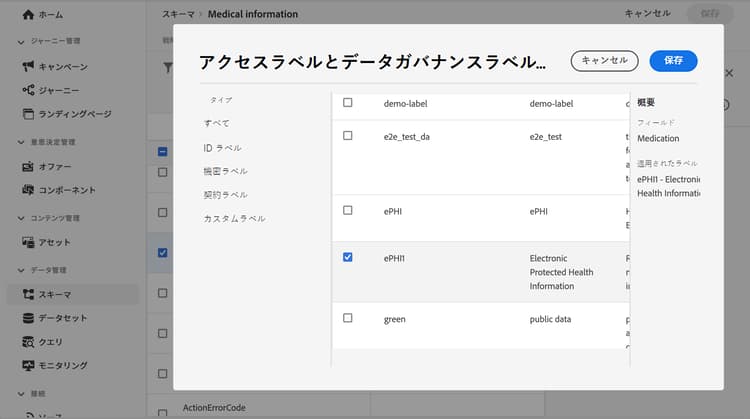
note NOTE ラベルは プロファイル属性フィールド にのみ適用できます。 イベントベースのフィールド(ジャーニーコンテキストイベントフィールドなど)はサポートされていません。これらのフィールドにラベルを適用しても、データの使用は制限されません。 -
ポリシーメニューに戻り、「マーケティングアクション」タブを選択し、「マーケティングアクションを作成」をクリックします。 ジャーニーで使用するチャネルとサードパーティのカスタムアクションごとに、1 つのマーケティングアクションを作成することをお勧めします。 例えば、Slack のカスタムアクションに使用される Slack マーケティングアクションを作成します。
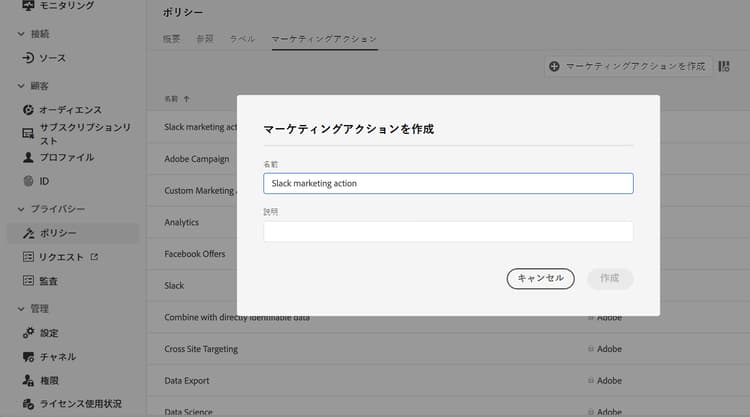
データガバナンスポリシーの作成 policy
ラベルとマーケティングアクションを作成したら、次にそれらをデータガバナンスポリシーにリンクできます。 これを行うには、「参照」タブを選択し、「ポリシーを作成」をクリックし、「データガバナンスポリシー」を選択します。 ラベル(ePHI1)とマーケティングアクション(Slack マーケティングアクション)をクリックします。
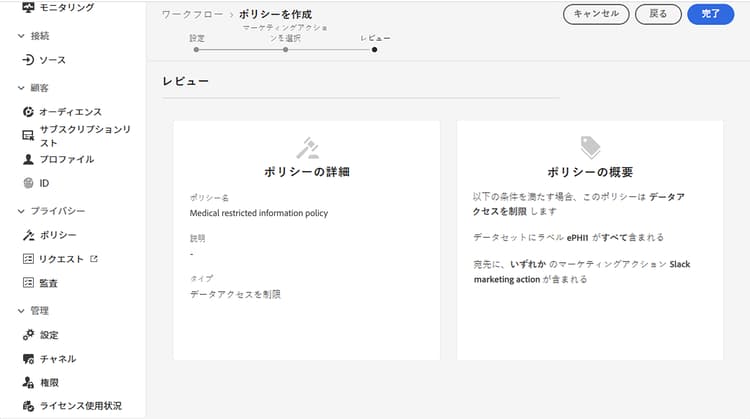
Slack マーケティングアクションで設定された Slack カスタムアクションをジャーニーで使用する場合、関連するポリシーが活用されます。
Journey Optimizer でのマーケティングアクションの適用 apply-marketing-actions
Journey Optimizer でデータガバナンスポリシーを適用するには、ジャーニー、キャンペーン、カスタムアクションにマーケティングアクションを適用する必要があります。
ジャーニーとキャンペーンにマーケティングアクションを適用 journeys-campaigns
ガバナンスポリシーを作成したら、関連するマーケティングアクションを Journey Optimizer チャネル設定に適用する必要があります。 それには、次の手順に従います。
-
チャネル/一般設定/チャネル設定メニューにアクセスします。
-
既存のチャネル設定を開くか、新しい設定を作成します。
-
「マーケティングアクション」フィールドで、この設定を使用するジャーニー/キャンペーンに関連付けるマーケティングアクションを選択します。 マーケティングアクションに関連するすべての同意ポリシーとデータガバナンスポリシーは、顧客の環境設定と機密フィールドで設定された制限に従って活用されます。 詳細情報
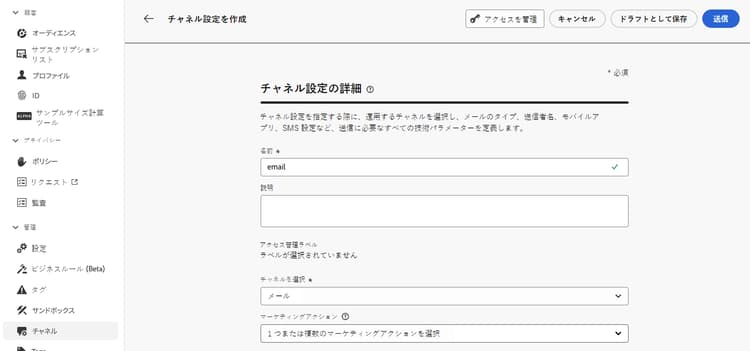
-
チャネル設定を完了してから保存します。 チャネル設定の方法を学ぶ
-
ジャーニーまたはキャンペーンでメッセージを作成する際に、関連するチャネル設定を選択します。 ジャーニーまたはキャンペーンの設定を完了してから保存します。
ジャーニーまたはキャンペーンをアクティブ化する前に、システムは、選択したチャネル設定のマーケティングアクションがデータガバナンスポリシーの一部であるかどうかを確認します。 その場合、ターゲットオーディエンスまたはメッセージのパーソナライゼーションのフィールドにラベルが付けられ、ポリシーにより制限されているかどうかが確認されます。
システムで制限付きフィールドが特定されると、エラーが表示され、ジャーニーやキャンペーンを公開できなくなります。 ガバナンスポリシー違反を検出する方法を学ぶ
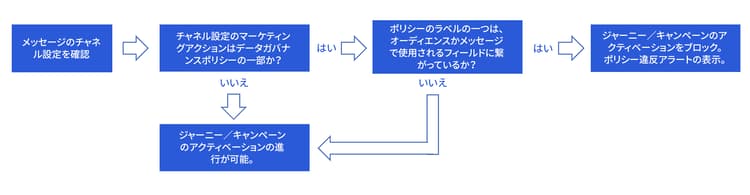
ジャーニーとキャンペーンのポリシー違反分析手順
カスタムアクションにマーケティングアクションを適用 custom-actions
例えば、カスタムアクションを使用してサードパーティへのエクスポートを制限する必要がある、血液型フィールドの例を見てみましょう。 これを行うには、マーケティングアクションをカスタムアクションに適用し、ジャーニーを作成してその中にカスタムアクションを追加する必要があります。
-
左側のメニューの 管理 で、「設定」をクリックし、「アクション」を選択します。
-
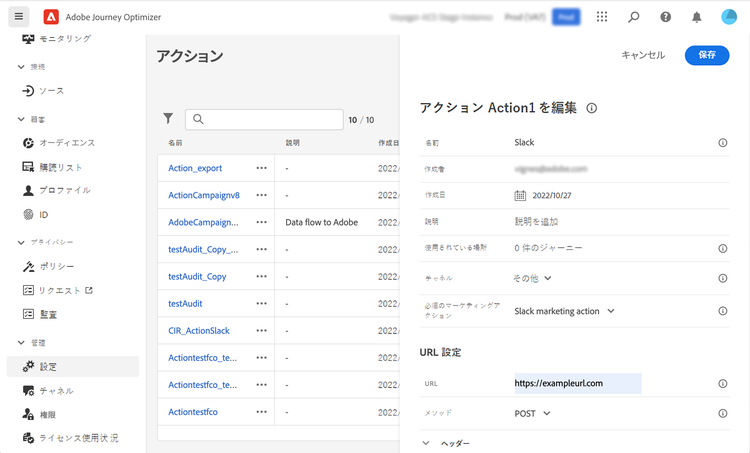
Slack カスタムアクションを開きます。 カスタムアクションを設定する場合、2 つのフィールドをデータガバナンスに使用できます。
-
「チャネル」フィールドでは、このカスタムアクションに関連するチャネルを選択できます。 これにより、「必須のマーケティングアクション」フィールドに、選択したチャネルのデフォルトのマーケティングアクションが事前に入力されます。 その他を選択した場合、デフォルトでマーケティングアクションは定義されません。 この例では、その他チャネルを選択します。
-
必須のマーケティングアクションを使用すると、カスタムアクションに関連するマーケティングアクションを定義できます。 例えば、このカスタムアクションを使用してサードパーティを介したメールを送信する場合は、「電子メールのターゲティング」を選択できます。 この例では、「Slack マーケティングアクション」を選択します。 そのマーケティングアクションに関連するガバナンスポリシーを取得して利用します。
カスタムアクションを設定するその他の手順について詳しくは、この節を参照してください。
-
-
左側のメニューの ジャーニー管理 で、「ジャーニー」をクリックします。
-
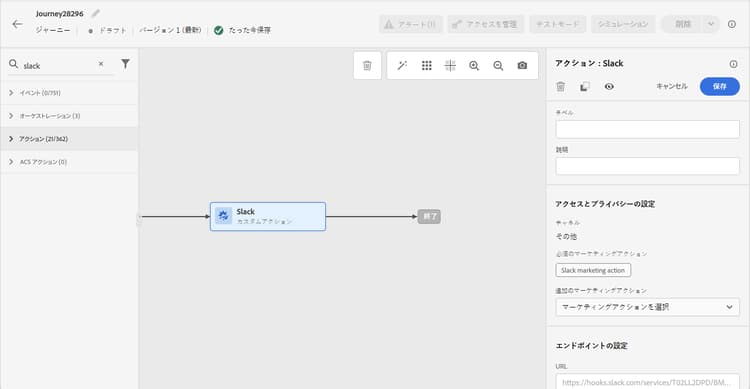
ジャーニーを作成し、カスタムアクションを追加します。 カスタムアクションをジャーニーに追加する場合は、データガバナンスを管理できるオプションがいくつかあります。 「読み取り専用フィールドを表示」をクリックして、すべてのパラメーターを表示します。
-
カスタムアクションを設定する際に定義した チャネル および 必須のマーケティングアクション は、画面の上部に表示されます。 これらのフィールドは変更できません。
-
追加のマーケティングアクションを定義して、カスタムアクションのタイプを設定できます。 これにより、このジャーニーでのカスタムアクションの目的を定義できます。 必須のマーケティングアクション(通常はチャネルに固有)に加えて、この特定のジャーニーのカスタムアクションに固有の追加のマーケティングアクションを定義できます。 例:ワークアウト通信、ニュースレター、フィットネス通信など。必須のマーケティングアクションと追加のマーケティングアクションの両方が適用されます。 この例では、追加のマーケティングアクションは使用しません。
-
「ePHI1」とラベル付けされたいずれかのフィールド(この例では、血液型フィールド)がアクションパラメーターで検出された場合、エラーが表示され、ユーザーはジャーニーを公開することができなくなります。 ガバナンスポリシー違反を検出する方法を学ぶ
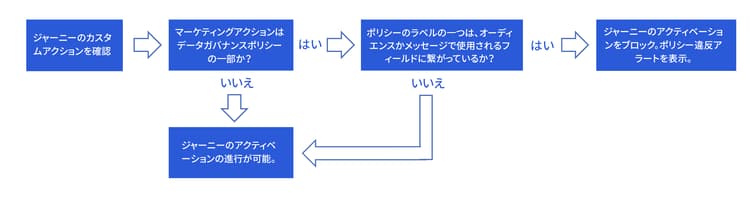
ジャーニーのカスタムアクションのポリシー違反分析手順
データポリシー違反 violation
システムによってジャーニー/キャンペーンやカスタムアクションで制限付きフィールドが特定された場合、エラーが表示され、ユーザーはそのフィールドを公開できなくなります。
エラーは、「アラート」ボタンから表示できます。 エラーを選択すると、発生したデータガバナンスポリシー違反に関する詳細情報が表示されます。
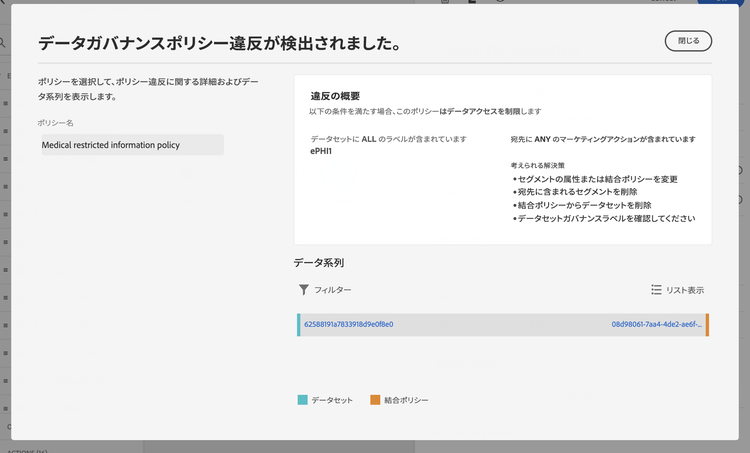
このダイアログは、現在のジャーニー/キャンペーンの設定が既存のデータガバナンスポリシーに違反していることを示します。 データ系列図を使用して、ジャーニーまたはキャンペーンをアクティブ化する前に必要となる、他の設定変更を理解します。
詳しくは、データ使用ポリシー違反のドキュメント{_blank}を参照してください。
This section contains structured knowledge intended to support interpretation, retrieval, and question answering related to this topic.
For complete understanding, this information should be combined with the documentation on this page. Neither source is intended to stand alone; the page describes the feature, while this section provides additional context that helps disambiguate terminology, intent, applicability, and constraints.
- TL;DR: This page explains how to create data governance policies that link labels to marketing actions and apply them to journeys, campaigns, and custom actions so restricted fields cannot be shared externally.
Intents:
- Create labels and apply them to profile attribute fields through Schemas
- Create marketing actions for each channel and third-party custom action
- Create a data governance policy that links a label to a marketing action
- Apply marketing actions to channel configurations and to custom actions
- Detect and interpret a data governance policy violation
Glossary:
- Data governance policy: A policy that links a label and a marketing action so that fields carrying that label cannot be used for the associated action (product-specific)
- Label: A tag applied to fields to restrict their usage, created under Privacy Policies (product-specific)
- Marketing action: A configurable element created per channel and per third-party custom action that governance policies are attached to (product-specific)
- Required marketing action: The marketing action defined when configuring a custom action, prefilled from the selected Channel and not editable in the journey (product-specific)
- Additional marketing action: A marketing action defined when adding a custom action to a journey to set the purpose of the custom action in that particular journey (product-specific)
- Data lineage diagram: The diagram in the policy violation dialog used to understand what configuration changes are needed before activation (product-specific)
Guardrails:
- DULE policy enforcement only applies to profile attributes; event-based fields (context attributes) such as journey event fields are not supported, and labels applied to them have no effect.
- Labels can only be applied to profile attribute fields.
- When applying a marketing action to custom actions, Campaign v7/v8 and Campaign Standard journey actions are not supported.
- If the system identifies a restricted field in a journey, campaign, or custom action, an error is displayed that prevents you from publishing it.
- When both are set, the required marketing action and the additional marketing action both apply.
Terminology:
- Canonical name: Data governance policy — Acronym: DULE (Data Usage Labelling and Enforcement) — variants: data governance, governance policy
- Synonyms: “labelling fields” = “applying labels to fields”
- Do not confuse: “Required marketing action” (defined on the custom action, read-only in the journey) ≠ “Additional marketing action” (defined per journey to set the purpose of the custom action)
- Do not confuse: “label” (tag on a field) ≠ “marketing action” (element the label is linked to in a policy)
FAQ:
- Q: Why does a label on a journey event field not restrict data usage? — DULE policy enforcement only applies to profile attributes; labels applied to event-based fields have no effect.
- Q: How is a data governance policy created? — From the Browse tab, click Create policy, select Data governance policy, then choose a label and a marketing action to link.
- Q: Where are marketing actions applied for journeys and campaigns? — In the Marketing action field of a channel configuration under Channels General settings Channel configurations.
- Q: Can a marketing action be applied to Campaign v7/v8 or Campaign Standard actions? — No, those journey actions are not supported when applying a marketing action to custom actions.
- Q: How is a policy violation detected? — An error prevents publishing and is visible from the Alerts button; selecting it shows details and a data lineage diagram.