このページ: Journey Optimizer で Adobe Experience Platform の同意ポリシーを適用します。これにより、各顧客の同意選択を尊重し、データ使用状況ルールに準拠した通信を実現できます。
データは、組織または法規制によって定義された使用制限の対象となる場合があります。 したがって、Journey Optimizer 内のデータ操作が、データ使用ポリシーに準拠していることを確認することが重要です。 これらのポリシーは、データに対して実行できるマーケティングアクションを定義する Adobe Experience Platform ルールです。
デフォルトでは、プロファイルがあなたからの通信の受信をオプトアウトした場合、対応するプロファイルは以降の配信から除外されます。 このデフォルトのロジックを上書きする 同意ポリシー を作成できます。 例えば、Experience Platform で同意ポリシーを作成して、特定のチャネルのコミュニケーションの受信に対してまだ同意をしていない顧客を除外できます。 カスタムポリシーがない場合、デフォルトのポリシーが適用されます。
同意ポリシーを適用する主な手順は次のとおりです。
-
Adobe Experience Platform で、関連付けられたマーケティングアクションを持つ同意ポリシーを作成します。 同意ポリシーの作成方法の詳細情報
-
チャネル設定またはジャーニーのカスタムアクションを使用して、Adobe Journey Optimizer で同意ポリシーを適用します。
-
関連付けられたマーケティングアクションを持つチャネル設定を作成します。 チャネル設定を使用して通信を作成すると、関連付けられているマーケティングアクションが継承され、Adobe Experience Platform で定義されている、対応する同意ポリシーが適用されます。 詳しくは、チャネル設定を通じて同意ポリシーを活用する方法を参照してください。
-
ジャーニーレベルでは、次のいずれかを実行できます。
- カスタムアクションを設定する際に、チャネルとマーケティングアクションをカスタムアクションに関連付けます。 詳しくは、カスタムアクションを設定する際の同意ポリシーを活用する方法を参照してください。
- ジャーニーでカスタムアクションを追加する際に、追加のマーケティングアクションを定義します。 詳しくは、ジャーニーでカスタムアクションを追加する際の同意ポリシーを活用する方法を参照してください。
-
チャネル設定を介した同意ポリシーの活用 surface-marketing-actions
Journey Optimizer では、同意は Experience Platform 同意スキーマで処理されます。 デフォルトでは同意フィールドの値は空で、お客様からの通信の受信に同意したものとして扱われます。 このデフォルト値はオンボーディングの際に、こちらに一覧表示されている値の 1 つに変更できます。
同意フィールドの値を変更するには、マーケティングアクションとそのアクションの実行条件を定義するカスタム同意ポリシーを作成します。 マーケティングアクションの詳細情報
例えば、メール通信の受信に同意したプロファイルのみをターゲットにする同意ポリシーを作成する場合は、次の手順に従います。
-
組織が Adobe Healthcare Shield または Privacy and Security Shield アドオン製品を購入していることを確認します。 詳細情報
-
Adobe Experience Platform で、(プライバシー/ポリシーメニューから)カスタムポリシーを作成します。 詳細情報
-
同意ポリシーのタイプを選択し、次のように条件を設定します。 同意ポリシーの設定方法の詳細情報
-
「If」セクションで、デフォルトの メールターゲティング マーケティングアクションを選択します。
note NOTE アドビが標準で提供するコアマーケティングアクションの一覧については、この表を参照してください。 カスタムマーケティングアクションを作成する手順について詳しくは、この節を参照してください。 -
マーケティングアクションが適用されたときの動作を選択します。 この例では、「メールマーケティングの同意」を選択します。

-
-
このポリシーを保存して有効にします。
-
Journey Optimizer で、メールチャネル設定を作成します。 方法についてはこちらを参照
-
メール設定の詳細で、「メールターゲティング」マーケティングアクションを選択します。

顧客の意向を尊重するために、そのマーケティングアクションに関連付けられているすべての同意ポリシーが自動的に活用されます。
そのため、この例では、キャンペーンまたはジャーニーでこの設定を使用するメールは、マーケティング組織からのメールの受信に同意したプロファイルにのみ送信されます。 メール通信の受信に同意しないプロファイルは除外されます。
カスタムアクションを介した同意ポリシーの活用 journey-custom-actions
重要な注意事項 important-notes
Journey Optimizer では、同意をカスタムアクションでも活用できます。 組み込みメッセージ機能と共に使用する場合は、条件アクティビティを使用して、ジャーニー内の顧客をフィルタリングする必要があります。
同意管理を使用すると、2 つのジャーニーアクティビティが分析されます。
- オーディエンスの読み取り:取得したオーディエンスが考慮されます。
- カスタムアクション:同意管理では、使用される属性(アクションパラメーター)と、定義されたマーケティングアクション(必須のマーケティングアクションと追加のマーケティングアクション)が考慮されます。
- 標準の結合スキーマを使用するフィールドグループに属する属性はサポートされていません。 これらの属性は、インターフェイスで非表示になります。 別のスキーマを使用して別のフィールドグループを作成する必要があります。
- 同意ポリシーは、マーケティングアクション(必須または追加)がカスタムアクションレベルで設定されている場合にのみ適用されます。
ジャーニーで使用されるその他のアクティビティは、すべて考慮されません。 オーディエンスの選定でジャーニーを開始した場合、そのオーディエンスは考慮されません。
ジャーニー中に、カスタムアクションの同意ポリシーによってプロファイルが除外された場合、メッセージはそのプロファイルに送信されませんが、そのプロファイルはジャーニーを継続します。 条件を使用する場合、プロファイルはタイムアウトとエラーパスに移動しません。
ジャーニーに配置されたカスタムアクションのポリシーを更新する前に、ジャーニーにエラーがないことを確認してください。
カスタムアクションを設定する際の同意ポリシーの活用 consent-custom-action
カスタムアクションを設定する際には、2 つのフィールドを同意管理に使用できます。
「チャネル」フィールドでは、このカスタムアクションに関連するチャネルを選択できます。 これにより、「必須のマーケティングアクション」フィールドに、選択したチャネルのデフォルトのマーケティングアクションが事前に入力されます。 その他を選択した場合、デフォルトでマーケティングアクションは定義されません。
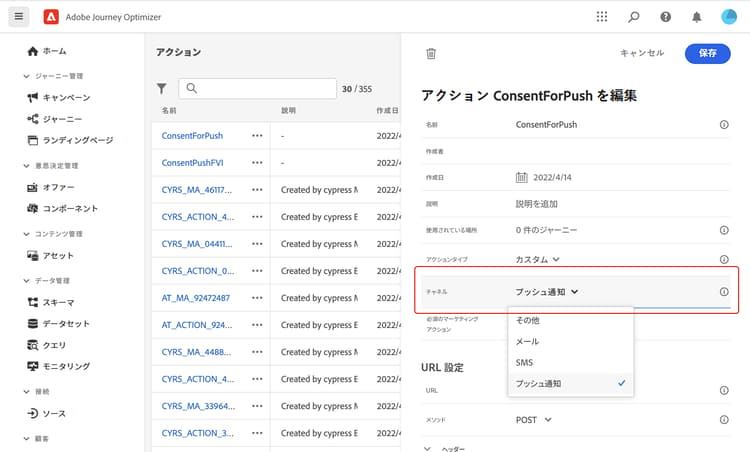
必須のマーケティングアクションを使用すると、カスタムアクションに関連するマーケティングアクションを定義できます。 例えば、このカスタムアクションを使用してメールを送信する場合は、メールのターゲティングを選択できます。 ジャーニーで使用すると、そのマーケティングアクションに関連するすべての同意ポリシーが取得され、活用されます。 デフォルトのマーケティングアクションが選択されていますが、下向き矢印をクリックして、使用可能なマーケティングアクションをリストから選択できます。
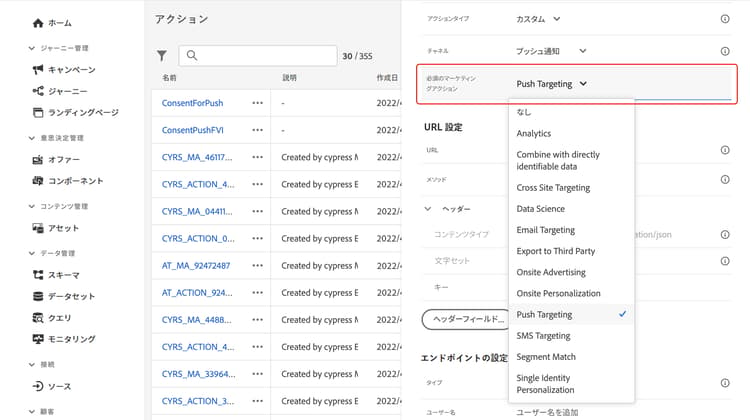
クライアントのパスワードをリセットするために送信されるトランザクションメッセージなど、重要な通信の一部の種類については、同意ポリシーを適用したくない場合があります。 次に、「必須のマーケティングアクション」フィールドで「なし」を選択します。
カスタムアクションを設定するその他の手順について詳しくは、この節を参照してください。
ジャーニーでカスタムアクションを追加する際の同意ポリシーの活用 consent-journey
カスタムアクションをジャーニーに追加する場合、いくつかのオプションで同意を管理できます。 「読み取り専用フィールドを表示」をクリックして、すべてのパラメーターを表示します。
カスタムアクションを設定する際に定義した チャネル および 必須のマーケティングアクション は、画面の上部に表示されます。 これらのフィールドは変更できません。
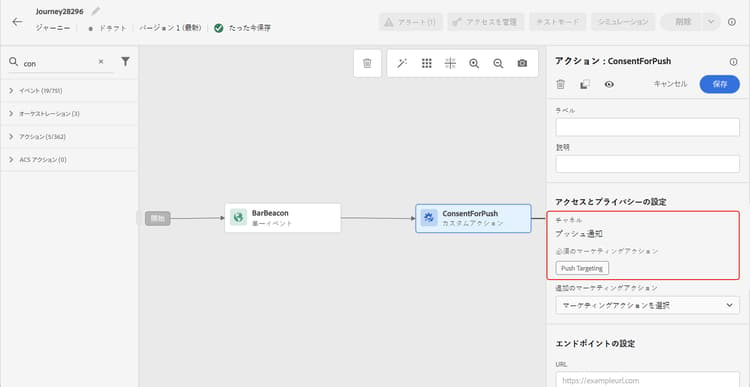
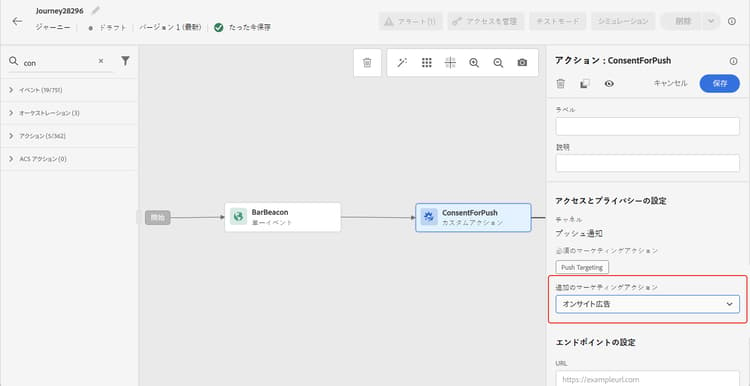
追加のマーケティングアクションを定義して、カスタムアクションのタイプを設定できます。 これにより、このジャーニーでのカスタムアクションの目的を定義できます。 必須のマーケティングアクション(通常はチャネルに固有)に加えて、この特定のジャーニーのカスタムアクションに固有の追加のマーケティングアクションを定義できます。 例:ワークアウト通信、ニュースレター、フィットネス通信など。必須のマーケティングアクションと追加のマーケティングアクションの両方が適用されます。
画面下部の「ポリシーの更新」ボタンをクリックして、このカスタムアクションで考慮するポリシーのリストを更新および確認します。 これは、ジャーニーの構築中に情報提供のみを目的としたものです。 ライブジャーニーでは、同意ポリシーは 6 時間ごとに取得され、自動的に更新されます。
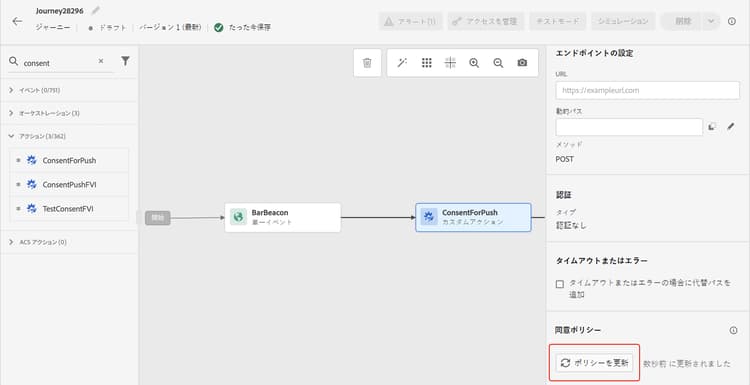
ジャーニーでカスタムアクションを設定するその他の手順について詳しくは、この節を参照してください。
This section contains structured knowledge intended to support interpretation, retrieval, and question answering related to this topic.
For complete understanding, this information should be combined with the documentation on this page. Neither source is intended to stand alone; the page describes the feature, while this section provides additional context that helps disambiguate terminology, intent, applicability, and constraints.
- TL;DR: This page explains how to apply Adobe Experience Platform consent policies in Journey Optimizer, through channel configurations or journey custom actions, so that communications respect each customer’s consent choices.
Intents:
- Understand how consent policies override the default exclusion logic for opted-out profiles
- Leverage consent policies through an email channel configuration by associating a marketing action
- Associate a channel and a required marketing action to a custom action when configuring it
- Define an additional marketing action when adding a custom action in a journey
- Refresh and check the list of consent policies taken into consideration for a custom action
Glossary:
- Consent policy: A policy you create in Adobe Experience Platform that overrides the default logic, for example to exclude customers who have not consented to receive communication for a given channel (product-specific)
- Marketing action: A marketing action, such as Email Targeting, associated with a channel configuration or custom action so that all consent policies associated with that marketing action are leveraged (product-specific)
- Required marketing action: The marketing action defined when configuring a custom action; prefilled from the default marketing action of the selected channel (product-specific)
- Additional marketing action: A marketing action defined when adding a custom action in a journey, describing the purpose of that custom action in that particular journey (product-specific)
- Consent schema: The Experience Platform schema that handles consent; by default the consent field value is empty and treated as consent to receive communications (product-specific)
Guardrails:
- Consent policies are currently only available for organizations that have purchased the Adobe Healthcare Shield or Privacy and Security Shield add-on offerings.
- With consent management, only two journey activities are analyzed: Read audience and Custom action; all other activities are not taken into account, and if a journey starts with an Audience qualification the audience is not taken into account.
- Consent policies only apply when a marketing action (required or additional) is set at the custom action level.
- Attributes that are part of a field group using the out-of-the-box Union Schema are not supported and are hidden from the interface; you need to create another field group using a different schema.
- If a profile is excluded by a consent policy in a custom action, the message is not sent to that profile, but the profile continues the journey and does not go to the timeout and error path when using a condition.
- Before refreshing policies in a custom action positioned in a journey, make sure your journey has no error.
- With live journeys, consent policies are retrieved and updated automatically every 6 hours.
- Selecting None in the Required marketing action field means no consent policy is applied, for example for transactional messages such as a password reset.
Terminology:
- Canonical name: Consent policy — Acronym: n/a — variants: custom consent policy, consent management
- Synonyms: “channel configuration” = “channel surface”
- Do not confuse: “Required marketing action” (defined when configuring the custom action, read-only when adding it in a journey) ≠ “Additional marketing action” (defined when adding the custom action in a journey)
- Do not confuse: “Healthcare Shield” ≠ “Privacy and Security Shield” (two distinct add-on offerings, either of which enables consent policies)
FAQ:
- Q: What happens by default when a profile has opted out? — By default the corresponding profile is excluded from subsequent deliveries; a consent policy can override this default logic.
- Q: Do I need a specific offering to use consent policies? — Yes, consent policies are only available for organizations that have purchased the Adobe Healthcare Shield or Privacy and Security Shield add-on offerings.
- Q: How often are consent policies updated for live journeys? — With live journeys, consent policies are retrieved and updated automatically every 6 hours.
- Q: What does the Refresh policies button do? — It updates and checks the list of policies taken into consideration for the custom action; this is for information purpose only while building a journey.
- Q: How do I avoid applying a consent policy to a transactional message? — Select None in the Required marketing action field so that no consent policy is applied.
Personas:
- developer: Can select a Channel field when configuring a custom action, which prefills the Required marketing action field with the default marketing action for that channel. Can select Email targeting as the Required marketing action, for example when the custom action sends emails. Can select None in the Required marketing action field for a transactional message such as a password reset. Where: “Leverage consent policies when configuring a custom action”.
- admin: Can create an email channel configuration in Journey Optimizer and select the Email Targeting marketing action in the configuration details. All consent policies associated with that marketing action are then automatically leveraged for communications using that configuration. The page states that consent policies are only available for organizations that have purchased the Adobe Healthcare Shield or Privacy and Security Shield add-on offerings. Where: “Leverage consent policies through channel configurations”.
Onboarding:
- Level: Experienced
- First minimal step: Create a consent policy in Adobe Experience Platform with an associated marketing action.
- Success check: Profiles who have not consented to receive email communications are excluded.
- Previous: Creating an email channel configuration before selecting a marketing action for it: Set up channel configurations (configuration/channel-surfaces.md)
- Next: Creating an email using a channel configuration that has a marketing action applied: Create an email (email/create-email.md); Configuring the other steps of a custom action after setting its consent management fields: Configure a custom action (action/about-custom-action-configuration.md)