在此頁面上:瞭解如何使用Adobe Journey Optimizer中的歷程儀表板、清單和行事曆檢視,來瀏覽、搜尋和篩選您的歷程。
歷程儀表板 dashboard-jo
在「歷程管理」功能表區段中,按一下歷程。 有三個專用索引標籤可供使用: 總覽 (儀表板)、瀏覽 (清單和行事曆)及資料夾檢視 (在資料夾中整理歷程)。
歷程概觀
概觀索引標籤會顯示儀表板,其中包含與您的歷程相關的關鍵量度。

- 已處理的設定檔:過去24小時內處理的設定檔總數
- 即時歷程:過去24小時內具有流量的即時歷程總數。 即時歷程包含單一歷程 (事件型)和批次歷程 (讀取對象)。
- 錯誤率:所有錯誤的設定檔與過去24小時內輸入的設定檔總數之比。
- 捨棄率:所有捨棄的設定檔與過去24小時內輸入的設定檔總數之比。 捨棄的設定檔代表無權進入歷程的人,例如,由於名稱空間或重新進入規則不正確。
歷程清單
瀏覽索引標籤會顯示現有歷程的清單。 您可以搜尋歷程、使用篩選器,以及對每個元素執行基本動作。 例如,您可以複製或刪除項目。

在歷程清單中,所有歷程版本都會連同版本號碼一起顯示。 當您搜尋歷程時,最新版本會在應用程式首次開啟時出現在清單頂端。 然後,您可以定義所需的排序,應用程式會將其保留為使用者偏好設定。 歷程的版本也會顯示在畫布上方的歷程版本介面頂端。 深入瞭解歷程版本管理。
歷程行事曆 calendar
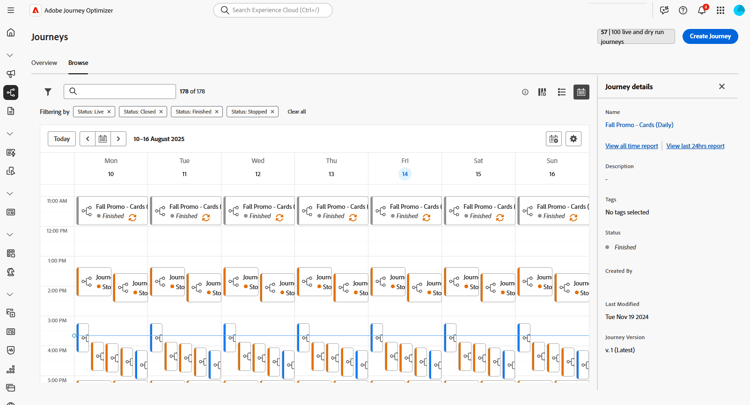
除了歷程清單之外,Journey Optimizer 還提供歷程的行事曆視圖,以清晰的視覺化方式呈現排程。
歷程的顯示方式:
- 依預設,行事曆格線會顯示所選周的所有即時和排程歷程。 其他篩選器選項可顯示已完成、已停止和已完成的啟動或啟動。
- 在測試模式中的草稿歷程和歷程不會顯示。
- 橫跨多天的歷程會顯示在行事曆格線的頂端。
- 如果未指定開始時間,則會使用最接近的手動啟動時間,將其放置在行事曆中。
- 歷程會顯示為1小時時間跨度,但這並不反映實際的傳送或完成時間。
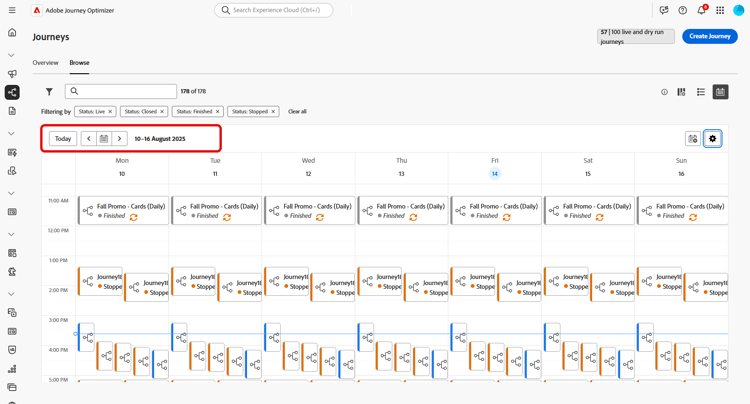
若要在您的「歷程」行事曆中導覽:
-
若要存取行事曆檢視,請開啟歷程清單,然後按一下

-
使用箭頭按鈕或行事曆上方的日期選擇器,在周之間移動。
行事曆顯示本週排程的所有歷程。
-
按一下「

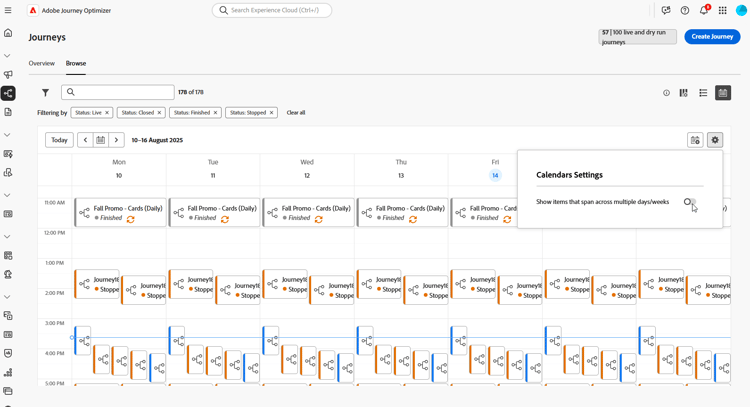
-
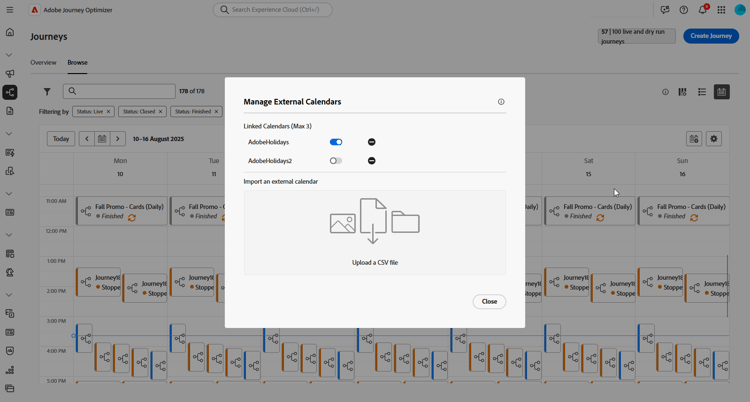
按一下

顯示外部行事曆的
-
拖放包含事件名稱、開始日期和結束日期的CSV檔案。
上傳的事件會針對您組織中的所有使用者顯示,並顯示在歷程和行銷活動行事曆上。
accordion CSV格式應如下所示: table 0-row-3 1-row-3 Column1 Column2 Column3 事件名稱 開始日期(mm/dd/yy格式) 結束日期(mm/dd/yy格式) -
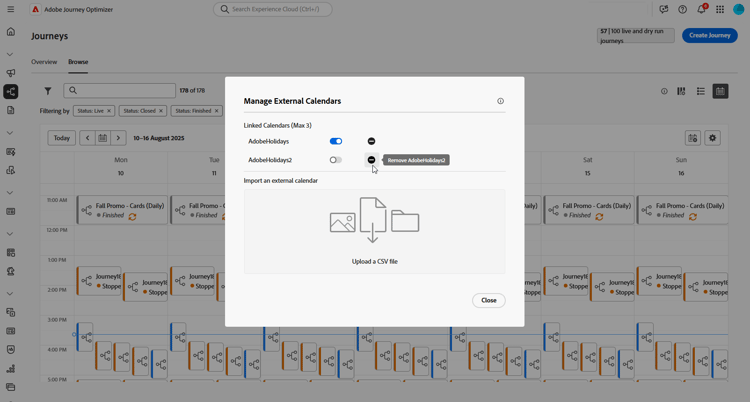
如有需要,您可以隱藏、取消隱藏或移除新增的外部行事曆。
顯示外部行事曆的
-
如需歷程的詳細資訊,請按一下其視覺區塊以開啟並探索其詳細資訊。
資料夾檢視 journeys-folders
開啟歷程資料夾檢視,該檢視具有歷程清單上的 顯示資料夾 圖示,或使用 資料夾檢視 標籤。 瞭解如何使用資料夾

篩選您的歷程 journey-filter
在歷程清單中,使用各種篩選器來調整歷程清單。

您可以根據歷程的狀態、型別、版本,以及從 狀態和版本篩選器 指派的標籤來篩選歷程。
使用建立篩選器,根據歷程的建立日期或建立歷程的使用者來篩選歷程。
顯示使用來自 活動篩選器 和 資料篩選器 的特定事件、欄位群組或動作的歷程。
使用 出版物篩選器 來選取出版物日期或使用者。 舉例來說,您可以選擇只顯示昨天發佈之即時歷程的最新版本。
若要根據特定日期範圍篩選歷程,請從 已發佈 下拉式清單中選取自訂。
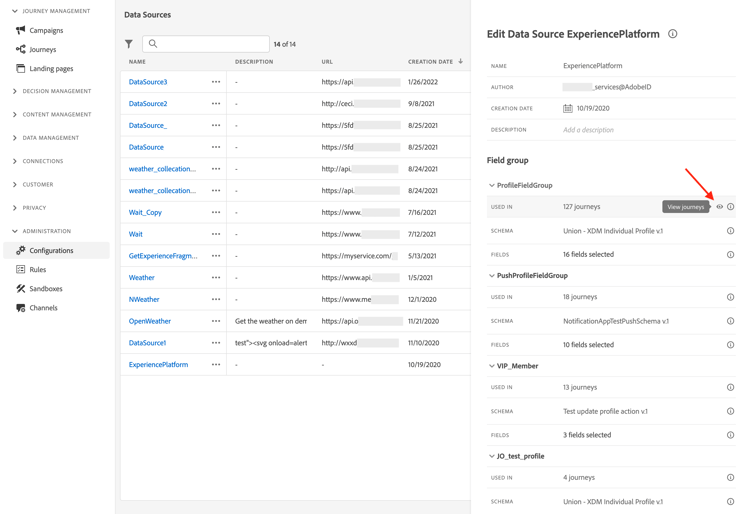
此外,在「事件」、「資料來源」和「動作」設定窗格中,用於欄位會顯示使用該特定事件、欄位群組或動作的歷程次數。 您可以按一下 檢視歷程 按鈕以顯示對應歷程的清單。
歷程型別 journey-types
歷程的型別取決於該歷程中使用的活動。 可以是:
在此頁面上進一步瞭解歷程型別和相關的專案管理。
歷程狀態 journey-statuses
歷程狀態取決於其生命週期。 可以是:
任何已設定的開始和結束日期會出現在歷程標題中、狀態徽章旁。 這讓您不需要開啟屬性面板,就能一目瞭然地檢視歷程排程。
複製歷程 duplicate-a-journey
您可以從 瀏覽 索引標籤複製現有歷程。 所有物件和設定都會複製到歷程副本。
請依照下列步驟執行:
-
導覽至您要複製的歷程,按一下 更多動作 圖示(歷程名稱旁的三個點)。
-
選取「複製」。

-
輸入歷程名稱並確認。 您也可以在歷程屬性畫面中變更名稱。 依預設,名稱設定如下:
[JOURNEY-NAME]_copy
-
新歷程已建立並可在歷程清單中使用。
大量作業 bulk-operations
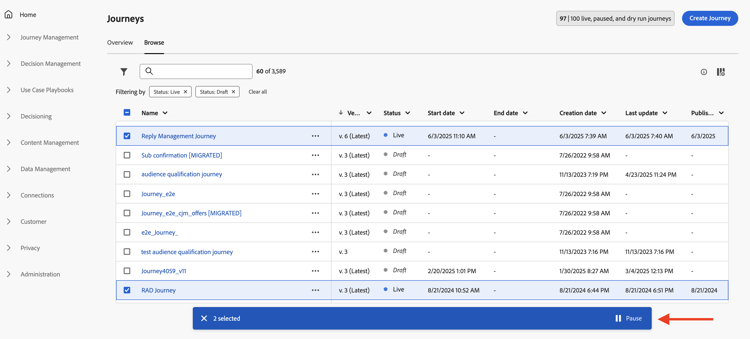
從歷程清單中,您可以使用核取方塊一次選取多個專案,並從畫面底部出現的大量動作列將作業套用至所有專案。

可進行下列操作:
- 新增到封裝 — 將選取的歷程匯出到另一個沙箱。 瞭解如何匯出物件 →
- 移至資料夾 — 將選取的歷程移至資料夾。 瞭解如何使用資料夾→
- 編輯標籤 — 編輯指派給所選歷程的標籤。 瞭解如何使用標籤 →
- 管理存取權 — 將存取權標籤套用至選取的歷程。 深入瞭解物件層級存取控制 →
- 刪除 — 永久刪除選取的歷程。
- 暫停 — 暫停選取的 即時 歷程(大量暫停)。 只有在選取 即時 歷程時才可用。
- 繼續 — 繼續選取的 已暫停 個歷程(大量繼續)。 只有在選取 已暫停 歷程時才可用。
This section contains structured knowledge intended to support interpretation, retrieval, and question answering related to this topic.
For complete understanding, this information should be combined with the documentation on this page. Neither source is intended to stand alone; the page describes the feature, while this section provides additional context that helps disambiguate terminology, intent, applicability, and constraints.
- TL;DR: This page explains how to browse, filter, view (list and calendar), duplicate, and perform bulk operations on journeys from the Journey Optimizer dashboard.
Intents:
- Browse and search journeys from the Overview and Browse tabs
- Filter journeys by status, type, version, tags, creation date, or publication date
- Switch between list view and calendar view to visualize journey schedules
- Add and manage external calendars by uploading CSV files
- Duplicate an existing journey to reuse its settings
- Apply bulk operations to multiple selected journeys from the bulk action bar: add to package, move to folder, edit tags, manage access, delete, pause, or resume
Glossary:
- Journey dashboard: The main journeys interface with an Overview tab showing key metrics and a Browse tab listing all journeys. (product-specific)
- Discard rate: The ratio of profiles not eligible to enter the journey (e.g., due to incorrect namespace or reentrance rules) compared to total profiles who attempted entry over the last 24 hours. (product-specific)
- Journeys calendar view: A visual weekly calendar representation of live and scheduled journeys, accessible by clicking the calendar icon in the journeys list. (product-specific)
- Bulk action bar: The action bar that appears at the bottom of the journeys list once one or more journeys are selected, offering add to package, move to folder, edit tags, manage access, delete, pause, and resume. (product-specific)
- Bulk pause/resume: The pause and resume operations available from the bulk action bar, limited to Live journeys (pause) or Paused journeys (resume), up to 10 per operation. (product-specific)
Guardrails:
- Dashboard metrics refresh every 30 minutes and only when new data is available; they cover the last 24 hours only
- Draft journeys and journeys in test mode are not shown in the calendar view
- Bulk pause/resume is limited to 10 journeys per operation
- The Resume button is only active when Paused journeys are selected; the Pause button is only active when Live journeys are selected
- The calendar displays journeys as 1-hour timespans regardless of actual send or completion time
Terminology:
- Canonical name: Journey dashboard — Acronym: none — variants: journeys list, journeys overview
- Synonyms: “Browse tab” = “journeys list”
- Do not confuse: “Discard rate” ≠ “Error rate” — Discard rate counts profiles ineligible to enter; Error rate counts profiles that entered but encountered a processing error
- Note: Add to package, move to folder, edit tags, manage access, and delete are shared with the Campaigns, Fragments, and Templates lists; pause and resume are journey-specific
FAQ:
- Q: Where can I see key journey performance metrics at a glance? — On the Overview tab of the Journey dashboard, which shows profiles processed, live journeys, error rate, and discard rate for the last 24 hours.
- Q: How do I find journeys that use a specific event or action? — Use the Activity filters and Data filters in the journey list to display journeys referencing a specific event, field group, or action.
- Q: Can I pause multiple journeys at once? — Yes; select multiple Live journeys in the list and click the Pause button in the bottom bar. Up to 10 journeys can be paused per operation.
- Q: How do I add external events to the journey calendar? — Click the calendar add icon, then drag and drop a CSV file with event name, start date, and end date columns; uploaded events are visible to all users in the organization.
- Q: Why does the calendar show a journey as 1 hour even though it runs longer? — The calendar displays all journeys as 1-hour timespans for visual consistency; this does not reflect actual send or completion time.
- Q: What bulk operations can I perform on multiple journeys at once? — Besides pause and resume, you can select multiple journeys and add them to a package, move them to a folder, edit their tags, manage their access, or delete them, using the bulk action bar at the bottom of the journeys list.