在此页面上:探索整个Adobe Journey Optimizer中的AI和机器学习功能,从AI Assistant和代理到内容生成、AI支持的集成和工具(如GenStudio和MCP服务器)、发送时间优化和决策,以便您可以更快地工作并提供更相关的客户体验。
Adobe Journey Optimizer利用人工智能和机器学习的强大功能,帮助您创建、优化和提供卓越的客户体验。 从生成个性化内容到预测最佳发送时间,AI功能可简化您的工作流并最大化影响。 用例行动手册提供预建模板以快速实施常见营销方案。
快速导航 quick-navigation
使用这些分组链接跳转到您需要的功能:
- 对话人工智能和代理: 人工智能助理,Journey Agent,Experimentation Agent,其他AI代理
- 内容创建: AI支持的内容生成
- AI支持的集成和工具: 图像到HTML转换器,GenStudio性能营销,品牌一致性得分,Adobe Journey Optimizer MCP服务器
- 优化和决策: 发送时间优化,用于决策的AI模型,AI支持的规则和公式优化
- 试验: 使用AI的内容试验
- 模板: 用例行动手册
- 帮助: 常见问题解答
AI 助手 ai-assistant
AI助手是您对Adobe Journey Optimizer的对话指南。 使用它可即时获得有关产品功能的答案、有关您历程的操作见解并帮助导航平台。
访问 AI 助手
单击顶部栏中的AI助手图标,打开屏幕右侧的助手面板。
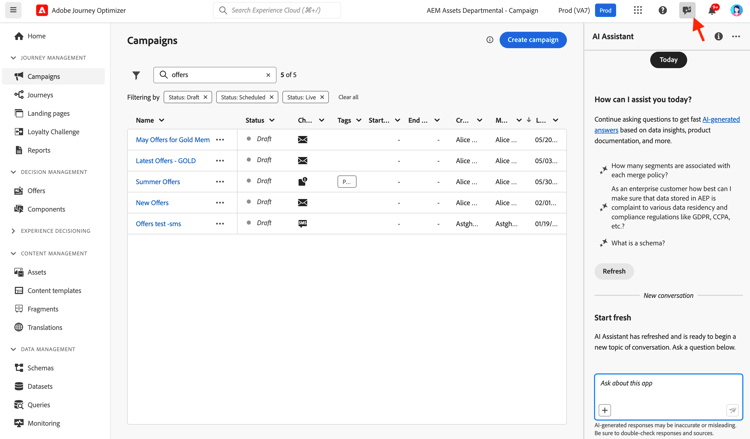
AI助手可以执行的操作
产品知识 — 询问有关Adobe Journey Optimizer功能和概念的问题:
- “如何在Adobe Journey Optimizer中设置营销活动?”
- “如何创建要在历程中使用的自定义操作?”
- “一个沙盒中可以有多少个实时活动?”
Operational Insights (Beta) — 获取历程的实时信息:
- “我有多少个实时历程?”
- “给我所有计划历程的列表”
- “过去7天内创建了多少历程?”
如何使用AI助手
- 在面板底部的文本字段中输入您的问题
- 按Enter键提交查询
- 查看AI生成的响应
- 单击 显示源 以访问相关文档
- 使用向上/向下缩略图对响应质量进行评级
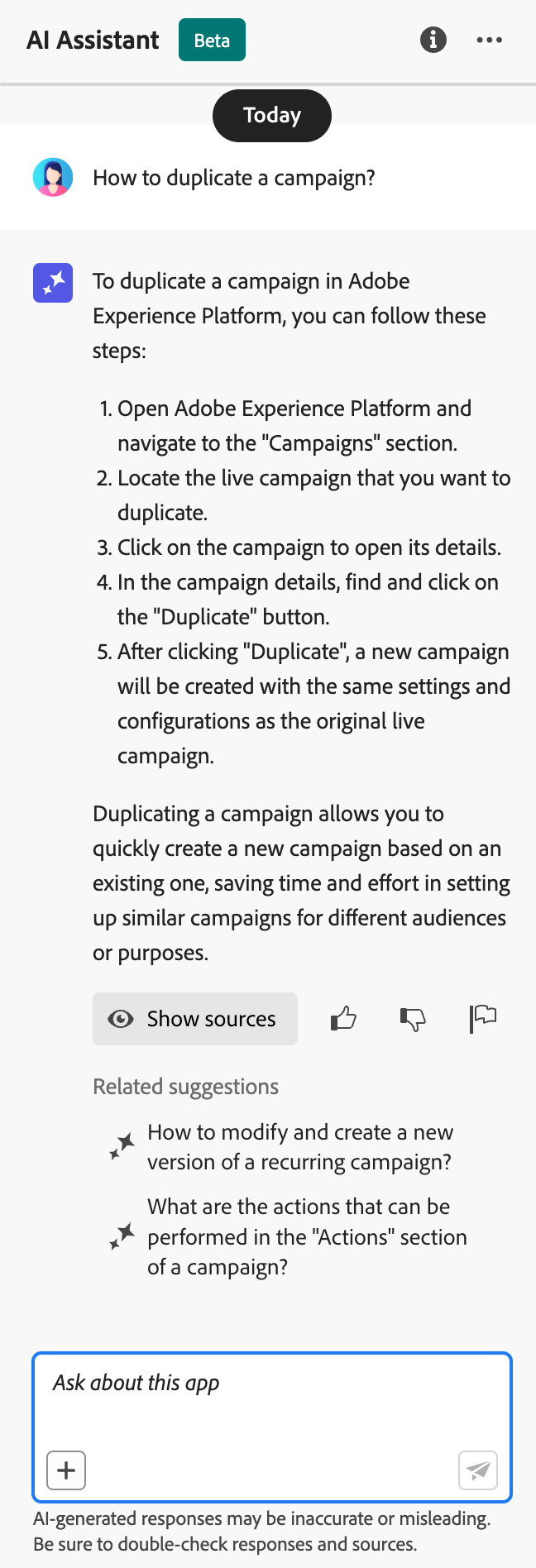
用于历程优化的高级AI代理 ai-agents
Adobe Journey Optimizer在AI Assistant的对话功能的基础上,提供专业的AI代理,这些代理为旅程优化和试验提供深入分析和切实可行的建议。
Journey Agent journey-agent
Journey Agent包含两种AI助手技能:分析和创建。 使用它们可优化现有历程或从自然语言提示构建新历程。
- 查看历程 — 直接在AI助手中查看历程见解
- 管理历程 — 直接在AI助手中创建新旅程
- 查看区段 — 查看受众分析并搜索现有受众
- 管理区段 — 直接在AI助手中创建新受众
- 查看历程事件、数据源和操作 — 创建技能要求搜索历程事件和自定义操作
历程分析技能 journey-analyze-skill
历程分析代理可帮助您通过自然语言分析优化旅程性能:
- 历程流失分析 — 识别客户在旅程中的流失位置和原因,检测脱离模式
- 受众重叠检测 — 分析多个历程中的受众重叠,以防止疲劳过度定位
- 计划冲突检测 — 识别针对同一受众的计划历程之间的时间冲突
- 运营分析 — 获取基于提示的分析,如“向我显示所有实时历程”或“超过X个历程中使用了哪些受众”
- “对旅程执行流失分析[历程名称]”
- “历程[历程名称]是否存在任何计划冲突?”
- “向我显示历程[受众名称]的历程重叠冲突”
- “超过5个历程中使用了哪些受众?”
历程创建技能 journey-create-skill
历程创建代理可帮助您从自然语言提示构建历程,将您的目标转换为结构化历程配置:
- 自然语言历程创建 — 描述您所需的历程并自动创建它
- 基于事件和基于受众的开始 — 创建事件触发、基于受众、业务事件或受众资格历程
- 条件逻辑 — 根据客户属性或行为生成拆分路径
- 多渠道消息传递 — 添加电子邮件、推送和短信操作
- 计划 — 配置开始日期和步骤之间的计时
- “创建一个历程,该历程从客户在线购买产品并发送感谢推送通知时开始。”
- “在两周内发送三封电子邮件,从12月20日开始,构建一个以我的每日徒步旅行者受众为目标的历程。”
- “创建一个历程,该历程在用户进入我的商店位置时开始,并根据他们是否有有效的电子邮件地址进行跟踪。”
Experimentation Agent experimentation-agent
Experimentation Agent可使您跨网站、电子邮件、推送消息和应用程序运行和管理数字实验的方式现代化:
- 性能分析 — 清楚地了解实验中发生的情况
- 分析生成 — 说明结果出现的原因
- 机会发现 — 有关后续操作的指导
- 内容分析 — 检查消息元素,了解为什么某些处理优于其他处理
- 推荐生成 — 根据见解提出新的处理或调整建议
- “哪些实验正在运行[Campaign Name]?”
- “对于我的[实验名称],采用什么治疗方法?”
- “我们从[实验名称]中学到了什么?”
- “你建议我在做这个实验之后做什么?”
- “从最近的测试中出现了哪些常见模式?”
- 查看实验 — 在AI助手中查看实验见解
- 管理试验元数据 — 在AI助手中创建新试验
注意:可用于Journey Optimizer Experimentation Accelerator许可证。
其他AI代理 additional-ai-agents
Audience Agent — 用于跨Adobe Experience Platform进行对话式受众探索和管理,包括重复检测和大小跟踪。 了解有关Audience Agent的更多信息
Agent Orchestrator — 协调多个专业代理以解决复杂的多步营销挑战。 Orchestrator会自动确定要涉及的代理并对其进行有效的排序。 了解有关Agent Orchestrator的更多信息
AI支持的内容生成 content-generation
使用创作AI跨多个渠道创建和个性化内容,在保持品牌一致性的同时加快内容创建过程。 生成内容适用于电子邮件、推送通知、短信和Web体验 — 帮助您生成主题行、正文文本、图像和完整的消息变体。
主要功能
- 生成完整内容 — 在一个流程中生成电子邮件、Web、登陆页和推送的完整内容体验(文本和图像)。 使用AI生成完整内容
- 文本生成 — 根据您的品牌语调和目标创建引人注目的副本。 使用AI生成文本
- 图像生成 — 使用Adobe Firefly生成自定义图像。 使用AI生成图像
- 内容变量 — 为A/B测试生成多个变量。 使用AI的内容试验
- Personalization — 从Personalization编辑器或电子邮件Designer工具栏(添加表达式)生成新表达式、解释现有代码或修复生成内容时出现的问题。 为个性化表达式生成内容
- 品牌一致性 — 确保生成的内容符合您的品牌准则。 评估品牌一致性
- 模板支持 — 利用您现有的电子邮件模板。 使用内容模板
最佳实践
- 具体化 — 提供清晰、详细的提示,以获得更好的结果。 了解提示最佳实践
- 上传品牌资产 — 使用PDF、图像或ZIP文件(最大50MB)来保持品牌一致性
- 使用自定义模板 — 使用最多8到10个图像的品牌特定模板
- 提供反馈 — 为输出评级,以帮助改进AI模型
- 审阅所有内容 — 始终在发布前审阅人工智能生成的内容是否准确
AI支持的集成和工具 additional-capabilities
图像到 HTML 转换器 image-to-html
使用AI支持的转换技术,将静态图像设计(JPEG、PNG)转换为可编辑的HTML电子邮件模板。
GenStudio性能营销 genstudio
与Adobe GenStudio for Performance Marketing集成以创建支持AI的电子邮件内容并将模板导入Journey Optimizer以进行编排。 将Journey Optimizer模板导出到GenStudio,使用AI生成变体,并将其带回以进行部署。 (可用性有限,仅限电子邮件渠道。)
品牌一致性评分 brand-alignment
使用AI支持的评分(衡量语调、语音和消息传送的一致性)评估内容与品牌准则的匹配程度。
Adobe Journey Optimizer MCP服务器(Beta) mcp-server
使用模型上下文协议(MCP)将Adobe Journey Optimizer连接到与MCP兼容的AI应用程序,例如Claude Web、Claude Desktop和Cursor。 利用MCP服务器,您可以使用纯语言提示查询促销活动、历程、选件和渠道配置,而无需进行API调用或UI导航。 所有操作当前均为只读。
了解有关Journey Optimizer MCP服务器的更多信息
发送时间优化 send-time-optimization
使用人工智能根据单个客户行为模式预测发送每条消息的最佳时间,最大化参与度。
工作原理
发送时间优化可分析历史参与数据(打开数和点击数),以预测每个客户何时最有可能与您的消息互动。 系统会自动在指定的时间范围内计划交货。
何时使用
用于决策的AI模型 ai-decisioning
创建智能排名模型,按转化率(转化率÷展示次数)对优惠进行排名,自动向每位客户显示最有可能转化的优惠。
模型类型
- 自动优化 — 学习优惠的整体非个性化性能,以随着时间的推移自动提高转化。 由于该型号大约每6小时重修一次,所以在选件经常变更时非常合适。
- 个性化优化 — 使用客户配置文件属性、行为和受众成员资格来预测每个人的最佳优惠。 当您需要为每个客户指定不同的排名,而不是一个总体入选者时,请选择此选项。
要求
最低数据要求因模型类型而异:
- 自动优化 — 最近14天内至少有2个选件包含100个以上的显示事件和5个以上的点击事件。 低于此阈值的选件会被视为新选件,且仅通过探索流量提供。
- 个性化优化 — 使用滚动式30天窗口。 Adobe建议每个选件每周至少显示1,000次展示和100次转化事件;默认情况下,展示次数少于1,000次或转化次数少于50次的选件将不会获得为其训练的模型。 最多可以选择5个受众来培训单个模型。
AI支持的规则和公式优化 decisioning-optimization
Adobe Journey Optimizer可以自动分析以PQL语法表示的决策规则和排名公式,并建议保留原始逻辑的简化。 发现简化后,规则或公式旁边会显示一个红色的 Optimize 指示符,该指示符将打开原始表达式与AI建议的表达式的并排比较,并通过可下载的分析来验证两者行为是否相同。
关键功能
- 保留逻辑的简化 - AI建议使用较短的表达式,在模拟的配置文件上返回相同的结果。
- 验证报告 — 下载分析(TSV),该分析显示应用更改之前,每个模拟配置文件是如何针对两个版本进行评估的。
- 一键应用 — 直接从 优化 窗口将原始PQL替换为优化版本。
使用 AI 进行内容试验 experimentation
实验加速器可帮助您使用人工智能驱动的见解和推荐更快地运行实验,更快地识别入选内容变体。
主要功能:
- 自动生成多个内容变体
- 接收试验设计的人工智能推荐
- 获取绩效趋势的早期指标
- 加快统计显着性的实现
了解有关Experiment Accelerator的更多信息
用例行动手册 playbooks
用例行动手册是帮助您快速实施常见营销方案的预建工作流。 每个行动手册都包括现成的历程、消息、架构和区段。
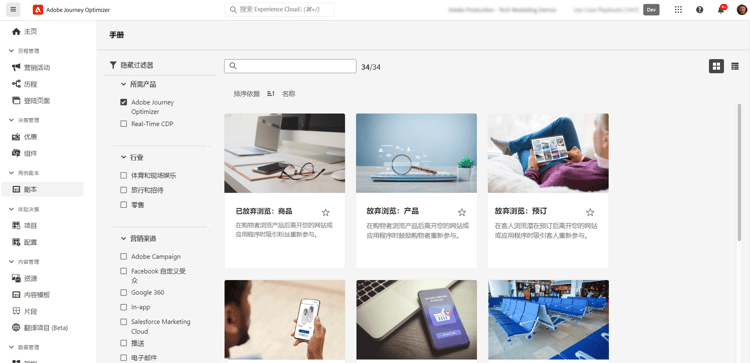
- 浏览行动手册库以查找与您的目标匹配的用例
- 启用行动手册以自动生成所有必需的资源
- 自定义生成的资产,以符合您的品牌和要求
- 在开发沙盒中将 部署 到生产或测试
浏览Journey Optimizer行动手册以了解常见方案,例如:
- 放弃的购物车恢复
- 面向新客户的欢迎系列
- 购买后参与
- 生日消息
- 重新参与活动
- 具有适当权限的沙盒
- 电子邮件、推送和/或短信的渠道配置
- 创建历程和消息的用户权限
查看所有可用的行动手册 | 请参阅Experience Platform文档以了解详情
常见问题 faq
- 生成内容 — 需要“生成内容”权限
- AI助手产品知识 — 需要与Adobe创作AI用户指南达成一致
- 历程分析代理 — 需要查看/管理历程和查看/管理区段权限
- 历程创建代理 — 需要管理历程、查看历程事件/数据源/操作、查看区段和管理区段权限
- Experimentation Agent — 需要查看试验和管理试验元数据权限
所有AI代理都需要访问AI Assistant并同意Adobe Experience Cloud创作AI用户准则。
This section contains structured knowledge intended to support interpretation, retrieval, and question answering related to this topic.
For complete understanding, this information should be combined with the documentation on this page. Neither source is intended to stand alone; the page describes the feature, while this section provides additional context that helps disambiguate terminology, intent, applicability, and constraints.
- TL;DR: This page is an overview of the AI and machine learning features across Journey Optimizer, including AI Assistant, AI agents, AI-powered content generation, integrations and tools, Send-Time Optimization, AI decisioning, and content experimentation.
Intents:
- Understand what AI Assistant can do and how to access it
- Learn which AI agents are available and what permissions each requires
- Generate content and message variations with AI across supported channels
- Predict the best send time per customer with Send-Time Optimization
- Rank and personalize offers with AI decisioning models
- Optimize Decisioning rules and ranking formulas with AI-suggested simplifications
Glossary:
- AI Assistant: The conversational guide to Journey Optimizer that answers product-knowledge questions and, in Beta, surfaces operational insights about journeys (product-specific)
- Journey Agent: An AI agent offering two skills in AI Assistant, Analyze and Create, for optimizing or building journeys from natural language (product-specific)
- Experimentation Agent: An AI agent that analyzes and manages digital experiments across websites, emails, push messages, and applications (product-specific)
- Generate Content: AI-powered content generation for subject lines, body text, images, and message variations (product-specific)
- Auto-optimization: A ranking model type that learns from overall, non-personalized offer performance and retrains roughly every 6 hours (product-specific)
- Personalized optimization: A ranking model type that uses customer profile attributes, behavior, and audience membership to predict the best offer per individual (product-specific)
- Send-Time Optimization: An AI capability that predicts the optimal send time per customer from historical engagement data (product-specific)
- Journey Optimizer MCP server: A Beta capability that connects Journey Optimizer to MCP-compatible AI applications for plain-language queries (product-specific)
Guardrails:
- AI Assistant requires agreement to the Adobe Experience Cloud Generative AI User Guidelines before use.
- Operational Insights are in Beta, are currently only available for Journeys, and reflect data from your current sandbox.
- Send-Time Optimization is only available for Email and Push actions in journeys; your organization needs at least 30 days of history using those actions before enabling it.
- AI Content Generation is only available for the Email, Push, Web, and SMS channels.
- Brand asset uploads support PDFs, images, or ZIP files (max 50 MB) (hard limit).
- Custom templates support up to 8-10 images.
- Auto-optimization requires at least 2 offers with 100+ display events and 5+ click events each within the last 14 days; offers below this threshold are treated as new and only served through exploration traffic.
- Personalized optimization uses a rolling 30-day window; Adobe recommends at least 1,000 impressions and 100 conversion events per offer per week (recommended); by default, offers with fewer than 1,000 impressions or 50 conversions do not get a model trained for them.
- Up to 5 audiences can be selected to train a single personalized optimization model.
- AI-powered rule and formula optimization analyzes only rules and ranking formulas whose PQL expression is larger than 2 KB (UTF-8 encoded); smaller expressions are not analyzed.
- AI-powered rule and formula optimization requires the Generate Content permission on the AI Assistant resource.
- The Journey Optimizer MCP server is in Beta, and all operations are currently read-only.
- GenStudio for performance marketing integration is in Limited availability and email channel only.
- The Experimentation Agent is available with the Journey Optimizer Experimentation Accelerator license and requires View Experiments and Manage Experiment Metadata permissions.
Terminology:
- Canonical name: Send-Time Optimization — Acronym: n/a — variants: send-time optimization
- Synonyms: “Generate Content” = “AI content generation”
- Do not confuse: “Auto-optimization” (learns from overall, non-personalized performance) ≠ “Personalized optimization” (predicts the best offer per individual)
- Do not confuse: “Journey Analyze skill” (optimize existing journeys) ≠ “Journey Create skill” (build new journeys from prompts)
- Do not confuse: “AI Assistant” (conversational guide) ≠ “AI Agents” (specialized agents for deep analysis and recommendations)
FAQ:
- Q: What permissions do I need for AI features? — Generate Content requires the Generate Content permission; AI Assistant product knowledge requires agreement to the Adobe Generative AI User Guidelines; each agent requires its listed View/Manage permissions.
- Q: Is AI-generated content always accurate? — No; always review AI-generated content for accuracy and brand appropriateness, and use the thumbs up/down feedback tools.
- Q: Which channels support AI Content Generation? — Only the Email, Push, Web, and SMS channels.
- Q: What are the requirements for AI ranking models? — They differ by model type; Auto-optimization and Personalized optimization have distinct minimum interaction-data thresholds described in Requirements.
- Q: How do I get access to these features? — Most AI features are included with Journey Optimizer; some capabilities such as Send-Time Optimization or AI Agents may require enablement by Adobe, so contact your Adobe representative.