在此页面上:通过选择渠道和渠道配置以及优化和多语言内容来配置营销活动操作,添加多个入站操作,或使用渠道优化为每个客户自动选择最佳出站渠道,以使您的营销活动跨渠道提供正确的体验。
使用 操作 选项卡为您的消息选择渠道配置并配置其他设置,如跟踪、内容试验或多语言内容。
-
选择频道
导航到 操作 选项卡,单击 添加操作 按钮并选择通信渠道。
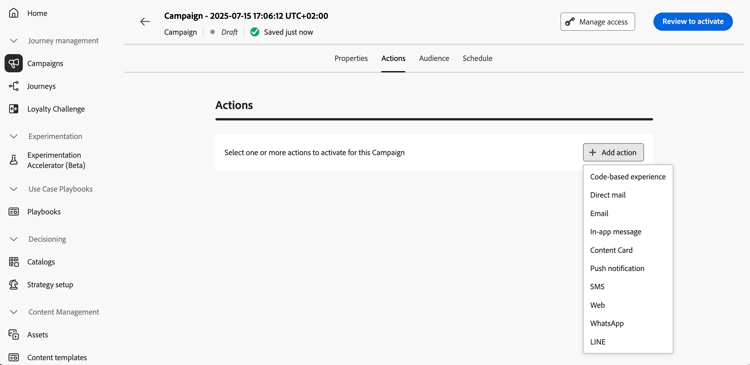
note NOTE 有关支持的渠道的更多信息,请参阅本节中的表:历程和营销活动中的渠道。 可用渠道因您的许可模式和附加组件而异。 如果选择入站渠道(基于代码的体验、应用程序内消息、内容卡或Web操作),则可以添加更多入站操作,在单个营销活动中总计最多10个操作。 了解如何操作
如果选择多个出站渠道(电子邮件、推送、移动设备),则可以使用渠道优化在发送时为每个客户自动选择最佳渠道。 了解如何操作
-
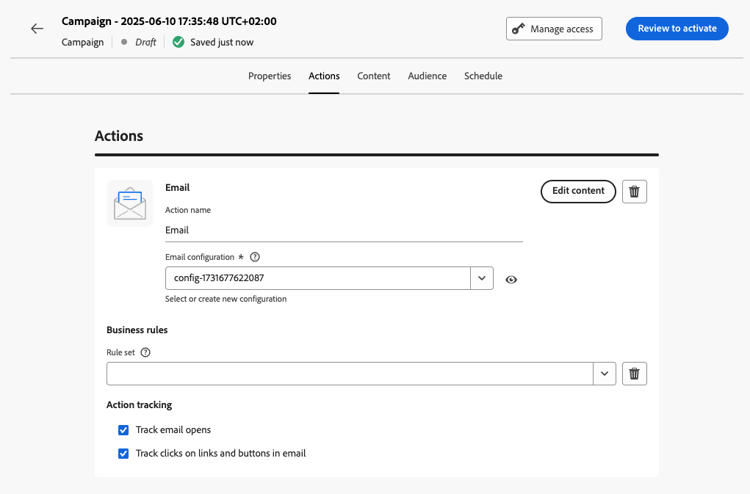
选择渠道配置
配置由系统管理员定义。 它包含用于发送消息的所有技术参数,如标头参数、子域、移动应用程序等。了解如何设置渠道配置
-
利用优化
使用 优化 部分运行内容实验、利用定位规则,或使用实验和定位的高级组合。 此部分中详细说明了这些不同的选项以及要遵循的步骤。
-
添加多语言内容
使用 语言 部分,在营销活动中创建多种语言内容。 要进行此操作,请单击 添加语言 按钮,然后选择所需的语言设置。 有关如何设置和使用多语言功能的详细信息,请参阅此部分。
根据所选通信渠道,可以使用其他设置。 展开以下部分以获取更多信息。
当营销活动需要与所选渠道配置不同的电子邮件值时使用此选项,而不创建其他配置。 您可以仅覆盖该操作所需的字段,而配置的其他部分保持不变。
快速传递模式是一个Journey Optimizer加载项,它允许通过营销活动以非常快的速度大量发送推送消息。 如果消息投放延迟对业务有重大影响,并且您想要在手机上发送紧急推送警报(例如,向已安装新闻频道应用程序的用户发送突发新闻),可使用快速投放。 了解如何在此页面🔗上为推送通知启用快速传递模式。
有关使用快速投放模式时的性能的详细信息,请参阅 Adobe Journey Optimizer 产品说明。
添加多个入站操作 multi-action
要简化活动的编排,您可以在单个活动内定义多个集客操作,每个操作都包含特定内容。
利用此功能,您可以向不同位置同时交付各种基于代码的体验、应用程序内消息、内容卡或Web操作,而无需创建多个营销活动。 它使营销活动的部署更轻松,并允许更流畅的报表,将所有数据整合到一个营销活动中。
例如,您可以将基于代码的体验发送到内容略有不同的多个端点。 为此,请在同一营销策划中创建多个基于代码的操作,每个操作具有不同的端点配置。
要在营销策划中定义多个集客操作,请执行以下步骤。
-
从 操作 部分中选择入站操作(基于代码的体验、应用程序内消息、内容卡或Web)。
-
选择渠道配置并定义该操作的特定内容。
-
使用 添加操作 按钮从下拉列表中选择其他入站操作。
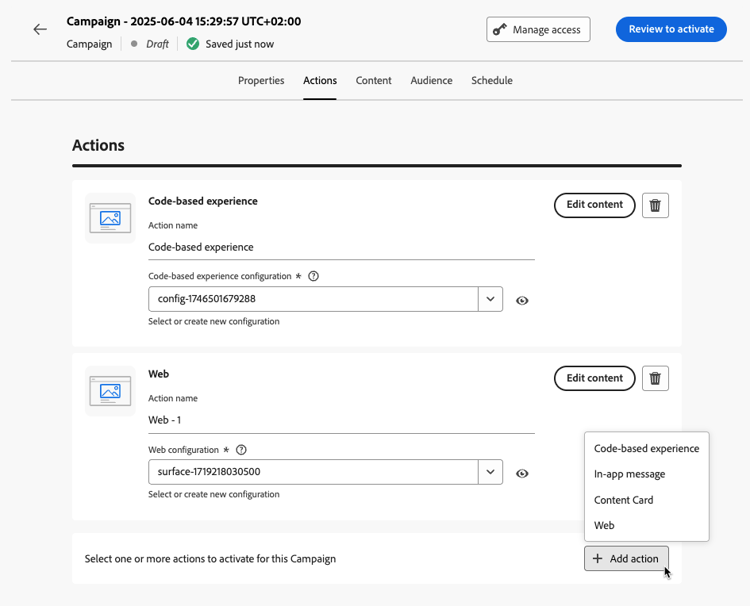
-
继续以类似方式添加更多操作。 在一个营销活动中最多可添加10个集客操作。
营销活动处于实时状态后,将同时激活所有操作。
后续步骤 next
活动操作就绪后,即可设计其内容。 了解详情
This section contains structured knowledge intended to support interpretation, retrieval, and question answering related to this topic.
For complete understanding, this information should be combined with the documentation on this page. Neither source is intended to stand alone; the page describes the feature, while this section provides additional context that helps disambiguate terminology, intent, applicability, and constraints.
- TL;DR: This page explains how to configure the action of a campaign in the Actions tab: select a channel and a channel configuration, set optimization and multilingual content, add several inbound actions, and apply channel-specific settings.
Intents:
- Select a channel and a channel configuration for a campaign message
- Add up to 10 inbound actions in a single campaign
- Use channel optimization when selecting multiple outbound channels
- Run content experiments or use targeting rules from the Optimization section
- Add multilingual content, capping rules, engagement tracking, priority scores, or other channel-specific settings
Glossary:
- Channel configuration: Defined by a System Administrator; contains the technical parameters for sending the message, such as header parameters, subdomain, mobile apps. (product-specific)
- Inbound channels: Code-based experience, In-app message, Content Card, Web action.
- Outbound channels: Email, Push, Mobile (Mobile message).
- Channel optimization: Automatically selects the best channel for each customer at send time when multiple outbound channels (Email, Push, Mobile) are selected. (product-specific)
- Rapid delivery mode: A Journey Optimizer add-on that allows very fast push message sending in large volumes through campaigns. (product-specific)
- Priority score: A numeric value assigned to a campaign to prioritize an inbound campaign when there is an imposed constraint such as a frequency cap. (product-specific)
Guardrails:
- A single campaign can have up to 10 actions when inbound channels are selected (hard limit); this applies to inbound actions only.
- Adding several actions to one campaign is only available for inbound channels. For outbound channels (Email, Push, Mobile message), use channel optimization.
- Priority score: enter a numeric value from 0-100; the higher the number, the higher the priority. It applies to Web, In-app, and Code-based.
- Capping rules (Business rules drop-down list) apply to Email, Direct mail, Push, Mobile.
- Action tracking applies to Email and Mobile.
- Additional delivery rules apply to Content cards; Edit triggers applies to In-app.
- Once the campaign is live, all actions are activated simultaneously.
Applicability:
- Available channels vary based on the licensing model and add-ons.
Terminology:
- Canonical name: Campaign action
- Do not confuse: “inbound channels” (Code-based experience, In-app message, Content Card, Web action) ≠ “outbound channels” (Email, Push, Mobile)
- Do not confuse: “channel configuration” (technical parameters defined by a System Administrator) ≠ “channel” (the communication channel selected with Add action)
FAQ:
- Q: How many actions can I add to one campaign? — Up to 10 inbound actions. This is only available for inbound channels (Code-based experience, In-app message, Content Card, Web action).
- Q: Can I add several Email actions to the same campaign? — Adding several actions is only available for inbound channels. For outbound channels (Email, Push, Mobile message), use channel optimization.
- Q: What is a priority score and which range can I enter? — A numeric value from 0-100 that prioritizes an inbound campaign when there is an imposed constraint such as a frequency cap. The higher the number, the higher the priority.
- Q: Who defines the channel configuration? — A System Administrator.
- Q: When are the actions of a multi-action campaign activated? — All actions are activated simultaneously once the campaign is live.
Examples:
- Send a code-based experience to multiple endpoints with slightly different contents: create multiple code-based actions within the same campaign, each with a different endpoint configuration.
- Rapid delivery mode: send an urgent push alert, for example breaking news to users who have installed a news channel app, when delay in message delivery is business-critical.
Related pages:
- Channel configurations: Learn how to set up channel configurations (configuration/channel-surfaces.md)
- Channel optimization for outbound channels: Channel optimization (building-journeys/channel-optimization.md)
- Optimization options: Get started with content optimization (content-management/gs-message-optimization.md)
- Multilingual content: Get started with Multilingual content (content-management/multilingual-gs.md)
- Capping rules: Learn how to work with rule sets (conflict-prioritization/rule-sets.md)
- Priority scores: Learn how to assign priority scores to journeys & campaigns (conflict-prioritization/priority-scores.md)
- Rapid delivery mode for Push: Configure a push notification, Rapid delivery mode section (push/create-push.md#rapid-delivery)
- Campaign reports: Learn more about campaign reports (reports/campaign-global-report-cja.md)
- Content cards delivery rules: Learn how to create content cards (content-card/create-content-card.md)
- In-app triggers: Learn how to create an In-app message (in-app/create-in-app.md)
- Next step, content: Edit the Action campaign content (campaigns/campaign-content.md)