이 페이지의 내용: Adobe Journey Optimizer의 오케스트레이션된 캠페인을 통해 관계형 데이터 세트를 쿼리하고, 정확한 인원수를 기준으로 대상자를 구축하고, 여러 채널에서 마케팅 및 거래 메시지를 전달하는 방법을 알아봅니다.
Adobe Journey Optimizer의 캠페인 오케스트레이션은 마케팅 및 트랜잭션 등의 모든 채널에서 정교한 브랜드 주도 캠페인을 지원합니다. 마케팅 캠페인은 참여도, 매출 및 고객 충성도를 대규모로 높이는 데 도움이 됩니다. 트랜잭션 메시지는 옵트인이 필요하지 않으며, 서비스 중단, 긴급 상황 또는 취소와 같이 시급한 커뮤니케이션에 적합합니다.
크로스채널 마케팅은 필수적이지만 오케스트레이션된 캠페인을 통해 원활하게 이루어집니다. 드래그하여 놓는 시각적 인터페이스를 통해 세그먼테이션에서 메시지 게재에 이르기까지 여러 채널에 걸쳐 복잡한 마케팅 워크플로를 디자인하고 자동화할 수 있습니다. 속도, 제어 및 효율성을 위해 구축된 하나의 직관적인 환경에서 모든 작업이 수행됩니다.
캠페인 일정은 통합 캘린더 메뉴를 통해 확인할 수 있습니다. 캘린더 사용 방법을 알아보세요.
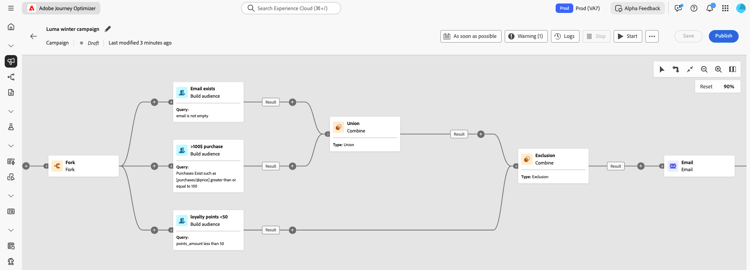
핵심 기능
캠페인 오케스트레이션은 다음 네 가지 주요 요소를 기반으로 구축됩니다.

데이터 세트 간 즉각적 쿼리를 통해 모든 데이터 형식과 차원의 조합을 자유롭게 사용하여 대상자 세그먼트를 만듭니다.

개인 기반 캠페인을 넘어 제품 카탈로그, 스토어 위치 또는 서비스 데이터와 같은 엔터티를 사용하여 정밀하게 타기팅합니다.
프로필별 및 연결된 보조 엔티티별로 메시지를 전송하는 다단계 전송을 지원합니다. 이 보조 엔터티에는 연락처, 예약, 구독, 계약 또는 기타 연결된 데이터를 포함할 수 있습니다. 예를 들어 이 기능으로 프로필의 알려진 모든 주소 또는 해당 프로필과 연결된 각 예약에 대해 캠페인을 전송할 수 있습니다.

실행 전에 정확한 세분화 수와 전체 캠페인 범위를 가져와 정확성과 신뢰도를 보장합니다.

일별 메시지부터 시즌 프로모션 또는 주요 제품 출시와 같은 복잡한 캠페인에 이르기까지 여러 단계의 캠페인을 디자인합니다.
오케스트레이션된 캠페인 여정
오케스트레이션된 캠페인 시각화는 여정과 유사하지만 목적과 사용 사례는 다릅니다.
-
여정 - 각 프로필이 각자의 속도로 다른 단계를 진행하는 1:1 캔버스입니다. 각 고객의 상태는 해당 컨텍스트 내에서 유지되어 실시간 액션을 트리거합니다.
-
오케스트레이션된 캠페인 - 여정과 달리 오케스트레이션된 캠페인은 세그먼트를 계산하는 배치 캔버스를 사용하여 작동합니다. 모든 프로필이 동시에 한꺼번에 처리됩니다.
두 캔버스 모두 각각의 사용 사례에 최적화되어 있습니다. 여정 캔버스는 보다 긴 기간 동안 작동하는 경향이 있는 여정을 게시하는 반면, 캠페인 캔버스는 배치 캠페인의 반복적이고 점차 증가하는 실행을 위해 설계되었습니다.
오케스트레이션된 캠페인 속에는 무엇이 있을까요? gs-ms-campaign-inside
오케스트레이션된 캠페인 캔버스는 어떤 일이 일어나야 하는지를 나타냅니다. 앞으로 수행할 다양한 작업과 이러한 작업이 어떻게 서로 연결되어 있는지 설명합니다.
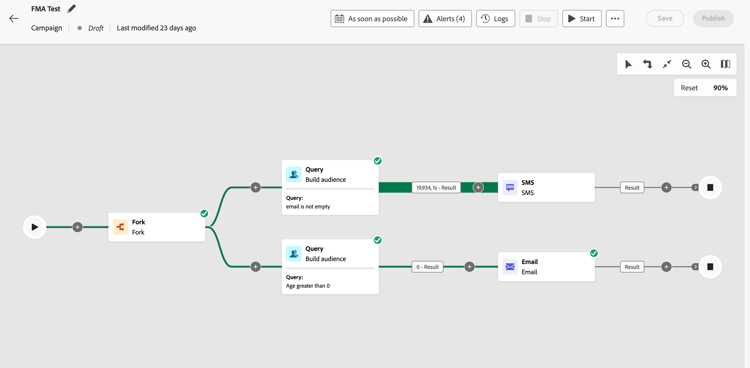
오케스트레이션된 캠페인마다 다음 항목이 포함됩니다.
-
활동: 활동은 수행할 작업입니다. 다양한 활동이 캔버스에 아이콘으로 표시됩니다. 각 활동에는 특정 속성과 모든 활동에 공통되는 다른 속성이 있습니다.
오케스트레이션된 캠페인 캔버스에서는 특정 활동 하나가 여러 작업을 생성할 수 있습니다. 특히 루프 또는 반복 액션이 있는 경우에 그렇습니다.
-
전환: 전환은 원본 활동을 대상 활동에 연결하고 해당 시퀀스를 정의합니다.
-
작업 테이블: 작업 테이블에는 전환에 의해 전달되는 모든 정보가 포함됩니다. 오케스트레이션된 캠페인마다 여러 작업 테이블을 사용합니다. 이 테이블로 전달된 데이터는 오케스트레이션된 캠페인의 수명 주기 전체에서 사용할 수 있습니다.
일반적인 초급 수준의 오케스트레이션된 캠페인은 다음과 같은 패턴을 따릅니다. 대상자 작성 → 포크 → 채널 A+채널 B.
이 접근 방식을 사용하면 단일 캠페인 실행에서 동일한 대상자를 두 개의 병렬 분기로 타기팅할 수 있습니다. 예를 들어, 한 분기에서는 마케팅 이메일을 사용하고 다른 분기에서는 트랜잭션 이메일을 사용하는 식입니다. 각 분기는 독립적이며 서로 다른 채널 구성, 메시지 콘텐츠 또는 카테고리를 사용할 수 있습니다.
소개 비디오 video-oc
오케스트레이션된 캠페인의 주요 개념과 사용할 수 있는 기능에 대해 알아봅니다.
더 자세히 알아보기
오케스트레이션된 캠페인이 무엇인지 이해했다면 이제 아래 설명서 섹션을 자세히 살펴보고 이 기능을 활용하여 작업을 시작할 차례입니다.


추가 리소스
- 첫 번째 규칙 작성 - 규칙 빌더를 마스터하여 타기팅된 쿼리를 만들고 관계형 데이터를 사용하여 대상자를 정밀하게 세분화합니다.
- 관계형 스키마 만들기 - 관계형 스키마를 설정하고 구성하여 캠페인에서 다중 엔터티 데이터를 활용하는 방법을 이해합니다.
- 오케스트레이션된 캠페인 보고 - 자세한 보고 지표와 인사이트를 통해 캠페인 성과를 추적하고 분석합니다.
- 캠페인 시작 및 모니터링 - 캠페인을 시작하고 실시간으로 실행을 모니터링하는 모범 사례를 알아봅니다.
- 가드레일 및 제한 사항 - 최적의 캠페인 성능을 보장하기 위해 중요한 가드레일, 제한 사항, 모범 사례를 검토합니다.
- 자주 하는 질문 - 오케스트레이션된 캠페인의 기능 및 사용 사례와 관련해 많이 나오는 질문에 대한 답변을 찾을 수 있습니다.
- 오케스트레이션된 캠페인 튜토리얼 - 기능 및 모범 사례를 다루는 단계별 비디오 튜토리얼을 살펴봅니다.
- 탐색 활동을 통한 고객 참여 유도 - 탐색은 했지만 구매하지 않은 프로필을 대상으로 다단계 오케스트레이션 캠페인을 사용하여 다시 참여를 유도합니다.
- 제품 재입고 알림 - 고객이 관심을 보인 제품이 재입고되면 알림을 보냅니다.
- 위시리스트 항목 업데이트 전송 - 위시리스트 항목이 할인되거나 재입고되면 개인화된 메시지를 전송합니다.
This section contains structured knowledge intended to support interpretation, retrieval, and question answering related to this topic.
For complete understanding, this information should be combined with the documentation on this page. Neither source is intended to stand alone; the page describes the feature, while this section provides additional context that helps disambiguate terminology, intent, applicability, and constraints.
- TL;DR: This page introduces Orchestrated campaigns in Adobe Journey Optimizer, explaining their core capabilities, how they differ from journeys, and what an Orchestrated campaign contains.
Intents:
- Understand what Campaign Orchestration enables: brand-initiated marketing and transactional campaigns across channels.
- Learn the four core capabilities of Campaign Orchestration.
- Distinguish Orchestrated campaigns from journeys.
- Identify the components of an Orchestrated campaign canvas: activities, transitions, and worktables.
- Recognize a typical entry-level Orchestrated campaign pattern using the Fork activity.
- Find the licensing requirement needed to access Campaign Orchestration.
Glossary:
- Campaign Orchestration: the capability in Adobe Journey Optimizer that powers sophisticated, brand-initiated campaigns across channels, both marketing and transactional (product-specific)
- Marketing campaigns: campaigns that help drive engagement, revenue, and customer loyalty at scale (product-specific)
- Transactional messages: messages that do not require opt-in and are suited for time-sensitive communications such as disruptions, emergencies, or cancellations (product-specific)
- On-Demand Audiences: instant querying across datasets to create audience segments using any combination of data types and dimensions (product-specific)
- Multi-entity segmentation & sending: targeting using entities like product catalogs, store locations, or service data beyond person-based campaigns, including multi-level sending where one message is sent per Profile and per associated secondary entity (such as contact addresses, bookings, subscriptions, or contracts) (product-specific)
- Pre-send visibility & precision: exact segmentation counts and full campaign scope available before launch (product-specific)
- Multi-step campaign workflows: design of multi-step campaigns, from daily messages to complex campaigns like seasonal promotions or major product launches (product-specific)
- Activity: a task to be performed, represented on the canvas by icons; a given activity can produce multiple tasks, in particular when there is a loop or recurrent actions (product-specific)
- Transition: links a source activity to a destination activity and defines their sequence (product-specific)
- Worktable: contains all the information carried by the transition; each Orchestrated campaign uses several worktables, and the data conveyed can be used throughout the campaign’s life cycle (product-specific)
Guardrails:
- Available channels vary based on licensing model and add-ons.
Prerequisites and permissions:
- To access Campaign Orchestration, the license must include either the Journey Optimizer – Campaigns & Journeys package or the Journey Optimizer - Campaigns package.
Terminology:
- Canonical name: Campaign Orchestration — variants: Orchestrated campaigns
- Do not confuse: “Marketing campaigns” (drive engagement, revenue, and customer loyalty at scale) ≠ “Transactional messages” (do not require opt-in, suited for time-sensitive communications such as disruptions, emergencies, or cancellations)
- Do not confuse: “Journeys” (1 to 1 canvas, real-time, profiles travel through steps at their own pace, state maintained within its context to trigger real-time actions) ≠ “Orchestrated campaigns” (batch canvas that calculates segments, all profiles processed together at the same time)
- Do not confuse: “Activity” (a task performed on the canvas) ≠ “Transition” (links a source activity to a destination activity) ≠ “Worktable” (contains the information carried by a transition)
FAQ:
- Q: What is required to access Campaign Orchestration? — The license must include either the Journey Optimizer – Campaigns & Journeys or the Journey Optimizer - Campaigns package.
- Q: How do Orchestrated campaigns differ from journeys? — Journeys use a 1 to 1 canvas where each profile travels through steps at its own pace with its state maintained in context; Orchestrated campaigns use a batch canvas that calculates segments, with all profiles processed together at the same time.
- Q: What does a typical entry-level Orchestrated campaign look like? — Build audience → Fork → Channel A + Channel B, letting two parallel branches target the same audience in a single campaign run, each with independent channel configuration, message content, or category.
- Q: What are the four core capabilities of Campaign Orchestration? — On-Demand Audiences, Multi-entity segmentation & sending, Pre-send visibility & precision, and Multi-step campaign workflows.
- Q: What does an Orchestrated campaign contain? — Activities, transitions, and worktables.
- Q: Do transactional messages require opt-in? — No, transactional messages do not require opt-in and are suited for time-sensitive communications such as disruptions, emergencies, or cancellations.
Examples:
- A typical entry-level Orchestrated campaign follows the pattern Build audience → Fork → Channel A + Channel B, for example one branch using a Marketing email and another using a Transactional email.
Related pages:
- For the list of supported channels: Channels in journeys & campaigns (channels/gs-channels.md)
- For details on activities shown on the canvas: various activities (orchestrated/activities/about-activities.md)
- For using the Fork activity in a campaign pattern: Learn how to use the Fork activity (orchestrated/activities/fork.md)
- For distinguishing Marketing vs Transactional messages in more depth: Understand Marketing vs Transactional messages (orchestrated/activities/channels.md)
- For building audience queries with relational data: Build your first rule (orchestrated/build-query.md)
- For setting up relational schemas for multi-entity data: Create relational schemas (orchestrated/gs-schemas.md)
- For tracking campaign performance: Reporting for Orchestrated campaigns (orchestrated/reporting-campaigns.md)
- For launching and monitoring campaign execution: Start and monitor campaigns (orchestrated/start-monitor-campaigns.md)
- For reviewing limits and best practices: Guardrails and limitations (orchestrated/guardrails.md)
- For common questions about features and use cases: Frequently Asked Questions (orchestrated/orchestrated-campaigns-faq.md)
- For an example of re-engaging profiles who browsed but did not purchase: Engage customers by browsing activity (orchestrated/engage-customers-uc.md)
- For an example of alerting customers about restocked products: Notify users about product availability (orchestrated/product-availability-uc.md)
- For an example of triggering wishlist-related messages: Send wishlist item updates (orchestrated/wishlist-uc.md)
Personas:
- marketer: Can use On-Demand Audiences, Multi-entity segmentation and sending, Pre-send visibility and precision, and Multi-step campaign workflows to build and launch Orchestrated campaigns. Can query across datasets to create audience segments and design multi-step campaigns such as seasonal promotions or major product launches in the drag-and-drop interface. The page states that available channels vary based on licensing model and add-ons. Where: “Core capabilities”.
Onboarding:
- Level: Beginner
- First minimal step: Build audience, then fork into two channel branches, for example one branch using a Marketing email and another using a Transactional email.
- Success check: Exact segmentation counts and full campaign scope display before launch.
- Next: Work with the various activities shown on the Orchestrated campaign canvas: Work with Orchestrated campaign activities (orchestrated/activities/about-activities.md); Master the rule builder to create targeted queries and segment your audiences with precision using relational data: Build your first rule (orchestrated/build-query.md)