このページ: Adobe Journey Optimizer のオーケストレーションキャンペーンにより、リレーショナルデータセットのクエリの実行、正確なカウントを含むオーディエンスの作成、複数のチャネルをまたいだマーケティングメッセージやトランザクションメッセージの配信が可能になる仕組みについて説明します。
Adobe Journey Optimizer のキャンペーンオーケストレーションは、マーケティングチャネルと トランザクション チャネルの両方で、ブランド主導の洗練されたキャンペーンを強化します。 マーケティングキャンペーンは、エンゲージメント、収益、顧客の忠誠度を大規模に促進させるのに役立ちます。 トランザクションメッセージは、オプトインを必要とせず、中断、緊急事態、キャンセルなど、時間的制約のある通信に適しています。
クロスチャネルマーケティングは不可欠ですが、調整されたキャンペーンはこれをシームレスにします。 視覚的なドラッグ&ドロップインターフェイスを使用すると、複数のチャネルをまたいで、セグメント化からメッセージ配信まで、複雑なマーケティングワークフローをデザインおよび自動化できます。 すべてが、速度、コントロール、効率のために作成された、1 つの直感的な環境で実行されます。
キャンペーンスケジュールを表示するには、統合 カレンダー メニューを使用します。カレンダーの使用方法の詳細情報。
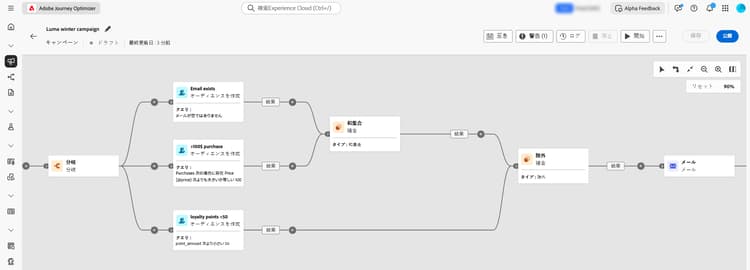
コア機能
キャンペーンオーケストレーションは、次の 4 つの主要な柱を中心に構築されています。

データセット間で瞬時にクエリを実行し、データタイプとディメンションの任意の組み合わせを使用してオーディエンスセグメントを作成します。

個人ベースのキャンペーンを超えて、製品カタログ、店舗の場所、サービスデータなどのエンティティを使用して、精密にターゲットを絞ります。
プロファイルごとおよび関連するセカンダリエンティティごとに 1 つのメッセージが送信される、マルチレベルの送信をサポートします。 これらのセカンダリエンティティには、連絡先アドレス、予約、サブスクリプション、契約、その他の関連データを含めることができます。 例えば、この機能を使って、プロファイルのすべての既知のアドレスまたはプロファイルに関連付けられた各予約に対してキャンペーンを送信できます。

ローンチ前に正確なセグメント化の数と完全なキャンペーンの範囲を取得し、正確性と信頼性を確保します。

毎日のメッセージから、季節のプロモーションや主要な製品の発売などの複雑なキャンペーンにまで及ぶマルチステップキャンペーンを設計します。
調整されたキャンペーンとジャーニー
調整されたキャンペーンのビジュアライゼーションはジャーニーと類似点がありますが、次のように目的とユースケースが異なります。
-
ジャーニー - 1 対 1 のキャンバスで、各プロファイルがそれぞれのペースで異なるステップを進んでいきます。 各顧客のステータスはコンテキスト内に維持され、リアルタイムのアクションをトリガーします。
-
調整されたキャンペーン - ジャーニーとは異なり、調整されたキャンペーンは、セグメントを計算するバッチキャンバスを使用して動作します。 すべてのプロファイルが同時に処理されます。
どちらのキャンバスも、それぞれのユースケースに合わせて最適化されています。ジャーニーキャンバスは、長期間にわたって継続する傾向のあるジャーニーを公開し、キャンペーンキャンバスは、バッチキャンペーンを反復的かつ段階的に実行できるように設計されています。
調整されたキャンペーンの内部とは gs-ms-campaign-inside
オーケストレーションキャンペーンキャンバスは、実行されるべき処理を表したものです。 これは、実行される様々なタスクと、タスク同士の関係を示すものです。
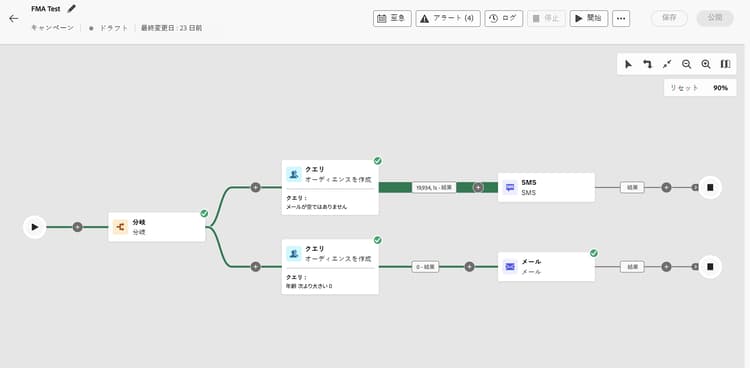
各オーケストレーションキャンペーンには、次が含まれます。
-
アクティビティ:アクティビティとは、実行されるタスクです。 各種アクティビティは、キャンバス内にアイコンで示されます。 各アクティビティには、特定のプロパティと、すべてのアクティビティに共通のその他のプロパティがあります。
オーケストレーションキャンペーンキャンバスでは、指定されたアクティビティによって複数のタスクが生成される可能性があります。特に、ループまたは反復的なアクションが存在する場合です。
-
トランジション:トランジションは、ソースアクティビティを宛先アクティビティにリンクし、そのシーケンスを定義します。
-
ワークテーブル:ワークテーブルには、トランジションによって実行されるすべての情報が含まれます。 各オーケストレーションキャンペーンでは、複数のワークテーブルを使用します。 これらのテーブルで伝達されたデータは、調整されたキャンペーンのライフサイクルを通じて使用できます。
典型的なエントリレベルのオーケストレーションキャンペーンは、オーディエンスの構築 → 分岐 → チャネル A + チャネル B のパターンに従います。
このアプローチにより、単一のキャンペーン実行で、同じオーディエンスを 2 つの並行した分岐でターゲティングすることができます。例えば、マーケティングメールを使用する分岐と、トランザクションメールを使用する分岐といったことが可能です。 各分岐は独立しており、異なるチャネル設定、メッセージコンテンツ、カテゴリを使用できます。
概要ビデオ video-oc
オーケストレーションキャンペーンで使用できる主な概念と機能について説明します。
さらに深く掘り下げましょう
オーケストレーションキャンペーンについて理解できたので、これらのドキュメントの節を深く掘り下げ、この機能の使用を開始します。


その他のリソース
- 最初のルールの作成 - ルールビルダーを習得して、ターゲットクエリを作成し、リレーショナルデータを使用してオーディエンスを正確にセグメント化します。
- リレーショナルスキーマの作成 - キャンペーンで複数のエンティティデータを活用するためにリレーショナルスキーマを設定および指定する方法について説明します。
- オーケストレーションキャンペーンのレポート - 詳細なレポート指標とインサイトを使用して、キャンペーンのパフォーマンスを追跡および分析します。
- キャンペーンの開始とモニタリング - キャンペーンを開始し、その実行をリアルタイムでモニタリングするためのベストプラクティスについて説明します。
- ガードレールと制限 - 最適なキャンペーンのパフォーマンスを確保するために、重要なガードレール、制限、ベストプラクティスを確認します。
- よくある質問 - オーケストレーションキャンペーンの特長、機能、ユースケースに関するよくある質問への回答を見つけます。
- オーケストレーションキャンペーンのチュートリアル - 機能とベストプラクティスを対象としたステップバイステップのビデオチュートリアルを参照してください。
- 参照アクティビティによる顧客との関与 - マルチステップのオーケストレーションキャンペーンを使用して、参照したが購入しなかったプロファイルに再び関与します。
- 製品の可用性に関するユーザーへの通知 - 顧客が興味を示した製品が再入荷した際に顧客に通知します。
- ウィッシュリスト項目の更新の送信 - ウィッシュリスト項目が販売中または使用可能になった際に、パーソナライズされたメッセージをトリガーします。
This section contains structured knowledge intended to support interpretation, retrieval, and question answering related to this topic.
For complete understanding, this information should be combined with the documentation on this page. Neither source is intended to stand alone; the page describes the feature, while this section provides additional context that helps disambiguate terminology, intent, applicability, and constraints.
- TL;DR: This page introduces Orchestrated campaigns in Adobe Journey Optimizer, explaining their core capabilities, how they differ from journeys, and what an Orchestrated campaign contains.
Intents:
- Understand what Campaign Orchestration enables: brand-initiated marketing and transactional campaigns across channels.
- Learn the four core capabilities of Campaign Orchestration.
- Distinguish Orchestrated campaigns from journeys.
- Identify the components of an Orchestrated campaign canvas: activities, transitions, and worktables.
- Recognize a typical entry-level Orchestrated campaign pattern using the Fork activity.
- Find the licensing requirement needed to access Campaign Orchestration.
Glossary:
- Campaign Orchestration: the capability in Adobe Journey Optimizer that powers sophisticated, brand-initiated campaigns across channels, both marketing and transactional (product-specific)
- Marketing campaigns: campaigns that help drive engagement, revenue, and customer loyalty at scale (product-specific)
- Transactional messages: messages that do not require opt-in and are suited for time-sensitive communications such as disruptions, emergencies, or cancellations (product-specific)
- On-Demand Audiences: instant querying across datasets to create audience segments using any combination of data types and dimensions (product-specific)
- Multi-entity segmentation & sending: targeting using entities like product catalogs, store locations, or service data beyond person-based campaigns, including multi-level sending where one message is sent per Profile and per associated secondary entity (such as contact addresses, bookings, subscriptions, or contracts) (product-specific)
- Pre-send visibility & precision: exact segmentation counts and full campaign scope available before launch (product-specific)
- Multi-step campaign workflows: design of multi-step campaigns, from daily messages to complex campaigns like seasonal promotions or major product launches (product-specific)
- Activity: a task to be performed, represented on the canvas by icons; a given activity can produce multiple tasks, in particular when there is a loop or recurrent actions (product-specific)
- Transition: links a source activity to a destination activity and defines their sequence (product-specific)
- Worktable: contains all the information carried by the transition; each Orchestrated campaign uses several worktables, and the data conveyed can be used throughout the campaign’s life cycle (product-specific)
Guardrails:
- Available channels vary based on licensing model and add-ons.
Prerequisites and permissions:
- To access Campaign Orchestration, the license must include either the Journey Optimizer – Campaigns & Journeys package or the Journey Optimizer - Campaigns package.
Terminology:
- Canonical name: Campaign Orchestration — variants: Orchestrated campaigns
- Do not confuse: “Marketing campaigns” (drive engagement, revenue, and customer loyalty at scale) ≠ “Transactional messages” (do not require opt-in, suited for time-sensitive communications such as disruptions, emergencies, or cancellations)
- Do not confuse: “Journeys” (1 to 1 canvas, real-time, profiles travel through steps at their own pace, state maintained within its context to trigger real-time actions) ≠ “Orchestrated campaigns” (batch canvas that calculates segments, all profiles processed together at the same time)
- Do not confuse: “Activity” (a task performed on the canvas) ≠ “Transition” (links a source activity to a destination activity) ≠ “Worktable” (contains the information carried by a transition)
FAQ:
- Q: What is required to access Campaign Orchestration? — The license must include either the Journey Optimizer – Campaigns & Journeys or the Journey Optimizer - Campaigns package.
- Q: How do Orchestrated campaigns differ from journeys? — Journeys use a 1 to 1 canvas where each profile travels through steps at its own pace with its state maintained in context; Orchestrated campaigns use a batch canvas that calculates segments, with all profiles processed together at the same time.
- Q: What does a typical entry-level Orchestrated campaign look like? — Build audience → Fork → Channel A + Channel B, letting two parallel branches target the same audience in a single campaign run, each with independent channel configuration, message content, or category.
- Q: What are the four core capabilities of Campaign Orchestration? — On-Demand Audiences, Multi-entity segmentation & sending, Pre-send visibility & precision, and Multi-step campaign workflows.
- Q: What does an Orchestrated campaign contain? — Activities, transitions, and worktables.
- Q: Do transactional messages require opt-in? — No, transactional messages do not require opt-in and are suited for time-sensitive communications such as disruptions, emergencies, or cancellations.
Examples:
- A typical entry-level Orchestrated campaign follows the pattern Build audience → Fork → Channel A + Channel B, for example one branch using a Marketing email and another using a Transactional email.
Related pages:
- For the list of supported channels: Channels in journeys & campaigns (channels/gs-channels.md)
- For details on activities shown on the canvas: various activities (orchestrated/activities/about-activities.md)
- For using the Fork activity in a campaign pattern: Learn how to use the Fork activity (orchestrated/activities/fork.md)
- For distinguishing Marketing vs Transactional messages in more depth: Understand Marketing vs Transactional messages (orchestrated/activities/channels.md)
- For building audience queries with relational data: Build your first rule (orchestrated/build-query.md)
- For setting up relational schemas for multi-entity data: Create relational schemas (orchestrated/gs-schemas.md)
- For tracking campaign performance: Reporting for Orchestrated campaigns (orchestrated/reporting-campaigns.md)
- For launching and monitoring campaign execution: Start and monitor campaigns (orchestrated/start-monitor-campaigns.md)
- For reviewing limits and best practices: Guardrails and limitations (orchestrated/guardrails.md)
- For common questions about features and use cases: Frequently Asked Questions (orchestrated/orchestrated-campaigns-faq.md)
- For an example of re-engaging profiles who browsed but did not purchase: Engage customers by browsing activity (orchestrated/engage-customers-uc.md)
- For an example of alerting customers about restocked products: Notify users about product availability (orchestrated/product-availability-uc.md)
- For an example of triggering wishlist-related messages: Send wishlist item updates (orchestrated/wishlist-uc.md)
Personas:
- marketer: Can use On-Demand Audiences, Multi-entity segmentation and sending, Pre-send visibility and precision, and Multi-step campaign workflows to build and launch Orchestrated campaigns. Can query across datasets to create audience segments and design multi-step campaigns such as seasonal promotions or major product launches in the drag-and-drop interface. The page states that available channels vary based on licensing model and add-ons. Where: “Core capabilities”.
Onboarding:
- Level: Beginner
- First minimal step: Build audience, then fork into two channel branches, for example one branch using a Marketing email and another using a Transactional email.
- Success check: Exact segmentation counts and full campaign scope display before launch.
- Next: Work with the various activities shown on the Orchestrated campaign canvas: Work with Orchestrated campaign activities (orchestrated/activities/about-activities.md); Master the rule builder to create targeted queries and segment your audiences with precision using relational data: Build your first rule (orchestrated/build-query.md)