このページ: Adobe Journey Optimizer でオーケストレーションキャンペーンを作成し、すぐに、特定の日時に、または繰り返し実行するための実行スケジュールを定義する方法について説明します。
Adobe Journey Optimizer で調整されたキャンペーンを作成し、その実行スケジュールを設定して、キャンペーンの開始時期と実行頻度を制御します。 キャンペーンをすぐに開始するか、特定の日時に開始するか、毎日、毎週、毎月の頻度などの柔軟なスケジュールオプションを使用して繰り返し開始するかを選択します。
キャンペーンの作成 create
オーケストレーションキャンペーンを作成するには、次の手順に従います。
-
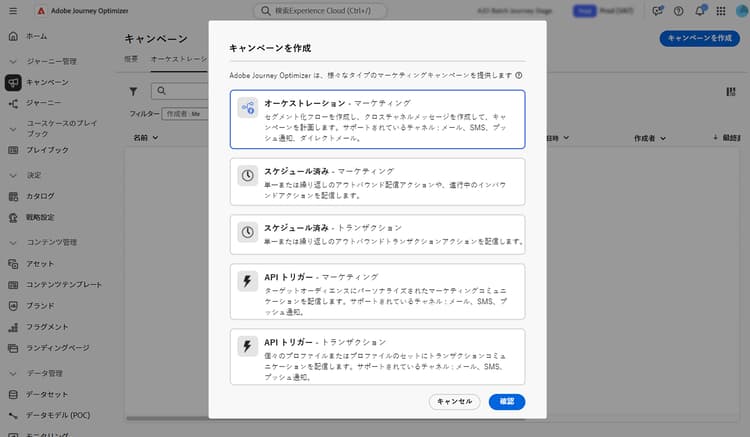
キャンペーンメニューに移動し、「オーケストレーション」タブを選択します。
-
「キャンペーンを作成」ボタンをクリックし、オーケストレーション - マーケティングとトランザクションキャンペーンタイプを選択します。
チャネルアクティビティを追加する際に、各メッセージがマーケティング用かトランザクション用かを選択します。
-
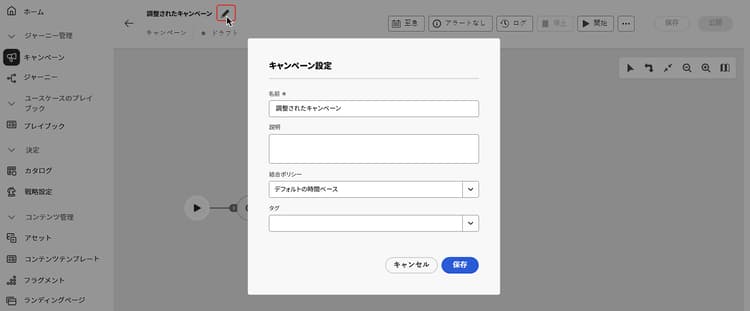
キャンペーンのプロパティを定義します。
-
キャンペーンの 名前 と 説明 を入力します。
-
キャンペーンの 結合ポリシー を選択します。
Adobe Experience Platform では、各オーディエンスは特定の結合ポリシーに関連付けられています。このポリシーは、プロファイル情報を組み合わせて結合プロファイルを形成する方法を定義します。 オーディエンスを読み取りアクティビティで結合ポリシーを選択した場合、同じ結合ポリシーに基づくオーディエンスのみを使用できます。 デフォルトでは、デフォルトの結合ポリシーが使用されますが、必要に応じて変更できます。 結合ポリシーについて詳しくは、Adobe Experience Platform ドキュメントを参照してください。
-
「タグ」フィールドを使用して、Adobe Experience Platform 統合タグをキャンペーンに割り当てます。 これにより、キャンペーンを簡単に分類し、調整されたキャンペーンリストからの検索を改善できます。 詳しくは、タグの操作方法を参照してください。
-
カスタムメタデータフィールドが定義され、オーケストレーションキャンペーン用に選択されている場合、キャンペーンプロパティのメタデータフィールド セクションに表示されます。 これらのフィールドに入力して、事業部門、製品、コストセンターなどの特定のビジネス情報を追跡します。 アスタリスクが付いたフィールドは必須です。 カスタムメタデータの詳細
note availability AVAILABILITY この機能は、限定提供で使用できます。 アクセス権を取得するには、アドビ担当者にお問い合わせください。 -
「保存」をクリックします。
キャンペーンのプロパティは、キャンペーン名の横にある

-
キャンペーンのスケジュール schedule
デフォルトでは、調整されたキャンペーンは手動でアクティブ化する際に開始され、関連するアクティビティを実行すると終了します。 実行を遅らせたり、キャンペーンを繰り返し実行したりする場合は、キャンペーンのスケジュールを定義できます。
調整されたキャンペーンをスケジュールする際は、次のベストプラクティスを考慮することで、最適なパフォーマンスと期待される動作を確保します。
- システム全体のパフォーマンスが落ちたり、データベースにブロックが作成されたりする可能性があるので、調整されたキャンペーンを 15 分毎以上で実行するようにスケジュールしないでください。
- 調整されたキャンペーンで 1 回限りのメッセージを送信する場合は、そのメッセージを 1 回実行するように設定できます。
- 調整されたキャンペーンで繰り返しメッセージを送信する場合は、「スケジュール」オプションを使用して実行頻度を設定する必要があります。 繰り返し配信アクティビティでは、スケジュールを定義できません。
キャンペーンスケジュールを設定するには、次の手順に従います。
-
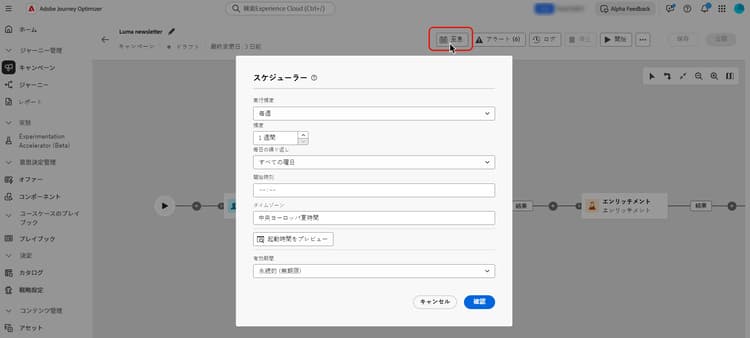
キャンペーンを開き、「できるだけ早く」ボタンをクリックします。
-
キャンペーンの実行頻度を選択し、使用可能なオプションを設定します。 設定は、選択した頻度によって異なります。
accordion 1 回 指定した日時にキャンペーンを 1 回実行します。
- 日付:キャンペーンを実行する日付を選択します。
- 時間:キャンペーンを実行する特定の時間を選択します。
accordion 毎日 毎日または選択した日にキャンペーンを実行します。
-
毎日の繰り返し:キャンペーンの実行頻度を選択します。
- 毎日:週末を含むすべての曜日にキャンペーンを実行します。
- 平日:月曜日から金曜日にのみキャンペーンを実行します。
- 特定の期間を通じて:定義済みの日付範囲(例:7月1日から 7月15日まで)内で毎日キャンペーンを実行します。 キャンペーンは、この範囲外では実行されません。
- 選択した曜日:指定した曜日(例:月曜日、水曜日、金曜日)にのみキャンペーンを実行します。
-
開始時間:毎日キャンペーンを実行する時間を定義します。
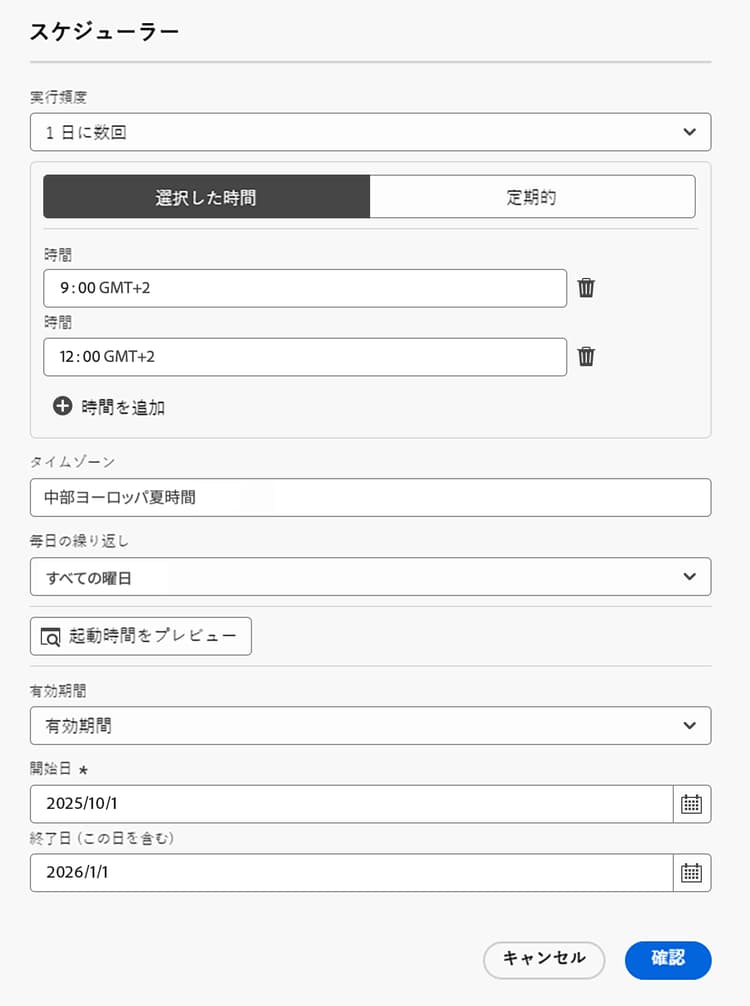
accordion 1 日に数回 同じ日にキャンペーンを複数回実行します。 特定の時間を選択するか、定期的な頻度を設定できます。
- 選択した時間:キャンペーンを実行する特定の時間を選択し、毎日の繰り返しを設定します(すべての曜日または特定の日に実行)。
- 定期的:n 分または n 時間ごとにキャンペーンを実行するように選択します。 また、実行が許可される日内の時間範囲を定義することもできます。
accordion 毎週 特定の曜日のオプションを使用して、毎週キャンペーンを実行します。
- 頻度:キャンペーンの実行頻度を選択します(例:毎週、2 週間ごと)。
- 開始日:繰り返しを開始する日付を選択します。
- 毎日の繰り返し:実行する特定の曜日を選択します(例:毎週月曜日と木曜日)。
- 開始時間:選択した曜日にキャンペーンを実行する時間を設定します。
accordion 毎月 特定の日のオプションを使用して、毎月キャンペーンを実行します。
-
毎月の繰り返し:毎月キャンペーンを実行するか、特定の月にのみ実行するかを選択します。
-
毎日の繰り返し:
- 毎日:週末を含む毎月のカレンダー日にキャンペーンを実行します。
- 月の最終日:各月の最終カレンダー日(例:1月31日、2月28/29日)にのみキャンペーンを実行します。
- 月の特定の日(例:15日):指定した日(例:毎月15日)にキャンペーンを実行します。
- 週の最初/最後または n 番目の曜日(例:最初の月曜日):指定した曜日(例:毎週月曜日)にキャンペーンを実行します。
- 選択した曜日:指定した曜日にキャンペーンを実行します。
-
開始時間:キャンペーンを実行する時間を設定します。
-
有効期間設定を使用して特定の開始日と終了日を定義し、キャンペーンの実行を限られた時間枠に制限します。
-
繰り返しスケジュールの場合は、「起動時間をプレビュー」ボタンをクリックして、現在の設定に基づいて今後の正確な実行日時をプレビューします。 これは、アクティブ化の前にスケジュールを検証し、キャンペーンが期待どおりに実行されることを確認するのに役立ちます。
次の例では、2025年10月1日から 2026年1月1日まで毎日、調整されたキャンペーンが 1 日に 2 回(午前 9 時と 12 時に)実行されるようにアクティビティが設定されています。
次の手順 next
キャンペーンの設定とスケジュールを設定したら、実行される様々なタスクの調整を開始する準備が整います。 キャンペーンアクティビティの調整方法の詳細情報
This section contains structured knowledge intended to support interpretation, retrieval, and question answering related to this topic.
For complete understanding, this information should be combined with the documentation on this page. Neither source is intended to stand alone; the page describes the feature, while this section provides additional context that helps disambiguate terminology, intent, applicability, and constraints.
- TL;DR: This page explains how to create an Orchestrated campaign in Adobe Journey Optimizer and configure its execution schedule to run it immediately, at a specific date and time, or on a recurring basis.
Intents:
- Create an Orchestrated campaign and define its properties (name, description, merge policy, tags, custom metadata).
- Choose the Orchestration - Marketing and transactional campaign type.
- Configure a campaign execution schedule using Once, Daily, Several times a day, Weekly, or Monthly frequency.
- Define a validity period to restrict the campaign’s execution to a limited time window.
- Preview upcoming execution dates and times for a recurring schedule before activation.
- Proceed to orchestrate the campaign’s activities after properties and schedule are configured.
Glossary:
- Orchestrated campaign: a campaign created from the Orchestration tab of the Campaigns menu, configured with a schedule to control when it starts and how often it runs (product-specific)
- Orchestration - Marketing and transactional: the campaign type selected when creating an Orchestrated campaign; determines that each message’s marketing or transactional status is chosen when adding a channel activity (product-specific)
- Merge policy: a setting tied to each audience in Adobe Experience Platform that defines how profile information is combined to form a merged profile; only audiences based on the same merge policy as selected are available in the Read audience activity (product-specific)
- Validity period: a setting that defines a specific start and end date restricting the campaign’s execution to a limited time window (product-specific)
- Triggered by a signal: a scheduling option where the campaign starts when called from the REST API or from another Orchestrated campaign’s End activity, instead of running on a schedule (product-specific)
- Preview launch times: a button for recurring schedules that previews the exact upcoming execution dates and times based on the current configuration (product-specific)
Guardrails:
- Do not schedule an Orchestrated campaign to run more than every 15 minutes, as it may impede overall system performance and create blocks in the database (recommended).
- The recurring delivery activity does not allow you to define a schedule; use a Scheduling option and set the execution frequency for recurring messages instead.
- Custom metadata fields for Orchestrated campaigns are available in Limited Availability; contact your Adobe representative to gain access.
- Fields marked with an asterisk in the Metadata fields section are required.
- By default, Orchestrated campaigns start when activated manually and end once their associated activities have been executed, unless a schedule is defined.
- For recurring campaigns, if the initial scheduled time has already passed, the campaign rolls over to the next available time slot according to its recurrence rules.
Terminology:
- Canonical name: Orchestrated campaign — variants: campaign
- Do not confuse: “Once” frequency (runs the campaign a single time at a specified date and time) ≠ “Triggered by a signal” (starts when called from the REST API or from another Orchestrated campaign’s End activity)
- Do not confuse: “Daily recurrence” (frequency applied within Daily or Monthly scheduling) ≠ “Weekly” frequency (a separate top-level scheduling option with its own Frequency and Daily recurrence settings)
FAQ:
- Q: What campaign type is used to create an Orchestrated campaign? — The Orchestration - Marketing and transactional campaign type.
- Q: How do I assign a merge policy? — Select a Merge policy in the campaign properties; only audiences based on that same merge policy are available in the Read audience activity.
- Q: How often can an Orchestrated campaign be scheduled to run? — Do not schedule it to run more than every 15 minutes, as this may impede overall system performance and create blocks in the database.
- Q: Can the recurring delivery activity define its own schedule? — No, the recurring delivery activity does not allow you to define a schedule; use a Scheduling option and set the execution frequency instead.
- Q: What happens if a recurring campaign’s initial scheduled time has already passed? — The campaign rolls over to the next available time slot according to its recurrence rules.
- Q: How can I start a campaign without using a schedule? — Set it to be Triggered by a signal so it starts when called from the REST API or from another Orchestrated campaign’s End activity.
Related pages:
- For adding a channel activity and choosing marketing or transactional status: channel activity (orchestrated/activities/channels.md)
- For working with Adobe Experience Platform Unified Tags on a campaign: Learn how to work with tags (start/search-filter-categorize.md)
- For details on custom metadata fields: Learn more on custom metadata (administration/custom-metadata.md)
- For triggering a campaign using a signal instead of a schedule: Learn how to trigger an Orchestrated campaign using a signal (orchestrated/trigger-orchestrated-campaign.md)
- For orchestrating the campaign’s activities after setup: Learn how to orchestrate campaign activities (orchestrated/orchestrate-activities.md)
Personas:
- marketer: Can create an Orchestrated campaign from the Orchestration tab and select the Orchestration - Marketing and transactional campaign type. Can define the campaign name, description, merge policy, tags, and custom metadata fields in the campaign properties. Can schedule the campaign using Once, Daily, Several times a day, Weekly, or Monthly frequency, and preview launch times for recurring schedules. The page states that an Orchestrated campaign should not be scheduled to run more than every 15 minutes. Where: “Schedule the campaign”.
Onboarding:
- Level: Beginner
- First minimal step: Browse to the Campaigns menu and select the Orchestration tab.
- Success check: You can preview launch times to see the exact upcoming execution dates and times based on the current configuration.
- Next: Configuring the campaign to start when it receives a signal instead of running on a schedule: Trigger an Orchestrated campaign using a signal (orchestrated/trigger-orchestrated-campaign.md); Orchestrating the campaign’s activities after configuring settings and schedule: Create Orchestrated campaigns with Adobe Journey Optimizer (orchestrated/orchestrate-activities.md)