このページ:視覚的なキャンバスでアクティビティを追加、設定、接続して、オーケストレーションキャンペーンを作成する方法について説明します。
調整されたキャンペーンを作成したら、実行される様々なタスクの調整を開始できます。 これを行うために、オーケストレーションキャンペーンキャンバスを構築できる視覚的なキャンバスが用意されています。 このキャンバスに様々なアクティビティを追加し、順番に接続できます。
アクティビティを追加 add
設定のこの段階では、オーケストレーションキャンペーンキャンバスには、オーケストレーションキャンペーンの開始を表す「開始」アイコンが表示されます。 最初のアクティビティを追加するには、「開始」アイコンに接続されている「+」ボタンをクリックします。
オーケストレーションキャンペーンキャンバスに追加できるアクティビティのリストが表示されます。 使用できるアクティビティは、オーケストレーションキャンペーンキャンバス内の位置によって異なります。 例えば、最初のアクティビティを追加する際に、オーディエンスを定義(例:オーディエンスを作成、オーディエンスを読み取り、ファイルを読み込みを使用)、オーケストレーションキャンペーンパスを分割、またはオーケストレーションキャンペーンの実行を遅らせる 待機 アクティビティを設定して、オーケストレーションキャンペーンを開始できます。 一方、オーディエンスを作成アクティビティの後に、ターゲティングアクティビティでターゲットを絞り込んだり、チャネルアクティビティでオーディエンスに配信を送信したり、フロー制御アクティビティで調整されたキャンペーンプロセスを整理したりできます。
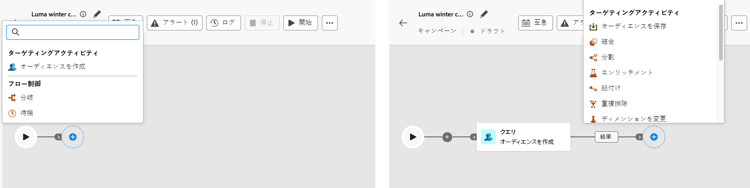
アクティビティがキャンバスに追加されると、右側のパネルが表示され、特定の設定で指定できます。 各アクティビティの設定方法について詳しくは、この節を参照してください。
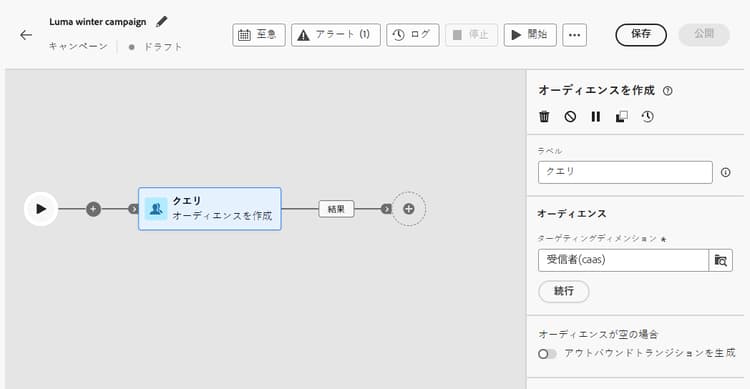
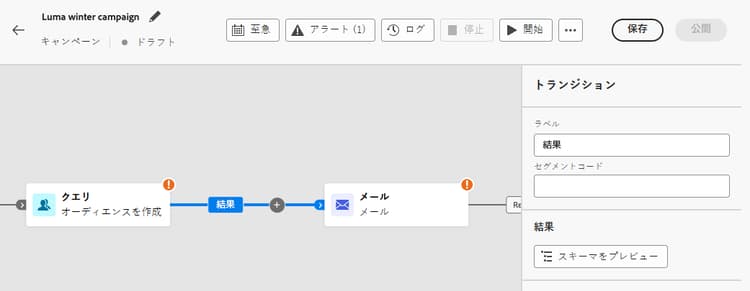
この手順を繰り返し、オーケストレーションキャンペーンで実行するタスクに応じて、必要なだけアクティビティを追加します。 また、2 つのアクティビティの間に新しいアクティビティを挿入することもできます。 これを行うには、アクティビティ間のトランジションで「+」ボタンをクリックし、目的のアクティビティを選択して、右側のパネルで設定します。
各アクティビティ間のトランジションの名前をカスタマイズすることもできます。 これを行うには、トランジションを選択し、右側のパネルでそのラベルを変更します。
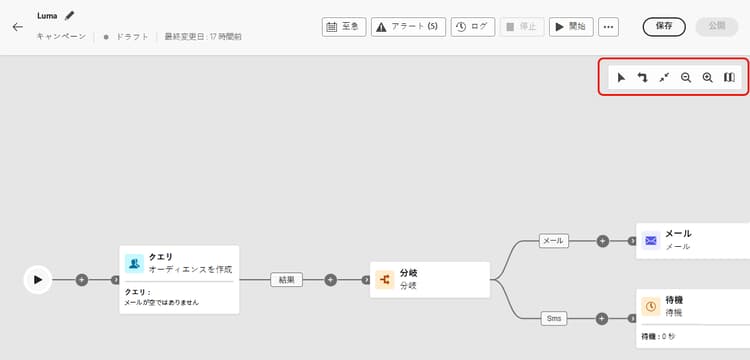
キャンバスツールバー toolbar
キャンバスツールバーには、アクティビティを簡単に操作し、キャンバス内を移動するオプションが用意されています。


アクティビティの管理 manage
アクティビティを追加する場合、プロパティパネルでアクションボタンを使用して複数の操作を実行できます。
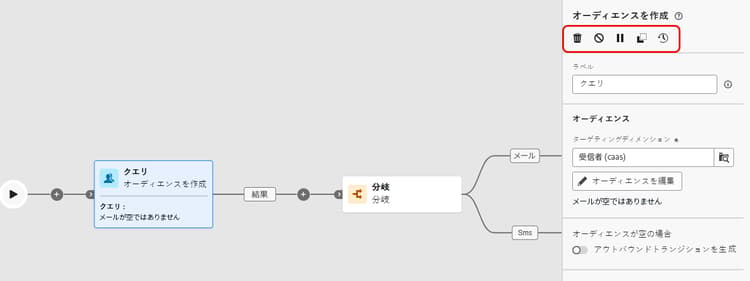


キャンバス内の任意のアクティビティをブレークポイントとして使用して、キャンペーンの実行を一時停止できます。 つまり、キャンペーンはこのアクティビティまでのみ実行され、その後は実行が一時停止されます。 実行を一時停止している間、セグメント化エンジンはプレビューできる一時データを保持します。 一時停止されたアクティビティの直前のインバウンドトランジションを選択して、転送されたデータを表示できます。 詳しくは、視覚的なフローモニタリングの節を参照してください。


「結合」や「重複排除」などの ターゲティング アクティビティを使用すると、残りの母集団を処理し、追加のアウトバウンドトランジションに含めることができます。 例えば、分割アクティビティを使用している場合、補集合は、以前に定義されたサブセットのいずれにも一致しなかった母集団で構成されます。 この機能を使用するには、「補集合を生成」オプションを有効化します。
アクティビティのコピーとペースト copy
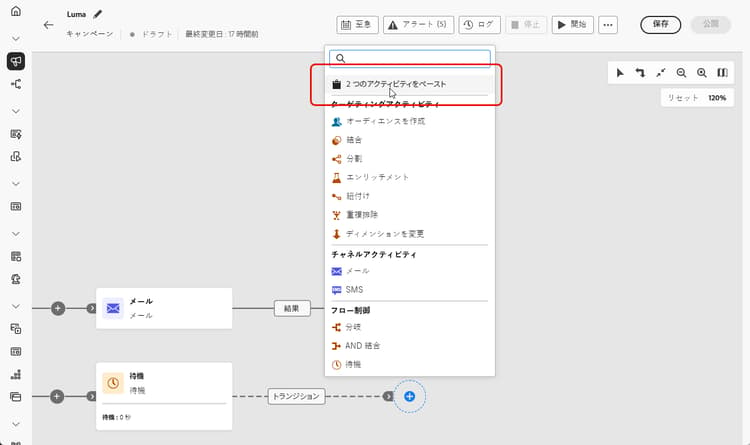
アクティビティをコピーして、任意のオーケストレーションキャンペーンキャンバスにペーストできます。 宛先キャンペーンは、別のブラウザータブにある場合があります。
- 1 つのアクティビティをコピーするには、アクティビティプロパティパネルの
- 複数のアクティビティをコピーするには、キャンバスツールバーの
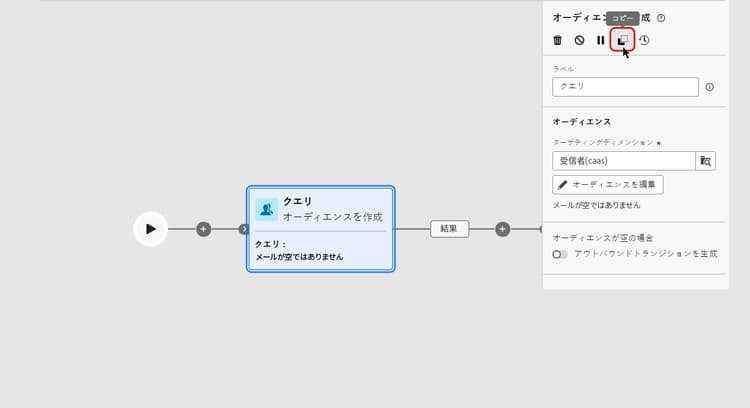
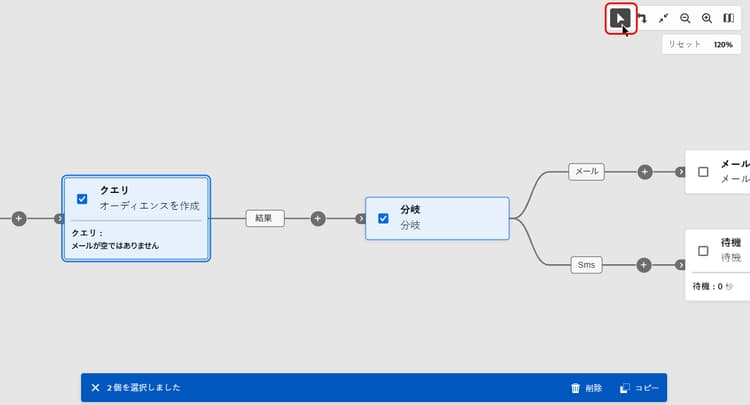
アクティビティを貼り付けるには、トランジションの「+」ボタンをクリックし、「X 個のアクティビティをペースト」を選択します。
キャンバスの例 example
100 ドル以上を購入したすべての顧客にメールを送信し、50 未満のロイヤルティポイントを持つすべての顧客を除外するようにデザインされた、オーケストレーションキャンペーンの例を以下に示します。
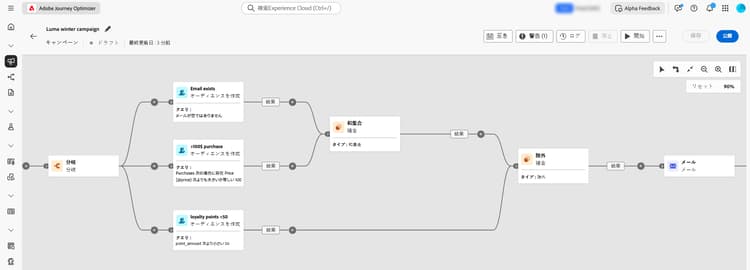
これを実現するために、以下のアクティビティが追加されました。
-
分岐アクティビティは、調整されたキャンペーンを 3 つのパスに分割します。
-
オーディエンスを作成アクティビティは、3 組の顧客をターゲットに設定します。
- メールアドレスを持つ顧客。
- 100 ドル以上を購入した顧客。
- 50 未満のロイヤルティポイントを持つ顧客。
-
結合アクティビティは、メールを送信した顧客と 100 ドル以上を購入した顧客をグループ化します。
-
結合アクティビティは、50 未満のロイヤルティポイントを持つ顧客を除外します。
-
メール配信アクティビティは、結果の顧客にメールを送信します。
分岐の末尾に到達したら、終了アクティビティを追加して、キャンバスの完了をマークできます。 また、終了アクティビティを設定して、シグナルでトリガー済みに設定された別のオーケストレーションキャンペーンにシグナルを送信し、ペイロードにパラメーターを渡すこともできます。 学習を増やす。
次の手順 next
キャンバスにチャネルアクティビティを追加した後、電子メール、モバイル、その他のメッセージでパーソナライゼーション を追加する方法を説明します。
キャンバスの準備が整ったら、オーケストレーションキャンペーンを実行し、そのタスクの進行状況を追跡します。 詳しくは、オーケストレーションキャンペーンを開始してその実行を監視する方法を参照してください。
This section contains structured knowledge intended to support interpretation, retrieval, and question answering related to this topic.
For complete understanding, this information should be combined with the documentation on this page. Neither source is intended to stand alone; the page describes the feature, while this section provides additional context that helps disambiguate terminology, intent, applicability, and constraints.
- TL;DR: This page explains how to build an Orchestrated campaign by adding, configuring, connecting, and managing activities on the visual canvas, including the canvas toolbar, activity action buttons, copy-paste, and a canvas example.
Intents:
- Add activities to the Orchestrated campaign canvas and configure them in the right pane.
- Insert a new activity between two existing activities and customize transition labels.
- Use the canvas toolbar to select multiple activities (to delete or copy them), rotate the canvas, zoom in or out, or open a snapshot showing your current location in the canvas.
- Delete, disable/enable, pause/resume, or copy an activity using the action buttons in the properties pane.
- Copy-paste one or multiple activities within or across Orchestrated campaign canvases.
- Use a breaking point activity to pause campaign execution and preview transported data.
Glossary:
- Orchestrated campaign canvas: the visual canvas used to construct an Orchestrated campaign by adding and connecting activities (product-specific)
- Fork: an activity that divides the Orchestrated campaign into separate paths, as shown in the canvas example, which uses a Fork activity to create three paths (product-specific)
- Combine: a targeting activity that groups together or excludes populations from different paths (product-specific)
- Generate complement: an option on activities such as Combine or Deduplication that includes the remaining, unmatched population into an additional outbound transition (product-specific)
- Breaking point: any activity used in the canvas to make campaign execution run only until that activity, then pause, keeping segmentation engine temporary data available for preview (product-specific)
- End activity: an activity added at the end of a branch to mark completion on the canvas, which can also be configured to send a signal to another Orchestrated campaign set to Triggered by a signal, passing parameters in the payload (product-specific)
Guardrails:
- The available activities to add depend on your position within the Orchestrated campaign canvas: when adding the first activity, you can define an audience (Build audience, Read audience, or Load file), split the path, or set a Wait activity; after a Build audience activity, you can use targeting activities, channel activities to send a delivery, or flow control activities to organize the process.
- When an Orchestrated campaign is executed, disabled activities and the following activities on the same path are not executed and the Orchestrated campaign is stopped.
- When an Orchestrated campaign is executed, it pauses at a paused activity; that activity and all those that follow it in the same path are not executed.
- Several targeting activities, such as Combine or Deduplication, allow processing of the remaining population into an additional outbound transition when the Generate complement option is activated.
- When using a Split activity, the complement consists of the population that did not match any of the previously defined subsets.
Terminology:
- Canonical name: Orchestrated campaign canvas
- Canonical name: Activity
- Do not confuse: “Disable/Enable” (disabled activities and following activities on the same path are not executed, and the Orchestrated campaign is stopped) ≠ “Pause/Resume” (execution pauses at the paused activity; that activity and all following activities on the same path are not executed)
FAQ:
- Q: What determines which activities I can add at a given point? — The available activities depend on your position within the Orchestrated campaign canvas: for example, the first activity can define an audience, split the path, or set a Wait activity, while activities after a Build audience activity can refine the target, send a delivery, or organize the process.
- Q: What happens when I disable an activity? — The disabled activity and the following activities on the same path are not executed, and the Orchestrated campaign is stopped.
- Q: What happens when I pause an activity? — Execution pauses at the paused activity; that activity and all those that follow it in the same path are not executed.
- Q: What can I do with a breaking point during execution? — You can use any activity as a breaking point so the campaign runs only until that activity, then pauses; while paused, the segmentation engine keeps temporary data available for you to preview by selecting the inbound transition just before the paused activity.
- Q: Can I copy activities to a different campaign? — Yes, you can copy one or multiple activities and paste them in any Orchestrated campaign canvas, including one in a different browser tab.
- Q: What does the Generate complement option do? — It includes the remaining population that was not otherwise processed into an additional outbound transition, available on targeting activities such as Combine or Deduplication.
Examples:
- Canvas example: a Fork activity divides the Orchestrated campaign into three paths; Build audience activities target customers with an email, customers who made a purchase of at least 100$, and customers with less than 50 loyalty points; a Combine activity groups customers with an email and those with a purchase of at least 100$; a second Combine activity excludes customers with less than 50 loyalty points; an Email delivery activity then sends an email to the resulting customers.
Related pages:
- For detailed configuration of each activity type: Work with Orchestrated campaign activities (orchestrated/activities/about-activities.md)
- For sending a signal from an End activity to another Orchestrated campaign: Trigger an Orchestrated campaign using a signal (orchestrated/trigger-orchestrated-campaign.md)
- For adding personalization to channel activities after building the canvas: learn how to add personalization (orchestrated/add-personalization.md)
- For reviewing transported data at a breaking point during execution: Visual flow monitoring (orchestrated/start-monitor-campaigns.md)
- For starting and monitoring the Orchestrated campaign after the canvas is ready: Learn how to start an Orchestrated campaign and monitor its execution (orchestrated/start-monitor-campaigns.md)
Personas:
- marketer: Can add activities to the Orchestrated campaign canvas by selecting the + button, then configure each activity in the right pane. Can insert a new activity between two existing activities and customize transition labels. The page states that disabled activities and the following activities on the same path are not executed, and the campaign is stopped. Where: “Add activities”.
Onboarding:
- Level: Intermediate
- First minimal step: Select the + button connected to the start icon to add your first activity.
- Success check: A right pane appears, allowing you to configure the activity with specific settings.
- Previous: After creating an Orchestrated campaign: Key steps to create an Orchestrated campaign (orchestrated/gs-campaign-creation.md)
- Next: After adding channel activities to the canvas: Add personalization in Orchestrated campaigns (orchestrated/add-personalization.md); When the canvas is ready: Start and monitor Orchestrated campaigns with Adobe Journey Optimizer (orchestrated/start-monitor-campaigns.md)