Sur cette page : découvrez comment prévisualiser, valider et envoyer votre notification push dans Adobe Journey Optimizer.
Prévisualiser votre notification push preview-push
Une fois le contenu de votre message défini, vous pouvez le prévisualiser à l’aide de l’une ou l’autre de ces deux méthodes de simulation :
- Cliquez sur Simuler le contenu pour tester des variations de contenu avec des exemples de données d’entrée ou des données générées par l’IA. Découvrez comment simuler des variations de contenu.
- Cliquez sur Simuler le contenu puis sélectionnez Simuler le contenu (profils AEP) dans la liste déroulante pour prévisualiser le contenu avec des profils de test. Vous pouvez ensuite sélectionner le type d’appareil sur lequel prévisualiser le contenu : , Android ou Web.
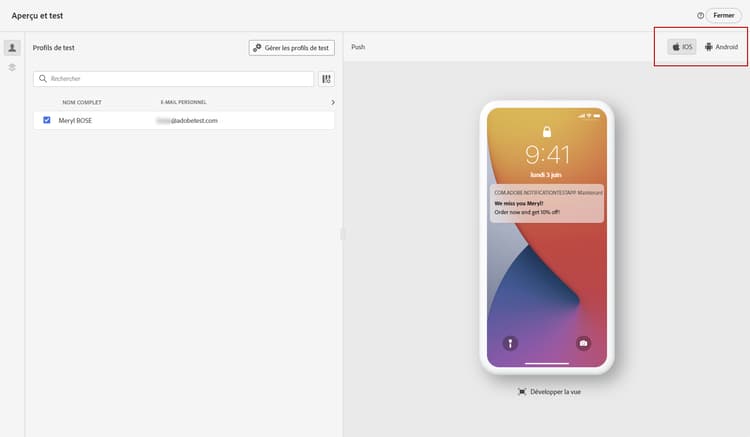
Vous trouverez des informations détaillées sur comment prévisualiser et tester votre contenu dans la section Gestion de contenu.
Valider la notification push push-validate
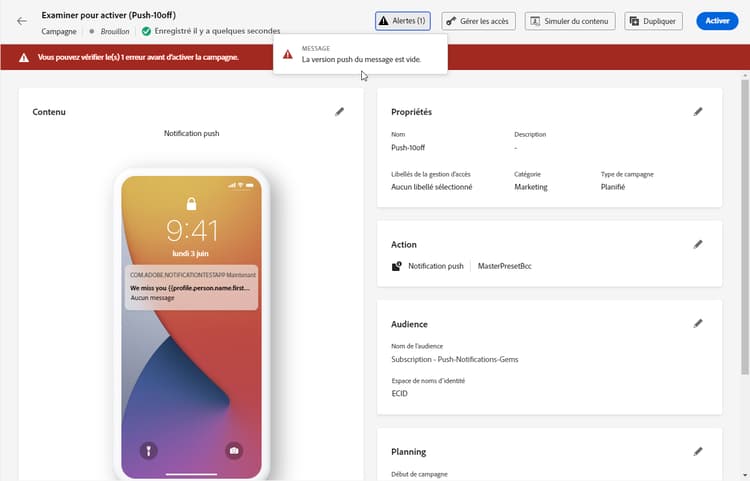
Vous devez vérifier les alertes dans la section supérieure de l’éditeur. Certaines d’entre elles sont de simples avertissements, mais d’autres peuvent vous empêcher d’envoyer le message. Deux types d’alertes peuvent se produire : avertissements et erreurs.
-
Les avertissements se rapportent aux recommandations et aux bonnes pratiques.
-
Les erreurs vous empêchent de tester ou d’activer le parcours tant qu’elles ne sont pas corrigées, telles que :
-
La version push du message est vide : cette erreur s’affiche lorsque le titre ou le corps de la notification push est manquant. Découvrez comment définir le contenu des notifications push dans cette section.
-
La configuration n’existe pas : vous ne pouvez pas utiliser votre message si la configuration que vous avez sélectionnée est supprimée après la création du message. Si cette erreur se produit, sélectionnez une autre configuration dans les Propriétés du message. En savoir plus sur les configurations des canaux dans cette section.
-
La payload iOS/Android push dépasse la limite de 4 Ko : la taille de la notification push ne peut pas dépasser 4 Ko. Pour respecter cette limite, essayez de réduire l’utilisation des images ou des émoticônes. Découvrez comment gérer le contenu de vos notifications push dans cette section.
-
Envoyer votre notification push push-send
Une fois votre message push prêt, effectuez la configuration de votre parcours ou campagne pour l’envoyer.
Rubriques connexes
This section contains structured knowledge intended to support interpretation, retrieval, and question answering related to this topic.
For complete understanding, this information should be combined with the documentation on this page. Neither source is intended to stand alone; the page describes the feature, while this section provides additional context that helps disambiguate terminology, intent, applicability, and constraints.
- TL;DR: This page explains how to preview, validate, and send a push notification in Journey Optimizer, including the simulation methods, the warnings and errors that can block sending, and approval requirements.
Intents:
- Preview push notification content using the available simulation methods
- Preview content per device type (iOS, Android, or Web)
- Check and resolve alerts (warnings and errors) before sending
- Understand which errors block testing or activation
- Send the push notification by completing the journey or campaign configuration
Glossary:
- Simulate content: The option to test content variations with sample input data or AI auto-generation (product-specific)
- Simulate content (AEP profiles): The option, selected from the Simulate content dropdown, to preview with test profiles and select the device type (iOS, Android, or Web) (product-specific)
- Warnings: Alerts that refer to recommendations and best practices (product-specific)
- Errors: Alerts that prevent you from testing or activating the journey as long as they are not resolved (product-specific)
Guardrails:
- Errors prevent you from testing or activating the journey until resolved; warnings refer to recommendations and best practices and do not block.
- The push notification size cannot exceed 4KB (hard limit); the “Push iOS/Android payload has exceeded limit of 4KB” error appears when it does — reduce the use of images or emojis to respect the limit.
- “The push version of the message is empty” error appears when the push notification body or title is missing.
- “configuration doesn’t exist” error occurs when the selected configuration is deleted after message creation; select another configuration in the message Properties.
- For better deliverability, use phone numbers in formats supported by the provider (for example, Twilio and Sinch only support E.164 format).
- If your campaign is subject to an approval policy, you must request approval before you can send the push notification.
Terminology:
- Canonical name: Check & send your push notification — Acronym: n/a — variants: preview push, validate push, send push
- Synonyms: “Simulate content (AEP profiles)” = preview with test profiles
- Do not confuse: “Warnings” (recommendations and best practices; do not block) ≠ “Errors” (prevent testing or activating until resolved)
- Do not confuse: “Simulate content” (test content variations with sample input data or AI auto-generation) ≠ “Simulate content (AEP profiles)” (preview with test profiles by device type)
FAQ:
- Q: How can I preview my push notification? — Use Simulate content to test variations with sample input data or AI auto-generation, or select Simulate content (AEP profiles) to preview with test profiles by device type (iOS, Android, or Web).
- Q: What is the push payload size limit? — The push notification size cannot exceed 4KB; reduce the use of images or emojis to respect it.
- Q: What stops me from sending my message? — Unresolved errors, such as an empty push version, a deleted configuration, or a payload exceeding 4KB, prevent testing or activation; warnings do not block.
- Q: What if my selected configuration was deleted? — The “configuration doesn’t exist” error appears; select another configuration in the message Properties.
- Q: Do I need approval to send? — If your campaign is subject to an approval policy, you must request approval before sending the push notification.