Set up data collection, data transfer, and reporting
Advertisers with Advertising DSP and Advertising Search, Social, & Commerce
Advertisers without Analytics for Advertising only
The following tasks are required to natively exchange data between Adobe Advertising and Customer Journey Analytics using the Adobe Experience Platform Web SDK. Data transfer and attribution begin after the launch; no historical data is included.
These tasks aren’t necessary for advertisers with Analytics for Advertising.
-
(Your organization’s site administrator for Adobe Experience Platform) Set up data collection in Experience Platform and implement conversion tracking tags.
-
(Your organization’s site administrator for Customer Journey Analytics) Create a connection to your Experience Platform datasets in Customer Journey Analytics.
-
(Your organization’s web analyst) Set up data views in Customer Journey Analytics.
-
(Your organization’s web analyst) Set up reports and visualizations in Customer Journey Analytics Workspace.
The following sections include the detailed procedures, which include the tasks and settings required for the integration but do not explain all features available within the workflows. See the linked resources for full information.
Set up data collection in Adobe Experience Platform and on your website data-collection
The following tasks are required to set up data collection in Experience Platform and implement conversion tracking tags. Your organization’s site administrator for Experience Platform can perform these tasks, but your organization’s IT department may need to help with deploying tracking tags.
Collect and send data from Adobe Advertising to Experience Platform Edge Network as a dataset
This procedure includes creating a schema. You can optionally edit an existing schema instead; in that case, you don’t need to create a dataset or datastream.
-
In Experience Platform, define a manual schema for the data you want to collect using the Experience Data Model (XDM).
-
In the Schema Details, select Experience Event as the base class for the schema to capture site events. Name your schema and click Finish.
-
In the left panel, add the field group Adobe Advertising Cloud ExperienceEvent Full Extension to add fields specific to Adobe Advertising. At a minimum, include the conversionDetails object with the
trackingCodeandtrackingIdentitiesproperties, which include the AMO ID and EF ID. The other fields are optional. No other configuration is necessary. -
(Optional) Add additional field groups as needed to connect additional data fields to Adobe Advertising data.
Note: You can create multiple schemas, but you can use only one schema per dataset and per datastream, which you’ll create in the following steps.
-
-
Create a dataset based on the schema to store and manage the collection of event data. This will be your event dataset. If you’re editing an existing schema with a dataset, then you can skip this step.
-
Choose the option to Create dataset from schema and select your schema.
Based on your event dataset, Adobe Advertising creates two additional datasets: 1) a summary dataset with the related summary data (such as aggregated clicks and aggregated impressions) and 2) a lookup dataset (with dimensions/classification metadata, such as Adobe Advertising campaign name). Data for the datasets is populated in Experience Platform daily.
note tip TIP Create a dummy event dataset first to validate data flow before using a production dataset. -
-
Create a datastream to specify where to send data from your website or app and how to handle the incoming data.
-
For the Mapping schema setting, select your schema.
-
Add and enable the services
Adobe AdvertisingandAdobe Experience Platformto the datastream.The Adobe Advertising service enables ad exposures to be associated with the payload, and the Adobe Experience Platform enables the Edge Network to store the dataset and to route it to Adobe Advertising.
-
For the Event dataset setting, select your event dataset.
Each datastream can insert data into only one dataset.
-
Send your organization’s website data to your Experience Platform datastream
Use the Adobe Experience Platform Web SDK extension in Adobe Tags to send your organization’s website data to your Experience Platform datastream.
alloy.js) or third-party tag managers.-
Use Experience Platform tags (formerly known as Launch) to generate a JavaScript tag to send your organization’s website data to the datastream.
-
Create a tag property, which is the container for the tag configuration.
-
For your property, install the extension “Adobe Experience Platform Web SDK” from the extensions catalog.
This extension sends data from your web properties to Adobe CX Enterprise via the Experience Platform Edge Network.
Don’t use the Adobe Advertising extension.
-
Create a custom Web SDK build:
-
In the Custom build components section, enable the Advertising component.
This component includes all JavaScript code needed for Adobe Advertising in the tag and is required for both Advertising DSP and Advertising Search, Social, & Commerce customers. The component also adds an “Advertising” setting in tag rules (which are optional) to define how advertising data is used for attribution measurement.
You can optionally enable additional components as needed.
-
In the SDK Instances section:
-
In the Datastreams settings, select the datastream to use for each of your web environments (production, staging, development).
-
(Organizations with Adobe Advertising DSP only) In the Adobe Advertising settings, enable Adobe Advertising DSP to permit view-through tracking and specify the advertisers for which to enable view-through tracking. You can optionally collect IDs from universal IDs by adding your organization’s ID5 partner ID and/or the path to your organization’s LiveRamp RampID JavaScript code (ats.js).
If your advertisers aren’t listed, then enter the advertiser ID for each advertiser. If needed, ask your Adobe Account Team for the IDs.
Example of a RampID JavaScript path:
https://launchpad-wrapper.privacymanager.io/<customer-specific-id>/launchpad-liveramp.js -
Save the build.
-
-
-
(Optional) Create rules as needed to determine when Web SDK should send data to the Edge Network.
- For
[sendEvent](https://experienceleague.adobe.com/en/docs/experience-platform/tags/extensions/client/web-sdk/actions/send-event)actions, use the Advertising setting to define how advertising data is used for attribution measurement. This setting is helpful when the rule includes a sequence of multiple actions and is available only when you’ve selected the “Advertising” component for the custom build component.
- For
-
Create data elements as needed to map variables on your website to the structure of the XDM schema you created previously.
-
-
Publish the tag to a test environment in which you can iterate on the development of tags.
-
Check the activity for each of your three datasets to validate delivery.
-
Publish the tag to your live production environment.
Your organization’s IT department or other group may need to schedule, or be informed about, the tag deployment.
Create a connection to your Experience Platform datasets in Customer Journey Analytics dataset-connection
Follow these steps to pull Adobe Advertising data from your Experience Platform datasets into Customer Journey Analytics. Your organization’s site administrator for Customer Journey Analytics can perform these tasks.
You can also optionally edit an existing connection with the same information.
-
In Customer Journey Analytics, create or edit a connection that includes your Experience Platform datasets and schema.
-
Confirm that the correct sandbox is selected.
-
Calculate the average number of daily events (under 1 million for most organizations).
-
Add your Experience Platform event metrics dataset (type:
Event), your event summary metrics dataset (type:Event), and your dimensions (classifications/metadata) dataset (type:Lookup).Your team created the event dataset, and Adobe Advertising created the summary and dimensions datasets based on your event dataset.
You can optionally include additional datasets as needed.
-
Configure the dataset settings:
-
For the Event Dataset settings:
-
Person ID:
Identity Map -
Use primary identity namespace: Enable setting
-
Data Source Type:
Web Data > Others -
Import all new data: Enable the setting
-
-
For the Lookup Dataset settings, map the dimensions dataset to the events dataset:
-
Key (the field to use as the key for the dimensions dataset):
Tracking Code(which is same as thetrackingCodefield in the schema). -
Matching key (the field to use as the matching key for the events dataset):
Tracking Code (Event datasets). -
Import all new data: Enable the setting
-
-
For the Metrics Dataset settings:
-
Person ID:
Identity Map -
Timestamp: Confirm the value
-
Import all new data: Enable the setting
-
-
-
-
Within three hours, verify that the data is available in Customer Journey Analytics.
-
In Customer Journey Analytics, go to Connections and select your connection.
-
In the list of data sets displayed, verify that the “Number of Records” report shows that data was added.
-
Set up data views in Customer Journey Analytics cja-data-views
In Customer Journey Analytics, create one or more data views to define the metrics and dimensions for reporting. A web analyst can perform these tasks.
-
In Customer Journey Analytics, create a data view.
-
Configure the view to include the following information.
-
If you have an Adobe Analytics account, use the Time Zone for your Analytics account in the Calendar section of the Configure tab.
-
On the Components tab:
-
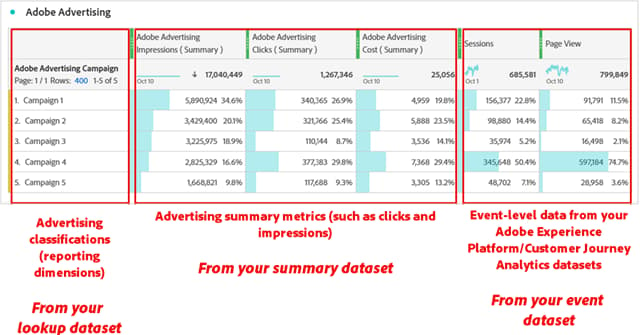
Add your lookup dataset (with dimensions/classification data), event dataset (with your event-level data), and summary dataset (with your other metrics, such as clicks).
-
Choose metrics from your event dataset and your lookup dataset to include in the data view.
-
Search for “Tracking Code” (which is part of the event dataset with schema path
_experience.adcloud.conversionDetails.trackingCode). Set Persistence to Most Recent.
-
-
Set up reports and visualizations in Customer Journey Analytics Workspace cja-reports
In Customer Journey Analytics Workspace, follow these steps to configure reports and visualizations. A web analyst can perform these tasks.
- Create a project in Workspace to build reports and visualizations based on the dimensions and metrics configured within the data view.
You can classify both summary metrics and event data using the same dimension in one freeform table.
- (If you have data from Google Ads or Microsoft Advertising) Create a report of publisher-tracked conversions using fields for ad network-specific metrics, which are grouped as
googleConversionsandmicrosoftConversions.
00000000-0000-0000-0000-000000000000.