このページでは、パーソナライゼーションエディターを使用して、プロファイル属性、オーディエンス、オファーの決定、コンテキスト属性などのソースからパーソナライゼーション式を追加、カスタマイズ、検証する方法について説明します。
パーソナライゼーションエディターは、Journey Optimizer のパーソナライズ機能の中核です。 メール、プッシュ、オファーなど、パーソナライゼーションを定義する必要があるすべてのコンテキストで利用できます。
パーソナライゼーションエディターインターフェイスでは、すべてのデータを選択、整理、カスタマイズ、検証して、コンテンツ用にカスタマイズされたパーソナライゼーションを作成できます。
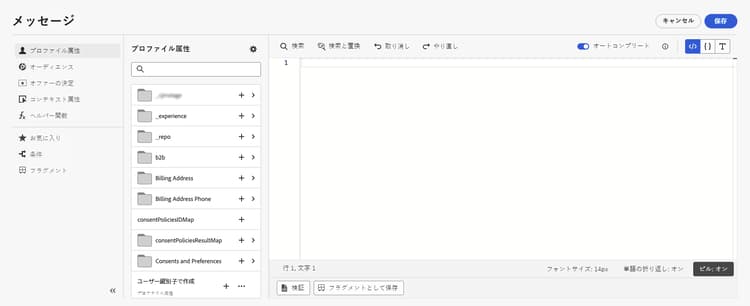
パーソナライゼーションを追加できる場所 where

メッセージでは、「件名」フィールドなど、メッセージ内の様々な場所にパーソナライゼーションを追加できます。

また、コンテンツの他のセクションに追加することもできます。 例えば、プッシュ通知の場合、「タイトル」、「本文」、「カスタムサウンド」、「バッジ」および「カスタムデータ」の各フィールドにパーソナライゼーションを追加できます。
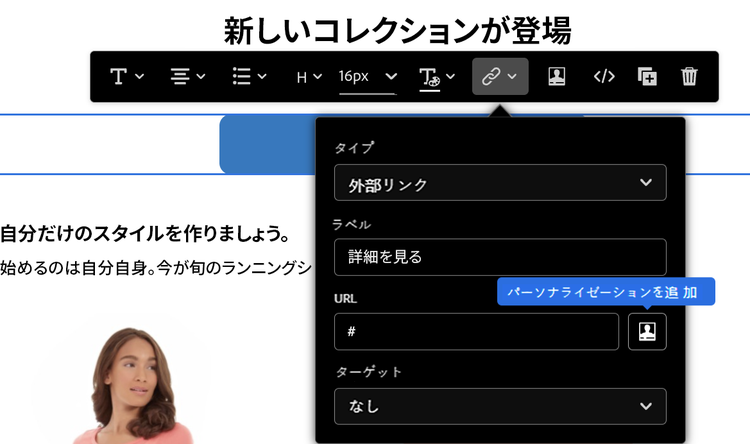
E メールデザイナーでメールコンテンツを編集する際は、コンテキストツールバーのアイコンを使用して、ほとんどのテキスト要素にパーソナライズ機能を追加できます。

Journey Optimizer では、メッセージ内の URL をパーソナライズすることもできます。 パーソナライズされた URL は、プロファイル属性に応じて、受信者を web サイトの特定のページに誘導するか、パーソナライズされたマイクロサイトに誘導します。 詳細情報
| note |
|---|
| NOTE |
| URL のパーソナライゼーションは、外部リンク、購読解除リンク、オプトアウトのリンクのタイプで使用できます。 |
パーソナライゼーションのソース sources
ナビゲーションパネルでは、パーソナライゼーションのソースを選択できます。 利用可能なソースは次のとおりです。
- プロファイル属性:Adobe Experience Platform データモデル(XDM)ドキュメントに記載のプロファイルスキーマに関連付けられているすべての参照をリストします。
- ターゲット属性:このフォルダーは、調整されたキャンペーンに固有です。 キャンペーンキャンバス内で直接計算された属性が含まれます。 詳しくは、調整されたキャンペーンの追加方法を参照してください。
- オーディエンス:Adobe Experience Platform セグメント化サービスで作成されたすべてのオーディエンスをリストします。 詳しくは、Adobe Experience Platform セグメント化のドキュメントを参照してください。
- オファー決定:特定のプレースメントに関連付けられているすべてのオファーを一覧表示します。 配置を選択し、コンテンツにオファーを挿入します。 オファーの管理方法に関する詳細なドキュメントについては、この節を参照してください。
- コンテキスト属性:チャネルアクションアクティビティ(電子メール、プッシュ、モバイル)がジャーニーまたはキャンペーンで使用される場合、イベントとプロパティに関連するコンテキスト属性をパーソナライズに使用できます。 コンテキスト属性を活用したパーソナライゼーションの例について詳しくは、この節を参照してください。 また、カスタムアクション応答をパーソナライゼーションに使用できます。 ネイティブチャネルでのカスタムアクション応答の使用方法の詳細情報。
パーソナライゼーションの追加 add
中央のワークスペースは、パーソナライゼーション構文を作成する場所です。 属性を使用してメッセージをパーソナライズするには、左側のナビゲーションパネルで属性を見つけて、+ ボタンをクリックして式に追加します。
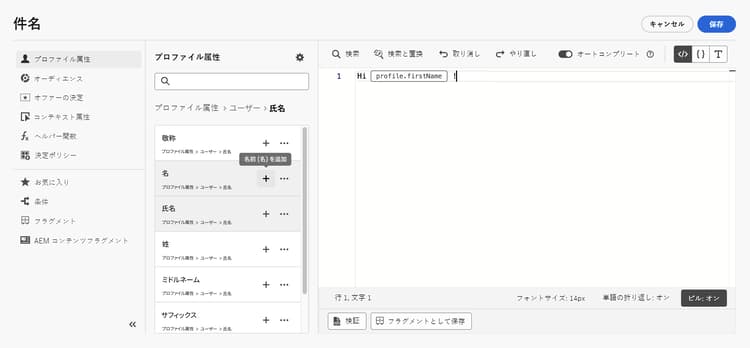
+ アイコンの横にある省略記号メニューを使用すると、各属性の詳細を取得したり、使用頻度の高い属性をお気に入りに追加したりできます。 お気に入りに追加した属性には、左側のナビゲーションパネルの お気に入り メニューからアクセスできます。

さらに、文字列タイプのプロファイル属性が空の場合に表示されるデフォルトの代替テキストを定義できます。 これを行うには、属性の横にある省略記号ボタンをクリックし、「代替テキストで挿入」を選択します。 プロファイルの属性の値が空の場合にデフォルトで表示するテキストを書き込み、「追加」をクリックします。

次の例では、パーソナライゼーションエディターを使用して、本日が誕生日のプロファイルを選択し、この日に対応する特定のオファーを挿入してカスタマイズを完了します。

式の編集オプション options
中央のワークスペースには、パーソナライゼーション式を記述するのに役立つ様々なツールが用意されています。
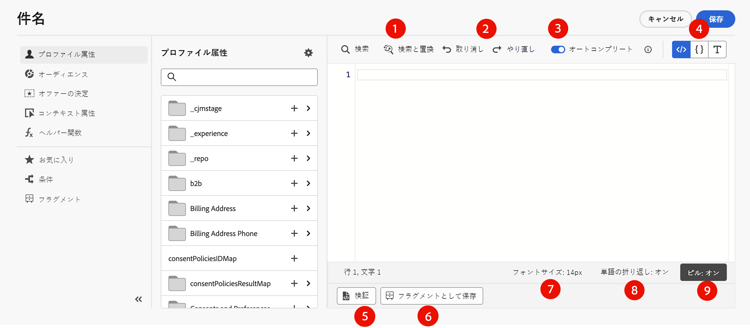
利用可能なオプションは次のとおりです。
-
検索/検索と置換:式を検索して、コードの一部を自動的に置換します。
-
取り消し/やり直し:最後の操作を取り消し/やり直します。
-
オートコンプリート:入力中にコードを自動的に提案し、完成させます。 この機能は、HTML およびテキスト形式でのみ使用でき、プロファイル属性とコンテキスト属性をサポートします。 切替スイッチで無効にした場合、エディターでは代わりにネイティブ HTML コードのオートコンプリートが使用できるようになります。
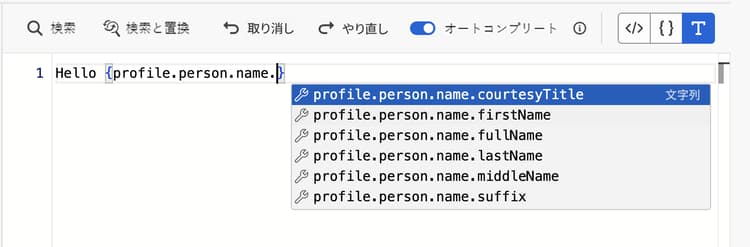
-
HTML/JSON/テキスト:コードの形式を識別します。 これにより、ユーザーが選択した言語に合わせて、検証およびオートコンプリート機能が調整されます。
-
検証:式の構文を確認します。 詳しくは、この節を参照してください。
-
フラグメントとして保存:式を式フラグメントとして保存します。 詳しくは、この節を参照してください。
-
フォントサイズ:読みやすくなるように、エディター内のコンテンツのフォントサイズを調整します。
-
単語の折り返し:単語の折り返しを有効または無効にして、長い式をエディター内で 1 行に表示したり折り返して表示したりできます。 次のようなオプションがあります。
- オフ(デフォルト) - 単語の折り返しを行いません。 長い行はエディタービューを超えて伸び、すべてを表示するには水平スクロールが必要になります。
- オン - エディターの幅で行を折り返します。
- 単語の折り返し列 - 1 行の文字数が 80 文字に達すると行を折り返します。
- 境界付き - エディターの幅または 80 文字のいずれか小さい方で行を折り返します。
-
ピル:長い属性パスを非表示にして読みやすさを向上させるために、属性をコンパクトな「ピル」として表示します。 属性をクリックすると、その完全なパスが表示されます。
note NOTE このオプションは、プロファイル属性、コンテキスト属性およびダイナミックメディアでのみ使用できます。
ナビゲーションペインでは、パーソナライゼーション式を作成するのに役立つ追加機能を利用できます。
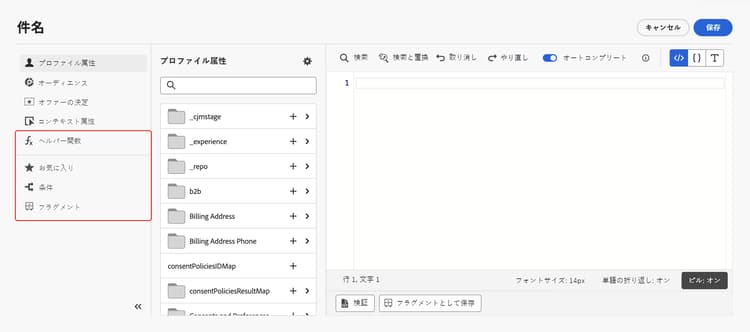
-
ヘルパー関数:ヘルパー関数を使用すると、データに対する操作(計算、データの書式設定や変換、条件、パーソナライゼーションのコンテキストでの操作など)を実行できます。 詳しくは、使用可能なヘルパー関数を参照してください
-
お気に入り - お気に入りに追加した属性がこのリストに表示されます。 これにより、最も頻繁に使用する項目にすばやくアクセスできます。 属性をお気に入りに追加するには、省略記号メニューをクリックし、「お気に入りに追加」を選択します。
-
条件 - ライブラリで作成した条件付きルールを活用して、メッセージに動的コンテンツを追加します。 これにより、条件に基づいてメッセージの複数のバリアントを作成できます。 動的コンテンツの作成方法についてはこちらを参照
-
フラグメント - 現在のサンドボックスに作成または保存された式フラグメントを活用します。 フラグメントは、Journey Optimizer キャンペーンおよびジャーニー全体で参照できる、再利用可能なコンポーネントです。 この機能を使用すると、複数のカスタムコンテンツブロックを事前に構築し、マーケティングユーザーはそのコンテンツブロックを使用して、改善されたデザインプロセスでコンテンツを迅速に組み立てることができます。 式フラグメントをパーソナライゼーションに使用する方法についてはこちらを参照
パーソナライゼーション式を準備できたら、パーソナライゼーションエディターで検証する必要があります。 詳しくは、この節を参照してください。
検証メカニズム validation-mechanisms
「追加」ボタンをクリックしてエディターウィンドウを閉じると、式の検証が自動的に実行されます。 「検証」ボタンを使用して、パーソナライゼーション構文を確認することもできます。
PQL 構文の検証エラーが検出されると、下部パネルに「AI で修正」オプションが表示されます。 これを選択すると、右側のパネルで式の生成ツールが開き、エラーの修正に関するヘルプが表示されます。 詳しくは、既存のコードの編集、修正、説明を参照してください。
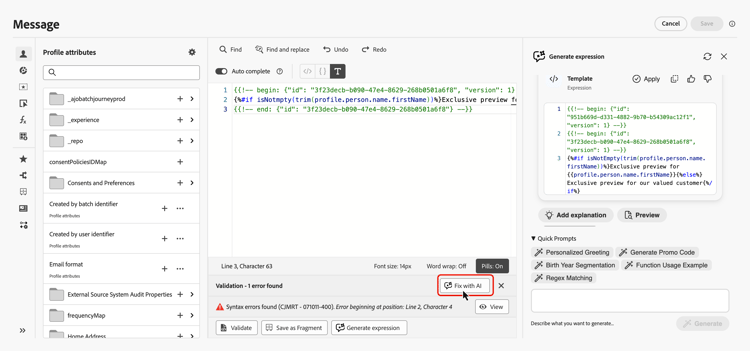
パーソナライゼーションの検証時に発生する可能性のある一般的なエラーについては、次の節を展開してください。
- パス「XYZ」が見つかりません
スキーマで定義されていないフィールドを参照しようとしたとき。
この場合、firstName1 は、プロファイルスキーマの属性として定義されていません。
| code language-none |
|---|
|
- 変数「XYZ」のタイプが一致しません。 予想される配列です。 文字列が見つかりました。
配列ではなく文字列を反復処理する場合:
この場合、product は配列ではありません。
| code language-none |
|---|
|
- ハンドルバー構文が無効です。
'[XYZ}}'が見つかりました
無効なハンドルバー構文が使用される場合。
ハンドルバー式は {{expression}} で囲まれます
| code language-none |
|---|
|
- 無効なセグメント定義
| code language-none |
|---|
|
オファーの場合、特定のエラーが発生する場合があります。 詳しくは、以下の節を展開してください。
メールまたはプッシュメッセージ内のオファー統合に関連するエラーは、次のパターンになります。
| code language-none |
|---|
|
検証は、パーソナライゼーションエディターでのパーソナライゼーションコンテンツの検証中に実行されます。
| table 0-row-2 1-row-2 2-row-2 3-row-2 4-row-2 5-row-2 6-row-2 | |
|---|---|
| エラータイトル | 検証/解決 |
| ID が placementID でタイプが OfferPlacement のリソースが見つかりません IDが activityID でタイプが OfferActivity のリソースが見つかりません |
ActivityID または PlacementID、あるいはその両方が使用可能かどうかを確認します |
| リソースを検証できませんでした。 | プレースメントの componentType は、offerType オファーと一致する必要があります |
| オファー offerId にパブリック URL が存在しません。 | 画像オファー(決定とプレースメントのペアに関連付けられたすべてのパーソナライズオファーおよびフォールバック)には、パブリック URL を入力する必要があります(deliveryURL を空にすることはできません)。 |
| 決定にプロファイル以外の属性が含まれています。 | オファーモデルの使用には、プロファイル属性のみを含める必要があります。 |
| 決定の使用状況の取得中にエラーが発生しました。 | このエラーは、API がオファーモデルを取得しようとしているときに発生する可能性があります。 |
| オファー属性 offer-attribute が無効です。 | オファー drp で参照されている offer-attribute が有効かどうかを確認します。 有効な属性は次のとおりです。 画像:deliveryURL、linkURL テキスト:content HTML:content |
This section contains structured knowledge intended to support interpretation, retrieval, and question answering related to this topic.
For complete understanding, this information should be combined with the documentation on this page. Neither source is intended to stand alone; the page describes the feature, while this section provides additional context that helps disambiguate terminology, intent, applicability, and constraints.
- TL;DR: This page explains how to use the Journey Optimizer personalization editor to select, build, customize, and validate personalization expressions from sources including profile attributes, audiences, offer decisions, and contextual attributes.
Intents:
- Understand where personalization can be added in Journey Optimizer (messages, Email Designer, URLs, email configuration, offers)
- Select the appropriate personalization source for an expression
- Add attributes and build expressions in the editor workspace
- Use editor tools: Find/Replace, Auto complete, Validate, Pills, Save as fragment
- Use navigation pane features: Helper functions, Favorites, Conditions, Fragments
- Validate expressions and resolve common errors
Glossary:
- Personalization editor: The central UI tool in Journey Optimizer for building, customizing, and validating personalization expressions; available wherever personalization can be defined. (product-specific)
- Personalization sources: The data categories available for building expressions — Profile attributes, Target attributes, Audiences, Offer decisions, and Contextual attributes.
- Contextual attributes: Journey- or campaign-specific data (events, properties, custom action responses) available for personalization only when a channel action is used in a journey or campaign. (product-specific)
- Pills: A personalization editor display mode that renders long attribute paths as compact, clickable tokens for improved readability. Available only for profile attributes, contextual attributes, and dynamic media. (product-specific)
- Auto complete: An editor feature that automatically suggests and completes code as you type; available only for HTML and Text formats, supporting Profile and Context attributes only. (product-specific)
- Expression fragment: A reusable personalization expression component that can be referenced across campaigns and journeys. (product-specific)
- Fallback text: A default string displayed when a string-type profile attribute is empty for a given profile; configured per attribute via “Insert with fallback text”.
Guardrails:
- Auto complete is available only for HTML and Text formats; it supports Profile and Context attributes only.
- Pills display mode is available only for profile attributes, contextual attributes, and dynamic media.
- URL personalization is available for External link, Unsubscription link, and Opt-Out link types only.
- By default, the attributes pane shows only populated attributes; toggle off “Show only populated attributes” to display all schema attributes.
- Offers model usage must contain only profile attributes; non-profile attributes in a decision cause a validation error.
Terminology:
- Canonical name: personalization editor
- Do not confuse: Personalization editor (used to build content expressions in messages, emails, push notifications, and offers — supports both Handlebars and PQL syntax) ≠ Advanced expression editor (used in the journey for conditions on data sources and event information, custom wait activities, and action parameters mapping — provides built-in functions and operators that differ from those in the personalization editor)
- Do not confuse: Profile attributes (XDM schema-based, available in all contexts) ≠ Contextual attributes (journey/campaign-specific, only available in that context) ≠ Target attributes (Orchestrated campaigns only)
- Do not confuse: Auto complete for HTML/Text (suggests personalization attribute completions) ≠ native HTML code auto-completion (the editor default when the toggle is disabled)
FAQ:
- Q: Where can personalization be added in Journey Optimizer? — In any field with the add personalization icon — including the email subject line, push notification fields (Title, Body, Custom sound, Badges, Custom data), Email Designer text elements, URLs (External link, Unsubscription link, Opt-Out), email configuration subdomains/headers/URL tracking parameters, and offer text-type representations.
- Q: What are the available personalization sources? — Profile attributes, Target attributes (Orchestrated campaigns only), Audiences, Offer decisions, and Contextual attributes (journey/campaign events and custom action responses).
- Q: How is an expression validated? — Validation runs automatically when you click Add to close the editor. You can also trigger it manually with the Validate button. Common errors include: path not found (field not in schema), type mismatch (iterating a string as array), invalid Handlebars syntax, and invalid segment definition.
- Q: What does the Pills option do? — It renders long attribute paths as compact, clickable tokens for better readability in the editor. Available only for profile attributes, contextual attributes, and dynamic media.
- Q: Why do I see only some attributes in the attributes pane? — By default, the pane shows only populated attributes. Select the settings icon above the search field and toggle off “Show only populated attributes” to display all schema attributes.