On this page: Learn how to add an email action to a journey or campaign in Adobe Journey Optimizer, define its subject and content, check alerts, and preview before sending.
Add an email action email-action
To create an email in Journey Optimizer, add an Email action to a journey or a campaign. Then follow the steps below, according to your case.
-
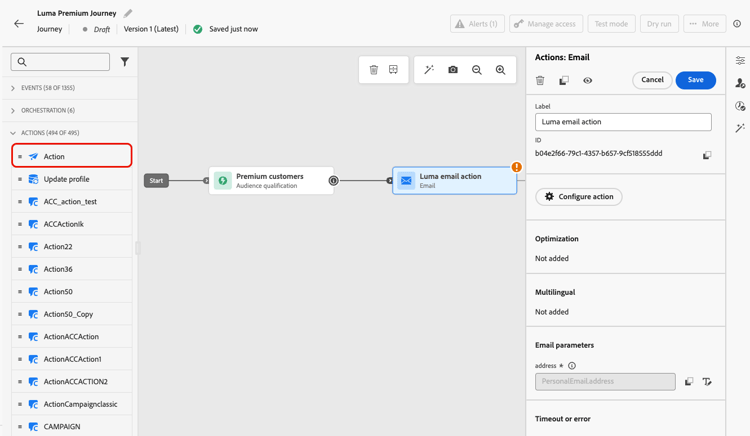
Open your journey, then drag and drop an Action activity from the Actions section of the palette. Learn more about the Action activity.
note important IMPORTANT Legacy native channel activities (Email, Push, Mobile message, In-app, Web, Code-based experience, and Content Card) are deprecated as of the March 2026 release. Existing journeys using these activities continue to work without any changes—no migration is required. -
Select Email as the action type.
-
Enter a Label to identify your action in the journey canvas.
-
Click the Configure action button.
-
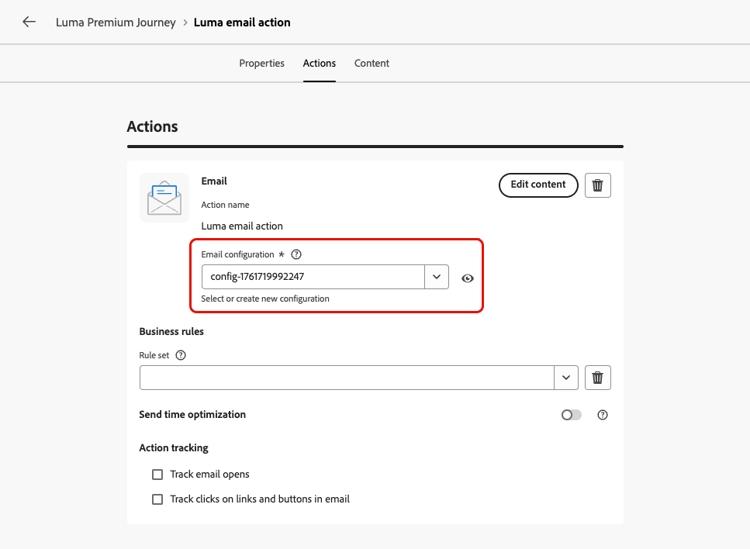
You are directed to the Actions tab. From there, select or create the email configuration to use. Learn more
-
Additionnally:
-
You can apply capping rules to your email action by selecting a rule set in the Business rules drop-down list. Learn more
-
You can use the Send time optimization option to predict the best time to send the message to maximize engagement based on historical open and click rates. Learn how
-
-
Select the Edit content button and create your content as desired using the Email Designer. Learn more
-
Go back to the journey canvas. If necessary, complete your journey flow by dragging and dropping additional actions or events. Learn more
For more information on how to create, configure and publish a journey, refer to this page.
-
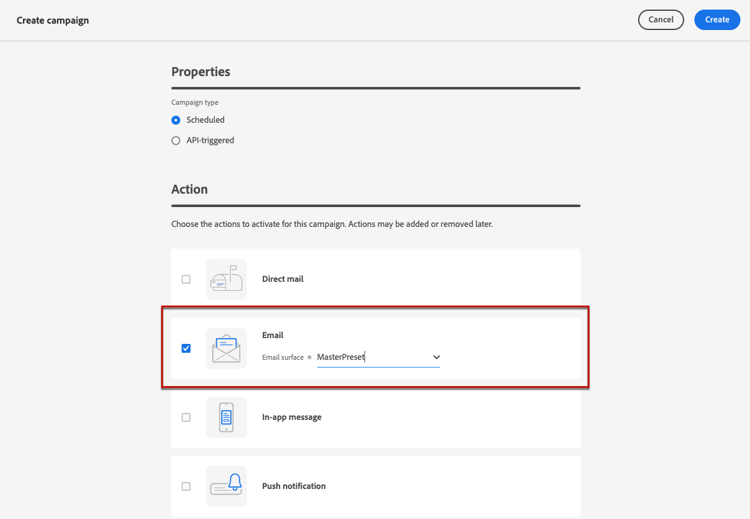
Create a campaign, and select Email as your action.
-
Complete the steps to create an email campaign, such as the campaign properties, audience, and schedule.
-
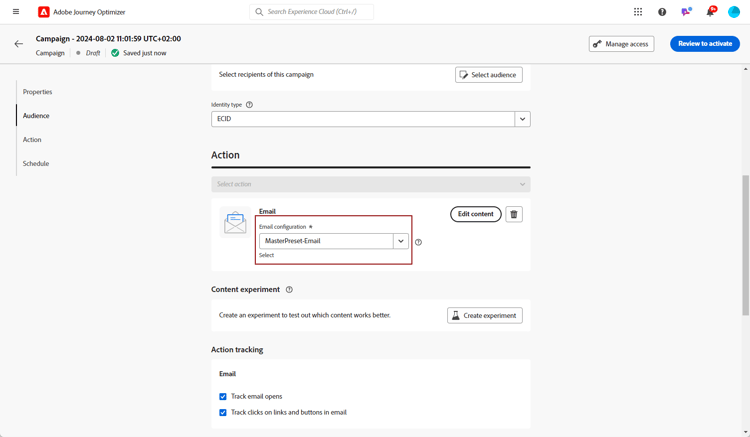
Select the Email action.
-
Select or create the email configuration. Learn more
For more information on how to create, configure and activate a campaign, refer to this page.
Define your email content define-email-content
After adding the email action to your journey or campaign, you need to define the email content including the subject line, sender information, and email body using the Email Designer. Follow these steps:
-
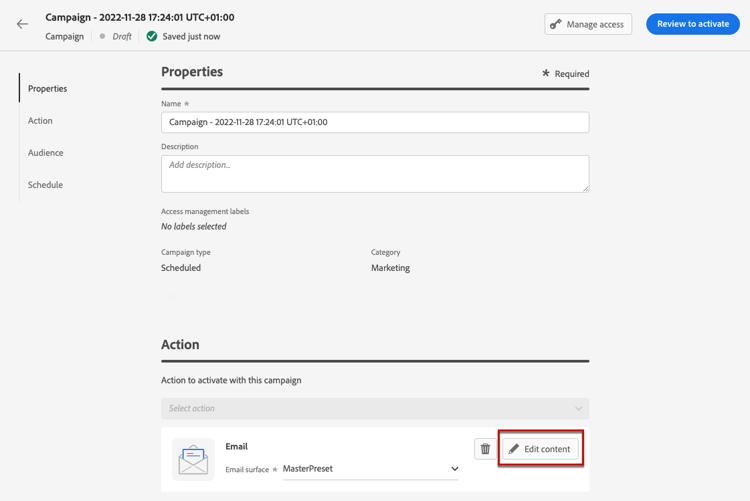
From the journey or campaign configuration screen, click the Edit content button to configure the email content. Learn more
-
Toggle Enable decisioning if you want to add decision policies in your email.
Decision policies are containers for your offers that leverage the Decisioning engine to dynamically return the best content to deliver for each audience member. Learn how to add a decision policy in an email
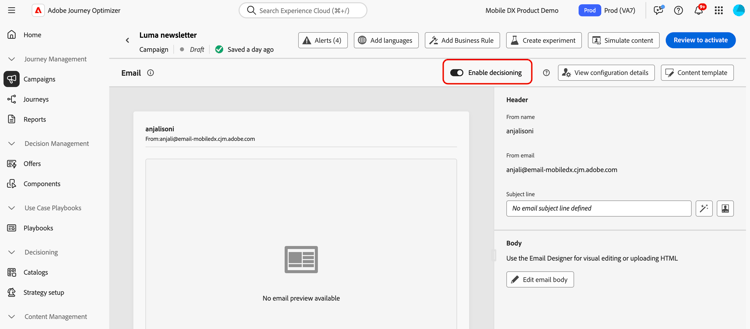
note availability AVAILABILITY For now, decision policy creation in emails is available in Limited Availability. Contact your Adobe representative to gain access. -
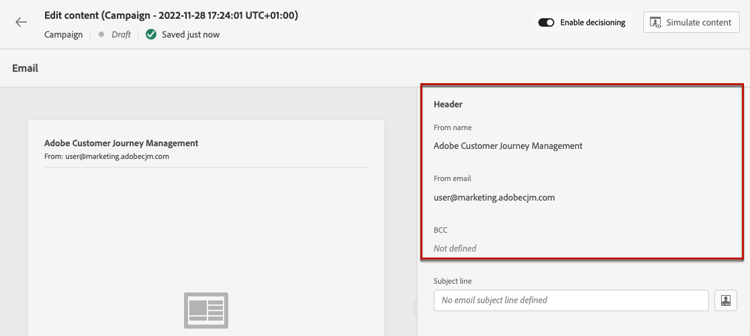
In the Header section, check the From name, From email and BCC fields. They are configured in the email configuration that you selected. Learn more
-
Add a subject line for your message. To configure and personalize the subject line with the personalization editor, click the Open personalization dialog icon. Learn more
note NOTE The subject line is mandatory. It must not include line breaks. -
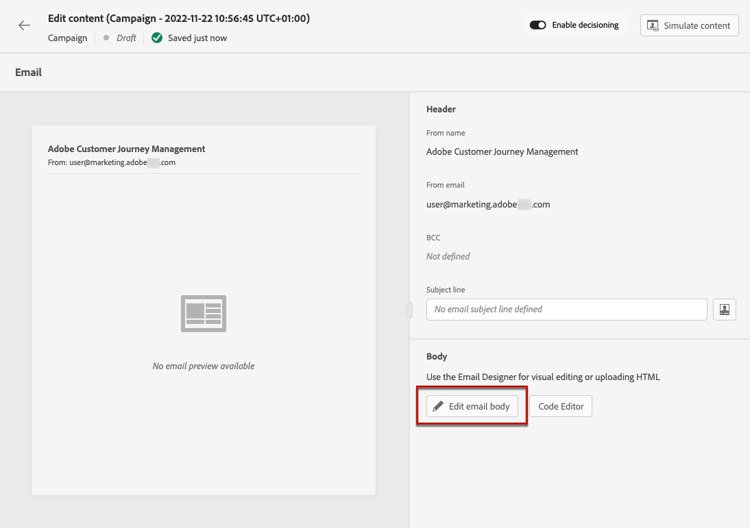
Click the Edit email body button to access the Email Designer and start building your content. Learn more
-
If you are in a campaign, you can also click the Code Editor button to code your own content in plain HTML using the pop-up window that displays.
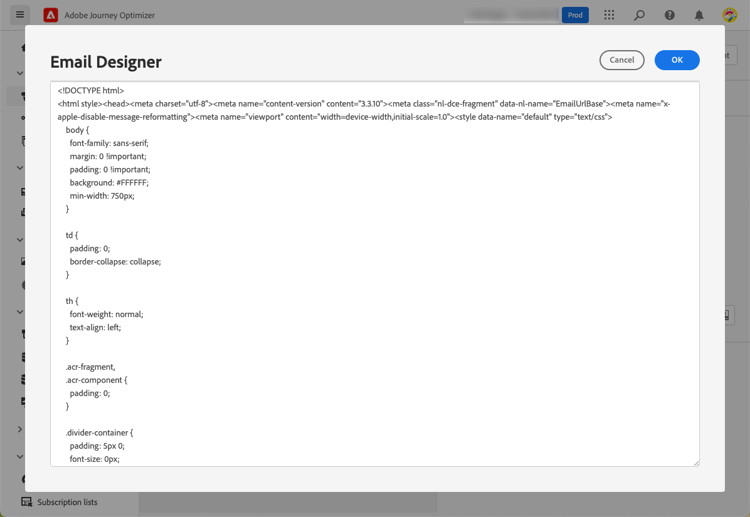
note NOTE If you already created or imported content through the Email Designer, this content will display in HTML. -
If needed, enable the Optimize HTML size option to reduce the size of your email HTML during the publishing process. Learn more
Check alerts check-email-alerts
As you are designing your messages, alerts are displayed in the interface (on top right of the screen) when key settings are missing.
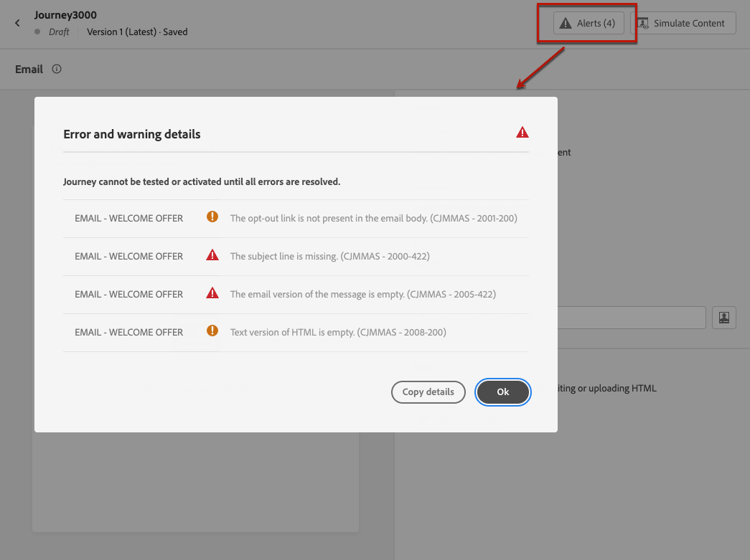
The settings and elements checked by the system are listed below. You will also find information on how to adapt your configuration to resolve the corresponding issues.
Two types of alerts can happen:
-
Warnings refer to recommendations and best practices, such as:
-
The opt-out link is not present in the email body: adding an unsubscription link into your email body is a best practice. Learn how to configure it in this section.
note NOTE Marketing-type email messages must include an opt-out link, which is not required for transactional messages. The message category (Marketing or Transactional) is defined at the channel configuration level and when creating the message from a journey or a campaign. -
Text version of HTML is empty: do not forget to define a text version of your email body, as it will be used when HTML content cannot be displayed. Learn how to create the text version in this section.
-
Empty link is present in email body: check that all the links in your email are correct. Learn how to manage content and links in this section.
-
Email size has exceeded the limit of 100KB: for optimal delivery, make sure the size of your email does not exceed 100KB. To reduce the HTML size, use the Optimize HTML size option. Learn more
-
-
Errors prevent you from testing or activating the journey/campaign as long as they are not resolved, such as:
-
The subject line is missing: email subject line is mandatory. Learn how to define and personalize it in this section.
-
The email version of the message is empty: this error is displayed when the email content has not been configured. Learn how to design email content in this section.
-
configuration doesn’t exist: you cannot use your message if the configuration you have selected is deleted after the message creation. If this error occurs, select another configuration in the message Properties. Learn more about channel configurations in this section.
-
Optimize email HTML size optimize-html-size
Journey Optimizer allows you to compress your email HTML version during the publishing process by removing unnecessary whitespace and indentation. Keeping HTML size small helps you:
- Avoid email clipping — some clients such as Gmail truncate messages larger than ~100 KB, preventing recipients from viewing the full content.
- Improve email load time in the recipient’s inbox.
- Improve deliverability and reduce bandwidth usage.
This optimization is not applied automatically — you must manually enable it in the Edit content screen.
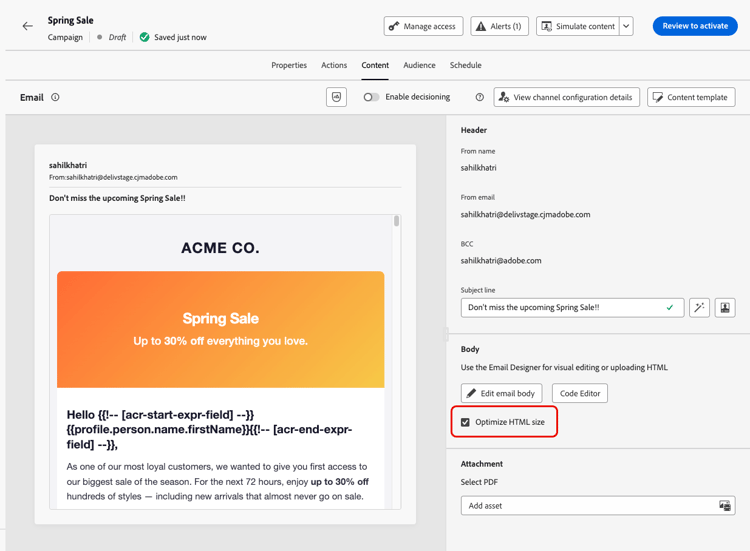
The optimization is email-client safe:
- It preserves MSO/Outlook conditional comments.
- It does not alter your actual content, images, or videos.
You can test the impact of HTML size optimization before publishing when sending proofs. Learn more
Optimize HTML size in multilingual emails optimize-html-multilingual
When working with multilingual email variants, the Optimize HTML size setting is tracked at the email level, not per locale.
Therefore, enabling this setting on any one locale applies it to all locales of that email at publish time — even locales where the checkbox still appears unchecked in the UI. You do not need to repeat the action for each locale.
To disable HTML size optimization, you must uncheck Optimize HTML size on every locale. Leaving it enabled on even one locale is sufficient for the optimization to be applied across all locales.
Check and send your email
Once your message content has been defined, you can preview its content using either simulation method:
- Click Simulate content to test content variations with sample input data or AI auto-generation. Learn how to simulate content variations
- Click Simulate content, then select Simulate content (AEP profiles) from the dropdown to preview with test profiles, send proofs, and check email rendering.
You can also validate your content quality to assess readability, effectiveness, and content cohesiveness. Learn more about content quality validation
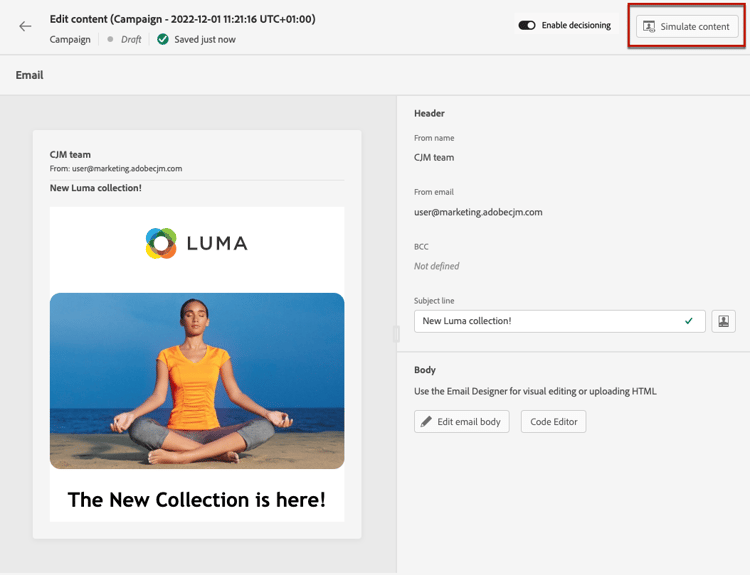
Detailed information on how to select test profiles and preview your content is available in the Content Management section.
When your email is ready, complete the configuration of your journey or campaign, and activate it to send the message.
Test HTML size optimization optimize-html-proof
If you have enabled the HTML size optimization option, you can evaluate its impact before publishing when sending proofs. Follow the steps below.
-
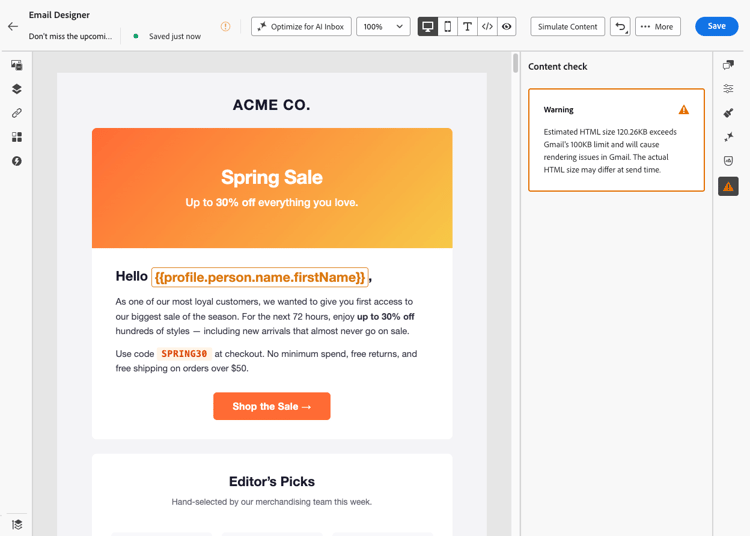
In the Email Designer, click the Issues icon in the right rail. If the rendered email size exceeds 100 KB, a message displays to warn you that this may cause truncation in some email clients.
-
Click Simulate content.
-
To test the optimized version, click the Send proof button and select the Optimize HTML size option. This will send a proof with the reduced HTML size to your test recipients.
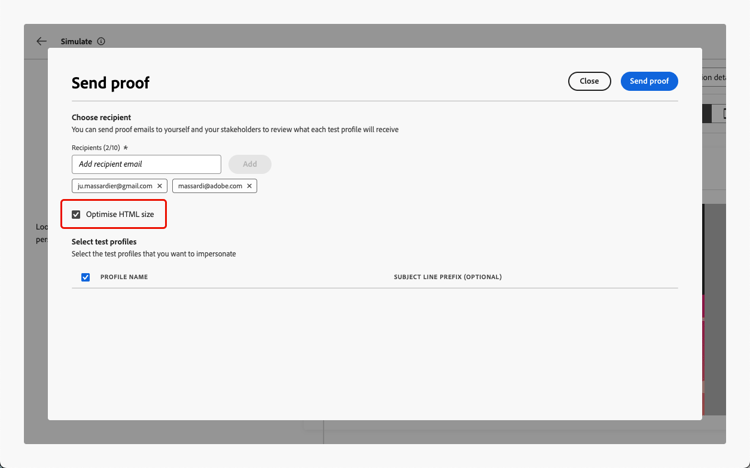
note NOTE This setting is independent from the email editor — the proof reflects whatever you select in the proof, regardless of whether the option is enabled or disabled in the email itself. -
Select the test recipients and click the Send proof button. Learn more about sending proofs in this section.
-
Once sent, back in the Simulate screen, click the View Proof button.
-
Click the Info icon next to the status of the proof. The optimization details are displayed in a pop-up window, including the original HTML size, the optimized HTML size, and the size reduction percentage.
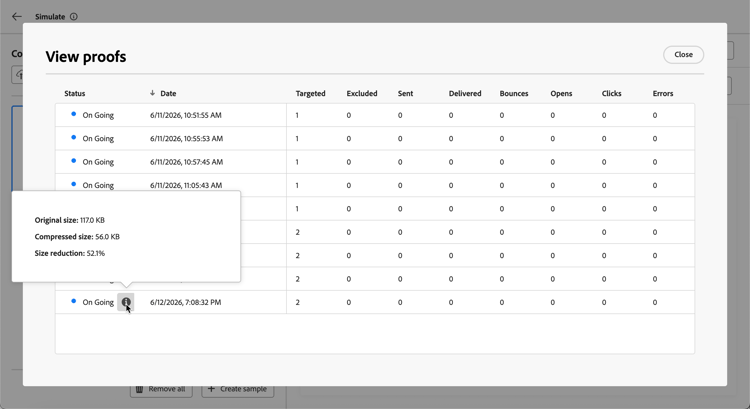
Use this information to validate the optimized output and confirm the email stays within the recommended 100 KB threshold before publishing.
note NOTE The sizes displayed in the View proofs pop-up reflect the size of your HTML template, where Handlebars expressions are evaluated at their minimum possible value — not the size of the final delivered email. At delivery time, dynamic expressions such as {{#each}}loops are resolved against the recipient’s profile data, which may significantly increase the actual email size.
If your email content returns an error code, see Content authoring errors.
This section contains structured knowledge intended to support interpretation, retrieval, and question answering related to this topic.
For complete understanding, this information should be combined with the documentation on this page. Neither source is intended to stand alone; the page describes the feature, while this section provides additional context that helps disambiguate terminology, intent, applicability, and constraints.
- TL;DR: This page explains how to create an email in Journey Optimizer by adding an Action activity with the Email channel selected to a journey, or by creating a campaign with the Email channel, defining its subject and content in the Email Designer, resolving alerts, optimizing HTML size, and previewing before sending.
Intents:
- Add an Action activity with the Email channel to a journey, or create a campaign with the Email channel
- Define the email subject line and body with the Email Designer
- Enable decisioning to add decision policies to an email
- Resolve warning and error alerts before testing or activating
- Enable and test HTML size optimization to avoid email clipping
- Preview and validate the email before sending
Glossary:
- Email channel: The channel selected in the Action activity of a journey, or in a campaign, to send an email when profiles reach that step (product-specific)
- Email Designer: The Journey Optimizer editor used to build and personalize the email body (product-specific)
- Optimize HTML size: An option that compresses the email HTML at publication time (removing unnecessary whitespace and indentation) to reduce size and avoid clipping (product-specific)
- Alerts: In-interface messages raised when key settings are missing — Warnings (recommendations/best practices) and Errors (blocking issues) (product-specific)
- Decision policy: A container for offers that uses the Decisioning engine to return the best content for each audience member (in Limited Availability for emails) (product-specific)
Guardrails:
- The subject line is mandatory and must not include line breaks.
- Legacy native channel activities (Email, Push, Mobile message, In-app, Web, Code-based experience, and Content Card) are deprecated as of the March 2026 release; existing journeys using them continue to work without changes and no migration is required.
- Decision policy creation in emails is in Limited Availability — contact your Adobe representative to gain access.
- All error alerts (for example a missing subject line, an empty email version, or a deleted configuration) must be resolved before you can test or activate the journey/campaign; warnings do not block.
- HTML size optimization is not applied automatically — you must enable it manually — and is applied only at publication time.
- In multilingual emails, Optimize HTML size is tracked at the email level, not per locale: enabling it on any one locale applies it to all locales at publish time; to disable it, uncheck it on every locale.
- Removal of non-essential HTML comments during optimization is temporarily disabled as of July 10, 2026.
- The sizes shown in View proofs reflect the HTML template with Handlebars expressions evaluated at their minimum value, not the size of the final delivered email.
Terminology:
- Canonical name: Email channel — Acronym: n/a
- Do not confuse: “Warnings” (recommendations/best practices; do not block testing or activation) ≠ “Errors” (must be resolved before testing or activating)
- Do not confuse: “Simulate content” (test variations with sample input data or AI auto-generation) ≠ “Simulate content (AEP profiles)” (preview with test profiles, send proofs, and check email rendering)
FAQ:
- Q: How do I create an email? — Add an Action activity with the Email channel to a journey, or create a campaign with the Email channel, then select or create an email configuration, then define the subject and body in the Email Designer.
- Q: Are the legacy native email/push/Mobile message journey activities still usable? — They are deprecated as of the March 2026 release, but existing journeys using them continue to work without changes and no migration is required.
- Q: Why can I not test or activate my journey or campaign? — All error alerts (such as a missing subject line, an empty email version, or a deleted configuration) must be resolved first; warnings do not block testing or activation.
- Q: What does the Optimize HTML size option do, and is it automatic? — It compresses the email HTML at publication time by removing unnecessary whitespace and indentation, which helps avoid email clipping (some clients such as Gmail truncate messages over ~100 KB). It is not automatic — you must enable it manually.
- Q: How does Optimize HTML size behave for multilingual emails? — It is tracked at the email level, not per locale: enabling it on one locale applies it to all locales at publish time, and to disable it you must uncheck it on every locale.
- Q: How can I preview or test my email before sending? — Use Simulate content (sample input data or AI auto-generation), or Simulate content (AEP profiles) to preview with test profiles, send proofs, and check rendering; you can also validate content quality.