On this page: Learn how to use the auto-synced default plain text version of an email or create a custom one, and when each approach works best.
It is recommended to create a text version of your email body, which is used when HTML content cannot be displayed.
From a security standpoint, offering a plain text version is important because HTML emails can carry risks such as malicious scripts, tracking pixels, or phishing attempts that rely on rich formatting and links. Plain text reduces the attack surface and is often preferred by security-conscious recipients or corporate email systems that restrict or strip HTML. Providing both versions lets recipients choose the format that fits their security and privacy requirements.
Access the default text version plain-text-default
By default, the Email Designer creates a Plain text version of your email, including personalization fields. This version is automatically generated and synchronized with the HTML version of your content.
To access the default text version, select the Plain text icon from your email content.

Use a custom text version plain-text-custom
If you prefer using a different content for the plain text version, follow the steps below:
-
From your email, select the Plain text icon.
-
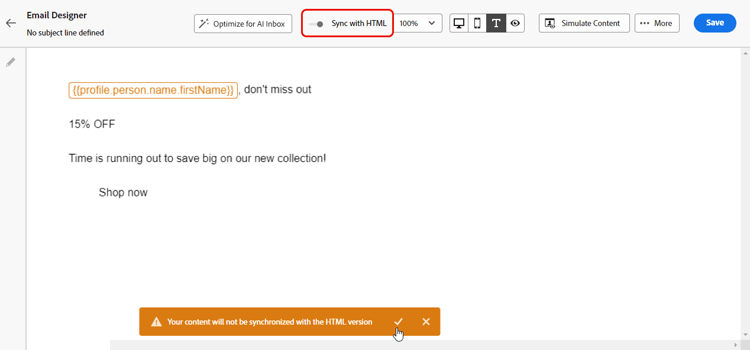
Use the Sync with HTML toggle to disable synchronization. Click the check mark to confirm your choice.
-
You can then edit the custom plain text version as desired.
-
When synchronization is disabled, changes made in Plain text view are not reflected in HTML view.
-
If you re-enable the Sync with HTML option after updating your plain text content, your changes will be lost, and replaced with text content generated from the HTML version.
When to use custom plain text versions when-to-use
Understanding when to create a custom plain text version versus using auto-sync helps ensure optimal email delivery and readability.
Use custom plain text (disable sync) when:
- Complex HTML layouts - Your HTML email includes multi-column layouts, tables, or complex CSS that don’t translate well to plain text.
- Visual-heavy content - Your email relies heavily on images, and you want to provide descriptive text alternatives for image-disabled clients.
- Different messaging structure - You want to provide a simplified or reorganized message structure optimized for plain text readers.
- Accessibility requirements - You need specific plain text formatting to meet accessibility standards.
- Legacy email clients - Your audience includes users on older email clients (e.g., Outlook 2003, text-only mobile clients) that need specially formatted content.
- ASCII formatting - You want to include specific plain-text formatting like ASCII art, tables, or specific line breaks.
Use auto-sync (default) when:
- Simple HTML design - Your HTML email has a simple, linear structure that translates well to plain text.
- Consistent content - You want to maintain exact consistency between HTML and plain text versions.
- Frequent updates - You regularly update email content and want to avoid manual duplication.
- Personalization works well - Your personalization fields function properly in both formats.
- Time constraints - You need to quickly launch emails without additional plain text customization.
Practical examples practical-examples
The following examples demonstrate real-world scenarios to help you decide whether to use custom plain text or auto-sync. Each example explains the context, the recommended approach, and the rationale behind the decision.
Scenario: Multi-column newsletter with images, styled buttons, and color-coded sections.
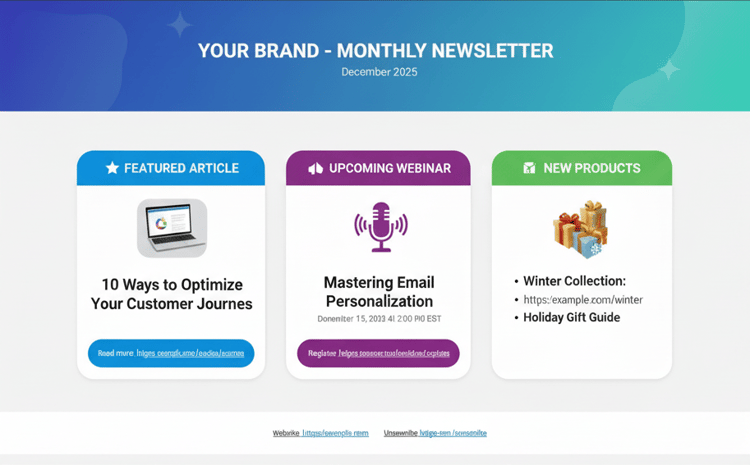
Recommendation: Use custom plain text (disable sync).
Why custom plain text: The HTML version uses a three-column grid layout with banner images, styled buttons, and color-coded sections. These visual elements don’t translate well to plain text through auto-sync, resulting in cluttered, hard-to-read content. A custom plain text version allows you to restructure the content into a linear, easy-to-scan format with clear section headers and properly formatted links.
Custom plain text example:
| code language-none |
|---|
|
Scenario: Order confirmation with structured data (order number, items, prices, shipping details).
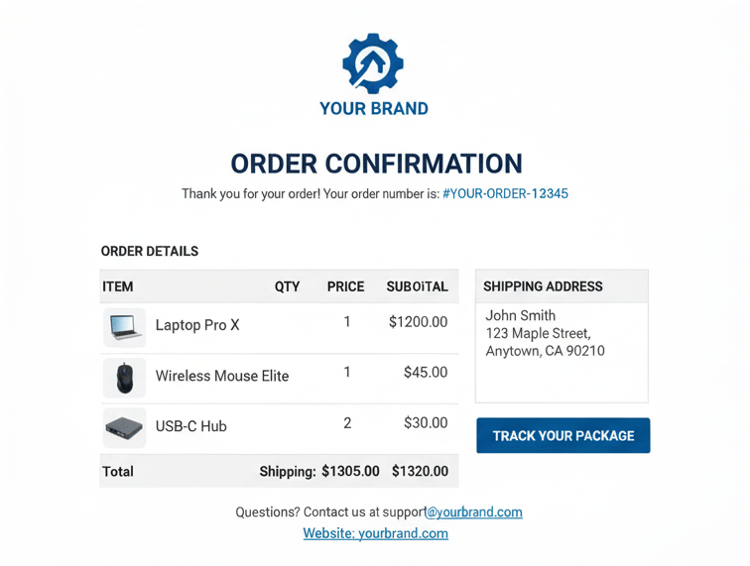
Recommendation: Use auto-sync.
Why auto-sync works: Order confirmations have a simple, linear structure that translates naturally from HTML to plain text. The information flows logically (order details → items → totals → shipping), and personalization fields like order numbers and customer names work identically in both formats. The structured, tabular data converts cleanly without requiring manual adjustments, saving time while maintaining clarity.
Scenario: Event invitation with background images, embedded videos, and interactive elements.

Recommendation: Use custom plain text (disable sync).
Why custom plain text: The HTML version relies on visual impact—background images, video embeds, and interactive RSVP buttons. Auto-sync would strip these elements out, leaving a confusing text version with broken references. A custom plain text version allows you to provide clear event details, speaker information, and direct registration links in a well-organized format that works without visual elements.
Custom plain text example:
| code language-none |
|---|
|
Common use cases common-use-cases
The following use cases demonstrate situations where creating a custom plain text version (disabling sync) is beneficial. Each example shows the challenge posed by the HTML version and how a custom plain text solution addresses it.
Challenge: HTML shows grid of products with images, prices, and buy buttons
Plain text solution: Create a structured list with clear product names, prices, and direct links
| code language-none |
|---|
|
Challenge: Branded welcome email with company logo and styled formatting
Plain text solution: Use ASCII art or text formatting to create visual hierarchy
| code language-none |
|---|
|
Challenge: HTML includes styled buttons and form elements
Plain text solution: Provide clear text links with instructions
| code language-none |
|---|
|
Frequently asked questions faq
Will my personalization fields work in plain text?
Yes, personalization fields like {{profile.firstName}} work identically in both HTML and plain text versions.
How do I test my plain text version?
- Toggle to Plain text view in the Email Designer. Learn how
- Send test emails to text-only email clients like old versions of Pine or basic mobile email apps.
What happens if I forget to create a plain text version?
The system automatically generates a plain text version from your HTML, which may not be optimally formatted but will ensure delivery to text-only clients.
Can I use different personalization in HTML vs. plain text?
Yes, once you disable sync, you can customize each version independently, including using different personalization fields or content.
Which email clients only support plain text?
Very few modern clients are text-only, but some corporate email policies, accessibility tools, and older mobile devices may display plain text. It’s also a fallback when HTML rendering fails.
How often should I update my plain text version?
Update it whenever you make significant changes to your HTML content. Minor HTML tweaks may not require plain text updates if the core message remains the same.
Can I include links in plain text emails?
Yes! Include full URLs (e.g., https://example.com/page) and most email clients will automatically make them clickable.
Should I include images in plain text?
No, plain text doesn’t support images. Instead, describe what the image shows or provide a link to view it online.
This section contains structured knowledge intended to support interpretation, retrieval, and question answering related to this topic.
For complete understanding, this information should be combined with the documentation on this page. Neither source is intended to stand alone; the page describes the feature, while this section provides additional context that helps disambiguate terminology, intent, applicability, and constraints.
- TL;DR: This page explains how to use the auto-synced default plain text version of an email or create a custom one by disabling sync, and when each approach works best.
Intents:
- Access the default, auto-generated plain text version of an email
- Create and edit a custom plain text version by disabling synchronization
- Decide when to use custom plain text versus auto-sync
- Understand how personalization fields behave in the plain text version
- Test the plain text version
Glossary:
- Plain text version: A text version of the email body, used when HTML content cannot be displayed (product-specific)
- Default (auto-synced) plain text: The Plain text version the Email Designer generates automatically, including personalization fields, and keeps synchronized with the HTML content (product-specific)
- Sync with HTML: The toggle that enables or disables synchronization between the Plain text and HTML versions (product-specific)
- Custom plain text version: A plain text version you edit independently after disabling Sync with HTML (product-specific)
Guardrails:
- When synchronization is disabled, changes made in Plain text view are not reflected in HTML view.
- If you re-enable Sync with HTML after updating your plain text content, your changes are lost and replaced with text content generated from the HTML version.
- If you do not create a plain text version, the system automatically generates one from your HTML, which may not be optimally formatted but ensures delivery to text-only clients.
- Plain text does not support images; describe what the image shows or link to view it online.
- Personalization fields work identically in both HTML and plain text versions; once sync is disabled you can use different personalization in each.
Terminology:
- Canonical name: text version of an email — Acronym: n/a — variants: plain text version, Plain text, custom plain text
- Synonyms: “auto-sync” = “Sync with HTML enabled”
- Do not confuse: “default (auto-synced) plain text” (generated from and synchronized with HTML) ≠ “custom plain text version” (edited independently after disabling sync)
FAQ:
- Q: How do I create a custom plain text version? — Select the Plain text icon, use the Sync with HTML toggle to disable synchronization and confirm, then edit the custom plain text as desired.
- Q: What happens to my custom text if I re-enable sync? — Your changes are lost and replaced with text content generated from the HTML version.
- Q: Do personalization fields work in plain text? — Yes; personalization fields work identically in both HTML and plain text versions.
- Q: What if I forget to create a plain text version? — The system automatically generates one from your HTML, ensuring delivery to text-only clients.
- Q: When should I use custom plain text instead of auto-sync? — For complex HTML layouts, visual-heavy content, a different messaging structure, accessibility requirements, legacy email clients, or specific ASCII formatting.
- Q: How do I test my plain text version? — Toggle to Plain text view in the Email Designer, and send test emails to text-only clients.